Showing posts with label classical liberal. Show all posts

08 January 2014

Why modern education isn't

Now open your books, class...

Laurentius_de_Voltolina_001Image Courtesy: Wikipedia

That is a picture of a late 14th century classroom at the University of Bologna.

353px-Meeting_of_doctors_at_the_university_of_Paris

Image Courtesy: medievalists.net

That is a meeting at the University of Paris in the Middle Ages.

University of Binghamton_newlanding

Image Courtesy: SUNY at Binghamton

And here is a modern counter-part, circa early 21st century, Binghamton, NY.

What made the University in its modern form?

Books.

Lack, thereof.

The modern university of having a teacher or professor or doctor or priest sitting in a central position of power and students looking to that individual for wisdom was necessary back in 1350 as moveable type hadn't been invented yet.  Books were scarce, rarely printed, and quite often hand copied.  Thus the best way to disseminate knowledge was to have someone who had time to read lots of books on a subject teach students from a curriculum that was dutifully, or not so dutifully, copied down in the form of notes.  If you had to really know what was in the book you could go to the library and, if you were lucky, they actually had a copy of it available.  Getting to read it was a matter of bureaucracy.

Even with moveable type books were still expensive but at least somewhat available... in the library... to read.

The availability of books for private libraries and at home did take a while to get into gear, and was mostly something for the rich and well off up to the late 19th century to early 20th century, where books were still cherished in poor families.  By the post-WWII era, books were readily available as forms of modern printing and the cost/benefit ratio of long press runs took over, and soon you had salesmen hawking the Encyclopedia Britannica in the new suburban neighborhoods.  It wasn't alone, of course, and the book store, once something that only those with a scholarly or Bohemian lifestyle went to, were soon in strip malls.

Yet the entire educational system still depended on 'experts' to present pre-digested 'material' for students to copy down.  Mind you mass-media was now available and out in semi-rural Western NY, out in pine tree and cow country, our black and white TV got Sunrise Semester where, in the early, pre-dawn hours, one could tune in to a course being presented on TV for that semester and do course-work by mail.

Amazing!

Revolutionary!

It went nowhere, of course, as those big palaces of learning had political clout, alumni, professors and buildings, all of which needed grease of the monetary variety to function.  And if you didn't like the public schools, well, you just weren't 'modern'.

For that you have to go back to late 15th and early 16th century and Martin Luther who wanted everyone to learn to read so they could read the Bible on their own.  In their own language.  This concept was expanded upon by Johann Heinrich Pestalozzi (1746-1827) and the web site dedicated to his contribution gives a list of the things he wanted put in place for what we would call 'Primary Education':

Pestalozzi’s approach has had massive influence on education, for example, his influence, as well as his relevance to education today, is clear in the importance now put on:

  • The interests and needs of the child
  • A child-centred rather than teacher-centred approach to teaching
  • Active rather than passive participation in the learning experience
    The freedom of the child based on his or her natural development balanced with the self-discipline to function well as an individual and in society
  • The child having direct experience of the world and the use of natural objects in teaching
  • The use of the senses in training pupils in observation and judgement
  • Cooperation between the school and the home and between parents and teachers
    The importance of an all-round education – an education of the head, the heart and the hands, but which is led by the heart
  • The use of systemised subjects of instruction, which are also carefully graduated and illustrated
  • Learning which is cross-curricular and includes a varied school life
  • Education which puts emphasis on how things are taught as well as what is taught
  • Authority based on love, not fear
  • Teacher training

Pestalozzi’s influence over the spirit, the methods and the theory of education has continued into the twentieth and twenty-first centuries and most of his principles have been assimilated into the modern system of education.

And by 1900 you got schools that look like this...

bpk 20.012.125

Photo Courtesy: GHDI

Oh, wait, that is a factory at AEG in Germany at the turn of last century!  So sorry!
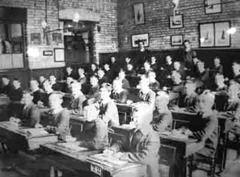
tiered-classroom

Photo Courtesy: 1900s.uk.org

There you go!  Rank upon rank of students at desks all doing the same tasks... I mean that is so different from an industrial facility, isn't it?  And that is so very different than the University!  I mean, you have... individual desks, no wait, that was there in Bologna... students writing notes on the topic, no wait, they were doing that in Bologna, too.  Hmmm...are we sure the production line wasn't invented in Bologna?

At least today is so different!

5277d3ad6e79a98d3a2b1a1b7ecffca4

Photo Courtesy: LA Childhood Education Examiner

I mean here the students can also push their desks together!  And learn the same thing... at their desks... at the same time...

Growing up with this sort of system, I never realized just how antiquated it was, even while I was just auditing college courses on Sunrise Semester.  When I was 6? 7 perhaps?  Definitely less than 10 years old.  The New Media of that era of the late 1960's to early 1970's was television, a one to many media that should function very well as an immediate replacement for that 14th century institution known as the 'Educational System', with bells and whistles like Kindergarten added in by the Germans.

And yet the US came into the late 19th and early 2oth century with a different sort of teaching environment.

oldsch

Photo Courtesy: Will County News blog

That is a one room schoolhouse, a place where children of both genders and different ages all learn in the same environment.  By the time of that image in 1938 there was some segregation by age.

One-Room Schoolhouse

Photo Courtesy: education14 blog

Yet a generation prior to that, this was not the case.  That idea of systematized learning also meant segregation not just by subject, but by age, and the requirement for specialized teachers not only by subject but by age range.  The education profession was turning into a reflection of the work environment, to some degree, but was also becoming a sort of guild system which had decided that further employment of its system required further specialization.  And yet the topics involved for reading, writing, math and even basic history, are ones that are amenable to distinction within a heterogeneous but delimited age range, say 6 to 18 years old. 

In a one room schoolhouse such instruction was mandatory due to the variety of ages coming to the school and the limited time to teach a subject.  Thus a subject was taught as a multi-level form of instruction in which basic facts could be provided and expanded upon in a fashion to suit the learning capacities not just by age but by individual.  This gave children a wider exposure to a given subject and a chance to pick up advanced learning at a young age.  Older students get a refresher and some new material, while younger students get more than they can handle so they have to learn just what it is that they will have to handle.  Simultaneously and in different subjects all by one individual leading the students.

That is teaching.

Talking on a single subject and having student writing down notes, that is instruction, and a largely passive affair.  This has been the case since the start of the modern University as seen in places like Bologna and what we have to day is an relic form of institution trapped in the old system that was driven by a lack of ready material in the form of ink printed on paper and bound into codices.

Today the world does not have a problem of ready material availability and, in the advanced post-industrial revolution Nations, a lack of access to them.  Quite the contrary the classical works are now available, by and large, for free via digital means which should be a great boon to education across all of mankind.  Yet the classification by subject and learning level for a cohort of homogeneous age students is not compatible with this ready availability.  Indeed no instructor in any subject, save for a few of the actual hard sciences, can be said to have any idea of the extent of their subject or be so well versed in it as to encompass its modern size. 

It is true that subjects that start in the Ancient Classical period and going through the Reformation, Peace of Westphalia, Enlightenment and post-Enlightenment era of the 19th century are relatively staid historical subjects.  These subjects serve as the basis for all later education in ALL FIELDS from views on religion and morality through what Nations are through economics through the hard sciences and into the requirement of personal ethics that upholds a given moral code and structure for the basis of individual freedom.  And here is the solution to basic education in these areas: record them at multiple current schools, digitize the lectures, hyperlink ideas together via topic, and formulate a program of self-instruction on them by individuals with actual written tests without access to anything but written source materials in hard copy format to demonstrate individual knowledge and fluency on topics.  This would be a self-paced, age independent system so that individuals could learn at the pace they wished to learn at and only if they see a requirement for demonstration of such knowledge need they ever be tested on it.

Getting to 20th century topics would also require such fluency and background, but the educational materials for them would not be limited by any means.  Demonstration of knowledge of the basis for these ideas and how they came to be is a touchstone demonstration of knowledge.  Just as being able to master the tools and concepts of welding, machining, and creation of materials via additive processes, there is a requirement that someone who actually knows how to do these things certifies that a student also knows them so, too, would the requirement for understanding economics, morality, the moral basis for ethics, physics, chemistry, biology, or any other subject useful for a career require the demonstration of being able to think independently without aid of any device save hard copy source material and marginal notes. 

These are mental tools that have direct applicability and requirements of mastery to them which can be tested in an age heterogeneous environment where there is no limit to re-taking such tests (albeit a small fee might be involved) and that could be sent to any three individuals with certified mastery of such knowledge up to that level,  and graded separately.  This would give the person seeking education feedback from three individuals with varying background and insights, and while passing an exam faults and flaws in everything from syntax to logic structure, along with historical accuracy would be given.  For the topical sciences the divorce of the hard sciences from the rest of post-Enlightenment topics would only come at the specialization level after demonstrating a knowledge of the basis for a given topical science and ability to do lab work in them, both held in equal proportion as science is as much about understanding a topic as testing it via lab experimentation.  Thus the basis for the sciences and their connections to the each other and to the world they worked in, historically, would be a major factor in understanding the place of the sciences in everyday life and have a requirement that anyone wishing to understand that place must also understand the method of experimentation and the moral and ethical basis for it.

Such testing isn't just written on many topics, but is also conversational: being able to demonstrate an immediate ability to reason through new topics on the spur of the moment is something we only do at the Graduate School level for individual topics, but are something that form each of us as individuals in our lives.  Being able to hold a discussion on, say, the basis for the Nation and what the function of a State is will vary across periods from Ancient Classical all the way to the modern age, but the groundwork for that reasoning is one that is historical and requires historical knowledge to make an informed decision.  Just as modern understanding of quantum theory rests on electromagnetic theory, and that, in turn, has links forward to relativity and backwards to Newtonian physics, the ability to discuss that as a topic in its modern realm requires a basis of understanding of its history and why the questions we ask today come about.  In attempting to divorce history from our modern lives, to seek to disconnect the modern State from our historical and cultural understanding of it, is a disservice to all men just as trying to disconnect biology and human experimentation from morality and the duty of citizens to practice their ethics on a known moral code in service to their fellow man both lead to ruin of not just Nations and societies, but mass slaughter of individuals.  Without a historical understanding of the present, the future is one of horror.  A little knowledge is a dangerous thing, but none is fatal.

If we are to take James Burke of Connections fame to heart then the basis for understanding our role as individuals in a complex world is to understand the basis for how our complex world came about.  Education, then, is no longer something limited by age, by class, by gender or by any other category we impose on humanity: it is for everyone at all ages at all times of their lives from the moment that cognitive thought first starts to the last thoughts of those at the end of their lives.  Fluency in the range of topics to address the modern world should have, however, no requirement that people learn them via an enforced educational system that relied on a lack of source material availability to require such things as Universities and, later, schools.  Jobs have requirements to them, and learning the basics of reading, writing, logic, basic four function mathematics, reasoning, syntax, spelling at a fluency and daily use level may have some age determinants in them, but even those can be highly automated via pre-recorded instruction that would serve as the basis for entry to taking further examinations to demonstrate skill and mastery of a topic later.  Many jobs, however, have only the need for basic mastery of material to them and while some might class these jobs as 'low' they are only low in their demonstrated skill requirement: people hauling trash make a good living doing so and those paid a pittance for doing manual labor for farming can still get a good life from doing so.

The entrance to higher capability in any field is a demonstrated ability to master topics and expand mental capacity so as to properly understand how a given area of knowledge fits in with all other areas of knowledge to create a complex web of knowledge that goes back and forth in history.  A concentration in a given topic can go far with just a little auxiliary knowledge in broader topic ranges, right up to the point where you question the morality of research and the ethics of doing certain kinds of research, at which point all those minor entrances into the other topics that allowed for a concentration in a given field must come into play and an individual put in the time and effort to learn what the moral basis for society and freedom are, and what their ethical obligation is to such a society actually is. 

All bureaucrats should have this as part of their essential 'must know' category of knowledge as it is the functionaries of the State that perform acts upon their fellow man and that can, indeed in our era must, contain a full and broad understanding of what society is, where our source of freedom and rights come from and the obligation of the individual in service to the State to not perform acts of immorality upon others as an ethical obligation to themselves, their society, their fellow man and the State they have created.

There is no Royal Road to education.

Our current formulation has run into the 21st century which is now set to sweep away all systems based on limitation of access to materials be they mental or durable goods, and bring a new age of humankind into being based on what we know of ourselves to be as individuals in Nature who are obligated to its laws and as individuals granted access to a moral code that seeks to engender liberty for each man without coercion upon him to think like anyone else.  You cannot get that through the University system, the current education system, or the current systems supporting them which are now failing in this modern era and have been failing ever since the first one-to-many forms of broadcast became available.  Our society upgraded the tools it has to learn but has not applied them for the utility of each individual.  That era is now ending not from the top-down, but from the bottom-up. 

I have already seen schools built in the post-WWII era turned into office space after being sold by their districts.  And I've seen entire cities crumbling because a way of life that was thought to be perpetual was so rooted in place that it required vast amounts of revenue to keep a dead way of life going as a veneer on the physical plant of the city itself.  The answer is not to throw more money into these institutions which have failed in critical ways to adapt and adopt to the 20th century, not to speak of the 19th and 18th century.  They were not even appropriate to the 20th century to say nothing of the 21st.  It is time we change our view of education from the warehousing of pre-teen and teenagers to the development of knowledge and skills that can be demonstrated by each and every individual if that is their desire.  Education must no longer be enclosed by brick walls and attempted to be walled off within our minds to institutions, but opened up as a conception that is held by each of us who are eternally students and, in our turn, practitioners of those things we sought to embed in mere material structures.  That, of course, will shake us all up as to what it means to have a job, when it is appropriate to have a job and how betterment of oneself is in one's own hands and not enforced by a bureaucracy that, in seeking to do 'good', walls us off from the eternal good of self-education and reasoning.


02 September 2007

Just where *did* they go to?

Well, seeing the link at Instapundit to Jamie Kirchick on "Whither the anti-totalitarian left?" I was quite surprised that one name is mentioned and that Mr. Kirchick did not recognize it as the actual answer to his own question.

So, to help out a bit I will give the name: Henry M. "Scoop" Jackson.

And another name, from the very early era of the Democratic Party: Andrew Jackson.

Old Hickory?


Jacksonians?

Ring any bells?

The Democratic Party committed an unforgiveable sin: after JFK convinced the Jacksonians that Viet Nam was *worth* fighting for, and Johnson continued that, the Democratic Party made it clear that it was going to join the leftists so as to gain *more supporters* and then disavow and 'empower' those wishing to end it dishonorably. Jacksonians are slow to go to war, prefer to put it off before anything, but when you convince them to start fighting they see anything short of victory as defeat. By saying that Viet Nam was lost and not worth fighting, the Democratic Party and their leftist friends turned their back on core Jacksonian values.

That is not something you do *twice* to Jacksonians.

And we did not walk over to the Republican Party as they have yet, to this day, learn how to speak to Jacksonians.

By embracing anti-American ideals, dishonoring the Nation by leaving an ally to be overcome by Communism and its two neighbors falling because of that, the deaths of millions are on the hands of those who espoused leaving: the left and their Democratic Party supporters. A very, very few stalwarts remain trying to redeem the Party of Jackson but I, for one, will have nothing to do with that and will vote for individuals. Never a 'party line' as NO party represents me.

Quite some few Jacksonians stand by America but see the entire two-party system as corrupt beyond redemption. Those you see in the Armed Forces are overwhelmingly Jacksonians. When you take up that America has no right to hold other Nations accountable to their cease-fires, that America should always lose and never, ever fight back, then you are telling Jacksonians to talk a walk away from you. Those of that era did just that. And that is still done to this day, as Jacksonians have joined the perennially disaffected as seen by this:


The above taken from US Census datasets.

By breaking faith with the Jacksonians and corrupting the Party of Jackson to some Transnational Progressivist wonderland that espouses highly anti-liberal themes and authoritarian views towards Americans and the world as a whole, the Democratic party has exchanged a minor fringe of leftists, far less than 10% and most likely hovering at 3% of the public, and told 30% to leave. That is why the Democratic Party stopped winning huge majorities after the 1970's. It is not that the Republican Party grew stronger, but that the support of the Democratic Party walked out on it. And we still HAVE huge problems with the Republican Party, which tends to be Transnational Capitalist at the expense of national sovereignty.

Somehow neither of these seem to be on the path *towards* liberty nor freedom.

And every word that is spouted by Democrats that is defeatist, anti-American, that runs down this Nation at all opportunity and that supports the barbaric enemies of mankind waging predatory war upon all Nations and seeks to excuse it confirms the belief that there is nothing of value left in the Democratic Party. Jacksonians still stand beside the belief that all men are created equal: it is self-evident. To make just government people must find out for themselves that they have those rights, and then value them and defend them and use them to uphold society and keep tyranny in check.

Not by government mandate.

Not by a system of taxation and handouts.

Not by coddling those destroying civilization.

Jacksonians realize that we are in a deadly conflict unlike any that has been seen for centuries as this kind of war has not been FOUGHT for centuries. And yet the defeatist, appeasement oriented, butcher excusing LEFT still trots out its anti-American ideals and puts forward that standing up for civilization and fighting FOR it is NOT WORTH THE COST. There are some liberals left who realize that the civil sword cannot remain unbloodied for peace to have a chance to exist. Our barbaric foes seek to end all Nations and replace it with their own order in the world.

The Left and the Right each have similar outlooks and they are ALL horrific to Jacksonians. And the longer we delay fighting, that we delay calling enemies what they are, and that we delay actually learning the scope of the global problem we are in, means that much, much more blood will be shed to try and preserve what we have. Not to go on the OFFENSIVE, just preserve the liberty and freedoms we have as a Nation amongst Nations.

We stood by and stand by America while the Democratic Party and its Left went off into the wilderness. I, for one, will not be coming to the Left in my lifetime. Nor the Right, for that matter.

Where are the Jacksonians?

Still here. Waiting. Watching. Seeing who stands by the ideals of America and who does not.

And believe me, by my reckoning neither the Left nor the Right amounts to very much on that score. That bodes ill for America and human liberty and freedom. Perhaps the day of Federalist #26 will return to us, and then, indeed, Jacksonians will show up. Let us hope that one of these two sides drifts back from the wilderness before that happens.

18 May 2007

Upholding the Nation and its 'classical liberal' roots

Today we hear of an immigration bill in the Senate that looks to 'legalize' a large swath of those currently here illegally. These individuals have sometimes come here for jobs, some for criminal activity and some for terrorism. They have moved over the porous border of the United States because Congress has refused to exercise its Authority to safeguard the Nation and put up comprehensive border security, protection and processing at legitimate ports of entry into the United States along not only the land borders but to the actual ports of entry, which see an influx of illegals via unaccountable shipping. I have gone over the full view of this in this article on terrorism, but the basics are also being violated by mere illegal presence.

Those that come for mere jobs are then said to be in need of humanitarian outlook or 'classical liberal' outlook. And yet it was 'classical liberal' outlook that did NOT put into the hands of foreigners the Right to come to this Nation illegally. In point of fact those 'classical liberals' put the Nation State as foundation for Rights and the Sanctity and Sovereignty of the Nation over the Rights of foreigners. This was done so that Nations could decide who was and who was *not* fit to join them. It is a classical, liberal view of autonomous Nation State that must be allowed to operate with Sovereignty and not have that put at peril by foreign forces.

Those that wish to assert 'classical liberalism' are not asserting 18th, 19th or even early 20th century liberalism. It is not 'classical' as the very means of its purview was set via Treaty and the Rights of individuals are overseen by their own Nation State and other Nations may deal with them as they please when they act without regards to the Treaty involved. The Universal Declaration of Human Rights clearly and unequivocally states that in:

Article 22.

Everyone, as a member of society, has the right to social security and is entitled to realization, through national effort and international co-operation and in accordance with the organization and resources of each State, of the economic, social and cultural rights indispensable for his dignity and the free development of his personality.
Those are Rights within their Sovereign Nation of which paramount is to have a Sovereign Outlook which does allow a Nation to restrict who can and cannot enter that Nation so that individuals *within* that Nation have a community free of interference from outside forces. Again those are Rights *inside* their Nation, not externally save those covered by Treaty and what Foreign Governments afford those that come to their Nation Legally. This Treaty even goes further and tells us what an individual may NOT do:
Article 30.

Nothing in this Declaration may be interpreted as implying for any State, group or person any right to engage in any activity or to perform any act aimed at the destruction of any of the rights and freedoms set forth herein.
By crossing borders contrary to the Laws of Nations, contrary to Treaties signed, and Contrary to the Will of the People of the United States, those that come here put Our Sovereignty at peril and Our Right to have a society at risk.

Those that wish to put forth some humanitarian or social or individual 'right' for individuals to violate the Laws of Nations put forth by their People and see them violated are NOT acting in accordance with that view of 'classical liberalism'. And by supporting that mere companies and foreign Nationals have some 'right' to work in a Nation in which they are not willing to get legally processed into are then putting forth something wholly alien to ANY form of 'liberalism' of ANY age. I go over that fully in this article and I cite, in particular, John Fonte on the problem of conservativism and the Transnational Right. Those wishing to assert the 'classical liberal' view may find this bit of interest in their SUPPORT by the Wall Street Journal as cited by Fonte on illegal aliens:
"Our own view is that a philosophy of 'free markets and free people' includes flexible labor markets. At a fundamental level, this is a matter of freedom and human dignity. These migrants are freely contracting their labor, which is a basic human right."
As Fonte looks at this so I will paraphrase what the effect of that is and what the outcome of passing some sort of 'amnesty' or 'regularization process' IS:
Thus, the Journal is telling us that immigration for employment purposes is “a basic human right.” It is not simply a policy preference but is elevated to the realm of a universal principle. On the crucial democratic question: who decides American immigration policy? The answer is clear enough. American immigration policy is decided by autonomous individuals who are foreign citizens in places like Mexico, Pakistan and Ireland. These decisions are made without the consent of the governed. Policy is not decided by ordinary American citizens in Ohio or Oklahoma. Nor on principle, the Journal editors tell us, should this policy be decided by the elected representatives of the American people in Congress assembled. Clearly, this is a post-democratic, post-constitutional principle advocated by the editors of the Wall Street Journal.
And that bit about consent of the governed is the critical part as it is the BASIS for 'liberalism'. If you support illegal aliens to take jobs in the United States contrary to the Laws of Congress then you are NOT supporting the ideal of Sovereign Nation State that has autonomy and freedom from outside forces and may, indeed, regulate who can and cannot enter their Nation. A whole group of 'classical liberals' got together and WROTE the US Constitution and the following is their view of who gets to decide immigration policy for the United States in Article I, Section 8 we find the following passages on this:
To establish an uniform Rule of Naturalization, and uniform Laws on the subject of Bankruptcies throughout the United States;

[..]

To define and punish Piracies and Felonies committed on the high Seas, and Offences against the Law of Nations;
And then in Section 9 Congress gets this:
The Migration or Importation of such Persons as any of the States now existing shall think proper to admit, shall not be prohibited by the Congress prior to the Year one thousand eight hundred and eight, but a Tax or duty may be imposed on such Importation, not exceeding ten dollars for each Person.
After that there are the prohibitions upon the States and lesser governments within the States in Section 10, here in full:
No State shall enter into any Treaty, Alliance, or Confederation; grant Letters of Marque and Reprisal; coin Money; emit Bills of Credit; make any Thing but gold and silver Coin a Tender in Payment of Debts; pass any Bill of Attainder, ex post facto Law, or Law impairing the Obligation of Contracts, or grant any Title of Nobility.

No State shall, without the Consent of the Congress, lay any Imposts or Duties on Imports or Exports, except what may be absolutely necessary for executing it's inspection Laws: and the net Produce of all Duties and Imposts, laid by any State on Imports or Exports, shall be for the Use of the Treasury of the United States; and all such Laws shall be subject to the Revision and Controul of the Congress.

No State shall, without the Consent of Congress, lay any Duty of Tonnage, keep Troops, or Ships of War in time of Peace, enter into any Agreement or Compact with another State, or with a foreign Power, or engage in War, unless actually invaded, or in such imminent Danger as will not admit of delay.
Then comes the Presidential powers in this area in Article II, Section 2:
He shall have Power, by and with the Advice and Consent of the Senate, to make Treaties, provided two thirds of the Senators present concur; and he shall nominate, and by and with the Advice and Consent of the Senate, shall appoint Ambassadors, other public Ministers and Consuls, Judges of the supreme Court, and all other Officers of the United States, whose Appointments are not herein otherwise provided for, and which shall be established by Law: but the Congress may by Law vest the Appointment of such inferior Officers, as they think proper, in the President alone, in the Courts of Law, or in the Heads of Departments.
Then the Judiciary via the Supreme Court gets these powers in Article III, Section 2:
The judicial Power shall extend to all Cases, in Law and Equity, arising under this Constitution, the Laws of the United States, and Treaties made, or which shall be made, under their Authority;--to all Cases affecting Ambassadors, other public Ministers and Consuls;--to all Cases of admiralty and maritime Jurisdiction;--to Controversies to which the United States shall be a Party;--to Controversies between two or more States;-- between a State and Citizens of another State;--between Citizens of different States;--between Citizens of the same State claiming Lands under Grants of different States, and between a State, or the Citizens thereof, and foreign States, Citizens or Subjects.

In all Cases affecting Ambassadors, other public Ministers and Consuls, and those in which a State shall be Party, the supreme Court shall have original Jurisdiction. In all the other Cases before mentioned, the supreme Court shall have appellate Jurisdiction, both as to Law and Fact, with such Exceptions, and under such Regulations as the Congress shall make.
Yes, there are some over-arching things that these 'classical liberals' then put into Article IV:
Section. 2.

The Citizens of each State shall be entitled to all Privileges and Immunities of Citizens in the several States.

A Person charged in any State with Treason, Felony, or other Crime, who shall flee from Justice, and be found in another State, shall on Demand of the executive Authority of the State from which he fled, be delivered up, to be removed to the State having Jurisdiction of the Crime.

[..]

Section. 4.

The United States shall guarantee to every State in this Union a Republican Form of Government, and shall protect each of them against Invasion; and on Application of the Legislature, or of the Executive (when the Legislature cannot be convened), against domestic Violence.
Now where, exactly, are these 'other' values that are purported to be here giving foreigners and mere companies the power to set immigration policy for themselves and the Nation? Where are these 'classical liberal' values upheld by the Laws of Nations which are the Sole Sovereigns to protect their People?

Where, exactly, in this 'classical liberal' view is MY right to have and hold a Nation in common with my fellow countrymen and NOT have that violated by foreigners? For that is a basic and 'classical liberal' value! Running back to the Declaration of Independence will not help you as Thomas Jefferson, not considered very conservative by any standard, wrote this with the editing help of Ben Franklin who is, likewise, not considered to be a conservative by any modern standard:
We hold these truths to be self-evident, that all men are created equal, that they are endowed by their Creator with certain unalienable Rights, that among these are Life, Liberty and the pursuit of Happiness.--That to secure these rights, Governments are instituted among Men, deriving their just powers from the consent of the governed, --That whenever any Form of Government becomes destructive of these ends, it is the Right of the People to alter or to abolish it, and to institute new Government, laying its foundation on such principles and organizing its powers in such form, as to them shall seem most likely to effect their Safety and Happiness. Prudence, indeed, will dictate that Governments long established should not be changed for light and transient causes; and accordingly all experience hath shewn, that mankind are more disposed to suffer, while evils are sufferable, than to right themselves by abolishing the forms to which they are accustomed. But when a long train of abuses and usurpations, pursuing invariably the same Object evinces a design to reduce them under absolute Despotism, it is their right, it is their duty, to throw off such Government, and to provide new Guards for their future security.--Such has been the patient sufferance of these Colonies; and such is now the necessity which constrains them to alter their former Systems of Government. The history of the present King of Great Britain is a history of repeated injuries and usurpations, all having in direct object the establishment of an absolute Tyranny over these States. To prove this, let Facts be submitted to a candid world.
Jefferson and Franklin are quite blunt and to the point here. To secure Rights government is instituted with the consent of the governed. And when government seeks to reduce these Rights through action or inaction it devolves towards Despotism. This does, indeed, mean that the Rights of the People to have commonality and government that is RESPECTED is paramount to ensure these self-same Rights of Man. That is what the Universal Declaration *upholds*.

I do not find it within any document of the Federal Government that the Rights of the People of the United States should be usurped and decided by foreigners and mere companies that are creations of man and legal constructs.

Where are these 'classical liberal' values that state this?

Any such value which does not adhere to the Nation State framework and the Sovereignty of a People to have a Nation State that upholds their Nation and protects them, is looking to destroy the entire basis FOR the Rights of Man.

I did not vote *for* that.

And when Congress does that thing it is diminishing Our Right as a People to have Common Government with the Consent of the Governed. Because that Right is one of the foremost 'classical liberal' values ever put forth for creating fair and just government amongst men. That proposal to allow others who have no authority delegated to them by the People to do as they will with respect to those things that are held in Common by the People are putting forth that the Nation State has NO MEANING.

If the Nation State has meaning then it is respected and upheld, even when you, as an individual, do not like what it does. Within the United States you have great input into what can be done, but the very basic compact amongst the Citizens to have Sovereignty over themselves dates back to 1776. It was clearly stated then, clearly enacted by the Constitution and clearly upheld since then by multiple rulings of the US Supreme Court.

Those that propose that there is something *above* the Nation had better damned well find out where We the People have SAID THAT. For the Sovereignty of the Nation is held in common by all and may NOT be broken due to sufferings of others who blatantly break with Treaties and the Law of Nations to have Sovereignty unimpeded by outsiders. Those that break with Treaties are no longer seen as being UNDER THEM. They have violated the agreements between Nations and can no longer appeal to anything but the *mercy* of Nations, not to any inherent Rights as they have BROKEN with the foundation of those Rights.

When something else is proposed as being 'more universal' do look to what the 'classical liberal' Jefferson warned of about the decay of government into Despotism. That is exactly what that is a call for: to start the Despotism of non-accountable actors to create rules of the Nation without the consent of the governed.

We fought a War over that.

The Revolutionary War.

Perhaps that is what those pushing for this seek: encroaching Despotism to incite war so as to extinguish Freedom and have it dictated by others.

I don't find that to be 'classical liberal' but do find it to be classically Barbaric.