Showing posts with label money laundering. Show all posts

04 April 2009

Looking at Mr. Goldberg's mailbag

The following is an article posted at The Jacksonian Party.

I started a letter after looking at the responses Jonah Goldberg at NRO got on going after narcotics traffickers at the small scale, and was writing a letter.  Instead, I'll make it into a post as it is getting rather lengthy...

After having looked at the economics behind organized crime and terrorism (here, here, here, here, here, here, here, and related on how that can play out in Iran and other places here, here, like Mexico) plus a very superficial view on agriculture as seen in Wealth of Nations (not being an economics deep thinker but applying what Adam Smith knew, then, to the work) I can only come up with a few things on the rate of drug incidents in the US and narcotics trafficking:

1) This was a societal problem before the Shanghai Meeting on opium, but the US government had already created the Food and Drug Purity Act to require labeling on such, and there was a decrease in the use of heroin, cocaine and other medications between that and the Harrison Stamp Act,

2) Organized crime utilizes prohibited societal venues to prosper, which is why easy to create and socially acceptable alcohol caused organized crime to grow quickly during prohibition,

3) Terrorist organizations have gained steady cash flows by becoming part of illegal trade networks (narcotics, human trafficking, etc.),

4)  Organized crime and terrorist organizations can gain a profit via avoiding internal National taxes, as well as through banking fraud, securities fraud and other venues,

5) Removing alcohol as a prohibited substance did not stop (4) or (3) from happening, and other venues (2) continue to appear where laws telling people what they can and cannot do to themselves and why they need to be highly taxed on some items are put on the books,

6) Legislating morality is one of the surest methods of funding organized crime and terrorism around as it creates profitable venues to traffic in goods where there is only direct competition with other black market/gray market suppliers (like the Colombian Narco-Kingpins falling and FARC taking it over moving from hired muscle to owner),

7) The ingenuity at outwitting all international banking laws, materials control systems and other means of National power demonstrates that no government, set of governments or global agreement beyond a dictatorial State can do anything about this, and even then the power would be corrupted by these groups,

Thus, from that, getting the money out of a system to supply illicit goods to individuals that has a high degree of interpersonal trust connections and relatively high profit or unserved markets due to laws is lucrative enough to attract talented individuals to thwart all National and International laws.  For this we have the hawala system, black market peso exchange system, and the highly talented Red Mafia groups that have included individuals such as Simon Reubens, Semion Mogilevich, Marc Rich and others.  Singly each of these has thwarted all regulations, improved regulations, doubly improved regulations and has seen some of the most sophisticated techniques from home grown ones to the massive penetration of the Bank of New York system and the compromise of the international monetary exchange system.

The local pusher or narcotics distributor is at the END of a vast array of material goods procurement and distribution, plus banking via 'white', gray and 'black' networks.  Thus black market goods can go through gray financial instruments into the white world to procure gray market goods for smuggling to allow these lower importance items to serve as a way to gain white market cash for drug organizations.  And that is a deep over-simplification of what is going on, and does not address the something like Reubens' multi-nation, multi-front company, multi-trade, multi-bank dummy account system that he kept totally in his head so that the UK and US police and intelligence services cannot piece that network together  nearly a decade after he formed it.

Removing narcotics from this system will not get rid of it, as legalizing alcohol (and taxing it so that criminals would utilize avoiding tax stamps as a form of revenue) did nothing to stop organized crime from shifting into traditional and non-traditional venues.  Today the other venues are still traditional (prostitution, human trafficking, white slavery, semi-precious stone trafficking, gun running) and non-traditional (pedophilia rings, international criminal extortion venues as seen in Iran, destabilizing Nation States as seen in Mexico and elsewhere).

When 'protecting the community' via laws creates such long-term, long-standing problems, the question of 'what is the cost of the harm vs. the cost of trying to stop it', becomes a pertinent one.  And when it comes to areas that were not regulated before the 'Progressive' era (Teddy Roosevelt agreeing that the US should be at the Shanghai meeting) to stop individuals from using goods that had previously been legal and had just had the purity laws placed on them to good effect, then why is it the role of government to enforce a moralistic behavior to the detriment of the individual's liberty and self-cognizance?  The problems of these things were seen as social problems in China, yes, but Mao demonstrated the only way to bring it to an end, temporarily, was to kill all of those involved in the trade *plus* their families.  That is where State power takes you.

It seems to me we have plenty of laws on the books to address the effects of substance abuse: child abuse/neglect/endangerment laws, spousal abuse/battery laws, public safety laws, driving while impaired by substances, public endangerment laws, food and drug labeling laws, and on and on.  If an individual can practice the use of such things without endangering the public, their children, family, loved ones or resorting to other criminal activity, then what is the rationale behind 'protecting the community'?  I thought that was something for all of us to do, with only government keeping the worst of abuses curbed.  Vesting *that* use of positive liberty in the government does not help society, but creates new venues for government to exercise power.  To read the opening pages of Common Sense demonstrates this:

Some writers have so confounded society with government,
as to leave little or no distinction between them;
whereas they are not only different, but have different origins.
Society is produced by our wants, and government by our wickedness;
the former promotes our POSITIVELY by uniting our affections,
the latter NEGATIVELY by restraining our vices. The one
encourages intercourse, the other creates distinctions.
The first a patron, the last a punisher.

And yet so few do read this in this modern age. And the effects of removing self-responsibility are evident in the urban and inner city areas where this societal good that depends upon the individual being vested in government is seen - when the individual  no longer has to be responsible for themselves, and the government is handed the curbing role, the lack of personal responsibility means that understanding why one shouldn't do something as a negative impact to society is diluted.

To counter that... well... that is why the modern Left wants all these lovely social programs: to remove that part of liberty from the individual, too, so that those in control of government can tell those under it what to do and punish you if you don't.  Soon the 'radicals' are those speaking up for personal liberty and freedom and less government... after the power has been vested in the Punisher of government.  Mind you this all started with religious groups at the turn of the 20th century looking to do a 'social good' by having government step in on narcotics and alcohol.  Their modern government backers are no longer religious, by and large, and only use 'protecting the community' in a way to sell further schemes to invest government with those things that used to be up to the individual before the 20th century.

If America is was touted, so inebriated and addicted back before these laws, just how did we create this Nation and put down the industrial infrastructure that would begin to dwarf all other powers in Europe BEFORE WWI?

Something is missing in the 'protecting society' concept when applied to personal liberty and vesting it in government.

That is the individual and their own personal responsibility to help form a good society.  Strange that all those inebriated, addicted and such folks back in the 19th century were able to do that without such laws, no?

22 June 2008

Currency and Corruption

For my previous articles on the Red Mafia and its allies:

Red Mafia and its connectivity

The Shockwaves of 5%, where jihad meets economics

The other source of change in Kenyan politics

Natural gas, crime and destruction

After the fall of Trans World Commodities

Nadhmi Auchi, connecting the dots between the candidates

The Bank of New York scandal and concordant Clearstream scandal and its ties through BNP/BNP-Paribas to the Al Mahdi and Al Taqwa banking systems had set up the largest financial system for the movement of illegal funds by putting them through legitimate channels that has ever been seen. To this day the complexity of Simon Reuben's system for financial movements amongst various off-shore havens through front accounts is one that stymies investigators. And yet its fallout continues to play through in various cases.

One of these is in the telecom industry as seen at RUSTELE in a report on a German probe into a Bermuda based fund, on 02 DEC 2005:

German prosecutors probing an alleged money-laundering scheme linked to a Bermuda-based fund are seeking judicial assistance for their probe from counterparts in other jurisdictions, according to The Wall Street Journal.

Friday’s newspaper report cited letters from prosecutors in Frankfurt. They mention suspicions that Russian telecommunications minister Leonid Reiman was involved in a plan to milk Russian state owned companies for cash or divert their assets elsewhere. Mr. Reiman is a close ally of President Vladimir Putin.

The prosecutors suspect Mr. Reiman “illegally enriched himself through a series of transactions”, and then set up a network of shell companies and trusts to secure and conceal more than $1 billion in assets, according to the report.

The Russian Telecommunications Ministry yesterday denied the reports and demanded an apology from the Journal.

The prosecutors are examining whether employees of Commerzbank AG may have helped the scheme. A bank board member has already resigned because of the Germany investigation and four other current and former officials of the bank including chief executive Klaus-Peter Muller are under suspicion for money laundering. A Commerzbank spokesman told the Journal that the bank fully backs its CEO believes no current staff are guilty of illegal activity in connection with the case.

The Journal reported that investigators are also probing whether the New York offices of Barclays Plc acted as middleman moving funds between firms in Cyprus and Bermuda.

Mr. Reiman, who has always maintained that he has done nothing wrong, says the allegations stem from a battle over a disputed stake in Megafon, Russia’s third largest mobile phone operator.

As previously reported in The Royal Gazette, billionaire Mikhail Fridman’s Alfa Group is fighting Jeffrey Galmond’s Bermuda-based fund IPOC for the Megafon stake. A former Galmond employee who is a convicted felon and Anthony Georgiou, who is Mr. Reiman’s former business partner, have given sworn testimony in the case although both acknowledge they have agreements to receive compensation from the Alfa Group or its allies.

Yes, organized crime fighting it out for a stake in a cellphone operator in Russia! That doesn't give one 'warm and fuzzies' when it comes to thinking about secure telephone calls routed through such a carrier. The IPOC fund, as the article goes on, serves as a system for accumulating funds for the takeover of Megafon, amongst other things, and is Bermuda based putting it outside of normal regulatory channels in the US and Europe. Mr. Galmond stood up IPOC to facilitate Mr. Reiman's movement of funds out of Russia so as to escape regulatory oversight there and in Europe by going through a series of fronts that are unregulated. In this case mostly in the Caribbean basin and Cyprus:

Mr. Galmond, the former Commerzbank executives and Vidya Sharma are the key suspects in the German probe. Mr. Reiman is not a criminal target of Western prosecutors since they do not have jurisdiction over the alleged crimes, which occurred wholly in Russia. The Journal said Russian authorities have reviewed some of the transactions and found no significant legal violations.

Mr. Reiman is named in search warrants and requests for international judicial assistance since prosecutors have “substantial evidence” that he participated in the initial crimes of stealing assets of the Russian companies and paying bribes to Russian officials, a spokeswoman for the German prosecutors told the Journal.

The German probe has caused similar probes in the US, Cyprus and Switzerland. The US Justice Department has begun its own investigation into the shell companies and the business dealings of the New York office of Barclays, which moved funds and converted currencies in many of the deals between firms in Cyprus and the Bermuda Commercial Bank which handles most of IPOC International Growth Funds operations in Bermuda, the newspaper said.

One of the prime ways to move funds is either through unregulated fronts pre-setup offshore via a legitimate source, hiding funds under much larger transactions (as was done in the BoNY scandal originally), by flying 'under the regulatory radar' through small fund transfers that are distributed across many outlets, or via the person-to-person banking systems like the hawala or Black Market Peso Exchange system. Here the legitimate source and multiple fronts are used to mask these transfers not only from the US but from Russia.

The WSJ would publish its article on 19 JAN 2006 (via RUSTELE)and examine the entire affair, starting with David Hauenstein, the IPOC fund manager in Switzerland, and his report on the fund:

Mr. Hauenstein’s affidavit said Mr. Galmond’s earlier sworn statements claiming sole ownership of the fund “could give a misleading impression”. But he added that he doesn’t know for certain whether Mr. Reiman is an owner of the fund, IPOC International Growth Fund Ltd.

In an emailed statement, Mr. Reiman said, “I have no relation to IPOC,” adding that, while he used Mr. Galmond’s law firm in the 1990s, “we are not linked by any business relationship at present.” He added that “it distresses me that because of someone’s poorly thought-out, possibly unprofessional actions, my name is mentioned in a conflict with which I am in no way connected.”

Mr. Galmond, in an interview this week, repeated his assertions that he is the sole owner of the fund and that the telecom minister doesn’t stand to benefit financially from any IPOC-affiliated trusts and companies.

He acknowledged his Denmark-based firm sent a letter to a Liechtenstein bank in June 2002 describing Mr. Reiman as “the ultimate beneficial owner of IPOC,” as well as “the economic beneficiary” of some Galmond-controlled companies, but he said the statements were made by his staff in error. Liechtenstein police seized the document from the bank and seized a similar document from a Liechtenstein law firm. The contents of the documents were described in the Hauenstein affidavit, though the documents themselves haven’t been introduced in court.

Mr. Galmond also disputed the accuracy of a 2001 internal memorandum that police seized from the office of Liechtenstein lawyer Daniel Kieber, which is also described in the affidavit. Mr. Hauenstein states that the memo claims Mr. Galmond himself, or one of his partners, “indicated that Leonid Reiman was the ‘economic beneficiary’ “ of three different trusts later used to set up IPOC. Mr. Galmond’s legal partner, F. Michael Boemke, who the memorandum said was also at the meeting, declined to comment.

This is a very strange sort of 'clerical' error to be made and affirmed multiple times by an organization and its owner, and then disputed by that same owner some years later. But the kicker comes as to why the thing starts to fall apart:

The fund’s legal retreat also followed the emergence of a previously undisclosed trust that Mr. Galmond set up in 1996 to benefit Mr. Reiman called Meridium. The Hauenstein affidavit alleges that, in meeting with an associate in 2001, Mr. Galmond “represented Leonid Reiman to be the economic beneficiary of Meridium”.

In at least five depositions or affidavits totalling thousands of pages that Mr. Galmond has filed in the past three years regarding IPOC and Mr. Reiman, he never disclosed the existence of Meridium. In the interview, Mr. Galmond said he had forgotten to disclose the trust and that it never paid any money to Mr. Reiman. At a separate press briefing, he publicly apologised to Mr. Reiman for any embarrassment he has caused Mr. Reiman.

The criminal inquiries grew out of a civil-court dispute between IPOC and Russian conglomerate Alfa Group over ownership of a stake in Russia’s third-largest wireless firm, OAO Megafon. Alfa has claimed in court filings that Mr. Reiman and Mr. Galmond are illicitly depleting Russian state telecom assets to fund a private telecom empire.

That is normally called 'embezzlement' amongst other epithets and legal terms attached to it. It is via a similar system that Semion Mogilevich was able to use the penetrated BoNY/Clearstream system to move funds via off-shore financial institutions to his Cyprus based Highrock Holdings and then from there into Ukraine via Dmitri Firtash, a holder in Highrock, to invest in the natural gas industry not only there but in places like Turkmenistan. Here the funds were taken from various sources, mostly Russian telecom, filtered through exterior systems or via stock holding in the US through Barclay's, and then into different mechanisms that then led to IPOC International Growth Funds in Bermuda and into Meridium. From there Mr. Rieman and Mr. Galmond could utilize those funds to go after the cellphone system of Megafon in contest against Mikhail Fridman's Alfa Group.

Over at Dirty Money Digest on 02 APR 2007 the source of this scheme is put into the context of utilizing the BoNY system, and for this the original Red Mafia article I did will stand you in very good stead:

Reiman triggered a process of privatising the St Petersburg phone company, creating a private company called Telecominvest in 1994 with the aid of his lawyer, Jeffrey Galmond. In the course of the privatisation, Reiman apeared to have acquired ownership of a large portion of the company.

His acquisition of the stock has not been fully explained or documented for understandable reasons. It would be alleged in subsequent litigation that he used his political position to steal the stock directly from institutions under his direct control in Russia. But others would say he acquired it at a market price from a third party for personal enrichment.

Galmond piloted the transfer of Telecominvest across many jurisdictions and companies. The company would be owned by Danish and Luxembourg vehicles, while the Russian state’s stake was reduced and Reiman’s increased.

The company made a particularly important stop-over in Germany. The German conduit for the assets was Commerzbank, a leading German institutional and corporate bank. Commerzbank calls itself ‘the creative relationship bank for the successful German Mittelstand, for major corporates and institutions in Europe as well as multinationals from all over the world.’ Galmond introduced Reiman to the bank, and the bank’s manager agreed to make a public statement to the effect that the bank had entered the Russian telecoms market on its own account.

In the course of negotiations, it would be made clear that secrecy in the transfer of beneficial ownership from Reiman to Galmand was essential. Reiman could clearly not be seen to hold the stock himself. He would not only have to explain how he had bought the stock on a ministerial salary, but also how, as minister, he could be a neutral arbiter when he owned a large share of the sector. The appointment of Commerzbank as his proxy was very attractive to the Minister and his advisers.

Commerzbank appears to have been untroubled by its client’s request for a fictional ownership structure. Revelations made long after the events in question show that the bank knew that a document declaring Reiman to be the beneficial owner was in existence. This triggered an investigation of the bank’s role by the German authorities. The bank’s head of Eastern European operations took responsibility and departed.

The asset’s final destination was Bermuda. Galmond had set up a mutual fund, of which he was declared the beneficial owner. This fund is called IPOC International Growth Fund Ltd and it is said to have stakes in Russia worth $1 billion. IPOC is a mutual fund, but with a single investor-- an unusual structure in itself. The fund was initially run by Vidya Sharma, a convicted fraudster, who had served time in a German prison for fraud. Sharma was a far from reliable employee as later litigation would reveal he had been bribed with over $1 million to give evidence against IPOC.

Vidya Sharma's bribers were, most likely, the very same Mikhail Fridman and the Alfa Group, just so you don't get a feeling that any of the players are inexperienced in the ways of these things:

Galmond had ridden the laundering roundabout with his IPOC fund for a number of years, no doubt earning considerable fees in the process, before his scheme hit an obstacle. This was the Russian oligarch Mikhail Fridman who decided to challenge his claim to ownership of a stake in a mobile phone company.

Fridman is the majority owner of a company called Alfa Group, which is today known as Altimo. Alfa owns stakes in VimpelCom, in a mobile phone operator in Ukraine and in Russia’s fixed line operator, Golden Telecom. Fridman made one early fortune by selling an interest in his oil business (originally acquired from US commodities trader, Marc Rich) to BP Amoco for $6.75 billion. He is no stranger to controversy. His company faces a lawsuit from the Canadian energy company called Norex, which alleges that Alfa issued invoices for fabricated services that were performed by offshore shell companies. Alfa has also been accused of bribing Ukrainian officials and is black-listed by the European Bank for Reconstruction and Development.

Alfa Group is assisted by two controversial characters. The first is Pyotr Aven who has allegedly been engaged in various misdeeds, including drug trafficking. The other is Hans Bodmer who allegedly worked with Fridman and Aven to send instructions to IPOC to wire money through banks in New York. Bodmer recently pled guilty to the criminal conspiracy to launder money and conspiracy to violate the United States Foreign Corrupt Practices Act in connection with a scheme to bribe foreign leaders.

Fridman is ably abetted by Leonid Rozhetskin a former investment banker who managed the New York listing of mobile phone network operator VimpelCom, part of the Alfa stable of telecoms interests. Rozhetskin is also a colourful character. He is an American-educated lawyer, who appeared on the cover of the Russian edition of Forbes, under the headline ‘The Most Dangerous shark in our waters.’

Rozhetskin’s activities threw a spoke into Galmond’s wheel. According to a suit brought by IPOC vs Leonid Rozhetskin, Mikhail Fridman, Pyotr Aven, Alfa Group Consortium, Alfa Capital Markets Inc, Alfa Telecom (n/k/a Altimo) and Hans Bodmer in the United States District Court for the Southern District of New York, June 8 2006, Rozhetskin’s company LV Finance was touting around an option to buy a stake in a nascent Russian telecoms company called Sonic Duo. The funds were to be used as seed capital, and Galmond made an initial payment to LV of $15m in early 2001. He put further money into the business over the course of the year, bringing his investment to $40m. The result was the creation of a company called MegaFon which was formed by bringing together IPOC and a communications company called TeliaSonera, a merger of Finnish and Swedish interests.

That should give the flavor of the goings-on between Rieman/Galmond and Fridman/Altimo & friends. Suddenly it is a corrupt Russian Minister against a corrupt Russian Oligarch, and things no longer look as nice as, whoever wins, it will be a corrupt institution. And just look at that list of names, groups, companies, funds and various exchange groups! How about Marc Rich, the man who sold Iranian oil during the Hostage Crisis... oh, wait, he was *pardoned* for his past misdeeds by President Clinton. Bet all the rest got cleared up by an act or two of Congress, right?

Remember, post-2001 things are supposed to be so much better, but most of the triggers for this come after 2001 and due to greed by the individuals involved and not due to US banking and financial regulations. The question then starts to arise: did 2001 do much of anything to help things out?

Leaving that question up to the individual to decide, lets start out with the smallest fish, the mercenary 'testimony for bribery' individual of Vidya Sharma, as it usually helps to get a handle on a smaller player to understand what is going on with the larger ones. The Guardian would look at this story on 07 DEC 2003 as the initial lawsuits started to be presented and try to puzzle its way through IPOC, Alfa and MegaFon, and come up with this little bit on Vidya Sharma after looking at the mess that unfolds:

IPOC claims it agreed to buy 25 per cent of MegaFon from Russian-based investor LV Finance in 2001, and has since handed over around $74m in transfers and loans towards the purchase. But Alfa, it is alleged, bought LV Finance in August, and transferred the stake into its own portfolio. Alfa challenges this version of events, insisting it is the rightful owner of the shareholding.

Already there have been legal skirmishes in Bermuda, the Bahamas, Rotterdam and elsewhere. In the British Virgin Islands, IPOC secured a court order appointing receivers to take control of Alfa's assets in the jurisdiction. Who owns what will only be fully decided at an international arbitration in Switzerland, which starts this month but could take years.

Nor is ownership the only issue. Under MegaFon's shareholder agreement, Alfa is prevented from taking control of the 25 per cent stake because it has a significant investment in Vimpelcom, one of the company's industry competitors. Alfa is trying to overturn the shareholder agreement in a Moscow court, arguing that since it is governed by Swedish law it should be rendered null and void in Russia.

If the court accepts this argument, says IPOC's general manager Roland Bopp, it will leave all international investors in Russia without proper legal protection. 'We believe the integrity of contracts with Russian companies is at stake,' Bopp said.

[..]

Aspersions have also been cast on some IPOC executives. Its co-founder Jeff Galmond used to advise Telecominvest, another major player in the sector, but Bopp denies the firm has any relationship either with Telecominvest or with its former president Leonid Reiman, who is now Russia's Telecoms Minister.

More damaging was the revelation in October that Vidya Sharma, a former Merrill Lynch banker and IPOC's former president, had a conviction for fraud. Bopp says IPOC had been unaware of the conviction and that Sharma left the firm on the day it emerged.

Glad such a guy left Merrill Lynch... and if you had any dealings with them prior to 1992 you might want to think about the fact that some of that may have gone through him, as we will see a bit later. Caribbean Net News on 24 NOV 2004 has a look at some of the ongoing legal matters and the actual testimony of Vidya Sharma:

The written ruling was a response to concerns raised by defendants in the case, including members of the Alfa Group, that the $40 million security deposit paid by IPOC could be the proceeds of money laundering. Defendants didn’t want to incur the risk of accepting any funds that themselves could become the subject of future litigation because their origin was unclear. Justice of Appeal Gordon noted that Vidya Sharma, former president and director of IPOC, gave evidence that IPOC was “part of a sophisticated money-laundering scheme that has been taking illegitimately obtained money out of Russia and cleaning that money for reinvestment into Russia.” Furthermore, Justice of Appeal Gordon cited Alfa’s concerns that “IPOC has demonstrated a marked reluctance to disclose details of who its beneficial owners are.”

Justice Gordon acknowledged that in making the decision, the court took into consideration that “the evidence indicated that these alleged acts of criminality had been on-going for nearly a decade.” Affidavits and “17 or 18 large ring binders struggled to contain” evidence entered for the court’s consideration, he noted.

Yes, ongoing for at least a decade by 2004, which makes this a pretty nasty affair even as it started to unravel in 2001. Also note that this case involves the banking and financial laws of: British Virgin Islands, Cyprus, Russia, United States, United Kingdom, Germany, Sweden, Norway, France, Ukraine, Netherlands, and lovely little Switzerland. I am, probably, leaving out a few countries as it is always necessary to cross up as many financial regulations as possible amongst as many Nations as possible to obscure financial wrong-doings. And by placing this starting in the 1991-1994 era, that places it pretty close to the founding of the BoNY scandal in the US.

Another look at Vidya Sharma, and a bit more revealing, comes from the Times Online (UK) on 09 NOV 2003, just as Vidya Sharma turned on IPOC:

Roland Bopp, general manager of IPOC and a former chief executive of Deutsche Telekom America, says: “We expected the shares to be delivered in August and were shocked to find out that they had apparently been sold to companies belonging to Alfa Group. You cannot sell the same stake twice.”

[..]

But Fridman will say that IPOC’s only major stake is in Megafon and, rather than being backed by Western investors, it is a vehicle for unnamed Russian interests. Its only other holding appears to be a $2m stake in a Kyrgyzstan telecoms company called Bitel.

Until recently the president and director of IPOC was Vidya Sharma, described in the court documents as “a former executive vice-president of Merrill Lynch”. Sharma left Merrill Lynch in December 1992 after “exceeding his powers”. It has emerged that he was jailed in Germany in the late 1990s for fraud and embezzlement. On Friday it was revealed that Sharma has now left IPOC.

One of the other IPOC directors is David Hauenstein, described as a Swiss banker and certified accountant. But his only recorded ownerships are a cheese shop in Zug, Switzerland, and an interest in a transport firm called Speedy Ant Transport.

The routes that corruption will go through are various and often a bit strange, not only a cheese shop but 'Speedy Ant Transport'! From the mundane to the quaint, you cannot get away from how such activities as embezzling funds to re-invest at a later time and being opposed by normal criminals all have the feeling of operating in an atmosphere not only far removed as in the banking laws, but in the everyday. You just never know *who* is funding that cheese shop, do you?

On 31 JAN 2006 the KYC News would take a look at the Bermuda part of the case in its Offshore Alert newsletter as the Bermuda Minister of Finance would hire KPMG Financial Advisory Services to look into this as one of KPMG FAS' employees was named in the civil lawsuit put in the US District Court for DC by IPOC. The briber was Diligence LLC characterized as a DC intelligence gathering firm headed by a former UK MI5 director and employing former directors of the CIA and FBI. The Royal Gazette on 20 OCT 2006 would summarize the Offshore Alert article:

Several other local businesses have also been linked by Offshore Alert to the scandal, including Bermuda Commercial Bank and/or its affiliates and the law firm of Wakefield Quin and/or its affiliates, including Roderick Forrest, Wakefield Quin's 'Senior Counsel, Corporate' who served not only as a director of at least five IPOC firms but also as vice president of IPOC International Growth Fund.

In addition, a US intelligence firm has agreed to pay $1.7 million in damages to settle an allegation that it corrupted KPMG's investigation into IPOC, according to Miami-based OffshoreAlert.

The newsletter said Diligence LLC, which settled the civil suit brought by KPMG, Mr. Butterfield and Mr. Morrison in June, had been accused of using bribery, deception, and computer hacking to obtain confidential information about the investigation into alleged money laundering by IPOC and 11 Bermuda-registered affiliates.

Businessweek would look at the connection between Diligence LLC and IPOC on 26 FEB 2007 in Spies, Lies & KPMG:

In the spring of 2005, Guy Enright, an accountant at KPMG Financial Advisory Services Ltd. in Bermuda, got a call from a man identifying himself in a crisp British accent as Nick Hamilton. Hamilton said he needed to see Enright about matters of utmost importance.

Over the course of two meetings, Hamilton led Enright to believe he was a British intelligence officer, according to a person familiar with the encounters. He told Enright he wanted information about a KPMG project that Hamilton said had national security implications for Britain. Soon, Enright, who was born in Britain, was depositing confidential audit documents in plastic containers at drop-off points designated by Hamilton.

But Nick Hamilton was not an agent of Her Majesty's secret service, and the documents never found their way to the British government.

Nick Hamilton was in fact Nick Day, now 38, a onetime British agent and co-founder of Diligence Inc., a Washington private intelligence firm that counts William Webster, former director of the CIA and FBI, among its advisory board members. Diligence's client was not Britain's Queen, but Barbour Griffith & Rogers, one of the most formidable lobbying firms in Washington. Barbour Griffith represented a Russian conglomerate whose archrival, IPOC International Growth Fund Ltd., was being audited by KPMG's Bermuda office.

A 2006 scandal involving Hewlett-Packard Co. (HPQ ) put the issue of corporate espionage in the headlines. Diligence's methods, revealed in court documents and interviews by BusinessWeek, show how far some in the corporate investigation business will go.

Q: How do you go from Russian organized crime to Hewlett-Packard?

A: Through a company has an ex-Director of the FBI and CIA William Webster on its advisory board.

That is known as being 'mercenary': hiring yourself out to a lobbying firm fronting for the Alfa Group and, yes, that is how I view 'lobbying groups' - they are 'front organizations' only given a fancy name on the legal side. Now, how much did Barbour, Griffiths & Rogers get to be such a front organization? Popping over to Open Secrets, one can get a look at their 2006 numbers and find Alfa Bank, that lovely Russian banking group gone international with Mikhail Fridman on the Board of Directors, at $580k. Looking at them, and they only go through BGR, we can get their rundown: 2004 - $360k, 2005 - $680k, 2006 - $580k, 2007 - $420k, 2008 - $110k.

For its cash to BGR and getting Diligence LLC to do some corporate espionage against KPMG FAS, the entire thing would unravel:

Diligence was paid handsomely for its work. An invoice produced in a federal court proceeding in Washington involving IPOC and Diligence shows that Barbour Griffith was billed by Diligence "For Bermuda report and Germany work--A Telecom." Diligence was paid $25,000 a month, plus $10,000 a month for expenses, according to documents reviewed by BusinessWeek and an interview with a person familiar with the matter. The company was also paid a $60,000 bonus for acquiring the first draft of KPMG's audit of IPOC. Diligence's total take couldn't be determined.

The undercover Project Yucca ended after someone--it remains unclear who--dropped a bundle of papers at the Montvale (N.J.) office of KPMG on Oct. 18, 2005. The papers included Diligence business records and e-mails with details of Project Yucca.

On Nov. 10, 2005, KPMG Financial Advisory Services sued Diligence for fraud and unjust enrichment in U.S. District Court in Washington. On June 20, 2006, the case settled. Diligence paid KPMG $1.7 million, according to a person familiar with the settlement.

On June 15, 2006, IPOC sued both Diligence and Barbour Griffith & Rogers in the same District Court, alleging civil conspiracy, unjust enrichment, and other misdeeds. That case is pending. Gavin Houlgate, a spokesman for KPMG, declined comment, as did attorneys for KPMG at the New York law firm Hughes Hubbard & Reed. Kirill Babaev, a vice-president at Alfa's telecom arm in Moscow, said in a statement when asked about Alfa's involvement in the Diligence operation: "We are...not a party in any litigation with IPOC, and therefore cannot comment on any rumours or speculations in this regard."

Barbour Griffith & Rogers' most famous co-founder is Haley Barbour, who is now governor of Mississippi. Barbour left the lobbying firm in 2003, before the Diligence operation began. Another Barbour Griffith co-founder, Ed Rogers, was an early investor in Diligence. The lobbying firm rented space at its Pennsylvania Avenue offices to Diligence. Edward MacMahon, a lawyer for Barbour Griffith, says the firm has done nothing wrong and that no one affiliated with Barbour Griffith currently has an equity stake in Diligence. A person familiar with Diligence says the firm's shareholders are CEO Day, former U.S. Ambassador to Germany Richard Burt, Edward Mathias of Washington-based private equity firm Carlyle Group, and Buenos Aires private equity firm Exxel Group. Burt confirms he is Diligence's chairman but declines to discuss Project Yucca. Mathias confirms he is an investor in Diligence but says he is unaware of the Bermuda events. Exxel Group lists Diligence among its portfolio companies on its corporate Web site but did not respond to an e-mail seeking comment.

It's unclear whether Diligence broke any British or American laws. In an interview at his Washington office, Day says he and his firm always stay within the law but have learned much since 2005: "As an organization we've changed a lot as a result of everything we've been through in the last year." He says Diligence has "spent a lot of time training our staff as to what they can and cannot do."

Now, I think I can do a bit of selective pulling of names without doing any harm to the Offshore Alert newsletter as they are the names of those associated with Diligence LLC with just a bit of re-formatting to make it easier to read:

The firm’s senior management includes

  • Richard Burt, Executive Chairman, who is described as a former Assistant Secretary of State and U.S. Ambassador to Germany who “served as the chief arms control negotiator in the first Bush Administration”, and
  • Nick Day, CEO, who is described as “a former officer of Britain’s Security Service (MI5) and a member of the U.K. Special Boat Service”.

Diligence’s “Advisory Board” includes

  • Judge William Webster, “former Director of the CIA and the FBI”;
  • Lord Charles Powell, “former advisor on foreign affairs and defense to British Prime Ministers Margaret Thatcher and John Major”;
  • Robert Blackwill, “former Deputy National Security Advisor and U.S. Ambassador to India”;
  • Thomas F. McLarty, formerly “President Clinton’s Chief of Staff and then Special Envoy to the Americas”;
  • Rockwell Schnabel, “former U.S. Ambassador to the European Union and earlier, Deputy Secretary of Commerce”;
  • Ed Rogers, “former deputy assistant to President George H. W. Bush”; and
  • Arnaud de Borchgrave, formerly “Newsweek magazine’s long-term chief foreign correspondent”.

There, that is much easier to read! Yes, a tangled web that gets to something pretty simple when you get down to it: Russian corruption both in government and outside it vying for control of a major telecom player inside Russia utilizing off-shore resources to ensure their funding and fight each other over control of said organization, with the Oligarchs going through a front firm in the US to get spies in the US private sector to get information on the other groups holding as they are being investigated in Bermuda. Easy, no?

Now its time to backtrack to Bermuda, having taken a look at how Russian corruption can spread to the US in... well... not easy steps but quick ones. Looking at the Bermuda Commercial Bank, mentioned in Offshore Alert and another place or two, it is interesting to see their connections to a man by the name of John Deuss. Mr. Deuss is a Dutch oil tycoon who got picked up on money laundering charges according to an al-Reuters report at Caribbean Net News on 16 OCT 2006:

HAMILTON, Bermuda (Reuters): A Dutch businessman and oil tycoon wanted in Europe for questioning about money laundering and other illegal activities has been arrested in Bermuda, authorities said on Saturday.

They said police in the British mid-Atlantic territory took John Deuss, 64, once considered one of the world's most important independent oil traders, into custody on Friday.

Deuss recently stepped down from the board of Bermuda Commercial Bank and Bermudan prosecutor Kulandra Ratneser said the warrant for his arrest, originally issued by authorities in the Netherlands, seeks his extradition for questioning about alleged handling of stolen property, money laundering, and belonging to a criminal organization.

[..]

Deuss supplied the South African apartheid regime with oil in the 1980s. He has also traded in Russian oil, before and after the collapse of the Soviet Union.

Deuss stepped down as chairman and chief executive officer of Bermuda Commercial Bank last month after it became public the bank's leading shareholder, First Curacao International Bank, was being investigated for money laundering in the Netherlands and on the Dutch Caribbean island of Curacao.

First Curacao International is wholly owned by Deuss, who has had a home in Bermuda for about 30 years.

First Curacao International linked to the Bermuda Commercial Bank by being its leading shareholder and its owner being John Deuss. But his involvement in things actually goes far further back than just the recent money laundering scandal, and stretches across a few continents. From Russia Intelligence on 26 OCT 2006 there is The Strange Case of Banker John Deuss, that looks at that history:

Deuss is widely known in international oil circles for having excelled as a trader in the early 1970s, working in particular with the USSR and handling part of Soviet petroleum exports until the late 1980s. Reputedly close to American and British intelligence services, he won renown in the 1980s for flouting the oil embargo on South Africa through his companies Transworld Oil and JOC Oil. In the 1990s, he acted as “manager” of Oman’s oil operations and, in that capacity, took part in a number of major operations that included construction of the Caspian Pipeline Consortium, the famous CPC.

The owner of two banks, one in Bermuda (Bermuda Commercial Bank) and the other in Curacao in the Netherlands Antilles (First Curacao International Bank), Deuss lived the life of a financial high flyer in recent months, with homes in Bermuda and Holland, a stud farm in Canada, two private jet aircraft and the“Fleurtije,” the biggest yacht in Bermuda where yachts tend to be big. Over those months, however, the Dutch and British authorities were beavering away to investigate fraud involving the recovery of VAT on exports. The scams, which normally resulted in ill-gotten gains landing in offshore banks (the Netherlands Antilles and British territories in the Caribbean) are said to cost the finance ministries of European Union countries a cool $50 billion a year. They involve vast networks that import and re-export goods such as cellular telephones and operate through front companies that end up by recovering VAT on the transactions. In the space of two years, the assets of Deuss’ bank in Curacao are said to have soared from $60 million to $25 billion, with the cash being spread among several thousand accounts.

That would make Simon Reuben proud, to know that someone had decided to one-up him by getting several thousand accounts spread globally to hide such funds... although it is probably electronically tracked unlike what Mr. Reuben did. This starts to tie a few things together, though: the Transworld Oil connection with the Caspian Pipeline Consortium and the cellular telephone scam showing the ability to link into the entire MegaFON affair in Russia.

In fact these definitely tie in as Russia would actually try something different this time:

By a strange coincidence, it so happens that Russia, which fears it could be contaminated by this type of crime, has been cooperating with the concerned EUnations, and particularly with the Netherlands (which has also just been invited to take a stake in the Nord Europe gas pipeline project alongside Gazprom). It also so happens that Deuss’ banks harboured considerable amounts of Mikhail Khodorkovsky’s money just before the boss of Yukos was arrested in October, 2004. Deuss was a close friend of Stephen Curtis, a British lawyer who held power of attorney over most of the offshore affiliates of Menatep and Yukos, in direct league with Khodorkovsky and his partner, Leonid Nevzlin. Curtis was killed in the spring of 2005 in a helicopter crash in southern England. Is there a link between these elements and could Deuss be the victim of Russian revenge, with the Dutch acting as stand-ins for Moscow ? There is no evidence to back that possibility for the moment even though Deuss’ friends believe it could well be the case. Russia Intelligence will obviously keep a close eye on developments.

Yukos, the neverending story of how one representative in Texas can have the entire assets of a Russian business considered to be under US law, for all the fact that their sole ownings are a house in Texas. You have to love that concept! Beyond that, however, is the money from the Reiman/Galmond/IPOC funds winding up going through the Bermuda bank *owned* by John Deuss. And as Reiman was part of the "Yeltsin Group", or those coming to financial and ministerial success under Boris Yeltsin (although not loyal to him) a certain kind of connectivity starts to show up of similar people doing similar things through same institution all knowing the same people. Not necessarily a 'conspiracy' but, perhaps, more of a 'business operational agreement' given how much was being looted out of Russia during those years being far more than what *just* a conspiracy could do.

Looking at his Russian contacts is Kommersant which has an article from 17 OCT 2006 on John Deuss and his work in the USSR and then Russia:

Although Russia does not figure in the missing trader schemes, the Deuss case is likely to have an impact here as well. Deuss owned companies that were active in the USSR, Russia and the CIS from the 1970s through the 1990s. Deuss was involved in the foundation of the Caspian Pipeline Consortium as the head of the Omani company Oryx, which has a 7-percent share in the consortium. That company is now controlled by the Omani government. He was also involved in the conflict over SIDANKO. Deuss' relations with the Soviet Union are even more interesting. He guaranteed deliveries of part of the Soviet oil that entered the world market and was taken to court by the Soviet government on accusations of stealing $122 million on one of his contracts. The USSR reached an out-of-court settlement with him and his companies continued exporting oil from the former USSR through the beginning of the 1990s. Deuss is known around the world for the activities of his company JOC Oil, which sidestepped the OPEC embargo to deliver oil to the United States in 1980 and 1981. It also evaded U.S. and EU embargoes of the Republic of South Africa. Deuss, a multimillionaire, has been a permanent resident of Bermuda for several years and heads offshore banks around the world.

John Deuss, then, is out not to support anyone but himself, easily playing 'both sides' of any game to look for his own advantage. Very few people actively tried to cheat the USSR, and yet he would get through that and *still* maintain his contracts with them. This takes us back to the RUSTELE site for another article on 02 DEC 2005 on the topic looking a bit more at the US side of things, especially Barclay's:

The chief money-laundering suspects named in the German probe include Mr. Galmond, who denies any wrongdoing, the former Commerzbank executives, who also have denied any improper conduct, and Vidya Sharma, who served time in a German prison for fraud before being hired to run Mr. Galmond's Bermuda mutual fund. Mr. Sharma's lawyer didn't respond to a phone call seeking comment.

Mr. Reiman is named in search warrants and requests for international judicial assistance, German prosecutors' spokeswoman Doris Moller-Scheu said. That's because prosecutors have "substantial evidence" that he participated in the initial crimes of stealing assets of the Russian companies and paying bribes to Russian officials, she said.

Commerzbank allegedly helped finance the expanding empire and conceal its true ownership, while Barclays handled many of the suspect transactions between its numerous offshore entities, according to investigators. A spokesman for Barclays in London said the bank can't comment on any law-enforcement matters.

A Commerzbank spokesman says the bank fully backs its CEO, Mr. Muller, who is one of the suspects, and it believes no current staff are guilty of illegal activity in connection with the case.

The U.S. Justice Department has begun its own investigation into the business dealings of the banks and shell companies, according to people familiar with the inquiries. It declined to comment.

The New York office of Barclays, the focus of the U.S. inquiry, acted as the middleman moving funds and converting currencies in many of the deals between firms in Cyprus and Bermuda, transaction records show. The bank acts as a "correspondent" bank for the Bermuda Commercial Bank Ltd., which handles most of Mr. Galmond's operation on Bermuda. John Deuss, chairman of Bermuda Commercial, declined to comment.

The Galmond fund in Bermuda, IPOC International Growth Fund Ltd., has been under investigation by the Bermuda government, which is looking into whether it violated regulations that require mutual funds to have many shareholders. Mr. Galmond acknowledges he is secretly the primary owner of IPOC, but the fund denies any impropriety.

So, what are the chances that having Red Mafia ties with some parts of the Yeltsin Group, that Mr. Deuss would not know of a large scale money laundering system going through a bank that he owns? To me those are down to two - slim and none. Where this will take us is to the MI5 and the unfortunate death of Stephen Curtis. An article at OffshoreNet looks at this by Thomas Catan on 14 MAY 2004 for the Financial Times entitled Before the Crash, examining how Stephen Curtis went from being a a retiring millionaire to the business of the Russian Oligarchs:

Today they are among the richest people in the world. But, in the early days, many used dubious means to reach their goals, causing Russians to fear that communism had been replaced by a form of "gangster capitalism".

During those days, Curtis was very much in evidence in Russia. As one western money manager with lengthy experience investing in Russia explained, the Russians in the early days were very unsophisticated and were grateful for the services he provided. Or, as a British lawyer who sometimes crossed paths with him said, Curtis was "a bag-man for the oligarchs".

Documents obtained by the FT show that for clients such as Yukos, Curtis set up a dizzying array of shell companies in tax havens around the world apparently to conceal money from prying eyes.

His partner in many of these schemes was Peter Bond, a financier based on the Isle of Man who has been investigated - but not prosecuted - by the FBI and other law enforcement agencies in connection with suspected money-laundering schemes around the world. He is facing disqualification proceedings by financial regulators on the Isle of Man after admitting to hiding millions of dollars for clients at the trial of a US stock promoter convicted of money laundering and fraud. Bond was granted immunity from prosecution by the US authorities in exchange for his testimony.

Inquiries and public records searches have revealed close links between Bond's company, called Valmet, Curtis's law firm and Khodorkovsky's Menatep Group. Just how close was made clear at an encounter between Curtis and Bond on June 1 1999, at Curtis & Co's elegant London offices at 94 Park Lane. A confidential "attendance note" of the meeting, obtained by the FT, shows that Curtis and Bond created a financial structure involving a web of shell companies stretching from Gibraltar to Cyprus and the Isle of Man.

The purpose, the documents strongly suggest, was to conceal profits from the sale of Russian oil so that they would not appear on Yukos's balance sheet. This would allow the company's principal Russian shareholders to avoid paying taxes and could also be used to deceive the minority shareholders - often western investors. The structure, one of several referred to in the documents, was codenamed "Jurby Lake" after a place on the Isle of Man.

Stephen Curtis would parlay his skills and law practice for the Yeltsin Group, Yukos and Bank Menatap, the latter of which was involved with Mogilevich and the BoNY penetration. What Khodorkovsky and others sought was to compromise the western financial institutions to hide money gained from Yukos and other enterprises via Stephen Curtis and Peter Bond. This was explicitly stated:

Did the Russian oligarchs know what Curtis and Bond were doing on their behalf? It seems very likely that they did - indeed, that both Khodorkovsky and Lebedev had personally authorised the creation of this financial structure. In a letter to a Yukos lawyer, also obtained by the FT, Curtis outlined a potential conflict of interest raised by his ownership stake in two shell companies involved in his financial structure. In the process, he made clear that his work had been authorised at the highest levels of the Yukos hierarchy.

"You, Mr Lebedev and Mr Khodorkovsky," he wrote, "were made aware of this conflict at a very early stage and kindly indicated that you did not believe it would prevent me in assisting in preparing this Structure."

[..]

Two other officials are mentioned in the minutes of the meeting and in personal correspondence from Curtis: Viktor Prokofiev, then a Menatep official, and Vasily Alexanyan, a lawyer for Yukos. A Menatep spokesperson said Prokofiev no longer worked at the company. Alexanyan, who now represents the interests of the principal shareholders, could not be reached for comment. Questions submitted to him via Yukos were not replied to.

While Mogilevich was interested in getting hard cash out of the US and Canada, and the BoNY system used to shift fraudulently earned money out, Stephen Curtis and Peter Bond were involved with Menatap seeking to shield oil money, also hard currency, from the record sheets so as to avoid taxation and distributing fair value to smaller stock holders in Yukos. The parallels to shield Trans World, YBM Magnex and the other Oligarchs through the BoNY/Reuben structure looks very similar to the work being done in the case of Yukos for the reason of needing the same obscurity through diversity of off-shore financial institutions.

Here is a bit of a look further on at how that worked in this case:

The work that Curtis and Bond performed for Khodorkovsky and the principal Menatep shareholders in Yukos was wide-ranging and extensive, and the relationship between them deep and long- standing. This helps to explain why Curtis was appointed managing director of the Russian billionaire's main holding company at a time when the Russian government was aggressively moving against its principals. Curtis was one of the very few people who knew his way through the maze of Menatep's complicated finances. Naturally, because he had helped to create it.

Following the complex trail of shell companies that hop- scotch from one secretive offshore haven to another shows that both Curtis & Co and Valmet have had important ties to Menatep, as well as to each other. In some cases, they have shared office space; in others, directors or shareholders. But behind both Valmet and Curtis & Co, Russian billionaires on the run from Russia's government can very often be discerned.

For example, Curtis & Co is mentioned in the UK registration information for Totbest Ltd, a now-liquidated company that has had all the key Menatep shareholders in Yukos on its board. The office for Yukos UK is based at Curtis & Co's Park Lane premises. And Curtis's number two, James Jacobson, sat on the Yukos UK board until 2002, when the company moved to Cyprus "for tax purposes". Jacobson declined to be interviewed for this article, referring questions to a public relations representative from APCO Worldwide. "[Jacobson] is not doing any media at the moment," said his spokesman, Simon Whitehead. "He's just sorting out his affairs and Stephen's affairs and making sure that things are running [at the office]."

This is the 'trust network' concept used by multiple organizations to hide finances: Becs and Benex shared the same individuals controlling them, while Benex and Blond Management shared office space. That said, because numerous individuals in a given network can be used on a global basis, such as how Nadhmi Auchi parlayed a few high ranking Ba'athists and cousins into a global financial misdirection system called the Al Mahdi, and it would include the al Qaeda Al Taqwa system, the HAMAS/Citibank joint venture, and contacts with the Menatap group via Marc Rich and others. To accomplish these things each of these organizations cast its own set of front companies, fraudulent financial vehicles, bank accounts and even couriers to get around the financial 'safeguards' put in place in the banking exchange system. The penetration of the Clearstream clearinghouse for financial transactions to Europe by Menatap and Auchi would mean that the SWIFT system, used to clear other transactions, would also be used to clear *these* transactions.

In this case the Valmet company name would be deployed in many places, and yet retain the same cast of characters wherever it showed up:

Valmet has also had long-standing links with Menatep, guiding its emerging billionaires through the complicated maze of offshore havens. An old Menatep prospectus lists Valmet (Bermuda) as a subsidiary, and company documents show that Menatep has held a 20 per cent stake in the overall Valmet Group. Bond's former partner at Valmet, Christopher Samuelson, told the FT that Menatep held shares in Valmet until 2001.

Completing the triangle between Khodorkovsky, Curtis and Bond is a series of factors linking Curtis & Co with Valmet. They have shared directors: Samuelson, who ran Valmet with Bond, was also a director of another Curtis company, 94 Park Lane Ltd. And the registration documents of 94 Park Lane Ltd reveal that its ultimate holding company is Valmet Holdings Ltd in Gibraltar. In fact, so close was Valmet to Curtis that its former marketing director, Branson Bean, told the FT that "we actually had offices in his building at one point".

[..]

While at Valmet, Bond worked on several controversial deals for Yukos and its principal shareholders at Menatep. Western investors, led by the reclusive US financier Kenneth Dart, launched lawsuits in 1999 contending that Valmet had been instrumental in a bare-faced scheme by the majority Russian shareholders to defraud them. Dart successfully sued in the Isle of Man to halt a secret effort to transfer Yukos's prize assets out to a wide array of dummy companies in jurisdictions around the world. Several of them had been set up or were operated by Valmet. Valmet later claimed that the transaction never got beyond the "early stages of contemplation", according to The New York Times.

Bond was also involved in a second dispute between Menatep and western investors, which again involved Dart. After buying a huge Russian titanium producer called Avisma from Menatep in 1997, the investors alleged in lawsuits on the Isle of Man and in Ireland that they were being swindled on a massive scale. They said they had discovered that tens of millions of dollars a year in profits were being drained by an offshore company called TMC, which was owned and operated by one Peter Bond. The investors claimed that the profits were finding their way back to Menatep. In 1998, the investors got a judge on the Isle of Man to freeze $20m that TMC was holding at Barclays Bank. TMC was forced to settle the case, returning some $8m to investors.

Back to Barclays, are we? This is proving to be an interesting bit of work, really, how multiple fraud schemes revolve around a set of financial institutions that appear again and again. Just as BNP-Paribas would support Oleg Deripaska in his pursuit of getting the assets of Trans World Commodities with the same limited suite of financial institutions, here this larger web concentrates on a few key institutions that have either lax practices or strict practices externally but lax ones internally. This scheme was part of the larger BoNY scandal:

Partly because of its role in the Avisma case, Valmet was also one of the first companies that US and Swiss investigators looked at during the Bank of New York money laundering scandal that erupted in August 1999 after more than $7bn in suspect Russian funds was found to have been funnelled through the venerable bank. It didn't help that Valmet had been moving the funds alleged to have been looted from Avisma though accounts at the bank.

Avisma, as of late, has been on the receiving end of help in Ukraine from Group DF, Dmitri Firtash's institution parlayed together after its deals with Gazprom which the primaries had been able to get in place three separate and continuous times, under different organizational names. The outlook, internally to such organizations is plain, and Peter Bond would testify about them under immunity, here about Robert Brennan a shady US stock promoter:

In the courtroom, Bond was remarkably candid about what he did, while never admitting wrong-doing himself. He testified that he set up dozens of dummy companies around the world to shield tens of millions of dollars for Brennan. On one occasion, Bond said he received $4m in bearer bonds which Brennan was hiding from creditors. "It was a very bizarre experience," he said, recalling his return trip to Britain holding the suitcase stuffed with bonds. "You think about putting it down in the gents toilet and losing it," he told the court. Bond testified that he had kept $1.7m in fees and expenses for setting up the dummy companies for Brennan. The latter's lawyer's roundly attacked Bond's credibility as a witness.

Curtis's connection to Bond helped him to get work managing offshore money for Arab clients and, increasingly, the emerging Russian oligarchs. Curtis worked for Boris Berezovsky, the Russian billionaire who was granted political asylum in Britain last September and, according to friends, enjoyed a close personal relationship with him. Last year Curtis worked to prevent Berezovsky's extradition to Russia, where he was wanted on charges of fraud. Curtis was one of two people to financially guarantee that Berezovsky would not flee while the extradition hearing was going on. Berezovsky has told friends that Curtis's death proves his contention that it is unsafe for him to return to Russia, for reasons that are unclear. Berezovsky declined to be interviewed for this story. There is no evidence to suggest that Curtis did anything improper for him.

Bond and Curtis would also work to help Roman Abramovich with Runicom. That said Curtis also held an interest in the Israeli Haaretz and the Ikea franchise in Israel, plus the ISC private investigation firm. Even though the oligarchs were starting to realize that bad reputations and PR was hurting them, the change to a more 'open' view would not, of necessity, shield them from their past works. In the days before his death in a helicopter accident, it became apparent that Stephen Curtis may have been trying to safeguard himself, or secure a position on 'both sides' of the board:

In the days before his death, he had been assigned to a handler at the UK's National Criminal Intelligence Service (NCIS), which collects information about organised crime in Britain. "My sense," someone close to British intelligence told me, "was that he was fearful of being prosecuted by the Russian authorities for being party to assisting in the capital flight and that he thought that going to the UK authorities would give him some sort of top cover."

Curtis was likely to have needed a great deal of cover. For the 45-year-old lawyer had found himself in the middle of one of the highest stakes contests between state and private power in the world - between Russia's most powerful man, President Vladimir Putin, and its wealthiest man, Mikhail Khodorkovsky.

This would not be the last of the deaths to follow the Red Mafia around in the UK, but it was one that marked the power of its influence there and more globally. And one which continues to influence markets, companies and Nations in many ways.

11 February 2008

Natural gas, crime and destruction

This should look familiar from GDF : Centragas:
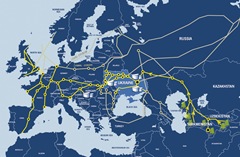
GDF centragas map

Centragas

  • Centragas AG is a holding company which holds a 50% interest in RosUkrEnergo (RUE), a Swiss gas distribution company
  • Centragas Holding AG was incorporated in Vienna in July 2004
  • RUE is a 50/50 joint venture between Centragas and Russian energy company Gazprom
  • RUE currently supplies circa 55 billion cubic metres of gas per year to Ukraine from the Central Asian countries of Turkmenistan, Uzbekistan and Kazakhstan
  • In 2007, RUE is supplying gas to Ukraine at a price of $130 per tcm which is substantially below the contracted and spot prices elsewhere in Europe.
  • Centragas, via RUE, holds 25% in UkrGasEnergo, a Ukrainian domestic gas distribution company
  • Also RUE currently exports circa 11 billion cubic metres of gas to Central and Western European countries, notably Hungary and Poland
  • RUE reported turnover in 2006 of $7.1 billion
  • Centragas AG is headquarted in Vienna and is headed by CEO David Brown
  • Centragas AG is 90% owned by GDF

GDF Group DF is The Firtash Group of Companies. To those of you who may recall, he is an individual seen as 'the right hand man' of Semion Mogilevich, or the Red Don (on the FBI Most Wanted list for dealings in the US and Canada for stock and banking fraud). I went over some of the outlines of the Red Mafia in an article some time ago, and it is proving interesting to see where those connections lead to. As can be seen the extended holdings of the Firtash Group via Centragas include a presence in Turkmenistan, which has recently shut off natural gas supplies to Iran. With that I looked at the Shockwaves of 5%, which is the amount of natural gas that Turkmenistan has in the Iranian natural gas market. And the dealings to get RosUkrEnergo are being looked at by the US (Source: St. Petersburg Times, Russia, 25 APR 2006), which has led to his arrest in Moscow (Source: Times Online, UK, 25 JAN 2008):

State television showed footage of the alleged mobster as police held him and bodyguards against their luxury cars. They also broadcast film of the rarely photographed figure in custody, wearing jeans, a cap and leather jacket.

Sergei Schneider has been arrested. He is better known as Semyon Mogilevich. He has several names, several nationalities and has been wanted for more than 15 years,” said Anzhela Kastuyeva, a Moscow police spokeswoman.

The arrest was made in connection with an investigation into an alleged $2 million tax evasion scheme run in connection with Arbat Prestige, a successful chain of Russian cosmetic stores. Vladimir Nekrasov, the owner of Arbat-Prestizh, was arrested in the same raid.

Monya Elson, a known associate of Mr Mogilevich, claimed in an interview given ten years ago that the Ukrainian was “the most powerful mobster in the world”.

An investigation by US newspaper the Village Voice, which apparently brought a death threat for its author, cited classified FBI and Mossad documents claiming that he was responsible for trafficking nuclear materials, drugs, prostitutes, precious gems, and stolen art. He was also said to have run a series of contract hit squads operating in the US and Europe.

Mr Elson claimed Mr Mogilevich, who was born in the Ukraine, controlled everything going in and out of Moscow's Sheremetyevo International Airport, which he called a ''smugglers' paradise”.

It is interesting that the arrest is only a few weeks after Turkmenistan had 'technical difficulties' in supplying natural gas to Iran. Surely the cosmetics business is just a sidelight to one of the richest criminals on the planet (Source: BBC Panorama transcript "The Billion Dollar Don"). But, like with Al Capone, it isn't the criminal activities but the *taxes* that get you. The Business Spectator on 31 JAN 2008 has this on the connection between Mogilevich, RUE and Firtash:

RosUkrEnergo

Investors have long been puzzled by RosUkrEnergo, which won its monopoly in January 2006 after Russia cut off the gas to Ukraine in a price dispute that disrupted supplies to Europe, questioning why the joint venture is needed.

Ukrainian premier Tymoshenko has resumed a campaign against RosUkrEnergo amid stormy negotiations about debts owed to the firm by Ukraine's state energy firm Naftogaz.

Some analysts have speculated that the Kremlin, facing an election in March which Gazprom chairman Dmitry Medvedev is likely to win, may have decided that RosUkrEnergo's current structure and remit may no longer suit Moscow's needs.

RosUkrEnergo's Ukrainian half is largely controlled by Ukrainian businessman Dmitry Firtash, who said last week he was in no way connected with Mr Mogilevich.

And from Forbes in 2006 we get this view of Gazprom:

Whatever Gazprom turns out to be, it is today a formidable force. Though still inefficient and scandal-prone, the company provides most of the gas to former Soviet states and to central Europe, as well as 25% of the needs of western Europe. Since Miller took over in 2001, the company has increased earnings from $440 million to $7.5 billion, on $42 billion in sales. It has announced one deal after another and is discussing a pipeline to Japan and a joint venture in Iran. By 2010 it expects to send gas in liquefied state from reserves near the Barents Sea to ports in the U.S. And the company is looking eastward, too, with plans to build pipelines to China. In a decade, executives insist, Gazprom's market cap will exceed $1 trillion.

Despite his title Miller is the second-most-important figure involved with Gazprom. Number one is the 53-year-old president of the Russian Federation, Vladimir V. Putin, who takes center stage at the Group of 8 summit beginning July 15 on his home turf in St. Petersburg. He has made energy security, a subject he has long pondered, the theme of the gathering. Nine years ago, in a late-life Ph.D. dissertation, he laid out his plans for management of the country's natural resources. And when he assumed the presidency from Boris Yeltsin in 2000, he started consolidating the Kremlin's power over the nation's most valuable asset--its rich store of oil, gas and other resources. Putin has seized control of large sectors of the economy, including stakes in autos, aviation, metals and mining. As chief executive of Russia Inc., he is creating a post-Soviet, post-Yeltsin superpower whose strength comes not from warheads but from commodities.

Putin has put his stamp in particular on the nation's largest company and crown jewel, Gazprom, where he packed the board with friends from his hometown St. Petersburg, including Dmitry Medvedev, simultaneously chairman of the Gazprom board and Putin's first deputy prime minister, and installed Miller, then an unknown technocrat with little direct experience in the gas industry. Last year the government paid $7.1 billion to Gazprom subsidiaries for an additional 10.7% stake in Gazprom, giving the Kremlin a majority stake in the company. Putin's interest in energy is perhaps not just geopolitical; there are rumors he will take over Gazprom himself in 2008 when his second term is over and he is supposed to step down.

From Israel News of 27 JAN 2008, there is a small bit of insight into how Mogilevich got the money to do the RUE/Gazprom deal into Ukraine:

Israeli links

In the 1990's, Mogilevich was considered to be one of the main targets of Israeli intelligence, who worked closely with international police in investigating and locating Mogilevich.

Israel was recently connected with the mafia boss, however, in an affair first revealed by the Moscow Times newspaper in 2003. The paper published a report claiming that companies founded by Mogilevich in Hungary and in Romania were connected with a money-laundering scheme in a big gas deal, which was intended for Poland but was carried out with a Russian energy holding company.

Backtracking a bit to Turkmenistan, the question of how Firtash got ahold of things there is seen in this bit in Moscow News on 29 DEC 2006, when the politics of Turkmenistan where in flux and Russia wanted to see Gurbankuly Berdymuhammedov become President there:

Unexpectedly for many, the heir apparent became politically active in summer 2006 when his father the president made him the head of the Turkmen official delegation at trade and economic talks with the United Arab Emirates. The mother Muza Alexandrovna Niyazova received the order from Ashkhabad to see to the son's political education and concentrated on it. It was not difficult at all, considering that the family was not exactly impoverished and that the atmosphere of the good old Vienna facilitated studies. Tutors in the Turkmen language, international law, and political scientists were found for the heir apparent. Active consultations with partners in Israel began in August.

Eural TG is the main communications line to Murat Niyazov's inner circle. One Dmitry Firtash is the key figure there. It was Firtash who "represented" Eural TG in Turkmenistan, Uzbekistan, and Kazakhstan and who became a beneficiary of RosUkroEnergo when it was established and took over Turkmen gas export to Europe. Known for his closeness to the Niyazovs, Firtash was even involved in the Orange Revolution in Ukraine. He financed the trip of the Ukrainian president's family from the United States to the inauguration ceremony in Kiev.

Establishment of the Vienna Headquarters comprising numerous pro-Western aides and advisors leads to the conclusion that Murat Niyazov is Western democracies' key project in Turkmenistan now. In the meantime, the People's Council complicated things enormously. It amended the Constitution and removed from it the provision that banned participation in the race for acting presidents. The forum even compiled a list of six candidates for president, one of them Berdymuhammedov. The president must be at least 55, he must speak the state language and live in Turkmenistan for at least a decade preceding the election. It does not take a genius to guess who meets and these fair requirements and who will therefore be elected the president on February 11, 2007.

Firtash, by situating himself in a position to be in contact with the Niyazov's, was able to facilitate not only the Russian agenda of Putin but his own of getting his company to have a foothold in the Turkmenistan gas market, all to the approval of the West. This would put Firtash into a position of consolidating holdings and thus needing to create the DF group. The Ukrainian magazine Zerkalo Nedali would have an article on 06-12 OCT 2007 by Alla Yeremenko trying to figure out just who owns *what* in Ukraine:

The first thing is that the debt might arise during the sale of gas to municipal heating enterprises. But this question has never been directly related to Gazprom before, since Naftogaz is buying gas not directly from the Russian monopoly but from UkrGazEnergo. However, if there was a debt it wouldn’t be that big. And UkrGazEnergo along with RUE, the co-owner of which is Gazprom, would be responsible for this debt anyway.

Theoretically, there could be a debt for gas in the underground storage facilities. According to Yuriy Boyko, there is a record for the last year's amount of gas in underground storage – around 32 billion cubic meters. But, at the same time, Yevheny Bakulin, the head of national stock company Naftogaz, says that there is only 5-6 billion cubic meters of gas that belongs to Naftogaz. All the rest of the gas in the underground storage facilities belongs to UkrGazEnergo, RUE and Gazprom. Which of these companies should pay for the gas in underground storage? It is obvious that this question is not related to Ukraine.

And why doesn’t Gazprom ask its “Ukrainian colleague” Dmitry Firtash, who holds 45% of RUE and a part of UkrGazEnergo, about the debt? Especially since his recent purchases in Ukraine are for a sum of money equal to the Ukrainian debt announced by Gazprom.

According to our sources, Dmitry Firtash bought shares in 6 OblGaz’s from Oleg Bahmatyuk for USD 108 million. He also bought the shares in Mandarin Plaza shopping center for USD 300 million. He paid almost the same amount of money for the big packet of shares in so-called business centre Parus, and around USD 200 million for a piece of land in the Obolon housing district.

It is well-known that D. Firtash is transforming his assets into a new company – DF (Group of Dmitry Firtash, GDF). He also is the owner of Hungarian gas-trader Emfesz, the annual turnover of which was more than USD 779 million last year.

Besides the gas business, Dmitry Firtash is the owner of shares in chemical industries in Europe, the Russian Federation, Ukraine, Estonia and Tajikistan through the Ostchem chemical holding.

According to Wprost magazine, cable TV channels K1, K2 and Megasport as well as the Kyiv basketball club belong to Firtash too.

So, “Ukrainian colleague” of Gazprom is a wealthy person and is able to answer for the debts of his firms and even of his partners. Why should Ukraine be claimed responsible?

How did Firtash get into so many companies? That appears to be bound up in the earlier deals that would create Gazprom as the giant it is now. Hans over at Dartmouth would go through the creation of Gazprom and trace out its lineage in an article on RosUkrEnergo on 26 OCT 2007. RUE was born in talks between Russia and Ukraine in 2004 between Putin and Kuchma and would replace Eural TransGas, and Gazprom would own 50% of that through Gazprombank-owned firm ArosGas Holding AG. The *other* 50% was owned by CentraGas Holding AG which was controlled by Raiffeisen Investment, on behalf of individuals 'yet to be named' in Ukraine. The Ukrainian company, Naftogaz disclaims any involvement with the stand-up of RUE. It would turn out that the 50% share of RUE would be owned by Dmitri Firtash (45%) and Ivan Fursin (5%) due to their ownership of Centragas (90%/10% respectively). [There is a lovely pdf file at Globalpolicy.org that goes through the particulars on the RUE stand-up and the actors involved.]

Ivan Fursin, the relatively quiet individual in all of this, owns a movie theater and bank in Odessa and runs two Firtash companies out of Cypress: Highrock Holdings and Arcadea Investment Fund Ltd. In a Hudson Institute report on Ukraine and its energy security in 2006, the ownership is straightened out a bit:

Finally, on April 26, Gazprom-owned newspaper Izvestia announced that Dmytro Firtash and Ivan Fursin, two Ukrainian businessmen, are the owners of RosUkrEnergo. Holding company Centragas confirmed Izvestia’s report in a statement, saying Firtash owned a 90 percent stake in Centragas, and Ivan Fursin a 10 percent stake. Firtash is director of the Cyprus based investment company Highrock Holdings, as well as board chairman of Estonian fertilizer factory Nitrofert, according to Global Witness. Fursin owns an Odesa bank and a movie theater, and, as the Russian newspaper Izvestia reported, is also president of a branch of Highrock Holdings. The newspaper also reported that Highrock was owned by Mogilevich.

In a parliamentary debate earlier this year it was alleged that Mogilevich, a reputed organized crime boss who is on the FBI’s “most wanted” list on charges of being involved in a stock fraud, was involved in the company. Firtash was previously involved in two other gas trading firms with Zeev Gordon, an Israeli lawyer who also represents Mogilevich. Mogilevich denied any involvement in RUE; Gordon said he had not met Firtash through Mogilevich; finally, Firtash insists while he met with Mogilevich, he never had any business dealings with him. Firtash’s background was probed by Austria’s Raiffeisen Bank, which subsequently cleared him of wrongdoing. However, this verdict was not quite as important as that of the court of public opinion, in which numerous doubts still remain.

It isn't what you know, its who you know and what they are involved in... and when you start to get a constellation of individuals showing up again and again, you begin to suspect a connection between them. If you want the original Izveztia article, it is held at the American Business Center website in Odessa.

As Firtash goes back with Mogilevich to the YBM Magnex deals in the US and Canada, Firtash has needed, in turn, a Western face to help do business, and that comes from one individual, as seen in the Dartmouth post on RUE:

Robert Shetler-Jones
Shetler-Jones
entered the Ukrainian business world at the age of 22, when he founded a consulting firm in 1991. He apparently met Firtash through the other partial owner of Centrgaz, Ivan Fursin (see above), and facilitated the cooperation between Firtash, the British-registered JKX Oil and Gas, and Eural-Trans-Gas. He is the managing director of RSJ Erste, which controls various Ukrainian, German and Italian chemical factories. (RSJ Erste is a subsidiary of Firtash’s GDF company, and was in the running in the recent re-privatization of the Krivorozhstal steel works.) In general, Shetler-Jones is seen as Firtash’s “Western” partner. He was removed from the direct management of RUE around June of 2005, following the “transition period” during which he was ostensibly installed to help guide the firm. Since then, however, he has apparently been reinstated and now continues to serve in a leadership position. (He also has been staying involved in Ukraine-Europe energy relations, particularly through his consulting firm Scythian Ltd.)

Yes, more companies than any one individual can keep track of, unless he is Simon Reubens! Some of this did start to hit the fan in 2005, as seen in this RFE/RL report of 05 JUL 2005:

In an interview with the newspaper "Zerkalo tyzhnya" published on 18 June, Turchynov said the SBU has been investigating the activities of two companies -- Eural Trans Gas and its successor, RosUkrEnergo -- which acted as the "operators" of Turkmen gas to Ukraine. Investigators are also probing any role that might have been played in their operations by the management of Naftohaz Ukrayiny, the Ukrainian state-owned energy monopoly.

Russia's Gazprom and Naftohaz Ukrayiny are closely linked to the activities of the two offshore companies under investigation. Turchynov charged that former high-level officials in Ukraine, together with Russia's current leaders, knew of and approved these illicit schemes, Interfax reported.

Also on 18 June, Ukrainian Gas Bank head Vadym Lyashko was arrested as he allegedly was preparing to flee the country, Ukraine's Channel 5 television reported. The Ukrainian Gas Bank was recently investigated for allegedly laundering $59 million for the Ukrainian Transportation Ministry during the administration of former President Leonid Kuchma. The bank is closely linked to Naftohaz Ukrayiny.

Lyashko's arrest and Turchynov's announcement were long-awaited steps in the realization of President Viktor Yushchenko's and Prime Minister Yuliya Tymoshenko's promise to close down highly suspect schemes in the gas-transportation business that are alleged to be have drained the Ukrainian state treasury of $1.2 billion since 2003.

[..]

Eural Trans Gas, according to the registration document filed with the Budapest business court, was of curious origin. It listed its place of business as the small village of Csabadi, outside of Budapest, and named three previously unknown Romanians as its principals.

Eural, according to a 2003 interview with Eural Director Andreas Knopp in "The Kyiv Post," was closely linked to Dmytro Firtash, a Ukrainian businessman with interests in Moldova and Turkmenistan and the owner of a number of companies in Ukraine. According to court documents provided by the Itera International group of companies, Firtash's Israeli-registered company, Highrock Properties Ltd., is being sued by Itera, which accuses him of owing them $28 million.

Hermitage Capital Management, an investment fund in Russia that campaigns for minority shareholder rights, published its report on Eural Trans Gas and Gazprom in 2003. This forced Gazprom and Naftohaz to take steps to distance themselves from Eural, a company they helped create. Eural was sold in 2004 to a group of investors and came to be headed by Cedric Brown, the former head of British Gas. Another prominent player in Eural became Robert Shetler Jones, although his exact role was not clear. He was described in "The Kyiv Post" on 16 June as a consultant to another investor in Eural, the British publicly traded firm JKX Oil and Gas, a company with substantial oil-drilling assets in Ukraine's Poltava region.

Despite these changes of ownership, Eural Trans Gas was finally replaced by RUE, which began operations on 1 January 2005.

[..]

Despite Gazprom's explanations, there was considerable speculation in the press as to the role of Raiffeisen Investment and its exact relationship, if any, to Raiffeisen Bank. Gazprom spokesmen never clarified the relationship, merely repeating that RUE is a "fully transparent" structure.

On 6 August 2004 Interfax reported: "In late July 2004, 100 percent subsidiaries of Russia's Gazprombank and Austria's Raiffeisen Bank created the RosUkrEnergoprom company for the supply of Turkmen gas to the Ukrainian market. The company, shared by the parties 50-50, will be registered in Switzerland. RosUkrEnergoprom will purchase Turkmen gas for the Ukrainian market and act as operator of the gas purchased and investor in the development of the gas-transport infrastructure required for securing the transit. The company will be run by a coordination committee including representatives of the leading officials of Gazprom, Naftohaz Ukrayiny, Gazprombank, and Raiffeisen Bank."

Research has shown that Raiffeisen Investments has no direct management connection to Raiffeisen Bank, although both companies are owned by the Austrian RZB Group.

Furthermore, Raiffeisen Investment is not ARosgas AG's partner in RUE. According to an interview with "The Kyiv Post" on 16 June, Raiffeisen Investment spokesman Wolfgang Putschek stated that the company only manages the portfolio for "a group of Ukrainian businessmen who have worked in the gas industry" and is paid a commission for managing that portfolio. When asked to name the "Ukrainian businessmen," the spokesman declined to do so, citing confidentiality agreements.

Apparently, the "Ukrainian businessmen" whose portfolio's were being managed by Raiffeisen Investment were acting as private individuals, while ARosgas was clearly connected to the Russian state and collected nearly $478 million annually for Gazprom, according to Hermitage Capital Management, a Moscow-based investment company.

The total fee paid to RUE by the Ukrainian state for transporting gas from Turkmenistan, in Gazprom's pipeline, to Ukraine is reputed to be close to $1 billion per year, paid to RUE in the form of 13 billion cubic meters of gas, which it then sells in the West through a variety of agents. This is the same fee that Ukraine paid Eural Trans Gas, according to a contract signed in Moscow in December 2002 that has been made available to RFE/RL.

Asked by Ukrainian journalists at a press conference earlier this year if Naftohaz Ukrayiny is a principal in RUE, Naftohaz Ukrayiny head Oleksiy Ivchenko replied that it is not and that Naftohaz was seeking to buy into RUE so as to have some say in its management and to receive the $478 million the unnamed businessmen are reputed to collect yearly.

Apparently the former management of Naftohaz, headed by Kuchma loyalist Yuriy Boyko, renounced its right to be a principal in RUE and reclaim the $478 million that Ukraine paid RUE for its services, giving its consent instead to a group of unnamed private "Ukrainian businessmen" to collect this money. Boyko, however, rejects any allegations of wrongdoing.

Prime Minister Tymoshenko has stated that as a consequence of the Eural Trans Gas and RUE, schemes, Ukraine lost more than $1 billion, Interfax reported on 15 June.

So $478 million/year is being collected by unnamed Ukrainian businessmen which would turn out to be Firtash and Fursin. Mind you that is transactional cash, but even a small amount of interest on it turns into decent walking around pocket money. Pocket money aided by many backers, to be sure, and one of those helpers was Mr. Shetler-Jones of the JKX firm. The Financial Times had an article looking at this from 29 APR 2006 (Cached at zawya) looking at the UK angle of this deal:

Dmytro Firtash, the Ukrainian trader who has emerged as a key player in the European natural gas market, was unfamiliar to most western business people until this week. But a small group of British businessmen have known him well for years.

When he appeared last year at a Mansion House dinner at which the Queen presented an award to Ukrainian President Viktor Yushchenko, the 40 year old Mr Firtash sat at a table hosted not by Ukrainians, but by JKX Oil and Gas, a British AIM-quoted company with interests in Ukraine.

Its chairman is Lord Peter Fraser, a former Tory trade minister, and the chief executive is Paul Davies, an oil man with extensive experience in the former Soviet Union. Mr Firtash is one of the company's biggest shareholders, controlling a 9.7 per cent stake through a holding company called Benam.

Few people beyond JKX's immediate circle were aware of Mr Firtash's significance. This week he was identified as a key shareholder in RosUkrEnergo, a trading company bringing gas from central Asia to Europe.

Half of RosUkrEnergo belongs to Gazprom, the Russian gas giant. The other half is split between Mr Firtash, with 45 per cent, and Ivan Fursin, a Ukrainian banker and associate of Mr Firtash, with 5 per cent.

Mr Firtash established his fortune by supplying food and other goods to Turkmenistan in exchange for gas for Ukraine in the 1990s.

Among his earliest contacts with British business people was Robert Shetler-Jones, whom he met through Mr Fursin. Mr Shetler-Jones lived in Kiev in the early 1990s and later in Moscow, working for a series of property companies.

Mr Shetler-Jones's contacts included Viscount Raymond Asquith, a member of JKX's board who had worked as a diplomat at the British embassy in Kiev. The contacts between Mr Firtash and Mr Shetler-Jones culminated in 2003 in a complex deal that brought together Mr Firtash and JKX.

Benam bought a stake in JKX, which acquired a small stake in Eural Trans Gas, at that time Mr Firtash's main gas-trading company. JKX credited Benam with helping it secure Ukrainian permission to export gas.

Personal loyalties seem to have mattered to both men. Mr Shetler-Jones sat next to Mr Firtash in this week's FT interview. Mr Firtash referred to the secrecy that until this week surrounded his background. He said: "I once asked Robert, 'Aren't you afraid I could embarrass you?' He said, 'No, I know you very well'."

Benam Holdings of Cyprus (Manta page here) is one of those little companies that looks to be about one piece of paper thick. This is where Eural Trans-Gas hits the big time, and it, apparently, didn't exist much before the RUE deal *either*. From the St. Petersburg Times, Russia, comes an article from 02 DEC 2003 to look at just what three Romanians in that little town in Hungary can do with just the right connections... or the right connections coming to them:

MOSCOW - "Three Romanians with no business experience and an Israeli with alleged mob ties register a trading company in a Hungarian village. Before the company is even legally formed it is granted the rights to transport billions of dollars' worth of natural gas from Central Asia, across Russia, to Ukraine."

These shareholders are, at least on paper: an actress hoping to earn money to pay her phone bill, a nurse, a computer programmer, and an alleged associate of a Ukrainian-born crime lord who is on the FBI's "most wanted" list for money laundering, racketeering and fraud.

Linked to the same mobster, according to the Russian government, is the head of the new company, Eural Trans Gas, which stands to gain about $1 billion a year in pre-tax profits that could have gone to Gazprom.

[..]

Not only has the world's biggest gas company let the little Hungarian operation take over a lucrative export channel over which it had pledged to regain control, it has also supported it with almost $300 million in loans and guarantees.

The gas giant, according to its own financial statement for the first half of 2003, is the guarantor of a $227 million loan to Eural TG from state-owned Vneshekonombank. On top of that, Gazprombank, which is 100 percent owned by Gazprom, loaded another $70 million to the company, according to a list of the bank's 10 biggest borrowers obtained by The Moscow Times.

Investors thought Gazprom management had put an end to such practices. When President Vladimir Putin put a loyal lieutenant, Alexei Miller, at the helm of the gas monopoly back in 2001, Miller vowed to liquidate the murky schemes used by former management to siphon off up to $3 billion a year from the company.

Miller regained most of those lost assets and eliminated a lot of the murky trading deals that mainly benefited Itera, an octopus-like structure based in Florida and widely believed to be tied to the old management team.

But Miller failed to retrieve one of the biggest channels - the sale of gas from Turkmenistan to Ukraine. Instead of wresting it back from Itera, as he said he would, it has been turned over to Eural TG.

[..]

Putin's crackdown on corruption and the jailing of Yukos founder Mikhail Khodorkovsky on charges of fraud and tax evasion to the tune of $1 billion are seen as part of a Kremlin campaign to gain greater control over the oil industry.

"The creation of Eural Trans Gas is comparable to what Gazprom did with Itera, which ultimately led to Putin's dismissal of the previous management team," says Vadim Kleiner, Hermitage's director of research.

Others say turning over the Turkmen-Ukrainian operation to Eural TG is even more outrageous than letting Itera take over Gazprom markets in the former Soviet Union.

"This would not be the first time Gazprom has created its own competitor," says Valery Nesterov, energy analyst at Troika Dialog. "But at least Itera is more solid, has its own reserves and extracts gas. Eural TG is just a trading firm that at best can be called shady."

According to a copy of company documents obtained by The Moscow Times, Eural TG was launched with just $12,000 in start-up capital.

Yes, with just $12k you too can join the world of international gas trading and suddenly get control over billions of dollars in revenue! Now out of investors including a struggling actress, a nurse, a computer programmer and a man linked with international organized crime stretching from the US and Canada all the way heading east across Morocco, Spain, Hungary, Romania all the way to the Golden Triangle and China, which of these apparently has financial clout?

Wouldn't you like to be in a minority holding position with a company headed by Semion Mogilevich and having $1 billion in natural gas revenue passing through it and over $300 million in loans from Russian banks? Such a deal! Hope the poor actress got her phone bills paid up...

Then there are the recurring payments in the deal. Recurring payments? Why, yes, if you get gas at below market prices and sell them at market prices you get to keep the difference. Standard capitalism of 'buy low, sell high', save that the buyer is the seller and the seller the buyer... don't believe that? Read on:

In return for its services, Ukraine is obliged to pay Eural TG 38 percent of the value of the deal, or 13.7 bcm in gas, according to Naftogaz Ukrainy, the Ukrainian gas monopoly that is paying Eural TG under the deal.

Now that Eural TG is beginning to export gas from Ukraine - it already has one contract under its belt to sell Poland 2 bcm by July 2004 - it is on track to post a pre-tax profit of more than $1 billion a year if it can export the rest of the gas Ukraine pays it, even after paying Gazprom $450 million in annual fees for the use of its pipeline network.

Gazprom says it was forced to give up the trade deal and bow to the wishes of its Ukrainian counterpart, which, it says, insisted that if Itera had to be replaced, the new agent had to be Eural TG.

Gazprom says its $227 million loan guarantee is designed to give it leverage over Eural TG's trading deals because it is collateralized with the gas Eural TG is being paid with.

But Naftogaz Ukrainy says that Eural TG is Gazprom's creation all the way. "All the agreements with Eural Trans Gas were made by Gazprom," says Naftogaz spokesman Konstantin Borodin. "It is a contractor for Gazprom."

So by getting 38% of the gas, and after paying off Gazprom for pipeline usage, you get $1 billion in profit per year *every year*. Ukraine buys it, it goes through Gazprom pipes thus selling it to Eural Trans-Gas, and then re-buys a portion of it after giving that 38% to Eural Trans-Gas. Ukraine buys it, sells it, buys and ETG gets the middle man on each of those transactions. Only a mobster could think up such a crooked deal that even the Russians get swindled by it! How? They are buying it from Turkmentistan in the *first place* from ETG to sell to Ukraine, then getting only transport cost back on the re-sale of it via Eural Trans-Gas. Someone is making a mint, here, and it isn't Gazprom, Russia or Ukraine... thus leaving Eural Trans-Gas.

And even if that is not the way it works, trying to figure it out has surely vexed the Russians and Ukrainians no end... it was set up to be hard to track and that is the point of it: obfuscation via complexity.

This is where Highrock Holdings, Furtash and Fursin come in as the money comes through *them* from Semion Mogilevich, the owner and backer of Highrock Holdings. Here is how that bit of it works:

None of these allegations could be confirmed independently, but a copy of a letter written to Interpol by Russian Interior Ministry Major General A. P. Mordovets links the head of Eural TG, former Hungarian Education Minister Andras Knopp, to Mogilevich. Mordovets told Interpol in the letter, a copy of which was obtained by The Moscow Times, that Knopp helped Mogilevich create a cigarette smuggling ring in the 1990s.

The letter, which was written in 1998 when Knopp was a vice president at major German cigarette maker Reemtsma, says Knopp supported Mogilevich's appeal for Hungarian citizenship. It says Mogilevich introduced Knopp to members of the Russian government responsible for the cigarette business. It alleges Mogilevich "threatened to kill" an individual who was disrupting their smuggling operation.

German investigators began looking into Reemstma's possible involvement in cigarette smuggling in 2000, but no charges were ever filed.

"Knopp's assistant said he could not be reached for comment, but in an interview with the Kyiv Post earlier this year, Knopp confirmed Eural TG did business with Mogilevich-linked Highrock Properties. He denied, however, any ties with Mogilevich himself."

Ah, 'plausible deniability'! Remember the Clintons didn't develop *all* of that sort of thing... and it is just this sort of deal of 'its not what you know, but who you know' that creates 'plausible deniability' by going through intermediaries and, since it is through intermediaries like Reemstma from Germany, that you can say ETG has only dealt with Highrock but not Mogilevich with respect to ETG and say *nothing* about ever having dealt with him on any matters. That is 'plausible deniability' at its finest: its not what you say but what you *don't* that matters.

The article also goes on to demonstrate how the Russian Mafia is unlike its Sicilian/Italian counterparts: the others who signed up to create ETG are still in poverty. The actress did, however get $34/month for her phone bill. So while the 'Family' approach to the mafia concept 'takes care of its own' and those who help it, the Russian one has no such high ideals: just the cash or your life.

And Gazprom was looking to *fix this* buy buying ETG and the Mogilevich response was: nuh-uh. Not outright, but how about we form a new 'partnership' and create RUE? This would bring in JKX and Benam, but things would not look brighter or better even if Gazprom got its 50% share:

In an ironic twist, Gazprom's funding of Eural TG may just fatten it up for a Western rival eyeing a way to break into Gazprom's monopoly on exports to Europe from the former Soviet Union.

British-based JKX Oil & Gas, which already has stakes in a number of Ukrainian oil ventures, has been trying to buy part of Eural TG together with a company called Benam Holdings since July, according to JKX.

JKX company has several heavy hitters behind it, including former British Trade and Industry Minister Peter Fraser and controversial Swiss tycoon Bruce Rappoport, who has close ties to the Israeli government.

JKX, for now, says it cannot say what Benam Holdings is. A web search for the company also came up with no results. Like Gazprom and Naftogaz, JKX says it is not worried about Eural TG's ownership structure, adding that any future deal will be conducted in the interests of its own shareholders.

Does the word 'snookered' come to mind here? Isn't this the exact, same thing that went on with ETG and 'can't tell you the interests behind it' sort of deal? Gazprom got hit hard on Itera, fell for it again with ETG and now, with forming RUE to get 50% of what it buys, will get it one more time from Mogilevich, Furtash and Fursin. What a sweet deal! Just give them $1 billion per year for a couple of years and they will let you in on half the action!

The reason that an intermediary company is wanted, in the first place, is that Russian gas is expensive, while that of the surrounding post-Soviet Nations of central asia is inexpensive. Euromonitor steps through this on 11 JAN 2006, and looks at how the deal does and does not work for the parties involved. Additionally Gazprom hoped that an independently financed company would be able to get payments more readily than a State owned firm. This works well when things are going well on the supply side, but recently that has changed as the problems, particularly in Turkmenistan, have caused RUE to utilize more expensive Russian gas thus effectively doubling the price of it to Ukraine. From that Russia also hoped to expand its presence in Europe to Slovakia and Poland through the Hungarian firm EMFESZ:

The figure of Dmytro Firtash is interesting in the whole story and it is related also to Slovakia. Since he is a partner in companies trading with or partly owned by Gazprom, mutual contacts between Firtash and the highest representatives of Gazprom must be above-standard.

The mechanism of RUE company enables to carry out Russian foreign energy strategy of expansion to European market through majority share of Russian state in Gazprom. RUE is already active on Hungarian and Polish markets via business organization EMFESZ, and Slovakia is mentioned as well. So far the Office for Regulation of Network Industries of Slovak Republic has no information on any companies interested in entering our gas market, yet the fact is that it does not have to be informed about it according to current legislation, because the entering should be based on a contract with an existing operator. SPP (Slovak natural gas industry) has not made a statement in relation to the issue so far.

EMFESZ is a Hungarian company trading with gas, and with the 2.8 billion cubic meters it is one of the biggest gas suppliers in the country. The official owner is Mabofi Holding seated in Cyprus . EMFESZ was founded in 2003 by Ukrainian enterpriser Dmytro Firtash, who – according to Hungarian press – is also the actual owner. In April 2006, the company by means of EMFESZ NG Polska signed contracts for supplies of 2.5 billion cubic meters of gas to Poland, and thus as the first company it took the chance to enter the up-to-then monopoly sphere of gas supplying (TPA – third party access) of industrial enterprises. EMFESZ became a regional partner of RUE, it is the only company which sells gas obtained from RUE in Hungary and which has a 10-year contract of gas deliveries signed with RUE. In the future, the company plans to enter the development of infrastructure actively by means of building their own gas pipeline from Ukraine to Hungary, as well as being active in construction of reservoirs. In the beginning of March Firtash announced that he was planning to place 25-35 % of EMFESZ shares in the stock market in Budapest, but at the same time he mentioned that a certain part would be sold to RUE company, which he owns together with Gazprom.

Beyond that, Russia has caused some artificial crises with gas supplies to Ukraine, like in JAN 2006. This was meant as pressure to Ukraine to pay more and to force a renegotiation of the previous deals made to stand up RUE. Going through that crisis the previous head of Naftohaz Ukrayiny, Oleksiy Ivchenko was interviewed by the BBC for a report published 12 NOV 2007 (Source: Zibb file cache), and he offers this perspective on the role of Firtash:

[Nayem] Is there a possibility of getting rid of RosUkrEnergo now?

[Ivchenko] Yes, it has always been there, and this should be done! But it should be understood that the Ukrainian side will be unable to do so on its own, neither technically, nor judicially, nor politically. It is just the will of the Russian side! I shall admit that if RosUkrEnergo becomes unprofitable for the Russian side for some reasons, then everything is possible... [ellipsis as published]

[Nayem] But why can RosUkrEnergo become unprofitable?

[Ivchenko] Well... [ellipsis as published] why were Itera and EuralTransGas unprofitable?

[Nayem] Let us say, EuralTransGaz was removed because of a scandal over relations with [alleged criminal Semen] Mogilevich... [ellipsis as published]

[Ivchenko] Yes, but RosUkrEnergo can be removed exactly the same way, as there are also numerous scandals surrounding it... [ellipsis as published] It is also unprofitable.

[Nayem] Do you believe that Firtash is an independent figure?

[Ivchenko] I don't believe so.

[Nayem] Do you think Firtash is linked to Mogilevich?

[Ivchenko] I don't know. I know Firtash very little. I think he is being backed by top-ranking officials from the Russian side. If it is not like this, then I think they are top-ranking officials from both Russian and Ukrainian sides.

If it is not like this, then explain me the following thing. We had a debt of 2bn dollars owing to Gazprom. Our senior officials [recently] inappropriately announced that this was state debt. All right. I believe that it is not Ukraine's debt. Formally, it is RosUkrEnergo's debt owed to Gazprom.

Then I have a question: what was [incumbent] fuel and energy minister [Yuriy Boyko] doing in Moscow, and what was [incumbent] prime minister [Viktor Yanukovych] doing there? On whose behalf were they speaking there? Did they recognize the debt and did they think over its repayment? On whose behalf?! On behalf of RosUkrEnergo?! I don't understand... [ellipsis as published]

This debt is no accident. Now, attention! A debt with exactly the same structure and origin was run up prior to 2005. And those who did this were the very same people... [ellipsis as published] This debt was formed for a second time with only purpose in mind: so as to hand over the gas transport system. But the [Orange] revolution prevented them from doing this in 2005. And this year it was due to the results of the parliamentary election [on 30 September].

Firtash, for all of his holdings, is seen from the inside by Oleksiy Ivchanko as someone who is not an independent actor but one who, at least on the gas deals, is following someone else's orders. It is time to sort out a few things on the side of who owns what, and get some firmer associations down. For that the Red Orbit site has a 09 AUG 2007 article from the Hungarian newspaper Vilaggazdasag:

Who is Firtash, the owner of 90 per cent of Centragas AG? The FBI in the US as well as the Ukrainian secret service has already tried to find the answer to this question. The primary interests of the Americans pertained to the kinds of common interests Firtash and Semion Mogilevich have, the latter believed to be a Russian Mafioso sought by the FBI, and whether Firtash is laundering money. Kiev was interested mainly in the way Firtash is linked to the Russians and to the rest of the members of the new Ukrainian elite in the post- Kuchma era, as well as in the identity of additional owners of the firm. It was revealed that the names of Mogilevich and Firtash appear together among the owners of several companies, and that Firtash, the Ukrainian businessman -who participated in the highest- level Russian-Ukrainian negotiations during last year's natural gas crisis and has also negotiated with Yushchenko -maintains three offices in Moscow, in the real centre of his economic interests.

[..]

Well-informed analysts in Vienna suspect that anyone who does business with Firtash is actually doing business with Gazprom. At this time Firtash gave an Austrian character to his most important firms, thus to Centragas and to Mabofi Holding, the company that directed EMFESZ from Cyprus so far, and further, its chemical industry, gas pipeline construction and real estate firms. One cannot tell however, between exactly who EMFESZ is acting as an intermediary; one cannot tell whether the telephone numbers shown on the websites of its businesses actually ring in the offices of Raiffeisen Investment AG?

Beyond this the Financial Times reported on Dimitry Firtash and reviewed the information it had published previously on the questions it had asked him. On 13 JUL 2006 they came out with a report by Tom Warner on the involvement of Firtash and Mogilevich over the years:

In an April interview, the Financial Times asked Dmytro Firtash about evidence from official records in Russia, Israel and Cyprus of his connections to associates of Semyon Mogilevich, an alleged crime boss. Here are his explanations and, where available, those of others involved.

June 2003 Mr Firtash replaced Galina Telesh (a woman with whom an Israeli police report said Mr Mogilevich had been in a relationship since the early 1990s) as director of the Cyprus-registered Agatheas Trading. Later, Agatheas became direct one-third owner of Highrock Holding, another Cyprus-registered company, where Mr Firtash had been director since 2001.

According to a Hungarian intelligence report obtained by the FT, Ms Telesh and Mr Mogilevich were married in 1995.

Mr Firtash accepted that Ms Telesh beneficially owned one-third of Highrock’s shares until June 2003.

However, Mr Firtash said he never knew Ms Telesh. He said his partner in Highrock was Igor Makarov, president of Itera, a Russian gas trader. Mr Firtash said his involvement as director and one-third owner of Highrock was set up by Yelena Yargina, his lawyer, while ownership of the remainder was arranged by Itera’s lawyers. “Yelena worked with Itera’s lawyers. “We don’t know about this,” Mr Firtash said.

Mr Firtash said that after he fell out with Mr Makarov in late 2002, he took full control of Highrock and “cleaned it up”, which eventually led to him taking over as director and owner of Agatheas in June 2003.

Mr Makarov, however, who replied to written questions through a spokesman, said neither he nor Itera had ever had any economic interest in Highrock or undertaken any role in setting up Highrock or its parent companies.

The FT asked Mr Firtash to provide evidence that Mr Makarov was involved in Highrock and was later shown part of a report by Kroll, the private investigator, which said Highrock was jointly established by Itera and Mr Firtash. However, the part of the report seen by the FT did not explain why Kroll believed Itera was involved in Highrock. Mr Firtash said his bank, Raiffeisen, commissioned the Kroll report.

November 2002 Igor Fisherman, one of three associates indicted with Mr Mogilevich in the US in April 2003, registered a car with Moscow traffic police and gave as his personal contact a telephone number that rang to Highrock’s offices in Moscow, at Novy Arbat 14.

Mr Firtash said Mr Fisherman never worked at Novy Arbat 14 or came into the office. “I don’t know why he gave that telephone number, but I can say for certain he didn’t sit there and didn’t work there.”

March 2002 Elmstad Trading, another Cyprus-registered company owned by Mr Firtash, transferred ownership in a Russian company called Rinvey in three roughly equal parts to Ms Telesh, Ms Yargina and Olga Zhunzhurova, who is Mr Fisherman’s wife, according to the US indictment. Rinvey then acquired stakes in Moscow perfume retailers. Ms Yargina co-owned Rinvey until April 2003 and continued to work for Mr Firtash throughout this period.

Mr Firtash acknowledged that Ms Yargina had joined Rinvey at his direction but he said he could not remember why he had asked her to do so. He said he had no involvement in Rinvey, its business and no ties to its other owners. “It’s not my business. It’s obvious I couldn’t do that business,” he said.

Mr Firtash said he asked Ms Yargina to end her involvement with Rinvey “when we were cleaning up”. He said she still works for him.

November 2001 An Israeli lawyer called Zeev Gordon helped set up a Highrock subsidiary in Israel called Highrock Properties. From December 2002 until early 2004, Mr Gordon was nominal (paper) owner of one-quarter of Eural Trans Gas, a company beneficially owned by Mr Firtash. Mr Gordon told the FT he counted Mr Mogilevich as a client and a friend.

Mr Firtash said his relationship with Mr Gordon had nothing to do with Mr Gordon’s relationship with Mr Mogilevich. Mr Firtash said Mr Gordon had many Russian- speaking clients: “When I asked Gordon, ‘Why do you have to work with Mogilevich?’ he said ‘Listen Dima, it’s my business, just like you trade in gas. I’m a criminal lawyer’.”

Mr Gordon said in a telephone interview he had been asked by Mr Firtash to help with Highrock and Eural, that Mr Mogilevich denied any involvement in Eural Trans Gas or RosUkrEnergo and that he did not know whether Mr Mogilevich was involved in Highrock.

Yes, 'plausible deniability' just happening to share common ownership with an organized crime figure and his entourage! Purely coincidental that this happens over and over, I'm sure. And it is Novy Arbat that Mogilevich was picked up for, so it is not out of the range of the possible that Mr. Firtash will also have to answer a few questions on his work with the firm. It is also interesting to note that while doing barter trades in Turkmenistan, Mr. Firtash created 'single use companies' and would never claim ownership of them, which is not a way to deal with things in a transparent fashion.

Now for some of the stranger outward bound associations that Semion Mogilevich gets attached to... like, what is his connection to the 2002 Salt Lake City Olympics? Well, if you remember the figure-skating being *fixed* by a mafia member, you are hitting in the right ballpark. From The Komisar Scoop of 06 AUG 2002, we have this connection show up:

For Alimzhan Tokhtakhunov, 53, called Taivanchik (the Taiwanese) because of his Asian features, the plot to get an Olympic gold medal for Russia’s top figure-skaters was small-time.

The Russian mafia don who was arrested July 31 for fixing skating contests at the Salt Lake City summer Olympics reminds one of Al Capone, who was put away for tax evasion, because the government couldn’t get enough evidence against him for murder, extortion and criminal racketeering.

The Russian was caught by Italian financial police tapping his phones in a money-laundering investigation. They informed the U.S., which last month secretly indicted him on charges he bribed skating judges. The U.S. now has moved to extradite him. He could get up to 10 years in U.S. prison and $500,000 in fines if convicted of the current charges: conspiracy to commit bribery and conspiracy to commit wire fraud related to a sports event. It’s a chance to lock up a man who is guilty of a lot more than simply sports competition fraud.

[..]

The FBI had cited him in an August 1996 report prepared by its Intelligence Section, Organizational Intelligence Unit, and entitled “Semion Mogilevich Organization.” The report, excerpts of which these reporters obtained, said, “The Mogilevich Organization is tied to two other major OC [organized crime] groups - the Vyacheslav Ivankov Organization and the Solntsevskaya Organization - and also to Euroasian crime figures Monya Elson and Alimzhan Tokhtakhounov. Their operations and contacts overlap in some instances, as evidenced by meetings, joint investments, and silent partnerships in firms engaged in OC activity.” (In 1995, the FBI would arrest Ivankov for extortion in New York; he was convicted and sent to federal prison for 9 years and 7 months.)

Czech police reports said that Tokhtakhounov controlled Russian crime groups active in Western Europe and acted as intermediary for newly arrived criminal bosses. The Czech police rap sheet on him includes:

1991: Departure from the USSR for Germany where he organized illegal arms deals partly from the stock of the Soviet Army;

1992: A search of his house turns up the business card of known Russian mobster Semion Mogilevich;

1993: He moves to Paris to escape German police inquiries;

1994: He meets with Ivankov and other major Russian crime leaders in Vienna to discuss division of interests in Moscow casinos; in July, he hosts representatives of Russian and Uzbek organized crime groups on his yacht Saravona in the Mediterranean Sea.

In October, Tokhtakhunov meets in Tel Aviv with Mogilevich, Gigori Loutchansky, Solntsevo mafia boss Sergei Mikhailov, and a representative of Ukrainian president Leonid Kuchma, believed by western intelligence to be involved in illegal arms trafficking. They discussed dividing spheres of influence in the export of strategic raw materials.

He represents an export division of the Association of the 21st Century, Moscow, one of whose heads is alleged crime leader Yossif Kobzon.

1995: In April, failing to get a visa extension, he is deported from France.

1996-97: Western authorities suspect him of involvement of trafficking in drugs, arms and antiquities and of participation in extortion. His Israeli citizenship is cancelled when it is proved that he obtained it illegally, through a false marriage on the basis of false documents.

Among his contacts, Czech police listed Arkady Gaydamak, object of an international arrest warrant for illegal sale of weapons to Angola.

[..]

Di Nicholas in his letter said Loutchansky, “a leader of the Russian Mafia,” controls the French company Kama Trade, a laundering-network centerpiece. He said it linked to Nordex, which Loutchansky founded in Vienna in 1989 at the behest of the Communist “Old Guard” to move cash from looted state and party assets and later from crime activities. Loutchansky said through his London attorney that he had won libel actions against such charges. “It is completely untrue that I have been involved in the mafia, in money laundering or in any other criminal activity,” he said.

The prosecutor said Mogilevich, based in Budapest, was a source of dirty money from drug trafficking, prostitution, illegal commerce of precious objects and art, extortion and money laundering. He said Mogilevich is active in Los Angeles, Miami, Philadelphia and St. Diego as well as Moscow, Prague and Tel Aviv. British authorities identified $200 million that companies or individuals linked to Mogilevich shipped through the London office of BoNY in 1998-99.

The 1996 FBI report said Mogilevich was involved in “weapons trafficking, nuclear materials trafficking, prostitution, drug trafficking, dealing in precious gems, and money laundering.” It said he was active in the U.S., as well as the Czech Republic, Austria, Russia, the Ukraine, the U.K. France, Slovakia, and Israel. The FBI said the center of his financial operations was Arigon Ltd, registered in the Channel Islands and using banks in New York, Geneva, London and Stockholm. Front companies in the U.S. were FNJ Trade Management Corp. in Los Angeles and YBM Magnex in Newtown, Pa.

Yes, how a simple Mafioso can lead to such Big Mafioso via figure skating is really quite amazing. The recently arrested Mogilevich also had dealings with al Qaeda, as seen in this Security Affairs article of Fall 2005 - #9 by Jason Freier (webarchive cache here):

Mogilevich’s activities tell a similar story. Just before the attacks of 2001, the Ukrainian mobster emerged at the center of a European investigation into the arrest of an al-Qaeda-linked group in Paris. When apprehended in August 2001, the group had in its possession a suitcase containing uranium-235.15 Subsequent investigations into the incident have determined that the group attained the uranium via Mogilevich’s Ukraine-Marbella route-a transit corridor that, prior to September 11th, had been a favorite among transnational criminals and terrorists entering Europe from the Maghreb.16

Patterns of interaction

In its study of the subject, the U.S. Library of Congress found three broad patterns connecting terrorism and transnational crime in Europe.

  1. Alliances for mutual benefit, in which terrorists enter agreements with transnational criminals solely to gain funding, without engaging directly in commercial activities or compromising their ideologically based mission;
  2. Direct involvement of terror groups in organized crime, removing the middleman but maintaining the ideological premise of their strategy, and;
  3. The replacement of ideology by profit as the main motive for operations.17

Al-Qaeda’s dealings with Mogilevich in Spanish Morocco and Bout in Liberia fall into the first category. In these instances, the cooperation has been based upon nothing more than mutual benefit, with neither group compromising its primary mission. The weapons traffickers, in short, view the terrorists as little more than clients, and business is business.

From the sublime to the supremely deadly in one shot, so to speak. When looking at someone like Dmitry Firtash, it is wise to remember that the money in the machine drives the entire affair, and there is a lot of money that shifts in the natural gas and other businesses that he is involved in. Thus, even as an intermediary to someone like Mogilevich makes him a very important person because of the extent of things that criminal enterprise is associated with.

When that pattern of companies having backers that don't want to be known appears time and again, this becomes an indicator that something needs to be looked at. Russia got hit by that *twice* with ETG and RUE, both, most likely, representing the exact, same individual behind Itera. This does not even begin to touch the extended holdings of Firtash or Mogilevich which stretch, cumulatively, all the way to China for Mogilevich and down to the nitty-gritty of real estate in Kiev for Firtash.

I thank my commentator cui-b0no for the posted information on Kiev, and I have been discussing with him the destruction of Kiev's historic buildings that have been surreptitiously destroyed by the likes of DF Group and others that now see 'development' ahead of preserving those things the city has designated as part of the cultural heritage of Kiev. How this happens on the small scale is *exactly* the same as on the large: corrupt officials willing to take money and look the other way while things go on. It doesn't matter if those individuals are running nuclear processing facilities or simple council members in a city, the basics are just the same.... save that the latter destroys our past and those things that connect us to it, while the former puts our future at risk. To those dealing in 'just the cash' without respect to ideology, trafficking in humans, compromised building permits, small arms and nuclear material is all equal.

When looking at the increasing economic savvy of groups like Hezbollah to compromise both 'white' and 'black' markets, the idea is that their existing power structure would not only be legitimized but expanded if something as simple as narcotics are made legal. M. Simon, also a wonderful commenter, put forward that moving such into the 'white world' was of benefit, while I put forward that it allows them to then expand further via laundering their funds to even more illicit and lucrative schemes. Russia, and the surrounding Nations coming out of the Communist Block, are the case in point, here: those running criminal enterprises have compromised large scale businesses to craft a unique and deadly system of laundering funds from some of the most profitable enterprises that one can work in. The reason that they are restricted by Nation States is that the outcomes of letting things like human slavery, narcotics trafficking and nuclear material sales go unchecked is a future made worse, not better, for the 'white world' investment in industry. With the ability to swindle $1 billion/year from a large scale gas transaction and then shift those funds across the board from real estate to other forms of trafficking, these Mafioso are not, necessarily, making a better life for those around them or the world at large.

They *are* making money, however, and truly willing to do whatever it takes to get more of that and the power that comes with it. These are not Carnegies or Rockefellers, nor even something remotely close the Gambino Family. These are ruthless thugs willing to put on suits to further some of the worst crimes imaginable on the face of the planet, and giving them legitimacy when they are willing to operate outside all bounds of Nation and law and, in fact, see themselves *above the law* puts them in a category very close to terrorism. They are not conducting Private War, but they sure, as hell, are supporting it on a global basis. This is not heading towards securing human liberty, but towards endangering it. While I do agree that things like drug use should be up to an individual to decide for themselves, I do start to draw the line at those supporting Private War through the promulgation of profits from such activities into illicit venues. As Russia and the surrounding ex-Communist Block Nations are proving: you can have lots of industrial support and still not be supporting society at *all*.

Playing upon personal vice that harms no one, is one thing.

Providing those seeking to bring down society and Nations with the means to do so is something thoroughly different.

And, currently, we are having a hard time convincing anyone that there is a difference between the two until some large number of people get killed... and then the idea is to look the other way and blame ourselves for the destructive hearts of others who are seeking our end. There is a reason I support the Law of Nations view to address this just like it did Piracy: it goes after those who support Private War as well as those who wage it. It is yet another tool in our National toolkit if we dare to find and use it.

So that we can address both those seeking to destroy our past, and our future.