When reading Angelo M. Codevilla's piece on America's Ruling Class -- And the Perils of Revolution at the American Spectator (JUL-AUG 2010 issue) I got to thinking about some concepts that had been present in my past work with other aspects of society: the science-fiction, science and technical communities. One of the main aspects of them deals with words, jargon and how they dove-tail in creating communities.
From Wikipedia, YMMV:
Technobabble (a portmanteau of technology and babble), also called technospeak[1], is a form of prose using jargon, buzzwords and highly esoteric language to give an impression of plausibility through mystification, misdirection, and obfuscation. Someone who does not understand a technical description that necessarily contains many technical terms may describe it as technobabble,[2] but it also can describe prose intentionally made obscure through gratuitous technical terms and technical slang.
From Merriam-Webster online:
Pronunciation: \ˌbyu̇r-ə-(ˌ)kra-ˈtēz, -ˈtēs, ˌbyər-\
Function: noun
Date: 1949
: a style of language held to be characteristic of bureaucrats and marked by abstractions, jargon, euphemisms, and circumlocutions
I've had to partake of both of those worlds of jargon-speak, plus a number of other venues in the science fiction and fantasy realms that feature such word use and creation (like Treknobabble). The use and utility of words in the english language means that new words formed by the importation of words from other languages and the contraction or compounding of older words or the creation of acronyms (like RADAR) allow for the language to be highly fluid and adaptable to new situations. While the French try to keep their language 'pure' via an official government committee, those who speak english in a varieties of dialects, pidgins and other culturally derived forms (ex. Spanglish) means that speakers of english can call a CD-ROM as a 'CD' and think nothing of it, while the official French language (as opposed to common, everyday, on the ground spoken french) does not allow 'le CD'. English, as a language, picked up traits from other languages (like the propensity of German words to just add in entire other words until you have to contract them down to something you can say in a single breath) and the use of linguistic short-hand allows for the entire richness of english to have humor types that aren't even conceived of in other languages ('time flies like an arrow, fruit flies like a banana').
The massive downside of that is in the realm of specialization, and it doesn't matter if it is scientific, religious, political, or the type of wine or beer you like, the jargon of any specialized field can sound very authoritative and important to an outside, while being relatively innocuous for those who are 'in the know'. Thus 'Anthropogenic Global Warming' sounds very important but is, in actuality, a hypothesis that the tiny amount of carbon dioxide increase seen during the span of man on the planet means we are all going to die as everything is flooded out and choked to death by poison. Don't mind the fact that the planet has had far more carbon dioxide in its atmosphere in the past and that this has never happened (because we are here to talk about it), and that such things as solar radiance, cloud cover, and the relatively shallow ocean basins and lack of circumglobal oceanic currents from the creation of the Isthmus of Panama have put us into a cyclic and somewhat chaotic glaciation cycle that won't abate no matter if we burn every last hydrocarbon on the planet. The technobabble and very important looking graphs with misleading scales and representation standards make it all sound very convincing because, you know, a scientist said it. And scientists were taken in by Piltdown Man and created a lovely, and utterly backwards system of science in the USSR called Lysenkoism because it catered to politicians, not due to it having any basis in science, at all. Carbon dioxide is used by plants to grow, a necessary inert gas that helps us breathe and relatively innocuous (unlike that evil dihydrogen monoxide).
Technobabble serves as an 'in-group' identifier, a means to show you actually are part of some group and hold similar beliefs to it by being able to talk in its jargon. Speak the lingo in a passable fashion and you get accepted. Nodding your head in agreement helps bunches, too.
Because it is an 'in-group' linguistic system it can also be used to stonewall those outside the 'in-group' by claiming that they 'don't understand what they are talking about'. To learn the jargon you must accept the premises of such groups so as to understand what they are getting at, even if the jargon is nonsensical as created and applied. That is how AGW, Piltdown Man and Lysenkoism actually got anywhere: they purported to show certain findings and correlations while, in fact, they were doing no such thing and yet utilized a variant of existing jargon to give some foundation to their outlooks. Of course scientific fraud has a relatively short shelf-life as it requires repeatability to it, that is you can repeat the exact, same experiment with the exact, same conditions and come up with the exact, same results (+/- 10% due to measurement error). Lysenkoism fell apart when Communist Genetics proved not to work in any way that was meaningful, for which we are all deeply thankful. Piltdown Man went down under analysis of the actual bones to show they were not only not of the same individual, not of the same species but not of the same time period. AGW is coming apart as the very basic concept of 'being able to show one's base data without any corrections done to it' cannot be met, and entire global datasets now have to be rebuilt from scratch due to the non-diligence and obfuscation of the researchers in the field.
While Lysenkoism only side-tracked Soviet genetic research, AGW is aimed directly at the heart of the industrial system to deny it energy production that isn't 'sustainable'. Don't ever ask what 'sustainable' actually means, or the time frame of it, because there is no, zero answer to that. When the answers vary from 'now, immediately! if not sooner!!!' to 'over the next thousand years or so', you know you are no longer talking about science, technology, economics, nor any other aspect of meaningful lingo. 'Sustainable' is a feel-good term that is too fluid to mean much of anything when applied to economics, science or technology. If using fossil fuels, mining for ore and doing anything other than growing plants, and then only 'sustainable plants' is an objective, then the entire planet was absolutely sustainable in the late Neolithic period. Save for all that wood burning, of course, we would have to drop that and get to mankind before the taming of fire. That was perfectly 'sustainable'. Miserable in the extreme with short life spans, rampant disease, high infant mortality rates, and so on and on.
Blending alarmism into technobabble gets you emotionally laden terms that mean very little. This has happened in religion where personal salvation, standing before your creator after you die to account for your life, is replaced by group-think or collective salvation where everyone must think alike, act alike and be controlled alike to be saved...too bad accountability is on a retail, not wholesale business level, huh? Collectivism is a creation of not only religious groups but of followers of Marx who believe in some 'will of the collective' to guide society. Using such concepts creates an 'in-group' that then talk about all sorts of lovely things to be done to 'save' the 'poor' by depriving ordinary citizens of the fruits of their labors so that the poor can be 'uplifted' from poverty. You know, steal a fish from one man to make him go hungry so you can feed another to keep him indebted to you, so the two of you can gang up on the first man to enslave him? That sort of thing. This only works by the importation of emotionally laden terms of 'wealth' and 'rich' and 'wealthy' that most people don't believe applies to them, yet those wishing to do the stealing tell you its on the upper X% of society. That X factor is always, without fail, no matter what is said, 49. Basically if the lowest 1/8th of the wealthiest (that 49%) can be convinced that they aren't 'wealthy' then the scam is on. And when the top 3-5% join in as they have so much that losing 15% more won't matter to them, you then have a 'majority' to steal from those able to create wealth to give to the poor who can't. Thus everyone gets poorer as those able to create wealth stop doing so because there is no pay-off in it for them, which then leaves the top 3-5% with any left-over wealth which which to rule everyone else as they beg for scraps.
But you meant to 'save the poor' and 'create a sustainable economy'! And you did! When 97% of the population is poor and the economy is ruled by a handful, that is sustainable for, oh, a decade or two, unless you have an beholden servant class and dedicated military class to keep the masses down. That worked for thousands of years for Hydraulic Empires (Egypt, Babylon, China and other Nations having a major waterway) and can even be semi-benign due to the crushing poverty involved. As technology goes up the sustainability of such societies must shift to the technocrats and military classes, so that Modern China revolves around the leadership, the crony capitalists beholden to the technocrats administering State guidance, and the ever present threat of military crackdown if you happen to think freedom is a neat idea. That sort of thing aptly describes: Libya, Cuba, North Korea, Syria and Zimbabwe. The proportions between adhering bureaucrats and technocrats to military varies, but they are, in sum total, higher than in feudal States of Europe (where 1 in 100 were in the nobility and aristocracy). This gets closer to the Japanese culture when they closed off their contact with other cultures due to the higher percentage of their elite (1 in 10 for feudal Japan until Admiral Perry came along and even that didn't change things much until WWII).
The concept of being able to dictate from the Nation State level down to its population to get an adoring, or at least obedient or subservient people, is a common one across all cultures. It is always presented as a 'solution' to social ills, and the programs used to mask it vary from the Kulturkampf against Roman Catholics to Gramsci's concepts of cultural hegemony that seeks to make 'common sense' not based on what one sees but on one's culture and a rising of 'class consciousness' to political consciousness which, instead of putting forward that all people are equal, puts forward that there are repressive groups in society and those that are repressed by them. Each of these puts forward that there is an 'evil' in society (Roman Catholicism, capitalism and capitalism... yes the last two are depressingly the same thing) and that the only way to go after these 'evils' are via State based power. By being able to put forward that there is a minority that 'controls' society to its own benefit and that a cultural reaction that seeks to put down that minority so as to gain 'authentic' majority control is then put forward with those doing so being the political class (or elite class) seeking to gain more power via villainization of a segment of society. If you would just reject the minority and give more power to the rulers of the 'majority' then all will be well! The White Knight, the One True Leader of the movement will then lead you into a land without repression and with lots of love, peace and prosperity!
Don't mind the repression from the military and police set up by these 'winners', their crushing laws applied to everyone and the poverty that ensues as the State seeks to subsume private wealth for the 'public good'. Tens of millions have died following this fruitless dream that more power to the State yields a better life, peace and prosperity. They are usually the ones elected to office and who seek to rig and game the system so as to never get challenged in their beliefs by marginalizing segments of populations via things like limiting representation and gerrymandering districts. Why we never see THAT going on in the good old US of A, right? Politicians who see their elected seat as THEIRS and not that of the people... who see fit to found political dynasties built upon the public coffers and handing out goodies to selected portions of the population instead of looking after the good of everyone. Couldn't happen here, right?
That is what Mr. Codevilla is getting after: it is a cultural imperative of the elite class (usually self-defined as we don't cotton on to warlords and such these days) who then need to convince you that they are smarter/better/more worthy than the average Joe to sit in the seats of power. They can cite lovely scholars, whip up graphs to show that more taxation leads to prosperity and back 'science' that then empowers them to tell you just how awful you are to lovely Mother Earth and that you really need to be punished for being healthy and wealthy. That has worked as an ongoing meme for over a century, now, and what is on the horizon is what comes to any Nation that puts bureaucrats ahead of good sense and thinking that you can regulate your way to prosperity: special police, adherent political militants, political crimes, and repression of those who disagree that those who rule are, actually, unfit to rule. Yup, bureaucrats, technocrats, police and military all set up by those in charge to make sure that they get what you make and you are enslaved because they are so much smarter than you... though far, far less competent in anything but grabbing power.
Flipping the side from the Ruling or Elite Class gets you Mr. Codevilla's Country Class.
This Country Class is not associated with 'populism', as 'populism' is a form of cultural political movement to address some 'evil' of society... in other words it is a ruse used to demonize some group/problem/ill by the Elite to get some popular fervor so as to pass laws and changes that invest more power to a centralized government, after which the fervor dies down as the laws 'changed things'. Until, of course, the next big 'problem' arises that the new laws didn't address, which is the reason why we hear that the answer to failed regulations is: more regulation! Perhaps what was regulated was not suitable to regulation in the first place? How rare we ever hear that little question. So the Country Class does not rely on nor descend from 'populism' or 'populist' movements, although members of it may join such things they do not consider such movements self-defining. So just who is in the Country Class?
The description Mr. Codevilla gives is one that is very similar to others I've presented (bolding mine, throughout):
Describing America's country class is problematic because it is so heterogeneous. It has no privileged podiums, and speaks with many voices, often inharmonious. It shares above all the desire to be rid of rulers it regards inept and haughty. It defines itself practically in terms of reflexive reaction against the rulers' defining ideas and proclivities -- e.g., ever higher taxes and expanding government, subsidizing political favorites, social engineering, approval of abortion, etc. Many want to restore a way of life largely superseded. Demographically, the country class is the other side of the ruling class's coin: its most distinguishing characteristics are marriage, children, and religious practice. While the country class, like the ruling class, includes the professionally accomplished and the mediocre, geniuses and dolts, it is different because of its non-orientation to government and its members' yearning to rule themselves rather than be ruled by others.
Even when members of the country class happen to be government officials or officers of major corporations, their concerns are essentially private; in their view, government owes to its people equal treatment rather than action to correct what anyone perceives as imbalance or grievance. Hence they tend to oppose special treatment, whether for corporations or for social categories. Rather than gaming government regulations, they try to stay as far from them as possible. Thus the Supreme Court's 2005 decision in Kelo, which allows the private property of some to be taken by others with better connections to government, reminded the country class that government is not its friend.
It is a class that believes, then, that the best government is that which provides equal treatment under the law for all citizens and tries to not correct the wrongs that come about due to discrepancies in talent and capability. When government attempts to do so it then moves from equality of treatment to seeking some form of 'justice' in outcome, thusly government becomes an institutionalized affliction for a certain group or class based on temporary problems.
What else is seen as defining? Meritocracy, not bureaucracy:
Members of the country class who want to rise in their profession through sheer competence try at once to avoid the ruling class's rituals while guarding against infringing its prejudices. Averse to wheedling, they tend to think that exams should play a major role in getting or advancing in jobs, that records of performance -- including academic ones -- should be matters of public record, and that professional disputes should be settled by open argument. For such people, the Supreme Court's 2009 decision in Ricci, upholding the right of firefighters to be promoted according to the results of a professional exam, revived the hope that competence may sometimes still trump political connections.
It is, culturally, a standpoint that to do right one must do good and that doing good requires not only the want of doing good, which is supported by the Elite in all they do, but that one must understand what they are doing and do it well so that something is done right. Doing something right by oneself to one's own liberty is upholding the greater rightness of society where we advance through capability, not adhering to Elitist word games and socialist equivalence. When each is according to their ability and need, and the absolute minimal needs of survival in society are few, then applying one's ability falters to a lowest common denominator: whatever it takes to get by. That is seen as a social inversion of doing right by doing good, and by creating a system in which there is no difference in mankind's efforts from beginning to end then mankind cannot advance nor self-improve as only base needs are met no matter what the effort. Promotion by skill and merit requires application of skills and ability and working at them to hone them and improve them, and the reward is fruits of one's liberties in better pay, advancement and recognition of the worth of the skills and the character necessary to get them. It takes character to build skills and society, and when character is removed through a grand equivalence of everyone, that all work is equal and therefore meaningless, then society falls backwards and humans no longer care about the maintenance of it through doing good work. From that meritocracy and rewarding good work because it is good work is paramount not only to improve the character of others but to show that good, hard and skillful work is its own reward.
The country class actually believes that America's ways are superior to the rest of the world's, and regards most of mankind as less free, less prosperous, and less virtuous. Thus while it delights in croissants and thinks Toyota's factory methods are worth imitating, it dislikes the idea of adhering to "world standards." This class also takes part in the U.S. armed forces body and soul: nearly all the enlisted, non-commissioned officers and officers under flag rank belong to this class in every measurable way. Few vote for the Democratic Party. You do not doubt that you are amidst the country class rather than with the ruling class when the American flag passes by or "God Bless America" is sung after seven innings of baseball, and most people show reverence. The same people wince at the National Football League's plaintive renditions of the "Star Spangled Banner."
Unlike the ruling class, the country class does not share a single intellectual orthodoxy, set of tastes, or ideal lifestyle. Its different sectors draw their notions of human equality from different sources: Christians and Jews believe it is God's law. Libertarians assert it from Hobbesian and Darwinist bases. Many consider equality the foundation of Americanism. Others just hate snobs. Some parts of the country class now follow the stars and the music out of Nashville, Tennessee, and Branson, Missouri -- entertainment complexes larger than Hollywood's -- because since the 1970s most of Hollywood's products have appealed more to the mores of the ruling class and its underclass clients than to those of large percentages of Americans. The same goes for "popular music" and television. For some in the country class Christian radio and TV are the lodestone of sociopolitical taste, while the very secular Fox News serves the same purpose for others. While symphonies and opera houses around the country, as well as the stations that broadcast them, are firmly in the ruling class's hands, a considerable part of the country class appreciates these things for their own sake. By that very token, the country class's characteristic cultural venture -- the homeschool movement -- stresses the classics across the board in science, literature, music, and history even as the ruling class abandons them.
The country class supports the military absolutely as it is necessary for the security of a free Nation and to safeguard us all within the Nation State. They normally do not vote lock-step Republican even when they do not vote Democratic, thus they are 'Independent' in word and deed. For us to have a Nation together there is no political ideology that is seen as 'correct' and the greatest good of the Nation is done by its people, not its government. Culturally the country class is very much a 'back to basics' view, so that which is good and has worked is cherished and the new only adopted when it has demonstrated its worth and value and does not contradict prior good teachings and work. The art of reconciling the 'new' to culture is not done from government, business or marketers, but at home and amongst family and friends. It is the individual that must find a good way to apply what is new under the sun and then ensure that it is understood and implemented to the benefit of all. To do that the good, old ways must be taught, understood and cherished, which means that new 'teaching methods' that short-change history and accomplishment in understanding are rejected, often completely rejected, and parents take up Do It Yourself schooling.
What is this country class? If you are an Elite this is an alien culture as they do not depend on the prism of race, class, politics, foreign affairs or any of the touchstones of the Elite to determine what needs to be done by individuals so as to guide society from the bottom up. Elite schools, elite culture and elite politics are all, in every instance, top-down structures and authorities at the top are not questioned to hold them accountable for what they say or do. Elitists must divide the rest of society and then push forward their notions of what is 'good' for a privileged sector so as to gain permanent power at the highest levels of government for a ruling class that becomes more and more archaic and brittle over time. To an Elite member of the select class (or those attempting to cast themselves into it by shutting down their minds to thoughts of human liberty as individuals) the tools of the trade are: attack, condemn, belittle and twist any fact to fit a pre-defined outlook that does not and cannot adjust to 'facts on the ground'. If they could adjust to what is actually happening in the world without a prism applied to it, then the ideology would fall to pieces as it cannot withstand actual results that are not what is expected. What is 'new' or 'good' to an Elitist is to remove power to the bureaucratic class and ruling class as these appointed members are best utilized in 'guiding' society via regulations in every aspect of life. It is the concept of the perfectibility of man and it always, without fail, comes at a high cost of human liberty, life and blood wherever it is applied.
If the ideology of the Elite class is apparent because it is used as a tool to demean and belittle citizens at every turn so as to invest power in government, then the country class seeks to invert that so that civil discourse and coming to term with honest disagreements can lead to a better society that has little need of oversight or regulation from government at any level. By keeping to the Framing and Founding documents of the Nation, and their outlooks that are invested in them, the country class feels little need to justify their concepts of a 'leave me alone' attitude towards government as it is a tried and true way to win a good life by one's hard work. Even such as 'reformers' of government become distrusted as they attempt to add more apparatus into government to 'correct' its problems, but those only serve to increase the size, power and scope of government at each and every turn. There is no 'good' that can be done by government, save their being less of it. It is hard to get a spokesman for these beliefs, and yet a few (very few) have cropped up in our history after the Founding. For this I need not travel back far, at all, in my own postings to come up with this document and these words from a past President of the United States:
It is to be regretted that the rich and powerful too often bend the acts of government to their selfish purposes. Distinctions in society will always exist under every just government. Equality of talents, of education, or of wealth can not be produced by human institutions. In the full enjoyment of the gifts of Heaven and the fruits of superior industry, economy, and virtue, every man is equally entitled to protection by law; but when the laws undertake to add to these natural and just advantages artificial distinctions, to grant titles, gratuities, and exclusive privileges, to make the rich richer and the potent more powerful, the humble members of society-the farmers, mechanics, and laborers-who have neither the time nor the means of securing like favors to themselves, have a right to complain of the injustice of their Government. There are no necessary evils in government. Its evils exist only in its abuses. If it would confine itself to equal protection, and, as Heaven does its rains, shower its favors alike on the high and the low, the rich and the poor, it would be an unqualified blessing. In the act before me there seems to be a wide and unnecessary departure from these just principles.
Nor is our Government to be maintained or our Union preserved by invasions of the rights and powers of the several States. In thus attempting to make our General Government strong we make it weak. Its true strength consists in leaving individuals and States as much as possible to themselves-in making itself felt, not in its power, but in its beneficence; not in its control, but in its protection; not in binding the States more closely to the center, but leaving each to move unobstructed in its proper orbit.
Experience should teach us wisdom. Most of the difficulties our Government now encounters and most of the dangers which impend over our Union have sprung from an abandonment of the legitimate objects of Government by our national legislation, and the adoption of such principles as are embodied in this act. Many of our rich men have not been content with equal protection and equal benefits, but have besought us to make them richer by act of Congress. By attempting to gratify their desires we have in the results of our legislation arrayed section against section, interest against interest, and man against man, in a fearful commotion which threatens to shake the foundations of our Union. It is time to pause in our career to review our principles, and if possible revive that devoted patriotism and spirit of compromise which distinguished the sages of the Revolution and the fathers of our Union. If we can not at once, in justice to interests vested under improvident legislation, make our Government what it ought to be, we can at least take a stand against all new grants of monopolies and exclusive privileges, against any prostitution of our Government to the advancement of the few at the expense of the many, and in favor of compromise and gradual reform in our code of laws and system of political economy.
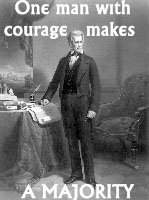
This is a succinct enunciation of the outlook of Mr. Codevilla's country class and that President is condemned by the Elite class for the outcomes of actions he started but succinctly said he did not wish to start in the first place and warned of the consequences of not using reason and accommodation to work out mutual problems. That is President Andrew Jackson and the quoted section, above, comes from his Bank Veto message of 1832 which was the last time a massive part of the federal government's work to 'guide' the economy was rejected and dismantled. That lasted for 80 years until President Wilson signed the Federal Reserve into being. As for the Elitist imputation that Andrew Jackson was a genocidal racist, they cannot square his actions of adopting a native child as his son nor his words and deeds to ensure that we had good relations with Indian tribes that did work with us and went so far as to castigate Congress for letting those accounts fall into disrepair. Racial genocide cannot be squared with those words, deeds and the meanings behind them, and yet to divide the people from those outlooks and actions (good and bad) they misrepresent the bad, hype it up to a high degree and then seek to say that is the sum total of the man. If that were the case he would not have taken the actions he did, give the warnings he did, attempt to avert the problems as best he could and then, only in failure, still try to find a good end to what was a very bad situation in which lives were being lost.
No matter how vilified the man is, his outlooks, rooted in the basics of human individualism as the source of strength for society and prosperity, continue to this day. Mr. Codevilla is not the first to highlight these people, and another writer took up that task nearly a decade ago:
The new Jacksonianism is no longer rural and exclusively nativist. Frontier Jacksonianism may have taken the homesteading farmer and the log cabin as its emblems, but today’s Crabgrass Jacksonianism sees the homeowner on his modest suburban lawn as the hero of the American story. The Crabgrass Jacksonian may wear green on St. Patrick’s Day; he or she might go to a Catholic Church and never listen to country music (though, increasingly, he or she probably does); but the Crabgrass Jacksonian doesn’t just believe, she knows that she is as good an American as anybody else, that she is entitled to her rights from Church and State, that she pulls her own weight and expects others to do the same. That homeowner will be heard from: Ronald Reagan owed much of his popularity and success to his ability to connect with Jacksonian values. Ross Perot and Pat Buchanan in different ways have managed to tap into the power of the populist energy that Old Hickory rode into the White House. In both domestic and foreign policy, the twenty-first century will be profoundly influenced by the values and concerns of Jacksonian America.
[..]
Jacksonian America’s love affair with weapons is, of course, the despair of the rest of the country. Jacksonian culture values firearms, and the freedom to own and use them. The right to bear arms is a mark of civic and social equality, and knowing how to care for firearms is an important part of life. Jacksonians are armed for defense: of the home and person against robbers; against usurpations of the federal government; and of the United States against its enemies. In one war after another, Jacksonians have flocked to the colors. Independent and difficult to discipline, they have nevertheless demonstrated magnificent fighting qualities in every corner of the world. Jacksonian America views military service as a sacred duty. When Hamiltonians, Wilsonians and Jeffersonians dodged the draft in Vietnam or purchased exemptions and substitutes in earlier wars, Jacksonians soldiered on, if sometimes bitterly and resentfully. An honorable person is ready to kill or to die for family and flag.
[..]
The underlying cultural unity between African Americans and Anglo-Jacksonian America shaped the course and ensured the success of the modern civil rights movement. Martin Luther King and his followers exhibited exemplary personal courage, their rhetoric was deeply rooted in Protestant Christianity, and the rights they asked for were precisely those that Jacksonian America values most for itself. Further, they scrupulously avoided the violent tactics that would have triggered an unstoppable Jacksonian response.
Although cultures change slowly and many individuals lag behind, the bulk of American Jacksonian opinion has increasingly moved to recognize the right of code-honoring members of minority groups to receive the rights and protections due to members of the folk community. This new and, one hopes, growing feeling of respect and tolerance emphatically does not extend to those, minorities or not, who are not seen as code-honoring Americans. Those who violate or reject the code—criminals, irresponsible parents, drug addicts—have not benefited from the softening of the Jacksonian color line.
[..]
Jacksonians are instinctively democratic and populist. Hamiltonians mistrust democracy; Wilsonians don’t approve of the political rough and tumble. And while Jeffersonians support democracy in principle, they remain concerned that tyrannical majorities can overrule minority rights. Jacksonians believe that the political and moral instincts of the American people are sound and can be trusted, and that the simpler and more direct the process of government is, the better will be the results. In general, while the other schools welcome the representative character of our democracy, Jacksonians tend to see representative rather than direct institutions as necessary evils, and to believe that governments breed corruption and inefficiency the way picnics breed ants. Every administration will be corrupt; every Congress and legislature will be, to some extent, the plaything of lobbyists. Career politicians are inherently untrustworthy; if it spends its life buzzing around the outhouse, it’s probably a fly. Jacksonians see corruption as human nature and, within certain ill-defined boundaries of reason and moderation, an inevitable by-product of government.
From Walter Russell Mead's The Jacksonian Tradition, put out in the fall 1999/2000 issue of the National Interest (archived here by Steven Den Beste).
From Mr. Codevilla's outlook of 'what if the country class took power in Congress and most Statehouses?' he clearly puts forward that the top-down methodology of the current ruling Elite class cannot serve as it is inherently Statist, not individual oriented:
Achieving the country class's inherently revolutionary objectives in a manner consistent with the Constitution and with its own diversity would require the Country Party to use legislation primarily as a tool to remove obstacles, to instruct, to reintroduce into American life ways and habits that had been cast aside. Passing national legislation is easier than getting people to take up the responsibilities of citizens, fathers, and entrepreneurs.
Reducing the taxes that most Americans resent requires eliminating the network of subsidies to millions of other Americans that these taxes finance, and eliminating the jobs of government employees who administer them. Eliminating that network is practical, if at all, if done simultaneously, both because subsidies are morally wrong and economically counterproductive, and because the country cannot afford the practice in general. The electorate is likely to cut off millions of government clients, high and low, only if its choice is between no economic privilege for anyone and ratifying government's role as the arbiter of all our fortunes. The same goes for government grants to and contracts with so-called nonprofit institutions or non-governmental organizations. The case against all arrangements by which the government favors some groups of citizens is easier to make than that against any such arrangement. Without too much fuss, a few obviously burdensome bureaucracies, like the Department of Education, can be eliminated, while money can be cut off to partisan enterprises such as the National Endowments and public broadcasting. That sort of thing is as necessary to the American body politic as a weight reduction program is essential to restoring the health of any human body degraded by obesity and lack of exercise. Yet shedding fat is the easy part. Restoring atrophied muscles is harder. Reenabling the body to do elementary tasks takes yet more concentration.
The grandparents of today's Americans (132 million in 1940) had opportunities to serve on 117,000 school boards. To exercise responsibilities comparable to their grandparents', today's 310 million Americans would have radically to decentralize the mere 15,000 districts into which public school children are now concentrated. They would have to take responsibility for curriculum and administration away from credentialed experts, and they would have to explain why they know better. This would involve a level of political articulation of the body politic far beyond voting in elections every two years.
If self-governance means anything, it means that those who exercise government power must depend on elections. The shorter the electoral leash, the likelier an official to have his chain yanked by voters, the more truly republican the government is. Yet to subject the modern administrative state's agencies to electoral control would require ordinary citizens to take an interest in any number of technical matters. Law can require environmental regulators or insurance commissioners, or judges or auditors to be elected. But only citizens' discernment and vigilance could make these officials good. Only citizens' understanding of and commitment to law can possibly reverse the patent disregard for the Constitution and statutes that has permeated American life. Unfortunately, it is easier for anyone who dislikes a court's or an official's unlawful act to counter it with another unlawful one than to draw all parties back to the foundation of truth.
The cutting of the size of government can be done either piecemeal, as Mr. Codevilla suggests, or via the concept of a 'Grand Bargain' like much of what the Progressives propose again and again. A reduction in government 'Grand Bargain' attacks the root of the government's intervention in the lives of Americans and would address not just the wastrel spending at Education, Energy, Agriculture, the various 'arts', and so on, but would introduce the dismantling of the government welfare state in a way amenable to any American.
That can be done by, firstly, letting those know who currently draw on Social Security that they can continue to do so. Second that those who paid into the system can then utilize their 'invested' funds to cut their own taxes. Third FICA goes away as SSA becomes a direct funding for those left in it, and no new individuals will be let into it. Fourth Medicare/Medicaid are added up, divided by two, apportioned to the States by population and phased out over 5 years. SSA, Medicare and Medicaid now eat up all income of the federal government and all else, including interest on the National Debt is paid off in loans. To working Americans this offers a double tax-cut that will last for some years as withholding from earnings plummets by 15-20%, which puts more money into the pockets of ordinary Americans, and by using SSA funds 'paid into' the system many people can live essentially tax free for some years.
That requires a 'cut to the bone' government which has already, at that point, agreed to remove the bulk of HHS and all of many Departments and Agencies.
The final piece, and really should be done, is to remove the 1911 Public Law setting the size of the House at 435 seats. That is anti-representative in the extreme and needs to end. For Americans to be represented in our diversity we need deep and diverse representation. A Maximum House of 10,000 or may be unachievable (though very Constitutional) and the concept is that the problem of corruption is not the amount of money seeking to corrupt, but too few and easily corruptible. If the Representative position is turned into a job with no real forward motion from it to higher office, then turn-over will be often for those seats as even minor demographic change impacts representation between each census. That can be done by a majority in both Houses and either a Presidential signature or a veto over-ride.
The 'Grand Bargain' is that Americans, in a time of economic trouble, look to each other and to get the government out of doing ill to all of us, first, and then reducing the size, scope, power and cost of inefficient and incompetent government and making sure that each American is on a level playing field unfettered by heinous taxation. The concept of being on a road to fiscal rectitude by paying down our debt with a goal of paying it off rang true after the Revolution as President Jackson made sure that he was the first President of a debt-free Nation. That didn't last past his administration. Now with the de-bunking of Keynesian economics and the bad examples set in Europe, the US can see its National budget like its household one and know that being in debt and facing bankruptcy is not at all good. That can be made to stick as it is compelling and offers a ready exemplar of how you manage your own fiscal house.
It starts with pulling out the underpinnings for the massive federal government and its intervention into our economy (via the Federal Reserve, Fannie, Freddie, Ginnie and Sallie) plus ending the insane proposition of the ponzi scheme of SSA and the demographic black hole of federally subsidized health care. It ends with increased representation, smaller government and much, much lower taxation aimed at setting us free of debt.
That cannot be done in one session of Congress.
Yet it must be done to retain liberty and freedom for all Americans rich and poor alike.





 Supporting Friends and Allies