Showing posts with label Incumbistan. Show all posts

24 September 2008

US lending doesn't follow the Nordic crisis

I have Nordic background, being half-Swede. Luckily I am also half-Polish so there is more than a large dose of common sense about affairs that also help me out culturally. In the aftermath of the Nordic Banking crisis of the 1990's, the Director Monetary and Exchange Affairs Department, Stefan Ingves at the IMF had a perspective speech that he gave in 2002, and while many are pointing to the similarities in what the US should do, lets see if there is basis for that in the original problem. I will paraphrase heavily, but hope to retain the gist of his overview. In that overview he gives the following as causes for the Nordic Banking crisis:

  1. Bad banking - Not only poor lending practices but lack of internal oversight and a culture aimed at gaining market share. There were few incentives to make prudent loans for bank managers or lending officers and there was no accountability when they did hand out loans to those with high risk background.

  2. Inadequate market discipline - Lack of transparency in lending practices leading to financial institutions being unable to judge the health of banks. Weak legal institutional and legal frameworks to ensure good banking practices. "Expectations of depositor and creditor bailouts may overpower any policy to the contrary."

  3. Weak regulatory and supervisory frameworks - Concentrated lending, portfolio mismatches and inadequate loan valuation. This lead to an overstatement of profits and working capital, as well as leading to poor market valuation. A prime cause here is also a lack of managerial staff to properly process and analyze investments, with such staff being inadequate and/or poorly paid.

  4. Inadequate macro policies and adverse macroeconomic developments - This created lending booms, excessive capital inflows, changes in the tax code to incentivize this. This lead to real estate/equity price bubble markets, a slowdown of exports, failing profitability in real estate markets, rising deficits for those institutions, current pricing accountability for institutions and the markets they were in, lower investment, weakening of the public to sustain the growing debt, and sharp exchange rate changes. As noted not all of these *can* be regulated. And then premature liberalization of lending practice rules.

  5. Contagion - The weakness and decay in one bank spreading rapidly throughout the banking sector.

The US has seen some of this going on, of course, but it is telling that in the Nordic crisis, as in the US, there was a government involvement in all of these areas that led to those problems. There are some underlying causes in the Nordic countries in the 1990's that are specific to them, however, and without understanding those, the generic 'problems' area cannot be properly assessed. Some of these are marked dissimilarities and others are very close to the current US crisis, so paying attention to them means being able to weight those differences against our current problems.

Mr. Ingves looks at those as follows:

  1. Bad bank management - Banks run by small groups of individuals or families, who treat the bank as a 'personal piggy bank' for themselves. That makes both bank managers and the owners problematical in having oversight capability as it is highly biased to the personal interests of the owners. Some owners sought to conceal these problems via off-shore institutions owned by their banks, very much like how the BNL scandal of the early 1980's had separate accounts to give regulators one set of numbers and hide a complete 'bank within a bank'. State owned banks (those licensed or run by governments) had this from the directional side of those governments, with implicit and explicit instructions to run poor lending practices to the benefit of politicians. State run or regulated institutions often do not have the level of accountability or scrutiny applied to them that private institutions have. "The clean up cost is often very large measured as a percentage of GDP."

  2. Macroeconomic sustainability constraints - Larger, better capitalized nations fare better than smaller ones in banking problems. While the Asian and Nordic crises would shock their respective regions, the economies, though hard hit, would remain without collapsing. Smaller countries have to put their creditability of their nation behind such bad banking so as to not have a full collapse of their systems. Thus the Nordic Crisis was, for all its pain, mild in comparison to something like what happened in Argentina or Turkey. The Nordic countries were already used to 'micro-managing' and were able to utilize those skills to address the crisis well and quickly, as they had practice in things going wrong with larger institutions.

  3. Ability of political systems to make decisions in the public interest - That is in the interest of the public, not public officials. Politicians need to absorb the losses equally across the political spectrum when such a crisis happens, and not politicize it. Banking ownership and structures in many countries prevent this from happening, and government representatives are willing to take a 'do nothing' approach rather than act in the public interest. Supervisors often lack legal protection to allow them to help bring the problems to light and to identify the problem areas involved, thus making the ability to understand what is going on harder. Again, the Nordic countries have a good cultural system which helped here.

  4. Access to well-trained staff, with personal integrity - When the Nordic countries couldn't find good, local help, they hired from the outside from reputable organizations or individuals with skills necessary to address the problems. Again the cultural requirement for high degrees of personal honesty and integrity play heavily into this area for being able to manage the crisis.

  5. Size and economic importance of banking system - The banking crisis was small in comparison to overall GDP. Many Asian countries had banking systems with a size of over valuated assets equal to 200% of GDP. The very small size of the banking sector in comparison to productivity helped the Nordic countries out immensely and caused very little exposure to deeper losses and long term economic stagnation.

So the US does have some fundamental equivalencies, but also some very stark contrasts with the Nordic banking crisis.

First up is the very nature of the institutions involved. Unlike the Nordic countries, the US does not have banks treated like personal piggy banks by families and small groups. That was the S&L scandal of the 1980's. So that is put by the side as a major causative factor.

Second up is federal influence in lending practices. Here this is more than just a mild equivalence, but a strong one and the primary cause. Fannie Mae and Freddie Mac are explicitly backed federal organs with 'private ownership' which boils down to private investment with the actual lending institutions being led by political cronies appointed by Presidents without oversight. In the atmosphere of increased home ownership lending spurred on by Congress, and then pressured by Congress by seeking to ease monetary policy, these quasi-federal organs then lobbied Congress to remove more constraints on bad lending practices so they could do more of them. Today there are Congressmen who are *still* pushing for allowing borrowers to keep their homes, even though they cannot pay the rates they agreed to... rates pushed on the industry by Congress reducing the amount a borrower had to put down to get FHA mortgage backing.

Third is weakness in oversight. Here, again, it is mostly federally backed institutions with the exception of AIG that made imprudent decisions based on the expected continuation of bad lending practices pushed by Congress. The idea of a bailout in one sector with a bunch of bad loans now gets another sector, those backing auto loans, to seek the exact, same protection and expectation of a bailout for *their* poor lending practices that depended heavily on the flow of easy money for home loans to then allow consumers to live well outside their financial capability and add a new car to the mix.

Fourth is the cultural attitude of responsibility and honesty that saved the Nordic countries. It is wholly absent from the federal side, after having pushed *in* those with political agendas to Fannie and Freddie: these individuals have no want nor need to hold themselves accountable, to point out crony loans or to even worry about the fact that these are public funds they are backed by. Lobbying Congress for politically targeted loans for those who cannot afford them as a way to garner political support then gets Congressional pressure *not* to be honest and uphold accounting standards when reviewing these organizations by other Federal organs, like the Federal Reserve. This becomes a multi-party, multi-President problem going back decades to slowly remove honesty and accountability from the system, not add it in.

Fifth is the size of the economy and the effect of boom/busts in various sectors. Starting in 2000 a large bust cycle in technology stocks was rocking the Nation and that would further be rocked by the 9/11 attacks that would severely hit the real estate market in NYC and the global insurance underwriting market for all the claims that came in due to those private structures coming down. The vast size of the US economy in 2001 weathered that and even showed a small GDP *increase*. With a market bust and a massive terrorist attack that hit the financial center of the US and the world, the United States *still* managed to grow. Those two, combined, would lose more value to the economy in an infrastructure way than the Fannie and Freddie mess will do in a personal way, and yet it is the violins trotted out for those personal losses that seek to get public underwriting for them. After 9/11 some insurance institutions would go 'critical' and either be absorbed or given some help to restructure, but a massive investment into the private underwriting sector of the economy wasn't done and the entire US economy would benefit from having a realistic risk re-assessment take place after 9/11 to properly valuate property and commercial risk to terrorist attacks.

Sixth the ability of public institutions to make good decisions in the public interest. Those institutions are the CAUSE of this problem along with the Congressional system that put them in place and the lack of oversight on Presidential picks to the boards of these institutions. This is a huge problem as these public institutions have been run for long-term political advantage and not on a sound monetary basis, and the two are in direct conflict. While some regulation for upholding such things as accounting and reporting standards are necessary, the 'public good' has been in pressing those economically unable to sustain home ownership and other purchases with public backed loans to assume an unhealthy risk financially for themselves at public expense. It is now the smart thing to take the keys to that overvalued house and drop them on the banks desk and 'walk away' from your responsibilities and there has been no political repercussions because some of those self-same politicians are doing the exact, same thing. That 'public good' has eroded basic honesty and integrity in financial responsibility by individuals, not supported it, which is part of the cultural problem now made worse by direct public support to abuse lending institutions and the public backing of them.

Seventh is the regulatory framework. They are not 'weak' but are operating in a way contrary to sound fiscal policy based on individual accountability. They are 'strong' in their support of political goals. Public institutions that do not have the acumen to understand this nor are willing to hire onto their staffs those that DO are a major and main cause of this problem. Because politicians seek political goals, they hire those with political motivations and ideas which are not in direct concordance with sound fiscal and monetary ideas. If Congress gets the blame in backing such institutions, it is each and every Congresscritter who refuses to take wise counsel from those who are well versed in the non-political requirements of sound fiscal and monetary accountability that are to be held at fault for pushing such unsound regulatory, legal and cultural attitudes out the door. And private institution that follows that lead and disregards its OWN wise counsel deserves the pain it will get as they are aiding and abetting unsound practice in search of political goals.

For all the cursory similarities with the Nordic banking crisis, we cannot and should not follow any path set by them as they have a different underlying basis for culture and the resultant economy of the 1990's than the US does today, in 2008. Those pathways are not an option to the US for those reasons. Until the American people can elect individuals who will eschew monetary and fiscal policy in search of political ends, that will remain the case as long as those elected representatives are in the majority control of both houses of Congress. Individual accountability not only rests with those who asked for such loans, those who gave such loans, but also those who pushed this environment and culture out the door via enacting legislation over the last 70 years to get us to this point in time. We can and should let those institutions *fail* as the economic shock, while large to the public, will be small to the overall economy and will enforce basic practices of accountability for those who have unwisely sought to live beyond their means. No matter the size of the Nation or its economic vibrancy, that will come to a bad and crashing end if it continues, and if our elected representatives cannot understand that, then it is up to the wheels of the economy to do their job for them and to teach them some humility that good politics in push a bad economic ideal comes to bad ends. It is a tiny minority of loans that are exposed in this and the vast majority of US households will only be at risk of having slightly over-valued loans and lower real estate taxes due to that for a period of some years until the bad loans and bad lenders are cleared off the boards.

That requires Fannie and Freddie to bite the dust along with all of the political appointees in them.

Don't I have any sympathy for those who got such loans and their impact to the economy?

No. Get it done and over with so we can learn, as a public, that we are required to recognize the basics of personal responsibility to each other and *not* involve the Nation in ill-conceived ideas about what we are 'due' as citizens. Because we currently don't have the culture to get accountability back into politics. Otherwise the fiscally sane and solvent will be dishing up lots of hard earned cash to bail out those who are neither and who will never have any incentive to GET fiscally sane and solvent.

Otherwise you will slowly lose the population that is fiscally sane and solvent, and that will bring down the Nation in the long run.

And abrogate our responsibility to hand the Blessings of Liberty to our Posterity.

Accountability is part of that.

03 August 2008

Skidmarks where rhetoric meets the road

You may have heard about the 47 US Congressmen that refused to leave the House on 01 AUG 2008.  It was the teapotted tempest with rhetoric that sounds most impressive.  The topic was drilling for oil so that the US can find a path towards an energy future, instead of being mired in its present controlled by overseas oil groups and speculators beyond the realm of Congressional reach.  From the WSJ blog post by Patrick Yoest on this, the Democrats looked to crack down on speculators, but how they will go after foreign speculators is something they don't realize they cannot do:

“Republicans are too scared to go home to face their constituents after voting against bills to force Big Oil companies to use it or lose it, demand that the President free our oil from the government stockpile and crack down on speculators,” said Nadeam Elshami, a spokesman for House Speaker Nancy Pelosi of California.

Yes that 'government stockpile' is the strategic petroleum reserve that serves as an emergency stockpile of oil kept safe in underground storage areas that can allow the US Armed Forces to operate if we suddenly lose all access to foreign oil.  It is a defensive measure, not the government sitting on a vast reserve of oil for no reason at all.  And speculators are the people who try to figure out what the actual price of oil and other commodities will be, and then put their future bids on those prices.  They win if they are right in the direction and minimal amount of change, and wrong if they get the amount or direction wrong.  We have speculators in wheat, corn, pork bellies, oranges, cotton, soy beans, nickel, cadmium, zinc, lead, platinum, gold... yes the world is rife with them.  Imagine what a sudden run up in copper prices would do to the semi-conductor industry or, even worse, gallium used in the actual semi-conductors themselves.  Silica is damned cheap for the processing, and your beach and glass recycling center can gets you tons of it.  Something like uranium is a bit harder to come by, which is why sitting on the vast reserve that is untapped in VA is a bit strange.  Seventh largest deposit on the planet that is safer to mine than coal, and less toxic.  We once had uranium mining in the Grand Canyon and witness the desolate vastness of that region because of worries over it?

These other commodities have speculators, and if you forgot the gold run-up in the 1970's, you missed the dizzying bonanza of what people would pay based on speculation that soon crashed back almost to where it started.  That did start up a whole lot of gold miners, many organizations continuing operations to this day: industry was spurred on.  Cracking down on speculators who are not under your legal control, say those in London, Paris, Bahrain, India, China, Japan... these cretins Upon the Hill do realize that they can't do that without staging a major conflict to actually take these places over, right?

Right?

And where, exactly, were these INCUMBENTS when economic war was being waged against our domestic producers in the late 1990's run by speculators paid off by a tyrant to hurt US future oil production and bring more of the market under his control?  You remember those guys?  Hailing from the UK, France, Canada, Russia, Switzerland... Oil For Food?

Where in the hell was the worry about speculation on the LOW SIDE damaging this Nation?

Those that complain today about the US not even having the capacity to get deep sea drilling rigs in place forget that they are the cause of those same capabilities disappearing from our National capability via our private concerns.  You do remember the 1990's, right?  Blue dress with stain on it?  Rip-roaring economy due to the rise in tech stocks and the Internet Bubble, along with the Telecom Bubble?  Primed by low taxes in the 1980's, remember that?

A bunch of speculators?

Now for the words of those that were in the House on 01 AUG 2008, once the recess was called, this from the WSJ blog article above:

“How many of you remember the Boston Tea Party?” Republican Rep. John Shadegg of Arizona asked the raucous crowd. “This is the Boston Tea Party!”

Texas Republican Rep. John Culberson and Michigan Republican Rep. Pete Hoekstra sent play-by-play dispatches about the pep rally via Twitter, an online messaging service. Indiana Republican Rep. Mike Pence, a former radio talk show host, called in to one of his brethren, Rush Limbaugh, to apprise nationwide listeners of the details. Another Texas Republican Rep. Kevin Brady came to the House floor with suitcase in hand, saying that he’d walked out of his scheduled flight home to join the rally.

A veritable Boston Tea Party?  'No Taxation Without Representation'?  I could get behind that sort of thing, actually, but I have seen far too much go on Upon the Hill to put my money down at the start of anything there.  From the CQ Politics site, an article by Edward Epstein who covered this:

“Madame Speaker, Where art thou?’’ Ted Poe , R-Texas, shouted from the well of the House. “This room is vacant of most members of Congress. Where, oh where, has Congress gone?” he yelled to about a dozen other Republicans, tourists in the gallery, some House pages, and Dennis J. Kucinich of Ohio, the lone Democrat who witnessed the unusual proceeding.

This from John Gizzi at Human Events on what was going on there [bolding is mine here]:

The same lawmakers said they agreed with Pence that the President should call Congress back from its five-week respite to deal with the energy crisis. Rep. Wally Herger (R.-CA) told me outside the House floor that “We’re doing everything we can” to get President Bush to bring Congress back. As to the White House’s attitude on making this rare-but-constitutional step, Herger said, “I’d say that right now, it’s rising on his [Bush’s] agenda.”

Rep. Don Manzullo (R.Ill.) told me he would be willing to come back even though his August schedule is “packed.. . .I even have a trip to Alaska to see ANWR.”

Rep. John Carter (R.Tex.) said that the message of the angry lawmakers who kept speaking and refusing to adjourn was “the spontaneity—we all showed up on the floor [and said] ‘Give us our country back.’”

Perhaps the happiest lawmaker I spoke to today was Rep. Thad McCotter (R.-Mich.), who has long urged Republican to capture traditional conservative theory and unite with strong tactics based on issues. Using the language of the rock ‘n’roll guitarist that he sometimes is, McCotter described the day’s remarkable events as “Republican riff on Yippie Street Theater on Pelosi.”

What?  The Republicans stand for traditional conservative theory?

Since when?

I haven't seen much of that since the military was gutted in the 1990's, the government grew quite large, requiring tax cuts so that people had some money to invest, thus increasing the size of government in the 2000's, realizing that this standing up to tyrants business is not a low cost affair, wishing they hadn't gutted the military in the 1990's, bemoaning the base corruption of earmarks which they have been happily signing off upon for decades, and generally acting like a 'Democratic Lite' party, with much talk on taxes and not much action on doing any other damned thing except restricting the rights of Americans on the internet, in areas of political speech, acting like they have some say in areas wholly given to the States and the people, and generally taking high moral stances that their own members can't live up to.

Conservative Republicans?  Those who actually KEEP TO THEIR WORD?

You know, a basic conservative value of doing what you say you will do?

From Politico's Patrick O'Connor on the happenings:

Republicans shouted their remarks from the well of the House until Arizona Rep. John B. Shadegg fumbled with the public address system and finally found the correct access code allowing him to turn on the microphone.

When he did, members cheered.

In fact, members did a lot of cheering Friday.

They cheered when the lights came on. They cheered when the lights went off again. They even cheered when the crowd in the galleries applauded their remarks.

In between, they shouted, “Work! Work! Work!”

Hey! Cheering to get things working!  I mean, 'work' is a conservative value, right?  But maybe they are a bit at sea on this 'working' business.  Perhaps they don't have time to ponder their work on 4 day weekends and 5 week recesses.  Under the Republicans it was only 3 day weekends and 4 week recesses.  Such 'conservative values' this working business.  Why don't they just be 'progressive' and pare that down to a 1 day work week and a 51 week recess?

Mr. O'Connor then sums up the proceedings of what happened at the press conference:

During the press conference, at least three members announced their intent to stay in Washington — if not on the floor — until Pelosi brought lawmakers back from break to vote on an energy package. Pence even asked President Bush to command Congress to return to session.

But minutes later, this band of partisan pranksters went back to the floor, where Price told the crowd that the Republicans were wrapping up their protest to end an afternoon of rarities in the Capitol.

He and his band high-fived and exchanged hugs as they left the floor to chants of “USA! USA! USA!”

So three members staying in DC... I wish them luck, even with a powerless, silenced House.

If any of these people had those 'conservative values' and stuck to them for the last 20 years or so, they wouldn't have to stage a prank like this, now.  The members of the Boston Tea Party knew their lives were on the line and couldn't count on any outcome, save that they would make their actions known and why they were taken.  Even if they wound up six feet under or in Davy Jones' Locker.  Those men put their lives on the line to start a principled attack on a Nation that no longer respected them as citizens and deprived them of their rightful say in government.

'No Taxation Without Representation'

If they don't like Pelosi's Politboro, perhaps it is time they told their party they will do what is right with or without their party.  Because this Politboro has gotten a lot of help from their fellow members in their party who like 3 day work weeks and 5 week paid vacations.  To do *that* requires guts, dedication and much, much more work than has been done by lackluster members of the Emirate of Incumbistan, lo these many years stretching into decades.

The job is voluntary, no one pushed them to their seats.

It requires much from those that want these positions.

Long hours.

Long days.

Little if any vacation time.

Families missed.

The Nation put first.

Speaking your values.

Commitment to your values.

And working to bring those values to fruition.

Hard work.

Work.

Work.

Work.

22 May 2008

Bipartisanship the opposite of good government

Consider a bit of what Congress is trying to get through when you hear about the splendidness of 'bipartisanship' and how it is such a good thing for America. Really, those folks wanting 'across the aisle' agreement should be very wary of what they are asking for. Lets take a look at what Senators Richard Shelby (R-AL) and Christopher Dodd (D-CT) are cooking up there, Upon the Hill (Source: National Low Income Housing Coalition) (h/t: W.C. Varones at Polipundit):

WASHINGTON, DC - Responding to pressure from Ranking Member Senator Richard Shelby (R-AL), the Senate Banking, Housing, and Urban Affairs Committee appears to be on the verge of diverting funds designated for a housing trust fund for housing for the poorest Americans to pay for Committee Chairman Christopher Dodd’s (D-CT) new program to refinance homeowners facing foreclosure.

In his bill “The Federal Housing Finance Regulatory Reform Act of 2008,” Chairman Dodd proposes to allow the Federal Housing Administration to insure refinanced mortgages of homeowners who face foreclosure. The Congressional Budget Office estimates this new program creates a potential liability for the federal government of $1.7 billion.

Reports are that Senator Shelby will only agree to the new FHA program if it is paid for by non-taxpayer funds. Senator Dodd’s bill also creates a housing trust fund with resources from Fannie Mae and Freddie Mac to build or preserve rental housing for extremely low and very low income people. Senator Shelby wants those funds to be used to pay for the new FHA program instead.

All well and good, then, right? I mean if you are 'facing a foreclosure' because you made a bad deal on your mortgage, the federal government needs to bail you out. Right? We certainly need another part of government just to 'oversee' those unwise enough to take mortgages beyond their means, right? And if the poor have to be put at risk as they have little to spend on housing, why that is just fine and dandy! Yes, make sure the poor don't have the ability to *rent* while those who *bought* a home under dodgy finances get away scot-free. Good job! Steal from the poor and give to the rich...

Dick Armey and Steve Forbes would like you to give a jingle on this at angryrenter.com and you, as a non-renter, can also support them against the anti-Robin Hoods in the Emirate of Incumbistan.

Then there is the category of 'we want to pander the public's money so fast we forgot to do our work' end of it, as seen by Michelle Malkin looking at the over-riding of the Bush veto on the Agriculture bill. And stealing from her linked article to the AP on this, there is a feeling of da-daist unreality:

The House overwhelmingly rejected President Bush’s veto Wednesday of a $290 billion farm bill, but what should have been a stinging defeat for the president became an embarrassment for Democrats.

Only hours before the House’s 316-108 vote, Bush had vetoed the five-year measure, saying it was too expensive and gave too much money to wealthy farmers when farm incomes are high. The Senate then was expected to follow suit quickly.

Action stalled, however, after the discovery that Congress had omitted a 34-page section of the bill when lawmakers sent the massive measure to the White House.

Yes, the bipartisan pig trough made it to the President's desk, he vetoed it. Congress, intent on getting the pig trough filled, was set to pay farmers already getting very wealthy off of high food prices even more so that they could be wealthier. Plus extra incentives NOT to plant crops! But, the little, eensy-teensy problem is: they didn't send the entire bill to be signed! Missing 34 pages, Congress now is in the position of trying to pass an incomplete bill...

So the anti-Robin Hood bipartisan coalition shows up and in their hurry to get the taxpayers money to wealthy farm supporters they just forgot a part of the bill. The White House then kindly pointed out that Congress was going to be back at square one and this is how Speaker of the House Nancy Pelosi's (D-CA) office responds:

A spokesman for House Speaker Nancy Pelosi, D-Calif., shot back.

“Partisan sniping won’t solve this clerical error that even the White House failed to catch,” said Drew Hammill.

Clerical error? The White House is not in the business of catching 'clerical error's in bills sent to it by Congress. Nope, that is solely the job of Congress.

And people call Bush 'stupid'!

Now if anyone needs some help on oil prices and production capacity, lets step through some basics, so we can get to the latest bit of 'bipartisan' views on this. To help us out we can go back to 1999 and the testimony given to the US Senate Committee on Energy and Natural resources by Steve Layton, President and CEO of Equinox Oil Company, part of the Independent Petroleum Association of America:

Today’s hearing is intended to examine the current state of the petroleum industry. I must say at the outset that I have never seen the domestic petroleum industry facing a more complicated and potentially devastating set of problems than it now does. The industry has faced a low oil price crisis for the past year, but today’s problems are very different and far more threatening than the ones that began the problem.

A year ago, the price crisis was started by a combination of events – the collapse of Asian economies, a warmer than normal winter in the northern hemisphere, and ultimately a market share fight between Venezuela and Saudi Arabia. The events created a surplus of oil in the international market and prices fell. The production most at risk was marginal oil wells in the United States – wells that produce about 20 percent of America’s domestic production, an amount equivalent to our imports from Saudi Arabia. And, I might add the wells from which I make my living.

Now, we have experienced a year of low oil prices – historically low prices that threaten the very heart of U.S. oil production. Domestic oil production is divided into three general areas – the onshore lower 48 states, offshore, and Alaska. The onshore lower 48 states account for about 60 percent of total domestic oil production. The Energy Information Agency has released a recent report that over 60 percent of this onshore lower 48 production comes from independents, a percentage that has increased by ten percent over the past ten years. It reflects an irreversible trend. Major oil companies are leaving the onshore lower 48 states. Particularly since 1986 when the last price crisis occurred, major oil companies have turned their attention away from the onshore lower 48 states shutting in or selling off their production. They have concluded that these wells do not produce the volumes they need to meet the return on capital that they seek. Majors now operate in the United States primarily in the offshore and Alaska, but more and more they are seeking their new production overseas.

Remember, the year is 1999 under the Clinton Administration with Republicans in charge of the Senate. During a period of slack due to the 'Asian Tigers' going bust, plus a warm winter and a race to undermine each other by Venezuela and Saudi Arabia, gas was cheap, oil was cheap and no one was worrying about future supplies, except the Independents. And who was in the catbird's seat for oil prices? Here is a very interesting part and looks at who was undermining the US oil production capability via market manipulation:

In fact, we would submit that Iraq now controls world oil prices. We would submit that the current U.N. sanctions program has failed on two counts. First, it has failed in its primary mission to provide humanitarian aid to the Iraqi people. Second, it has handed Saddam Hussein the victory he lost in the Gulf War. He invaded Kuwait to control oil prices; now he does and he is penalizing his enemies.

How quickly people forget, no? Then he lays out exactly why the IPAA believes this:

First, world oil prices are essentially set by the last barrel sold. A year ago, Iraq exported about 700,000 barrels/day. In December 1998, it exported about 2.3 million barrels/day. By March it will have another 500,000 barrels/day of capacity on line. Iraq was the only OPEC country to boost its oil revenue in 1998. As other OPEC countries have reduced production to stabilize oil prices, Iraq has become the swing producer of world oil. The swing producer sets the price.

Second, Saddam’s objectives differ from other oil producers. He wanted higher oil prices when he invaded Kuwait – money he needed to build his military forces. Now, he can’t spend money to buy arms. But, he can – by keeping oil prices low – punish his enemies, first by reducing the income to Saudi Arabia, Kuwait, Iran, and others; second, by driving critical U.S. production to be shutdown and plugged forever.

Third, looking purely at demand and productive capacity, today’s surpluses should not drive prices to their historic depths. We estimate that worldwide production capacity currently exceeds demand by about 4 percent.

Now for those who haven't taken a look at oil wells: when you plug a well you can't 'unplug it' to start it back up again. The need for constant pressure and maintenance means that geophysics get to that hole pretty quickly and once its plugged you now have to drill a brand new hole if you want production again. Shutting down wells means that to re-open production requires new capital expenditure. The IPAA was hoping to get some way of keeping production going because of an artificially set low market back in the late 1990's. You didn't hear about that little tidbit recently, did you?

This economic warfare, aided and abetted by US environmental laws and prohibitions on production and drilling, would mean that once the artificially low market was gone, the US would be at a much lower production capacity and there would be economic hell to pay. For those in the 'no blood for oil' camp, this was 'oil profits for tyrants', which is not only no better, but a damned sight worse as it is aiding and abetting economic war under the thin veil of a cease fire. When the prices went low, many of the marginal companies suffered economic problems and the oil and gas industry underwent consolidation.

Then the US Senate Judiciary Committee, led by Sen. Arlen Specter (R-PA) was looking at this consolidation as it might lead to 'gouging' of consumers. The Cato Institute looked at this on 24 MAR 2006 which examined the cause of price fluctuations and two GAO reports that had been criticized:

Both studies are problematic. The GAO study has been criticized by the Federal Trade Commission for questionable methodological assumptions and practices. Oxedine and Ward concede that their study is incapable of distinguishing between mergers that create more efficient (albeit higher) prices and mergers that produce market power and correspondingly inefficient prices.

Regardless, even if the studies were methodologically flawless, the effect on consumers (I cent a gallon) is trivial. How then to explain the gibberish on display at the Senate hearing last week?

Only two conclusions are possible. First, the senators on the committee might be unfamiliar with the economic literature pertaining to oil markets and the insights it provides. But many experts have made similar arguments over the last 30years, and the congressional idiocy does not dissipate with time.

This suggests another conclusion: Committee members don't care about economic facts or logic. All they care about is scoring points with swing voters who have a deep-seated religious belief that price increases at the pump are always and forever manifestations of some corporate conspiracy. Pandering to the lowest common intellectual denominator is the name of the political game.

We're not sure which is worse.

Remember, now, this is Republicans complaining about high gasoline prices and not understanding the market. Now, as many of those exact, same Senators are still around as Elder Emirs in Incumbistan, they were also present at the ones on 21 MAY 2008 as seen by John Hinderaker at Powerline:

The last theme that was sounded repeatedly was Congress's responsibility for the fact that American companies have access to so little petroleum. Shell's John Hofmeister explained, eloquently:

While all oil-importing nations buy oil at global prices, some, notably India and China, subsidize the cost of oil products to their nation's consumers, feeding the demand for more oil despite record prices. They do this to speed economic growth and to ensure a competitive advantage relative to other nations.

Meanwhile, in the United States, access to our own oil and gas resources has been limited for the last 30 years, prohibiting companies such as Shell from exploring and developing resources for the benefit of the American people.

Senator Sessions, I agree, it is not a free market.

According to the Department of the Interior, 62 percent of all on-shore federal lands are off limits to oil and gas developments, with restrictions applying to 92 percent of all federal lands. We have an outer continental shelf moratorium on the Atlantic Ocean, an outer continental shelf moratorium on the Pacific Ocean, an outer continental shelf moratorium on the eastern Gulf of Mexico, congressional bans on on-shore oil and gas activities in specific areas of the Rockies and Alaska, and even a congressional ban on doing an analysis of the resource potential for oil and gas in the Atlantic, Pacific and eastern Gulf of Mexico.

The Argonne National Laboratory did a report in 2004 that identified 40 specific federal policy areas that halt, limit, delay or restrict natural gas projects. I urge you to review it. It is a long list. If I may, I offer it today if you would like to include it in the record.

When many of these policies were implemented, oil was selling in the single digits, not the triple digits we see now. The cumulative effect of these policies has been to discourage U.S. investment and send U.S. companies outside the United States to produce new supplies.

As a result, U.S. production has declined so much that nearly 60 percent of daily consumption comes from foreign sources.

The problem of access can be solved in this country by the same government that has prohibited it. Congress could have chosen to lift some or all of the current restrictions on exportation and production of oil and gas. Congress could provide national policy to reverse the persistent decline of domestically secure natural resource development.

Later in the hearing, Senator Orrin Hatch walked Hofmeister through the Democrats' latest efforts to block energy independence:

HATCH: I want to get into that. In other words, we're talking about Utah, Colorado and Wyoming. It's fair to say that they're not considered part of America's $22 billion of proven reserves.

HOFMEISTER: Not at all.

HATCH: No, but experts agree that there's between 800 billion to almost 2 trillion barrels of oil that could be recoverable there, and that's good oil, isn't it?

HOFMEISTER: That's correct.

HATCH: It could be recovered at somewhere between $30 and $40 a barrel?

HOFMEISTER: I think those costs are probably a bit dated now, based upon what we've seen in the inflation...

HATCH: Well, somewhere in that area.

HOFMEISTER: I don't know what the exact cost would be, but, you know, if there is more supply, I think inflation in the oil industry would be cracked. And we are facing severe inflation because of the limited amount of supply against the demand.

HATCH: I guess what I'm saying, though, is that if we started to develop the oil shale in those three states we could do it within this framework of over $100 a barrel and make a profit.

HOFMEISTER: I believe we could.

HATCH: And we could help our country alleviate its oil pressures.

HOFMEISTER: Yes.

HATCH: But they're stopping us from doing that right here, as we sit here. We just had a hearing last week where Democrats had stopped the ability to do that, in at least Colorado.

HOFMEISTER: Well, as I said in my opening statement, I think the public policy constraints on the supply side in this country are a disservice to the American consumer.

The committee's Democrats attempted no response. They know that they are largely responsible for the current high price of gasoline, and they want the price to rise even further. Consequently, they have no intention of permitting the development of domestic oil and gas reserves that would both increase this country's energy independence and give consumers a break from constantly increasing energy costs.

This is not *just* the Democrats who have been negligent on the issue - this has been a bipartisan panderfest for nearly a decade of 'screw them when they are down' and 'bitch when they are up'. Yep, that's America, all right. That legislation didn't get passed *just* by Democrats and there is more than enough blame to go around on this. So if you want the Clowns in Congress to be held accountable: don't re-elect them.

Especially if they have been in there for a decade. There really is no excuse at that length of time *not* to know how things work.

15 April 2008

Winner take all, some, none? Or Abort, Retry, Fail?

Steven Den Beste took some time to give a quick look at the trainwreck of the Democratic Party in this post of 09 MAR 2008 at his Chizumatic site entitled Winner take none. There are two insights in the article worth noticing one procedural and one effects based. First the procedural:

Hence the irony: the Republican primary process has mostly consisted of state level winner-take-all contests, and as a result, the Republicans now have a clear winner. The Republican convention, once it happens, will be just as meaningless as party conventions have been every four years since about 1972.

The Democrats have mostly been using proportional delegate allocations. This is, supposedly, more fair, or so they believe.

The Democrats also have "super delegates". The Republicans don't.

And that's why this nominating process has been so much fun: The nominally-fascist-awful-elitist Republicans (if you listen to radical Democrats) have unambiguously selected a candidate via the primary process. But the most likely result of the Democratic primary/caucus process is that no candidate will have a majority going into the convention.

And now the effects based:

UPDATE: Myself, I happen to think that "winner take all" is a good thing, because it represents a high noise-rejection threshold. That means the system can tolerate a great deal of noise without breaking down.

I explained it in greater depth, via round-about means, in this post five years ago. The bottom line: winner-take-all systems can tolerate a much broader range of political speech. Proportional representation systems tend to be much more nervous and tend to implement content-based restrictions on political speech.

Looking at the system, as designed and with design intentions requires finding out what the purpose of the Democratic Primary system actually is. If it is set up with the sole end-purpose of getting a nominee, then it is, as Mr. Den Beste describes, a poorly created affair. To get an idea of why it was created this way, we can turn to one of the individuals responsible for the creation of the 'superdelegate' concept. In a WaPo column of 27 FEB 2008 we see Jim Hunt defending the superdelegate system:

In presidential election years, Americans see the face of a political party most clearly in the personality, views and character of its presidential candidates. But a national political party is about more than just the president. Its senators and House members pass the nation's laws and budgets. Its governors lead the states. All must work together for progress in America.

I chaired the 1982 Democratic Party Commission on Presidential Nominations that created certain automatic delegates to the Democratic convention -- the "superdelegates." It was a good idea then, and it is still a good idea. The superdelegates will be crucial to Democrats winning the presidency in November and governing successfully for the next four years.

In creating superdelegates, the Democratic Party recognized the expertise that its top holders of public office have gained by running for office themselves. They are experts at winning. They know the issues. They are in a unique position to evaluate presidential candidates. They have a well-honed instinct for how candidates will be received in their own states and districts. In short, they can help the Democratic Party pick a winner.

But the superdelegates' value extends beyond the convention. If they play a role in picking the nominee, they will be more likely to campaign actively for the nominee in the general election.

The first paragraph is that of defining what the system is supposed to do: it is an attempt to unify all elected positions from local to State to Federal under one coordinated affair. Note that this is given a tag of 'progress in America' or progressivism, in which the unified ability of the party would trump politics from national to local level, and shift the focus from the actual political process to that of the party, alone. In doing this, however, and attempting to broaden all races into nationally influenced affair, so that federal level elections influence all levels in trying to unify the Democratic Party.

What this does, however, is fly in the face of democracy which a party elder, Thomas P. ('Tip') O'Neill had stated: "All politics is local."

Indeed the lifeblood of democracy is not uniformity of message, but diversity of message being winnowed down to those few that can fall under the purview of politics. In trying to shift this view to the highest level of office and enforce party unity for that, the local messages either get diluted due to the funds and attention paid to the highest level, or the highest level of candidates all get tagged with purely local issues due to their supporters.

Moving on from there the stated intent is to pull in 'experience' from those 'experts' at winning. This is party rule by expert, in which those that have won elections, by the fact of their having won them, are granted expert status even if they run in unopposed elections or have run on topics that have little or no applicability to the entire party. Indeed the entire aim of the Democratic Party since 1968 has been to effectively shed the 'right wing' of the party, traditionally Jacksonians and National Security Conservatives, to craft a left of center party that does not get diversity of internal debate. The fall from power from 1968 onwards and the shift in electoral politics from the super-majority that had favored the Democratic Party for 40 years is an outgrowth of this thinking.

By shifting party allegiance levels to the highest levels, those few 'winning' topics get greater play than their actual representation for the population. What is even worse is that charismatic candidates who win not based on message but on 'star quality' get equal play in this system. By shutting out the 'losers', those who have lost close races based on political differences in elections, the Democratic Party is actively removing insight into how the entire electorate feels about topics. In these two ways the Democratic Party becomes further isolated on a few 'winning' topics and becomes unable to address larger topics because of fidelity to message not to fidelity to democratic process. From that the 'superdelegates' bring too narrow a focus for a national party: their expertise at 'winning' reduces vibrancy of message input into the party as a whole.

What this also does, however, is secures an incumbent position with additional security of funding from higher levels of the party. By pulling in elected officials who have *already won* previous elections, the Democratic Party starts to take a 'trench warfare' mentality that is not conducive to voter and topic outreach, but is conducive to guarding every incumbent. The effect of this is stagnation in party politics and politics at all levels as an entrenched party starts to fight any change based on demographic shifts and popular changes in outlook. What has been humorous is not the consistent entrenchment attitude towards the Republican Party, but to attempts within the Democratic Party to get it to shift in *any* direction, left or right. For every 'Blue Dog Democrat' who has barely won by trying to get to the rightmost part of the Left, there are far left organizers trying to pull the party towards the decreasing vote counts of the fringe. In shifting to a minority creating course on the left of center and then sticking to that and not changing message or faces for decades, the Democratic Party is now Establishment Left and becoming the target of those who do not like Establishment politics of any sort across the political spectrum. Being unable to cast off the siren song of socialism, communism, progressivism and far left nihilism, the Democratic Party has drifted away from the center of the US political spectrum to the point where these two points are not even residing in the same plane of politics.

That view of top-down adherence to message where the 'grass roots' must 'support' the party nominee, even if that nominee has views toxic to the local level are toxic to democracy. By centralizing monetary support and ability to direct contributors to 'supporters' who must adhere to the 'message' so as to remain an incumbent, the message emerges that all politics is NATIONAL not local. By giving the superdelegates such a weight in the final nomination process for the Presidency, no matter WHO runs at the top of the ticket the incumbents are ensured of having someone who will pay them off for support.

In this I think that Mr. Den Beste is right in his view if taken from the view of having a robust political dialog to screen out a noise based effect and get a broader view of public opinion. By putting in a secondary feed-back system via elected officials, those officials are given a disproportionate weight per vote. If each delegate represents, say, 2,000 individuals (and I am making that up as this varies by system type for delegates), giving individual super delegates a 1/3 say in the overall process weights their vote to be equivalent of that exact, same amount. One man, one vote... one superdelegate, 2,000 voter equivalents.

This is not noise, but bias in the system directed towards a given outcome. That outcome is adherence to party message across-the-board via a rewards system for incumbents. The point of the Democratic Party primary system is *not* to get a winning Presidential candidate but to get a fealty to message directed from the highest levels of the party downwards. That is the intentional design effort in creating this system: to disenfranchise voters by giving 'The Establishment' a disproportionate say in the outcome if the plebeians can't come up with a candidate 'The Establishment' likes. It is a system set up, not to inculcate electability, but to thwart diversity of views and opinions by party members to shape the message of the party which is supposed to represent THEM.

Elitist, biased, partisan, narrow focused, and disregarding of democratic principles, that is the view of the system.

It's not a bug, its a feature in the current Emirate of Incumbistan.

13 February 2008

The Presidential race at the cusp

This election year, before the race is decided on the Democratic Party side, is shaping up to be a race continuing historic trends in the US electorate.  Consider the widely viewed CW on each of the candidates, not what the CW says about their chances to win, but their supporters.

Hillary Rodham Clinton (D) - Her base of support has been increasingly white. middle to lower class, and hispanic, thus drawing on the 'Identity Politics' that the Democrats have inflicted on the population.  Currently she is losing on that base and, with help of her husband, is creating more of her historical negatives which, at best, never reached beyond 47% Nationwide.  Her popularity as a campaigner has drifted that downwards towards 43% and, perhaps lower.

Barack Hussein Obama (D) - His base is characterized as black, young affluent whites, and college educated.  By pressing forward no program or policy, he remains a cipher, and each time he utters an idea that does have some basis in reality, like the need to attack Pakistan, his base shudders.  His fragile coalition depends on platitudes and having a greatly disliked opponent and saying *nothing* that will damage his nascent base.

Thus the Democratic side is breaking into distinct factions between race and class with the shares apportioned between them.  Minorities are over-represented in the Democratic Party and, thus, hold a higher sway there than in the electorate at large.  The class breakout has always tended towards poor to middle class with a very small 'intellectual elite', making up less than 1/3 of the entire party.  Hillary Clinton, then gets white middle class-poor (15%), hispanics (~18%) and a smattering of party apparatchiks beholden to the Clintons (~5-10%) for a rough total of 43% of the Democratic Base.  Flipping those numbers Obama gets the black vote (10-15%), upper class whites (25%) and a smattering of the 'new' party machine from Soros and other rich fundees who seek to replace the Clinton apparatchiks (~5-10%) for ~50%.  Thus the break-out and edge go to Obama in the race

John McCain (R) - While being the presumptive nominee, John McCain is facing problems within the Republican Party.  I looked at the Three Factions of the Republican Party and how the McCain nomination is splitting one faction (Social Cons or SoCons) down their amalgamation lines between Christian Right and Traditionalist Conservatives. 

John McCain's problems are coming from the Traditionalist Conservatives with more than a few Fiscal Conservatives (FiCons) joining in that demurral. 

Even among SecCons (Security Conservatives) there is some whispering between the NeoCons and more traditional faction that grew up around Ronald Reagan, seeing limited engagement as key to stressing US power by using it rarely.  While this is the smallest overall faction (say 15% of the whole) the breaking of the NeoCons and Traditionalist Hawks (those that remember a strong defense and use it sparingly) splits it into 10%/5%.  That last 5% remembers the 'peace dividend' and working against it, to keep the Armed Forces up to size and speed as we did not know *what* the post-Cold War world would look like.

FiCons, however, may applaud McCain's 'anti-earmark' views, but have great problem with the 'budget busting' programs he signed on to not only in the last 10 years, but going to his first years in office.  Nor has John McCain carried through with those FiCon views of restricting spending.  Increasing the size of government is seen as a negative when not coupled by methodology to slow government growth: either by direct cuts to government or creating a fiscal atmosphere where the economny outgrows the government.  John McCain's record is breaking the FiCons (perhaps as much as 45%) into a 35% support base that will follow any Liberal views so long as it can get economic growth higher and 10% that have seen only continued growth in the budget and John McCain offering no leadership from the Senate on actually cutting things other than DoD.

Amongst the Christian Right, John McCain is also seeing some problems crop up as his ability to work with Liberals seeking to try and regulate morality is not only not a *plus* but a negative.  Thus out of the remaining 40%, this group has about half of that (20%), which has been represented by the Big Government views of Mike Huckabee.  He has been fighting it out for McCain's FiCons and trying to get any Traditionalist support that he could.  Here that worrying problem of working with Kennedy, Feingold and Lieberman, will damage some chances for McCain.  That could be as bad as 10%/10% on the pro/anti view.

Traditionalist Conservatism is the largest problem for John McCain as the views held there of small and restricted government, low taxation to remove burden from individuals (not necessarily businesses which is a FiCon view) and the expansion of government regulation with John McCain helping that, brings this group into stark relief.  Mitt Romney using a FiCon form of Traditionalism gathered this 20% to him and found his outreach to Traditionalist Hawks gaining some ground which made the FiCons a three-way draw with those that have no SoCon views. 

Thus there is a solid 45-55% backing of McCain from the Rockefeller Conservatives, NeoCons and some Christian SoCons.

The solid party backing that can be expeted, per candidate (looking at either of the Democrats winning their nomination):

Hillary Rodham Clinton (D) - 45%

Barack Obama (D) - 55%

John McCain (R) - 45%

That leaves the Independents - those that are voting, that is, and more on that in a bit.  Here each party has garnered 10-20% support base over the years and the final 10-30% coming in as 'tie breakers'.  This section of the population has enjoyed 'split government' and since the 1980's and tends to vote in a way to break up single party alignment of the Executive and Legislative branches.  If the 2006 Legislative elections are any key, here, they point to a continued division by electing a Republican for President.  If that is not predictive, however, a Democrat, even with so many Republicans retiring this year, faces a social conservative backlash in their own party, as seen by the 2006 Freshman class.  Winning a majority has not only not *helped* the Democratic Party, but has actually hurt it through incompetent leadership in the House and Senate.

The final key to looking at the electorate is throwing away the idea of a '50/50' Nation.  Historical trends, as I have examined, point to another concept entirely - that of a 30/30/30/10 Nation or even a 30/30/40 Nation with the first two 30% being the two parties.

The above taken from US Census datasets.

These trends start with the entry of the 1946 'baby boom' nearing voting age (prior to the Amendment moving it down to 18) and there was already a downward trend in voting participation in the US prior to that.  The post-1968 Democratic Convention is most telling as a political turning point in voter participation in Presidential Election cycles and in their confluence during the Watergate years. Both of these graphs demonstrate the concept of 'regression towards the mean' where a mean, average slope is held across temporary ups and downs in the actual data points.

For that mean slope to be held to, the expected participation rate of the 2008 Presidential year is not one that will outdo either of the past few elections and possibly exceeding the downward trend seen in 1996.  By putting the two parties at 30% each of the population overall (including leaning independents) there is substance and backing to the concept that a minimum of 40% will not show up this year and may, actually get to 50%.

This is an artifact of the two party system which endeavors to have victors turn-off so many of those that do not *win* and make them non-voters.  That did not work well past 1968, however, as the solid Democratic post-War majority fizzled out in the early 1980's as more voters walked from the Democrats than the Republicans.  While one could still 'win elections' it was only amongst those committed to participate and that commitment has been the target for almost 40 years.

For the Democratic candidates, then, there is a serious move to shift emphasis away from white blue collar to middle class voters and hispanic voters to black poor and middle class voters and white elite upper class voters.  Even as much as a 20% drop in the 'losing' side means a 2-5% drop in the turnout of the electorate coupled with some slight drop amongst the hardcore independents that sometimes lean Democratic.  That, alone, will move the next Election to 56-53% turnout.

On the Republican side, the Party that promised so much to its Conservatives is in the hard bind of having had control of Congress for over a decade and simultaneous control of the Executive for 8 of those years and accomplishing *none* of the goals it had set out to do in 1994 and, before that, with Ronald Reagan in the 1980 election.  Welfare reform was only garnered by waging a public campaign to restrict it and demonstrate valid reason for it that appealed to a broad spectrum of Americans... and it was accomplished with a Democratic President.  Since then the Party has broken its agreement to work for those things it set out to do, leaving it, now, with much of its pre-Reagan base of a 45-55% John McCain.

These Traditionalist Republicans, ranging across from the Social through the Fiscal and Security side will see the Democratic Party as an anathema, and John McCain no better than, say, Sam Nunn.  Unfairly to some degree and most will hold their noses and vote for McCain, but many will *not*.  Even a 2% walkout along with similar affiliated hardcore (unleaning) independents will lower the election turnout to 56% and possibly lower if John McCain cannot explain his past work on 'budget busting' appropriations, helping to over-ride Reagan's vetoes, his actual views of the structure of DoD and his work to remove personal liberty via Campaign Finance Reform.  Many Conservatives will be paying attention to this as the 'Straight Talk Express' has not talked in any way 'Straight' about the Moderate to Liberal views of their candidate.

Together the two parties, then, are looking to drop voter participation by a  minimum of 4% and up to 10% depending on the campaign on each side.   This then puts the election within the traditional mean range of 48-54%.  As there is no feeling of a 'landslide' about to happen or an incredibly weak President going to be replaced by anything better (and in incumbency rate in Congress guaranteeing nothing will happen there of major import) that puts a close fought election victory in the 24%-27% range... slowly whittling down to those committed to party, personality and the ideologies the second bring to the first via elections.

How do you choose amongst politicians:  I look at their record, the historical context of that record, what they say about that record and if it jibes with the first parts, and when they have no record, they need to be put in the brine for a bit more seasoning at a lower level or have some demonstrated and absolutely compelling capability beyond that to take on Executive responsibilities.

They must...

Do as they Say.

Say what they Mean.

Mean what they Do.

Then I will look at ideologies... when those first three fail, then I am stuck with ideologies and the worrying view is that they won't carry through, won't mean it or apply themselves to it to get the job done.  And the days of running away *from* your record is over.  And that is what all three of these candidates wish to do... plus none can actually adhere to the basics of Doing, Saying and Meaning.  Of course we run those folks out, first, as they are dubbed 'unelectable' or have no 'fire in their belly' or just aren't 'good candidates'.  Which is why many of your Fellow Americans will not be voting this year.

Look at the numbers.

This is what we have bought with 'two party politics'.

07 February 2008

The two party trainwreck

I have noticed, of late, that the two party system of America is starting to find itself on the same track in a head-on collision. To most this is a very worrying spectacle as the Democratic Party factions, ethnic groups, big money backers and such, head down a road towards huge tax increases, socialized medicine and putting their nose into everyone's lives to tell you exactly how to live the *right way*. Well, far be it from me to complain if blacks are set against women and hispanics, if old are set against young, and those wanting free goodies will find themselves, soon, very soon, trying to explain to a bureaucrat why they need their daily medication and then finding they will not be given enough of it. And those who *don't* want the free goodies, but want to remove the borders will soon find those on the low end of the economic spectrum fighting them because their jobs have gone to low cost, illegal immigrants!

Just like the Republicans want to do!

The Republican Party has finally decided that it can do without concepts of small government and has decided to attack its own business factions with the security faction, which is aided by the Christian faction wanting big government largesse for everything social. Just like the Left! And since there is common accord to removing the borders, removing sovereignty and needing to expand the government endlessly, we will see the specter of wanting to prohibit gambling, booze and other societal no-no's just like was done in the early era when government found it could issue tax stamps for marijuana and then not PRINT ANY. Making just asking for the stamp for trade, and thus having possession of the actual substance, a CRIME. Lets do *that* to 'internet gambling' then 'sexually explicit sites' and then hand over all that need for enforcement to the thought police (which will be a bipartisan group of schizophrenics swinging between finding those wanting the soon to be outlawed cheeseburgers from the Left with the porn criminals outlawed on the Right).

In case the D and the R party fanatics have missed this, you are both asking for the EXACT SAME THINGS.

Your candidates for President are seeking to liquidate society in the name of government.

Is this a cause for worry, as the federal budget will swell by another trillion or two in the next four years? You betchya!

Are there any choices between the 'progressives' give human rights out without accountability Left and the give up sovereignty and Nation and look at those outlaws of Nations as mere criminals and give them sanctuary within the law? No, not a single dime's worth of difference.

If you push *Iraq* up, I will point out and have been saying for nearly two years, that the trendlines for that conflict have been going well and the US has performed the impossible of getting through a COIN 'half-life' faster than any other Nation in history, bar none save those regimes that just executed everyone it didn't like. If the US goes to hell in 2009-2010 because of the asinine things the two parties want *done* to the Nation, Iraq has a very good chance of surviving... even odds by the time the US election rolls around.

Do I want to see the Iraqis deserted? NO I DO NOT.

Will John McCain bring in hundreds of terrorists into the US judicial system so their lawyers get access to classified data for civil criminal trials or are *set free*? Yes, yes they will just like the D party. If you think Lynne Stewart with the Blind Sheikh was a problem, imagine tens if not hundreds of lawyers paid for by CAIR and other groups getting access to that kind of data. I would, in truth, dearly like the US to survive the next four years, but the two parties seem to have chosen airy and impossible ideals that are contrary to cold, hard facts on the ground. In doing that Sen. John McCain will go contrary to the one man in his party who matters: Abraham Lincoln and how he viewed the activity we call 'terrorism'. The concept of 'summary judgement as highway robbers or pirates' on the battlefield of those days had one meaning and one meaning only: execution. Today that would mean just put them in jail for LIFE. We are a hell of a lot more civilized than poor old Honest Abe, but can you find a Republican that will actually back one of their FOUNDERS?

Hell, no.

So much for 'conservative'.

It will be a very, very interesting trainwreck to watch, as both parties so confuse government and society that they think government *creates* society, not the other way around.

If you have had it up to here (gesturing somewhere above the forehead but below the ceiling) with government trying to do *good* instead of just enforce the laws, I have a grand suggestion that will also tie up the legal system no end: help to start a Class Action Lawsuit against Social Security demanding that individual citizens have complete access to their 'contributed' funds at any time. Point out any and all cases of disability where bureaucrats have over-ridden doctors, and also point out that government was not set up to provide for our retirement nor to MANDATE an age to retire at: that, too, is a civil liberty reserved for the People under Amendments IX and X. Yes, make it a Civil Rights suit at the EXACT, SAME TIME.

Together those two (and some minimal payment to lawyers like 0.1% of all Social Security funds 'held' by the government) will sop up every ambulance chaser, civil rights activists and throw the largest monkey wrench in the two party system as *both* use this to threaten and cajole older Americans to the point where threatening anything like *accountability* to the system will bring the two parties *together* and demonstrate that they are, now, one single party. Plus, as an upside, you just might get your hands back ON your money.

What? You say the money isn't there? That this isn't a 'trust fund' nor 'insurance' but a cash redistribution system.... just like some marvelous 'health insurance' concept would be?

Good.

So while the trainwreck is starting to rev up, it is time for all good patriots to make sure they are in a safe community, stock up on ammo and see about calling their lawyer. If these twits want to use the legal system for terrorists, then it should be very amenable to getting OUR MONEY BACK. And as the two parties of Incumbistan pull out sob stories, the other side, being the people, can bring out stories of payments refused, forgotten or over-ridden by bureaucrats.

And if the government goes insolvent because of that? Well, it will have to start prioritizing things, now wouldn't it? And see if it could find any lawyers left that are *not* tied up with the massive dual lawsuits. Remember, just *one* has to win to get your money back from the government... and those who *want* to stay with a government run system *can* and those who *don't* would not have to pay for it. For Liberty is YOU deciding what to do with YOUR money for health, well being, retirement, investing and savings.

Or squandering it on that home theater set-up you have been aching for.

That is the basis of Liberty: you decide and *live* with your decisions.

Government bailing out idiots who cannot figure out an 'adjustable rate home mortgage' deserve exactly what is coming to them. Ditto on 'economic stimulus'. You want 'stimulus'? Then let folks get their money back from Social Security and do as they please with it and end the automatic 'deduction' from payroll.

At the very least break out the popcorn and watch as both parties justify bigger government, more intrusive government, higher taxes, more bureaucrats that you will have to answer to and see just how many terror attacks we will get once the treasure mine of data is handed over to terrorist supporting lawyers.

Worried about Iraq? Yes.

Damned worried about the US? Oh, yes, very much so.

Iraq just might make it through without us... they may *have to* at this point no matter *who wins the Presidency*.

Safe community for yourself and loved ones, security for same, lawyers and popcorn.

Because I remember the last time this happened and what happened after that:

Some writers have so confounded society with government,
as to leave little or no distinction between them
;
whereas they are not only different, but have different origins.
Society is produced by our wants, and government by our wickedness;
the former promotes our POSITIVELY by uniting our affections,
the latter NEGATIVELY by restraining our vices. The one
encourages intercourse, the other creates distinctions.
The first a patron, the last a punisher.

Do you?

21 January 2008

Left in the desert of his own creation

As so many like to point to Sen. John McCain's American Conservative Union ratings, I decided to take a look at them!  It gives a good idea of what they see as important and how members of Congress voted on those items.

Thus starting in Mr. McCain's House time, and votes contrary to what the ACU supported are listed (Year - ACU percent - comments), all ratings from the ACU Ratings site and I am doing my best to de-conflict the votes for on a proposal against and such [note that non-votes are on ACU cited votes, not of all votes taken].  This list is representative of their views which are biased and I do disagree with a number of their takes and backing, but it is a fair view from a given biased perspective of how to grade Congresscritters:

1983 -  96 - Voted for a pork barrel spending bill that the ACU opposed.

1984 -  86 - Voted for a Public Health bill that the ACU describes as 'budget busting' and for the Civil Rights Act of 1984 which the ACU characterizes as 'absurdly expanding federal power'.

1985 - 81 -  Voted for a Clean Water Bill, for sanctions against South Africa, for textile import quotas, and for expanding the Superfund program.

1986 - 73 -  Voted against an amendment to freeze the Community Services Block Grant Program, against an amendment to delete funds from the Legal Services Corp., for minority set-asides in DoD contracting, voted to over-ride President Reagan's veto of the South African Sanctions bill, and voted to adopt more money for the Superfund program.

Now on to his time in the Senate:

1987 - 91 -  Voted to over-ride President Reagan's veto of the Clean Water Act re-authorization which the ACU describes as 'budget busting' and voted to continue the support of the Legal Services Corp. which was 'controversial' in its outlook and services.  Did not vote on: a $1.06 billion bill that federalizes 'the homeless' by creating new government bureaucracy, the Line-Item Veto, and Congressional salary increases.

1988 - 80 -  Voted to over-ride President Reagan's veto of a bill to extend coverage of civil rights laws (Grove City) so that if one part of an institution receives federal funds all parts are subject to those controls, voted to ratify the Intermediate-range Nuclear Forces Treaty (which the ACU opposed), voted for a 60-day plant closing bill to warn workers if their plant is closing no matter what the circumstances are, voted to reject the amendment to decrease funding to the LSC.

1989 - 91 - Voted for the Americans with Disabilities act (which ACU opposed), voted for a motion to table an amendment calling for the ouster of Manuel Noriega.

1990 - 87 - Voted for a bill to overhaul the Hatch Act to bar federal employees from engaging in political activities (ACU opposed the bill), voted for an HHS bill $11.5 billion larger than the President requested, voted for the Clean Air Act which increased federal regulation capability on manufacturing, energy, and increased the cost of those things to consumers.

1991 - 86 - Voted against aid to help promote free market policies in Latin American countries, voted to continue funding of LSC that helps fund 'special interest litigation', voted for a Quota Bill to reverse a SCOTUS decision and put the burden of proof on businesses to demonstrate that they had met quotas for hiring.

1992 - 85 - Voted for a report supporting public money for campaigns, voted to support bilingual balloting for certain language minority populations, voted to over-ride President Bush's veto of the Parental Leave bill and a second bill to re-regulate the cable business which President Bush had vetoed.

1993 - 83 - Voted for the Family and Medical Leave Act, voted for the Campaign Finance bill to provide for public financing of congressional campaigns and put spending limits on races, voted against an amendment that would prohibit support of US troops put under UN command, voted for the Brady Bill.  Failed to vote in the confirmation of lesbian activist Roberta Achtenberg to Assistant Secretary of HUD.

1994 - 96 -  Voted to invoke cloture on a campaign finance bill to provide public funding for congressional campaigns and finance limits.  Did not vote on a bill to kill an amendment to mandate that US loans to the former USSR require collateral and the Goals 2000 education 'voluntary'  standards providing 'opportunity to learn' norms to be established by federal boards.

1995 - 91 - Voted for the Ryan White Reauthorization with Kassebaum amendment that stripped out the Helms language preventing funds to be used in promotion of homosexuality or IV drug use, voted to stop a bill prohibiting open-ended support in Bosnia without Congressional authorization of the mission.

1996 - 95 -  Voted to invoke cloture on the Welfare for Politicians S 1219 Campaign Finance Reform which would set voluntary spending limits and provide taxpayer subsidies for postage and discounted rates for broadcast time.

1997 - 80 -  Voted for the Chemical Weapons Treaty even though it mandated unconstitutional search and seizures and ceded national sovereignty to international agencies, voted for the establishment of National Assessment Governing Board with exclusive authority over voluntary testing in national tests in 4th grade for English and 8th grade for math, voted against a requirement that the American Heritage Rivers Initiative be approved by Congress and end the encroachment of property rights by environmentalists, voted to approve Free Speech Limits in campaigns and change SCOTUS meaning to restrict first amendment rights of issue advocacy groups.

1998 - 68 -  Voted to invoke cloture on the Satcher nomination to be US Surgeon General *and* Assistant Secretary for Health in HHS, voted to revise financing for federal campaigns (McCain Amendment) banning soft money, limit candidate self-financing and put restrictions on issue advertising,  then voted to ensure the amendment was not tabled, then voted to table an amendment by Olympia Snowe that would replace language defining 'express advocacy' (as seen in the SCOTUS ruling), increase disclosure requirements, and prohibit use of labor or corporate money to broadcast campaign ads shortly before an election.  Voted to increase tobacco taxes, then voted for cloture on a bill that would allow the FDA to regulate nicotine and force the industry to pay for anti-smoking advertising.  Voted on the McCain amendment to allow US troops to remain in Bosnia without express approval of both Houses of Congress.

1999 - 77 -  Voted against an amendment to prohibit courts from issuing orders on civil cases regarding prison condition and that such orders would require prisoners to be released from prison or not admitted to prison if incarcerated for a felony or violating parole, voted against the Tax Cut Package, voted against an amendment ending federal campaign contribution limits, ending public financing and requiring national parties to record amounts sent to candidate and disclose that, voted to continue Overseas Private Investment Corporation that supports loan guarantees overseas.  I take an 'A' in the column for votes to be other than positive or negative to the ACU and thus not voting, in which there are 8 instances of this: Local Government Census Review allowing local governments to review census data before it is finalized for housing units and vacancies (this is a Federal not State or Local power), a Tax Limitation Amendment requiring 2/3 majority in House and Senate for a Constitutional Amendment to require a 2/3 majority for any but trivial tax increases (the Amendment failed by 57 votes total, House and Senate), Ground Troops in Bosnia bill requiring that no more funds be authorized unless war is declared, Y2K liability limitations,  payment increase to the UN, UN World Heritage Series endangered monuments bill, Physician-Assisted Suicide.

2000 - 81 -  Voted for an amendment to delete all tax cuts in the Congressional Budget, voted against limiting troop deployment in Kosovo, voted against Bradley Smith to the FEC (Smith is opposed to federal control of politics), voted to continue IRS requirements to disclose membership in political and policy organizations.  Did not vote in 3 matters: Property Rights, S. 625 (killing an amendment allowing federal over-ride of local owner-tenant laws), Educational Savings Accounts, and 2001 Budget Resolution including tax cuts.

2001 - 68 -  Voted on his amendment to end the requirement that unions and corporations obtain permission from dues paying members or shareholders before spending money on political activities, also against an amendment requiring a detailed listing by unions and corporations of their political expenditures,  and another amendment to lift the ban on soft money and disclosure requirements for issue-based advertising (found unconstitutional).  Voted against accelerated removal of the 'marriage penalty' tax, against a temporary reduction in the capital gains tax,  and against the Tax Cut bill containing the previous two items plus a phase-out of the federal estate tax.  Voted against a Sense of the Senate motion on wishing to remove restrictions on the Medical Savings Account demonstration program. Voted against an amendment that would allow lower health care costs by allowing providers to have participants sign a waiver agreeing not to sue.

2002 - 78 -  Voted against a bill to allow States to clear their voter lists every four years so as to remove voters who have not voted in two or more consecutive federal elections, voted against an amendment that would forbid the national government from setting fuel efficiency standards for SUVs and light trucks, voted to pass a bill limiting contributions to national political parties to $2,000 and limit rights of groups and individuals to participate, voted against making the repeal of the Death Tax permanent.  Did not vote on 2 items: Democratic Stimulus and Spending Bill and Government Discrimination in Farm Regulations amendment.

2003 - 80 -  Voted against the Senate final spending and revenue targets for 2004, voted against phasing out taxes on investments and dividend income, voted against an 11 year tax cut reduction package, voted to enforce US compliance with the Kyoto global warming treaty.

2004 - 72 -  Voted against an omnibus spending bill that contained a provision for vouchers to cover tuition at private schools in DC, voted for an amendment to require the States to demonstrate 90% seat buckle use, voted for an amendment prohibiting the sale of handguns without a secure gun storage or safety device, voted for an additional 13 weeks of unemployment benefits, voted for an amendment to make it more difficult to cut taxes, voted for an increase and an attempt to make mandatory federal funding for programs educating the disabled, voted against legislation moving class action lawsuits of >100 people or $5 million into the federal court system.

2005 - 80 -  Voted against an amendment protecting tax cuts, voted for requiring businesses to meet year 2000 'greenhouse gas' emission levels, voted for a joint resolution applying emission standards to existing electrical generation facilities, voted to retain restraints on oil and gas leasing in ANWR, voted for an amendment to raise taxes oil and gas development.

2006 - 65 - Voted for an amendment that would require a 60-vote majority in the Senate to cut taxes, voted against an amendment that would bar illegal immigrants from claiming Social Security credits for work done in years before they had a valid SSN, voted for a bill giving a 'path to citizenship' for illegal aliens, voted against a constitutional ban on same-sex marriage, voted for a bill to allow native Hawaiians to set-up 'self-determination' and government to have government-to-government relationships with the US, voted against sanctions on Iran, voted against border fencing, voted for embryonic stem cell research.  Did not vote in two instances: Asbestos Trust fund, and the Medical Malpractice motion limiting liability in malpractice cases.


So, over the years John McCain has voted consistently against tax cuts and for making them harder, for unlimited 'peace keeping' operations without Congressional oversight, increasing the size and scope of government in multiple areas (education, air quality emissions, greenhouse gases, quota systems, and regulation of all federal election spending), ignored Constitutional provisions for free speech in campaigns, expanding money to questionable legal services organizations backing advocacy litigation, and would vote even against President Reagan's vetoes... that latter making him that venerable 'maverick' one assumes.

He has voted on many good things, but the instances where he votes to limit the rights of individuals in the areas of basic freedoms (first and second amendments), marginalize State's rights to autonomy within the Union and even vote to factionalize one State government (Hawaii) points to a form of Identity Politics at work... and Nannystate, come to that.

While John McCain has an ACU lifetime of 82.3 (average)...well, I come up with a bit different at 82.1 for the mean, 81 for the median (or center number of the range) with a range of 65 to 96.  Graphically it looks something like this:
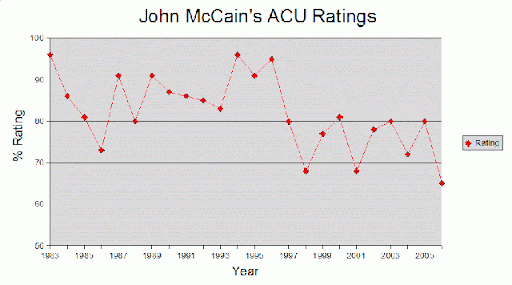
McCain ACU ratings

This is, perhaps, not the graph of a reliable conservative, but an individual who has some conservative values and some others that are not in tune with conservatives at large.

I have, however, enough views outside the 'conservative' realm that are at variance with the general 'conservative' concept in at least two of the three brands (social and fiscal) and only moderate agreement with the third (security) that I am more than likely to have problems with *any* conservative running for High Office.  For Sen. McCain, however, I do have other problems with him beyond that of the ACU or the other conservative folks, by and large, and have clearly stated so multiple times.

One of the first was in this piece where, for me, John McCain had hit bottom and was continuing to dig hard and furiously downwards.  Some of my concerns are reflected in the ACU view and others are not.  For me Sen. McCain's political life is something that bears examination, even while giving him high regard for his time in the armed forces and as POW, that does not gain a Teflon coating and to my view he has never, ever properly explained himself in many areas going all the way back to the Keating Five scandal.  In trying to make up for that scandal by 'campaign finance reform', Sen. McCain has lost sight of what it was that needed to be addressed: campaign money influencing actual votes in High Office.  The extremely simple route of disclosing all corporate and private source political donors and then not allowing them to author or vote on issues that are of concern to their industries has, somehow, never graced the brow of any of the high-minded 'reformers'.  If you accept money from, say, a corporate or union group, then you should be barred from authoring or voting on legislation regarding those groups.  That does not take a federal mandate or law and could be set up as a set of rules in the House and Senate Chambers done by the members themselves as they are ALLOWED TO DO.  Any union or industry or political lobbyist group or activist organization would be donating so as to get good politicians into office.  And campaigns could *refuse* funds from same JUST LIKE THEY CAN DO TODAY.

For all the worries about 'corrupting influence of funding in politics' this extremely simple answer has, somehow, never been put forward by the 'maverick' or any other of the Congresscritters bleating upon the Hill.

Then there is the atrocious ideas that came forward to *try* and regulate free speech on the campaign trail.


Yes the 'I'm the Budweiser Donkey and I approved this message' bit!  Gotta love that, no?  With 'issue ads' suddenly appearing all over the place because, in the attempt to *restrict money* so that it would not *buy votes* it gave us semi-anonymous groups we would never hear from that served as front organizations to get a message out that, in theory, was 'informative' while, in fact, it was just another form of candidacy advertising done by rich individuals, corporations, and groups.  That tag line of being this or that individual/group/corporation and approving the message is all fine and dandy... and hadn't seen the light of day until the idea of 'restricting' donations popped into place.  The question of the utility of such thinly disguised 'issue ads' is one that can be considered by the public at large, and that route may have opened in any event, with the modern mass media proving such a heavy sway in politics. 

Instead of getting forthright organizations that proudly put forward their donor lists to demonstrate that they really, and for true, stand behind their message, we get, instead, organizations funded by front groups for billionaires, overseas interests and second or third level intermediaries between corporations and unions to politics.  That does sound like one other organization that has done this to a fare-thee-well in another realm:  the mafia.

Perhaps limiting downstream funding and demonstrating that only a first level organization directly and openly tied to those pushing a message should be allowed?  And if those involved want to fund a different message group they can do so *directly* and not through an intermediary.  I am, actually, perfectly fine with such advertising and marketing when it is straightforward, above-board and makes no attempt to hide who is actually funding the damned stuff.  Make that a felony where a company gets discorporated (yes un-incorporated but the finality sounds better) and that should remove *that* from the lovely idea of political obfuscation: one strike and you are *out*.  And some hefty prison terms for those that authorized such things, to boot.

Don't worry, you won't get that from Congress, either.  Way, way too simple when you can, instead, infringe upon the average individual's first amendment rights to speech...

I also have problems with Sen. McCain's views and votes on 'the tobacco deal' and Sen. McCain's view about worrying on the influence of tobacco money in Congress could *easily* have been addressed by simple and up-front disclosure by Congresscritters on campaign and lobbyist donations.

Plus making their appointment calendars PUBLIC.  It would be handy to know who they meet with while in office, no?  They are your representatives in the federal government, but heaven forbid if you find out who they actually MEET WITH.  The Media Reformer and Real Reformer hasn't done a thing to actually do any of this 'reforming' and has now formed into something totally other than a 'reformer'.

That, too, will never be seen from the 'maverick' or the other bleating masses of gelatin Upon the Hill: they lack spines.

A prime area of concern for a President is this thing known as 'foreign policy'.  Actually, Sen. McCain had a taste of that already with the idea of limiting Nations that we have Treaties with on their activities.  Which ones?  The Indian Tribes that tried to put up casinos in Arizona.  If John McCain can't figure out Treaties with Native Americans, and that they can, indeed, offer things like gambling and tax-free gasoline and cigarettes, and make some money off of the gambling vice, then perhaps he might rethink this idea of actually being able to know what to do with something a bit more complex like Pakistan with at least two major ethnic groups looking for autonomy (or more) and multiple tribes taking sides on different fronts, along with radical Islamic views percolating through it... and nuclear weapons as the big prize behind the National door.  If he can't figure out Indian Tribes in Arizona, then I have a hard time seeing how he will deal with Pakistan or Kenya or Indonesia.

For me this idea of 'defending the Nation' starts right at the borders: every other Nation thinks that and we are the only ones asinine enough to not believe that, save Europe which appears to be dissolving internally for the want of 'unity' while allowing in so many disparate ethnic groups that the idea of 'the Balkans' may soon have to include Londonistan and Sweden.  And Greenland, come to that.  That is why the 2006 and 2007 immigration views are asinine: it is not about race, it is about national security and national sovereignty.  With Chinese 'Snakeheads' importing near slave labor into the US for 'closed factories', the idea that there is a single 'ethnic problem' is ludicrous.  It is global in scope with folks in the Middle East being able to pay a couple of thousand dollars to get smuggled across the border.  And don't mind the jackets with insignia of groups allied to al Qaeda being found in the desert in the US... I'm sure they were a complete mistake.  As we have started to see in Oklahoma and elsewhere - if we enforce the laws, the majority of illegals will 'self-deport' back home and we are then left with the intractable criminal (and terrorist) problem which, today, we have ZERO handle on due being lost in the noise of so many here illegally.  And *rewarding* those here illegally will NOT STOP THE FLOW.  To stop the flow one must, in actuality, stop the flow.

Walls make damned good neighbors.  Sensor arrays are cheap.  So are those lovely close-in weapons systems the British have reworked for anti-small ship work from their original anti-missile work.  Wall, sensors and NORTHCOM, so the border patrol can ensure that those coming through the actual and legal ports of entry are who they say they are.  That is cheaper than building a nuclear aircraft carrier *hull*.  And even if we are, in the long term, wrong-headed for doing so, it then leaves us with a monument to our utter folly... one that we can enjoy because we did stand up to have a Nation with borders and enforce not only the rule of law but the Law of Nations.

And since I have mentioned *that*, what is it with Sen. McCain and the rest of the wool covered, gelatinous, bleating masses Upon the Hill bleating about having difficulties with *terrorism*?  Their Article I, Section 8 powers specifically mention one tract of information and one particular text known as the Law of Nations (not the lower case assumed law of nations, but the uppercase Title and particular citation sitting right there in the US Constitution where we all ignore it).  This is a generalized society level problem, however, as we are too advanced to remember what Nations are about and what their duties and responsibilities are not only between Nations and within Nations, but citizens within Nations to other Nations.  In our lovely multi-culti 'hug everyone, criticize no one' world of Sen. McCain views, where Americans won't pick lettuce of $50/hour... and even if he *meant* $15/hour it is a slur and insult to the American working population... in that world where nice folks only out of desperation because they are too incompetent to stage a revolution to get rid of inept or dictatorial government at home come to the US to be incompetent, the idea is that Nations *matter* and you do *not* get to break the agreements set up by your Nation with other Nations.  International lawlessness starts, at home, with the individual and then is held accountable by other Nations in their laws when individuals break the Law of Nations.  In that act, even if it is not one done in violence, there is violence done to the concept of Nations by those individuals willing to break down international law to 'find a job'.  To each and every individual who points to such things as the Universal Declaration of Human Rights: it applies to Nations and the Nationals within them and those foreigners there legally.  It does not and cannot apply to those who break international law by their actions as they are left up to the Nation they affect to deal with as that Nation sees fit. 

Terrorism is something that, under the Art. I, Sec. 8 powers, Congress can deal with on the 'civil side' of things:  it is given for Congress to put laws against Private War as it is a contravention of the Law of Nations.  While the explicit immigration and Naturalization language is given to Congress, that would also be kept under the more general Law of Nations penalties, so that illegal aliens could be dealt with via either means.  So, too, is the lawlessness of Private War given to Congress on the 'civil side' as it is not Public War in which it can make military rules about.  Just as Piracy had to be dealt with via either the apprehension or killing of those outlaws, so, too, are terrorists in that same category as they both fit under the umbrella of Private War.  Sen. McCain is used to Public War against Nations as are all of our contemporaries: even though we feel the lash and pain of Private War we can no longer name it for the outlawry that it IS.  And, as with Piracy, 'civil law' covers those that are either captured by civil society (police, bounty hunters, etc.) and then put to civil justice so that they get one, and only one, opportunity to demonstrate that they are not part of an organization waging Private War.  That was done with Piracy so that those falsely accused could *clear their names* and the reason we remember Captain Morgan who was branded Pirate for a land based attack is that he went back to London, stood trial and *cleared his name*.  Got Knighted to boot.  On the military side, however, as these are not civil enemies, but enemies against all society, it is left to the military commander to promulgate what should be done with such miscreants.  One President has clearly and unequivocally put forward that as Commander of the Armies and the Navies, that those waging Private War are considered Pirates.  That President offers the most succinct view of how to deal with military targets that are *captured* waging Private War against the Union and it is not a President we would expect it from:  Abraham Lincoln.

If Sen. McCain (R-AZ) cannot abide by the way the Nation was set up and the military view of Private War prosecuted against the US to be handled by the President as something outside the Public War arena, then he will try to muddle that clarity given to the United States by one of the greatest Republicans and a founder of the Republican Party.  Terrorists put themselves into the Outlaw position: not mere criminality but outside the protection of civil law and reverting to the law of nature.  Those that wage Private War, of all stripes, are an abomination to civilization and President Lincoln gave battlefield soldiers the ability to do summary justice based on finding them as they were.  If Sen. McCain thinks that those breaking international law during wartime by abusing prisoners in Vietnam are bad, then terrorists who threaten all the Nations of mankind by declaring war against them are something far worse than mere treaty violators: they repudiate civilization itself.

I can, have and *do* blame both parties and, indeed, most of the modern era for wanting to give up the fabric of civilization in an ephemeral quest to have a lovely transnational world where everyone has the exact same freedoms of the Chinese, the wealth of Namibians and the health of whatever the State decides to give you.  By looking to higher taxes, expanded government and less National Sovereignty, Sen. John McCain has demonstrated by his votes and outlook over more than two decades that this is actually what he supports.  When the Congress of 1986 promised, from the seat of power Upon the Hill, to actually do something to secure the borders and 20 years later we have Sen. McCain trotting out an *amnesty* plan because that hasn't been done, the very best that I can call all those who have sat that long and done nothing is "Seatwarmers".  And trotting it out *again* makes them Incompetent Seatwarmers for they cannot even do their jobs to establish justice and ensure that it is done.  That includes each and every Congresscritter who has matriculated through Congress since 1986 and applies multifold to those who were IN that Congress and had that Congress make a pledge to the American People that they would do their JOBS.  Not that Sen. McCain can actually remember what that job *is* most days as he is a bit too busy being high minded about how he can raise taxes and increase spending to actually worry about the rest of the job description that he and the rest of Congress gets. 

And when Sen. McCain trots out his views on COIN, I take that with a hefty sack of salt as he puts forward something that could not be done with the forces of the Union at that time because conditions were changing rapidly and we did not have the manpower to actually have more forces in the field.  And it was the self-same Sen. McCain that was so hot for a 'peace dividend' that he was willing to cut more than the President wanted from the budget and claim to be a 'conservative' because he wouldn't cut as much as the D party wanted to!  While a 'conservative' realizes that a studied view of what the proper force size should be is done *first* and then the forces adjusted to fit those views, not the other way around.  That left the US with two entire Army Divisions, one of which was the 10MD , so badly hung out to dry in Bosnia for so long because Sen. McCain didn't want to keep President Clinton accountable.  Thus his votes to reduce the force size and readiness along with the impact of long-term 'peace keeping' that Congress would not actually put any oversight upon, meant that when 9/11 rolled around, the foremost Army division for Mountain Warfare was *still* recovering from the abuse it had suffered to put it at the lowest readiness status ever seen since Vietnam.  If he stood true to not wanting to ever repeat that experience for the Armed Forces of the Union, then he should have held President Clinton accountable and *not* allowed the US Army to be hung out to dry by a neglectful CinC and a Congress that didn't want to pay for that neglect... a Congress that he sat in as a Senator.

I will not be voting for Sen. McCain for *anything* and that goes for the rest of the Congresscritters Upon the Hill.  They have all reached the end of the Peter Principle and their incompetence is vast and unwieldy as it stands, thus they are at the pinnacle of their careers.  Like Sen. Clinton, however, Sen. McCain gets especial view, but in his case it is not for being a sociopath, but for being deceitful and seeking to increase the size, scope and power of government over the common man while gesturing as a 'hawk' and then wielding the knife in the background, and then claiming none of the problems he has helped cause have any accountability to him.  In using first illegal alien amnesty and then the armed forces as political footballs in the 1990's, we have reaped a Nation that has porous borders and stood less than ready to respond to Private War brought hard to our shores one bright September morn.  What a difference a single Mountain Division could have made in Afghanistan sent quickly and efficiently to deal with dangers only it could be prepared to know.  By doing this we have seen erosion of the rule of law and such lessened respect for the US that those seeking to attack us felt they could do so with impunity.  And the worse part is that those connections between Charles Keating and BCCI continue to echo throughout the enemies of the Nation and the support given by one Senator who was never held to account for his part in it.  Many of the greatest foes of the US took part in BCCI... and because of those high level connections in government we may never know the full extent of how easily our enemies traded for the means to go after liberty and freedom on a regional and global basis.  And I am sure that is *just* the way Sen. McCain likes it... he has 'reformed' since then.

And it is a form I do not like in the slightest.