Lets start at the front and work backwards, and this with an article by John Fund on 03 MAR 2008 on Obama and Chicago Mores seen at the Wall Street Journal and Jewish World Review also printed at on the same day:
Mr. Obama has admitted that the 2005 land deal that he and Mr. Rezko were involved in was a "boneheaded" mistake, in part because his friend was already rumored to be under federal investigation. The newly elected Mr. Obama bought his $1.65 million home on the same day, June 15, that Mr. Rezko's wife bought the plot of land next to it from the same seller for $625,000. Seven months later she sold a slice of the land to the trust that Mr. Obama had put the house into, so the senator could expand his garden.
Mr. Obama has strenuously denied suggestions that the same-day sale enabled him to pay $300,000 under the house's asking price because Mrs. Rezko paid full price for the adjoining lot, or that he asked the Rezkos for help in the matter. Both actions would be clear violations of Senate ethics rules barring the granting or asking of favors.
Still, there are anomalies. Mr. Obama admits that he and Mr. Rezko took a tour of the house before it and the adjoining plot were sold. Financial records given to federal prosecutors a year later show Mrs. Rezko had a salary of only $37,000 and assets of $35,000. In court proceedings at that time, to explain how much his bail should be, Mr. Rezko declared that he had "no income, negative cash flow, no liquid assets."
So where did the money for Mrs. Rezko's $125,000 down payment — and the collateral for her $500,000 loan from a local bank controlled by Amrish Mahajan, like Mr. Rezko a Chicago political fixer — come from?
The London Times reports that, three weeks before the land transactions, Nadhmi Auchi, an Iraqi billionaire living in London, loaned $3.5 million to Mr. Rezko, who was his Chicago business partner. Mr. Auchi's office says he had "no involvement in or knowledge of" the property purchase. Mr. Auchi is a press-shy property developer (estimated worth: $4 billion) who was convicted of corruption in France in 2003 for his involvement in the Elf affair, the biggest political and corporate fraud inquiry in Europe since World War II. He was fined $3 million and given a 15-month prison term that was suspended provided he committed no further crimes.
Mr. Auchi was also a top official in the Iraqi oil ministry in the 1970s. He has for years vigorously denied charges he had dealings with Saddam Hussein after the first Gulf War. However, an official report to the Pentagon inspector general in 2004 obtained by the Washington Times cited "significant and credible evidence" of involvement by Mr. Auchi's companies in the Oil for Food scandal and illicit smuggling of weapons to the Hussein regime.
In 2003, Mr. Auchi began investing in Chicago real estate with Mr. Rezko. In April 2007, after his indictment, Mr. Auchi loaned another $3.5 million to Mr. Rezko, a loan that Mr. Rezko hid from U.S. Attorney Patrick Fitzgerald's office. When Mr. Fitzgerald learned that the money was being parceled out to Mr. Rezko's lawyers, family and friends, he got Mr. Rezko's bond revoked in January and had him put in jail as a potential flight risk.
In court papers, the prosecutor noted that Mr. Rezko had traveled 26 times to the Middle East between 2002 and 2006, mostly to his native Syria and other countries that lack extradition treaties with the U.S. Curiously, Mr. Auchi has also lent an unknown sum of money to Chris Kelly, who, like Mr. Rezko, was a significant fund-raiser for Illinois Gov. Rod Blagojevich (himself under investigation by a federal grand jury as an alleged beneficiary of the Rezko shakedowns). Mr. Kelly is himself under indictment for obstructing an IRS probe into his activities.
It is hard to have a spotless image when working with folks someone being tied to the problems of Oil-For-Food monetary accountability problems shows up in US Federal Court and the Pentagon Inspector General's report. A Malaysia Today Special Report on OFF looks at how the banking part of the system was set up, as part of their report which concentrates on more localized wrong-doing, but needs to set the context of the entire OFF deal for that:
Background and design
The program was instituted to relieve the extended suffering of civilians as the result of the comprehensive sanctions on Iraq from the UN, following Iraq's invasion of Kuwait in August 1990. After an initial refusal, Iraq signed a Memorandum of Understanding (MOU) in May 1996 for arrangements for the implementation of that resolution to be taken.
The Oil-for-Food Programme started in October 1997, and the first shipments of food arrived in March 1998. Some 60 percent of Iraq's 26 million people were solely dependent on rations from the oil-for-food plan.
The programme used an escrow system: oil exported from Iraq was paid for by the recipient into an escrow account possessed until 2001 by BNP Paribas bank, rather than to the Iraqi government (Anglo-Iraqi billionaire Nadhmi Auchi is BNP Paribas major single shareholder through his firm General Mediterranean Holdings). The money was then apportioned to pay for war reparations to Kuwait and ongoing coalition and United Nations operations within Iraq, with the remainder (and majority of the revenue) available to the Iraqi government for use in purchasing regulated items.
The Iraqi government was then permitted to purchase items that were not embargoed under the economic sanctions. Certain items, such as raw foodstuffs, were expedited for immediate shipment, but requests for most items, including such simple things as pencils and folic acid, were reviewed in a process that typically took about six months before shipment was authorised. Items deemed to have any potential application in chemical, biological, and nuclear weapons systems development were not available to the regime, regardless of what their stated purpose was.
This confirms an earlier NYT article of 30 APR 2003:
BNP Paribas said that it had had no contact with Mr. Auchi since it was formed in 2000 from the merger of Banque Nationale de Paris and Paribas, and that Mr. Auchi was uninvolved in the bank's management or shareholder relations. It also said that BNP had secured the oil-for-food account before its merger with Paribas and that Mr. Auchi played no part in winning the account.
BNP Paribas added that its participation in the oil-for-food program was the result of competitive bidding and that the United States Treasury had approved its participation.
''We believe we were appointed by the U.N. for this contract because they were looking for a large European financial institution and we are the largest bank in continental Europe,'' BNP Paribas said in a statement. ''The oil-for-food program revenues represent about one-tenth of 1 percent of the total revenues of our company. It has no significant influence on our size or our level of profitability.''
Mr. Auchi, who declined to be interviewed for this article, holds his stake in BNP Paribas through a Luxembourg concern he controls called General Mediterranean Holdings. As recently as 2001, General Mediterranean Holdings described itself in an annual report as one of largest single shareholders in BNP Paribas.
Mr. Auchi's London lawyer, David Corker, said that since 2001 General Mediterranean Holdings had reduced its BNP Paribas stake to about 0.4 percent of the bank's total shares, about half of the position he held before then. That stake would still make Mr. Auchi one of the bank's biggest single shareholders. Mr. Corker said his client had ''never knowingly had any business dealings with the Hussein regime.''
Mr. Auchi first became involved with Paribas, the predecessor to BNP Paribas, in the 1970's. He also played a central role in the 2000 merger of Paribas and BNP, helping to steer Paribas away from a merger with a rival concern.
In 1996, according to European news accounts, Belgium's ambassador to Luxembourg charged that Banque Continentale du Luxembourg, a bank that Mr. Auchi and Paribas jointly controlled until 1994, had handled personal accounts for Mr. Hussein.
After that the report would look at the sales of Italian naval vessels with the help of Mr. Auchi which would be brought up in an Italian organized crime crackdown by a banker, Pierfrancesco Pacini Battaglia, who would also assert that Mr. Auchi was an important intermediary for Middle Eastern countries. So, even though no shares are held directly by Mr. Auchi, his control of General Mediterranean Holdings and its investment in BNP-Paribas leaves him as the largest single shareholder at the time of OFF.
Part of this network that would come together is pre-existing as cited by Kenneth R. Timmerman in The French Betrayal of America, published 2004, which looks at Saving Saddam in chapter 12, and I will excerpt a bit from pp. 230-231 and the TotalFinaElf scandal that would go on parallel to the OFF scandal:
Maugein’s close ties to Chirac were also well known to Loik LeFloch-Prigent, the president and CEO of French state-owned oil company Elf-Aquitaine, who was jailed in 1995 and again in 2002 on corruption charges. In his often bitter and self-exculpatory memoir, Affaire Elf, Affaire d’Etat, LeFloch-Prigent claims that Maugein played a role in several commercial projects in which Elf was accused by investigative magistrate Renaud Van Ruymbeke of distributing kickbacks to French political parties and their leaders.
One of those deals – the purchase of the Spanish oil refinery Ertoil in 1990 – was the handiwork of an Iraqi businessman named Nadhmi Auchi, who later became a target of the worldwide hunt for Saddam Hussein’s hidden assets that was spearheaded by Wall Street investigator, Jules Kroll. Auchi’s main venture was a Luxembourg-based holding company called General Mediterranean Holdings (GMH), He was named in a June 16, 1988 Italian parliament investigation as one of two intermediaries who helped broker a $1.6 billion deal for Cantieri Navali Riuniti of Italy to sell six “Lupo” class frigates to Iraq in 1980, an activity that generated a $23 million payment to Auchi’s Dowal Corporation, according to company documents discovered by the Italian Guardia di Finanza. Neither the Italian parliament or the Kroll investigation established that Auchi had violated existing laws or that he was sheltering Iraqi government assets, despite alleged ties to Saddam Hussein’s half-brother Barzan Ibrahim al-Tikriti, a former Iraqi intelligence chief (Auchi today denies he had any relationship to Barzan). GMH bought the Ertoil refinery on Elf’s behalf in late 1990 and resold it to Elf a few months later at a profit of at least 300 million French francs. French prosecutors were investigating claims that some of that money had been distributed to French political parties.[v]
“Everyone knows there were strong ties, longstanding ties, between expatriate Iraqis and the RPR,” LeFloch-Prigent explained. “That party has a president, whose name is Jacques Chirac. Chirac knows Saddam Hussein, who knows Auchi.” If you wanted to understand the ties between Chirac, Auchi, Iraq and Elf, LeFloch-Prigent said, the man to see was Patrick Maugein, whose name was “inseparable from that of Chirac.” Maugein “was very much involved in oil, from Iraq to Africa. Today he heads a British oil company, SOCO.” Asked by co-author Eric Découty whether he was implying that Auchi had financed Chirac’s political activities through Maugein, LeFloch-Pringent replied evasively: “I’m saying that the subject of investigation is the following: trace the links from the Iraqis – both abroad, and inside Iraq – to the RPR. Nadhmi Auchi is part of the Iraqi diaspora… If the prosecutors want to really investigate the money Auchi is said to have distributed, they may find the RPR which Chirac headed.”[vi]
But Maugein insists that he never knew Auchi, was never involved in fund-raising on Chirac’s behalf, and “had never met or sought to meet Saddam.” Auchi also denies any involvement in the alleged fund-raising scheme. Crossley noted, correctly, that LeFloch-Prigent never pursued the more startling “revelations” contained in his book when he took the witness stand during his public trial. Maugein freely admits that he traveled often to Baghdad in the 1980s, when Iraq was a major economic partner of France. Even after the first Gulf war, he told Le Canard Enchainé, he went to Baghdad “more than once as an emissary for Chirac,” who was then Mayor of Paris.
Maugein has never sought to hide his friendly relationship with Tariq Aziz and the top management of Iraq’s oil ministry, or that he considers Iraq “part of [his] business,”Crossley says. During the UN embargo, Maugein sent a shipment of free medicine to Iraq “because there was a humanitarian problem there.” He also introduced Tariq Aziz to LeFloch-Prigent when he became president of Elf, “because there was a dispute over fields the Iraqis wanted to take away from the French and give to the Russians.” Maugein’s intercession appears to have been successful, since the Iraqis announced in January 1999 that they had signed a production sharing agreement with Elf-Aquitaine for the Majnoon oil fields that was nearly as generous as the $40 to $60 billion deal negotiated earlier with Total for Nahr Umr.[vii] . “Patrick maintained these contacts during the embargo in the belief that when the embargo was lifted it would be useful to his London-based oil company, in which American interests were also represented,” Crossley says.
Moving back to the OFF scandal, in a 2006 GAO Audit of OFF, in Appendix III, they go through the min/max that was made illicitly via the program and smuggling, which would include surcharges on oil sales ( $230k to $900k), commodity purchase kickbacks to the regime ( $1.5 million to $3.5 million) and smuggling/trading outside the OFF program ($5.7 million to $8.4 million). The totals range from a minimum estimate of $7.3 million to $12.8 million during the years 1997 to 2002. Those min/max numbers come from looking at multiple reports on the problems of the OFF program. In testimony by Mark L. Greenblatt, Counsel US Senate Permanent Subcommittee on Investigations given on 15 NOV 2004, we get to see how the surcharge portion of this works:
- In mid-2000, Hussein directed SOMO to generate additional revenues outside the Oil-for-Food Program. Pursuant to that directive, on September 1, 2000, SOMO began lowering the price of oil and demanding a ‘‘surcharge’’ of 10 cents a barrel for each barrel exported from Iraq.
- Over the succeeding months, the rate of the surcharge fluctuated widely, reaching a peak of roughly 30 cents a barrel. Exports to the United States had a higher surcharge than shipments elsewhere in the world. These surcharges were to be paid by the oil purchaser directly to the regime, illegally bypassing the UN-controlled escrow account at BNP Paribas.
- As a result, many of the traditional oil companies refused to pay the surcharges. Out of the shadows, however, came numerous unknown middle-men that were quite eager to participate in the scheme. The scheme continued on for 2 years, until the United States and the UK, as members of the Subcommittee overseeing the program, took action to end it. The device they used was called retroactive pricing.
- For the sake of brevity, I will not get into detail concerning what retroactive pricing is, but suffice it to say that retroactive pricing was completely effective in ending the surcharges. Over that 2-year period that the surcharges were in effect, Saddam amassed more than $230 million in the scheme. Every single one of those dollars was obtained under the table, outside the OFF Program. I will now present a behind-the-scenes look at how those dollars went into Saddam’s coffers.
-
- These funds would, indeed, bypass BNP-Paribas, but that is not to say BNP-Paribas was not involved. Later in his testimony he will detail how a particular transaction would work out:
Al-Hoda purchased 4 million barrels of oil in connection with contract M/09/15 under the Oil-for-Food Program and sold half of that oil, 2 million barrels, to the American company. According to page 2 of the contract between Al-Hoda and the American company, which is page 2 of the exhibit, there was a 40-cent markup on the official selling price per barrel.
Interestingly, the payment mechanism for this oil contract was divided in three parts. I will direct your attention to the last paragraph on the bottom of page 2. That paragraph describes a payment ‘‘inside the letter of credit,’’ which refers to the approved letter of credit within the Oil-for-Food Program where the funds would go to BNP Paribas.
Moving up to the next paragraph, the second to last paragraph on the page, there is a payment of 10 cents a barrel ‘‘outside the letter of credit’’ at the instruction of Al-Hoda.
Moving up to the third paragraph from the bottom, there is another payment outside the letter of credit, this one for 30 cents per barrel. The Subcommittee will demonstrate how that 30-cent payment outside the letter of credit was, in reality, an illegal surcharge to the Hussein regime.
Moving on to the third page of this exhibit, it is a handwritten sheet of paper by the oil buyer which confirmed that the 40-cent fee is broken down into two separate payments, a 10-cent letter of credit to Al-Hoda and an identified 30-cent payment. The question remains, where is that 30-cent payment going?
The next document in the exhibit is an invoice from Al-Hoda requesting payment for the 40-cent markup which amounts to roughly $836,000. This $836,000 includes the mystery 30-cent-per-barrel fee.
The next document in this exhibit is the order from the oil company to its bank, which just happens to be the Geneva affiliate of BNP Paribas, to make the payment of $836,000.
The next document in this exhibit is an excerpt from the oil company’s accounting ledger that confirms that a payment to Al-Hoda for $836,000 from the company’s BNP Paribas account was actually paid.
So how do we know that the $836,000 payment included a 30- cent surcharge to Iraq? The Subcommittee has obtained SOMO records that provide detailed information about each surcharge payment that was received. Included in this chart is a 30-cent payment from Al-Hoda for this very contract.
If I could direct your attention to Exhibit 19,1 this is an excerpt of the chart created by SOMO in February 2004 that details each oil contract in which a surcharge was paid. The column headers, which are in Arabic and therefore read from right to left, are as follows: Phase, contracting company, contract number, amount of oil lifted, amount of surcharge owed—I am sorry—amount of oil lifted, and then that is the surcharge rate is the fifth column, the amount of surcharge owed, the amount of surcharge paid, and finally is the difference, the balance owed on the surcharge.
If we look at the entry on the chart for Al-Hoda’s contract M/09/ 15, which falls roughly in the middle of the page, we see that Al- Hoda agreed to pay a surcharge of 30 cents per barrel. Therefore, it appears that the mystery 30-cent fee did indeed reflect an illegal surcharge payment to the Hussein regime.
From Al-Hoda to BNP-Paribas to Saddam Hussein. Presented in documentary form to the US Senate, and indeed, such had been presented earlier to the House and Senate. Somewhere in there 'due diligence' was lost.
The Independent Inquiry Committee looked at the goings on with BNP before it joined up with Paribas, in Chapter 4 of its final report (the Volcker Commission report) and looked at the conflict of interest problem of BNP:
- One highly significant provision of the Banking Agreement allowed BNP not only to confirm letters of credit issued by other banks for oil purchases, but also to “issue [letters of credit] directly as the Purchaser’s Bank on behalf of its customers who are approved purchasers of Iraqi petroleum and petroleum products.” BNP frequently availed itself of this option—either directly or through subsidiaries and affiliates, principally BNP’s offices in Geneva, Switzerland, which together issued approximately three-fourths of all letters of credit for oil transactions during the Programme.719
- For BNP, already a major provider of financial services for the oil sector, the opportunity to issue a letter of credit in the first instance rather than simply to confirm a letter of credit issued by another bank meant that BNP acquired a second customer, and with it, the possibility for a conflict of interest with its primary customer—the United Nations. BNP operated during the Programme through various branches, subsidiaries, and affiliates, including BNP New York, the branch responsible for maintaining the escrow account. These other branches, subsidiaries, and affiliates will hereinafter be referenced by the designation “BNP,” followed by the location of the branch, subsidiary, or affiliate (e.g. BNP Geneva, BNP Hong Kong, and BNP New York).
In having this capability BNP not only could ensure that other banks stood behind credit lines for Iraqi oil purchases, but then could issue its *own* credit lines: this is beyond an 'oversight' role and directly participating in the assurance structure itself. Instead of acting as a trusted intermediary to ensure that sufficient cash was available for backing up individuals in OFF, BNP could, itself, back those oil sales on its own say-so with no oversight. By issuing those credit lines to individuals, and taking those individuals on as customers, the ability to ensure credit worthiness was left up to an institution that was backing its own customers in the deal. How could anyone ensure that any given individual was checked for trustworthiness when the bank, itself, had no one to ensure that *it* was not circumventing that very same trust arrangement?
Beyond the kickback system as evidenced in things like the Al-Hoda deal going through various accounts, and issuing its own, unchecked lines of credit, there was yet another problem with BNP during the OFF, and that is looked at a bit further on in Chapter 4:
- Although many purchases of Iraqi oil under the Programme were the result of direct transactions between the purchaser as the contracting party, and SOMO as the seller of oil, numerous other transactions were infused by the addition of third parties that financed the purchases of oil for the contracting party and ultimately received the oil from the original purchaser.739 These companies will be referred to throughout as “third-party purchasers.” One of the reasons given by staff members of BNP Geneva for intercession of a third party in such transactions was that contract holders who obtained the right to buy oil from SOMO often did not have sufficient credit to finance the purchase, nor the technical expertise to fulfill the obligations of the oil transaction (i.e., to charter a ship to lift the oil and deliver it to a refinery). Therefore, the contracting party turned to established oil traders and oil companies with capability to receive the requisite financing from a financial institution.740 On the other hand, as discussed in Chapter One of this Report, a more nefarious purpose for an oil trader or oil company to purchase oil from a contractor rather than directly from SOMO was to maintain an apparent distance from the payment of any illicit oil surcharges.
- BNP Geneva financed many letters of credit within the Programme on behalf of third-party purchasers. Often, the third-party purchaser requested BNP Geneva to withhold any mention of its company’s name from the letter of credit, as illustrated in the figure below showing such a request by Vitol in connection with the purchase of oil in the name of Al-Rasheed International:741
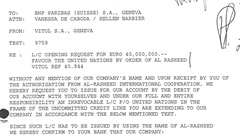
Figure: Sample instruction requesting that the Bank not disclose the financer’s identity in the letter of credit (excerpt).
BNP Geneva did not disclose the third-party purchaser involvement to its own affiliate in New York that received all letters of credit for the United Nations; nor did it disclose to the United Nations itself. When interviewed, employees of BNP Geneva explained that these financing arrangements, and the non-disclosure of the purchasing entity’s identity, were routine in the oil trade business. These officials offered three reasons for this practice: (1) that the third-party purchaser client requested non-disclosure; (2) that the disclosure would cause complications to the confirmation process and would place the letter of credit in a position of likely rejection by the beneficiary if a name other than the purchaser was identified; and (3) that disclosure might violate Swiss bank secrecy laws.742
Here the conflict of interest of leveraging its own resources to back individuals and companies combines with companies unwilling to be directly named due to the types of schemes being used to bypass the OFF structure. Through two means there are now ways to remove assurance that those seeking to sell oil could be properly accounted for and if BNP stood up its own money and the individual wanted to be a third-party purchaser, then there would be no way to find out who was making the purchase at *all*. One part of BNP would hide this from another part of BNP to make this happen.
Now we are getting a look at this after BNP-Paribas formed up from its constituents: BNP and Paribas Bank. One of the shareholders on the Paribas side was someone I quite did not expect to see, here seen from the 1997 Paribas financial report, of who is sitting on the Supervisory Board and on the Compensation Committee:
Paul Desmarais (2)
Age 71. Chairman of the Executive
Committee of Power Corporation
(Canada). Member of the Boards
of Great-West, Bruxelles-Lambert,
C LT- U FA and Axa-UAP.
Member since September 27, 1990.
Mandate expiring in 2000.
Owner of 230 Paribas shares.
And a bit further in:
POWER CORP. Power Corp., 2.1% owned by Cobepa, is a Canadian company, whose largest shareholder is the family of Mr. Paul Desmarais Sr. It is active in insurance (Great-West Life), asset management (Investors), media and communications, and holds a 25% interest in Pargesa. In 1997, Power Corp. became Canada’s largest life insurer, through the successful acquisition of London Life for CAD 2.94 billion.
PARGESA Switzerland-based Pargesa , 14.7% owned by Cobepa and 50% owned by the Frère and Desmarais groups, holds interests in Belgium’s Groupe Bruxelles Lambert. Through this company, it exercises a significant influence over Petrofina in the oil sector, Compagnie Luxembourgeoise de Télédiffusion (CLT, 50% owned by Bertelsmann) in the media sector, and Imetal in construction materials. A key development of 1997 was the sale of its interest in Banque Bruxelles Lambert, as part of the public exchange offer launched by ING Groep, generating substantial capital gains.
Have to love those company ownership documents. Ok, find a search engine of your choice and put in: 'desmarais' and 'scandal'! Yes it is just that easy...
Here is a Newsmax article by Charles R. Smith on 18 JAN 2005,on the OFF scandal and BNP-Paribas, and remember that Nadhmi Auchi is cited as the largest minority investor so it would help to know the majority investor and that the combined company formed up in 2000:
BNP Paribas
Top among these is the European-based BNP Paribas bank, which the U.N. chose to administer the program and which reportedly received nearly $1 billion for its efforts. Congressional investigators reviewing the bank's actions have discovered broken rules, missing documents and improper transfers by BNP Paribas, which up until now has been assumed to be a French bank.
In fact, BNP Paribas is actually controlled by Power Corporation, an appropriately named Canadian company that has a shocking track record of 'business' relationships with the worst gangsters and tyrannical regimes in the world.
[..]
BNP Paribas bank is part of a holding company, Pargesa Holding, which is jointly owned and controlled by the Frère and Desmarais families. Paul Desmarais Sr. is the chairman of the group, while Albert Frère is the vice-chairman. Gerald Frère, Albert's son, is one of three general managers who oversee day-to-day operations, and Paul Desmarais Jr. is also an officer.
Pargesa, and thus Power Corporation and the Canadian Desmarais family, holds a controlling significant stake in TotalFina Elf, the Belgian-French petroleum multinational corporation formed from the merger of Total and Petrofina.
BNP Paribas and TotalFina may have blood-stained corporate histories, but the intimate and intricate connections of Power Corp. to Canada's governing elite raise the truly disturbing questions.
Power Corporation CEO Andre Desmarais is the son-in-law of former Prime Minister Jean Chretien, who went out of his way to oppose U.S. intervention in Iraq, where the family's business interests with the Saddam regime would be jeopardized.
Current Canadian PM Paul Martin is a former Power Corporation employee who made his fortune when he bought Canada Steamship Lines from Power Corp. aided by loans from Power Corp. To this day both CSL and Power are reported to have mutual equity interests in each other.
The most senior foreign affairs/international trade adviser to current Canadian PM Paul Martin is Maurice Strong, former CEO of Power Corp. and a longtime U.N. and Kofi Annan adviser.
You see, there gets to be a reason why things fall together here: Saddam naming BNP and Paribas as two of the banking institutions he would trust to handle funds in 1997, an ex-Iraqi oil minister in one company, a rich Canadian with investments in Iraq in another and the two form into one company. And Paul Desmarais goes from minor owner in Paribas to majority owner with the Frère family. And from the Institute for the Analysis of Global Security there is this bit from their Energy Security section on 21 APR 2003 after they examine the corruption in France around TotalFinaElf:
In 2001, TotalFinaElf signed an agreement with Iraqi dictator Saddam Hussein allowing the firm to develop 25 per cent of Iraq’s oil fields. TotalFinaElf largest single shareholder, Canadian Paul Desmarais', youngest son Andre is married to Canadian Prime Minister Jean Chretien's daughter France. Desmarais son Paul Jr., CEO of Montreal Power Corp., a firm whose annual revenues exceed 18 billion Canadian dollars, sits on the French oil company’s board of directors.
William F. Jasper at a FindArticles cache of The New American on 07 MAR 2005 would look at the 'conflict of interest' problems of Paul Volcker who headed up the Independent Inquiry Committee to look at the UN OFF scandal and comes up with one very interesting tie:
Volcker has ties to the Desmarais family and Power Corporation, the huge Canadian conglomerate at the heart of the oil-for-food scandal. Volcker sat on the international advisory board of Power Corp. with Paul Desmarais, St., while Paul Desmarais, Jr. and Andre Desmarais served as co-CEOs. The Desmarais family and other Power Corp. execs and directors are also major players in BNP Paribas, the bank that underwrote most of the oil-forfood scam, and TotalFinaElf, France's largest oil company and a multi-billion dollar contractor with Saddam's regime.
So, whenever the IIC is brought up, remember that a previous co-worker at the advisory board of a company owned by those being investigated was heading up the thing. Yes, even in their own reporting they had to actually tell what they saw as going on, like in the Chapter 4 excerpts previously. That isn't the only connection of Volcker with Paul Desmarais, however, as seen on 28 JAN 2005 at FoxNews.com, looking at Paul Volcker's background [bolding in the original]:
While few, if any, are questioning the integrity of the man heading the Independent Inquiry Committee, there is concern about his personal and professional interests that create an appearance at least of impropriety, which some on Capitol Hill say fits the definition of conflict of interest.
Volcker acted as a paid adviser — and remains an adviser — to a company that is closely linked to Total, the French oil giant that bought $1.75 billion of oil from Iraq under the Oil-for-Food (search) program. Volcker also acted as an adviser to BNP Paribas (search), the French bank that is one of the focal points of the investigation.
[..]
Since 1987, Volcker has been a close friend and paid adviser to billionaire Paul Desmarais Sr. (search), who owns the Power Corporation of Canada. Volcker is a member of its International Advisory Council, the company confirmed to FOX News. Members of the council are paid when they meet.
Power Corporation, along with a Belgian partner, Baron Albert Frere, shares control of a holding company called Groupe Bruxelles Lambert (GBL), which in turn is the largest single shareholder of Total.
[..]
Until 2001, Paul Desmarais Sr. was also a director of Total; his son, Paul Desmarais Jr., now has that position.
Power Corporation also has close ties with BNP Paribas, the bank that handled all Oil-for-Food transactions and also the institution that congressional investigators have found did not properly monitor transactions involving Saddam's oil sales. BNP owns a large stake in a Power Corporation subsidiary Pargesa Holdings, as well as in Total.
Meanwhile, Michel Francois Poncet, vice chairman of BNP, also sits on Power Corporation's International Advisory Council alongside Volcker. The council had a membership of 21 people, according to the company's 2003 annual report.
[..]
The latest news came soon after information surfaced regarding Volcker's relationship with the UNA-USA Business Council (search), a powerful group that has been highly vocal in its support for the United Nations since news came out that Iraq's Oil-for-Food program was plagued with mismanagement problems and lack of oversight.
Volcker was on the board of directors of the council until last year and hasn't ruled out going back once he concludes his investigation.
One of the three biggest financial contributors to the UNA-USA Business Council in 2003 was BNP Paribas. Sen. Norm Coleman (search), R-Minn., has served a subpoena on BNP Paribas.
This picture is becoming a bit more clear as the origins of BNP-Paribas and the shifting of the Desmarais, Frère and Auchi funds to other places for investing via fund holding organizations: Desmarais teaming up with the Frère family using companies to represent their families and Auchi moving over to General Mediterranean Holding. Together this work puts responsibility cut-outs between the principles and their chosen bank vehicle, BNP-Paribas. Any member of the group can, rightfully declaim that they have 'no contact' with Saddam, as a personal matter and then bypass the work done for them by the organizations involved, be they holding companies or BNP-Paribas itself.
Beyond that the circle of individuals who have been with Power Corp. who also work with BNP-Paribas indicates a cooperative effort to control the workings of the bank itself both via ownership and placing trusted individuals within the highest levels of the bank's operations. That combined with the moves by Saddam Hussein to mask his efforts to gain illicit funds makes the difficulty of actually holding BNP-Paribas accountable. From the 2005 House Committee report on OFF, the problems behind OFF become apparent from the start:
The OFFP was a complex operation that was vulnerable to corruption given the scope of the operation and the nature of the Iraqi regime. Consequently, the OFFP required modern management practices and effective diplomatic skills, neither of which the UN possessed or demonstrated during the OFFP.8 As one former 661 Committee diplomat said, ‘‘the UN didn’t stand a chance against the Iraqis.’’ Iraq, he said, ‘‘outmaneuvered the UN at every point.’’ The UN, he continued, ‘‘had no authority to tell the Iraqis what to do. The Iraqis would only cooperate to the extent it would benefit them.’’ 9
From the start, the OFFP was compromised in favor of Saddam Hussein’s sovereignty. Officials at the U.S. Mission to the UN maintained that there were real battles conducted within the UN over sovereignty. ‘‘Short of taking over a country, how do you tell Saddam Hussein what to do?’’ suggested one U.S. official.10 A former Treasury Department official said that the U.S. wanted an inspection regime similar to one used in Yugoslavia a few years before. 11 The UN, however, did not institute such a system.12 The compromise was ‘‘the best political deal that could be gotten,’’ suggested our diplomats in New York.13
Saddam Hussein was allowed to choose the bank, BNP,14 which was awarded the escrow account into which the proceeds of the sale of Iraqi oil were deposited. Iraqi Bank officials told the Committee that one reason the bank was chosen was that BNP was a major holder of Iraqi government accounts overseas.15 BNP maintains that it won the contract in a fair bid, a point that the IIC disputes.16 According to the IIC, former Secretary-General Boutros Boutros Ghali unfairly awarded the contract to BNP.17
The very same Volcker report cited earlier. Do take some of what they deflect with a grain of salt, but there is more than enough blame to tarnish all involved with OFF. One of the things that does pop up, going through OFF documents, is that front companies or paper shell companies, were used to misdirect who was getting oil. This sort of network is not easy to describe as it is a person-to-person sort of network using agreed-upon fronts for the movement of illicit goods and funds. This is typical of large scale criminal enterprises like the Bank of New York scandal, Clearstream scandal, and the Alfa Group/IPOC scandal (which is really a part of the other two). A more complex realm of associations can be done via a pass-off system, however, between friends in a network routing needs through other friends that will benefit the network as a whole. In the Duelfer Report of 2004 on Iraqi WMD, Volume I would look at the entire trading arrangement of the OFF program, and it is views put the problems of BNP-Paribas into some perspective. Saddam Hussein would look to utilize his pre-existing system of front companies, contacts, traders, banks and such to bypass normal regulatory controls for illicit funding of his regime. That is in addition to the smuggling, illegal trades, mis-statements of shipping manifests and circumvention of treaty arrangements with that aim. More on that, later.
One of the better overviews of the Desmarais family comes from Mark Steyn's The Power behind the thrones (source: canadian mail archive) at the Western Standard on 14 FEB 2005:
And yet, throughout this period, there has indeed been a Canadian making a difference in the world-and if The National wanted to do a 133-part special report on him, for once they'd have enough material. Most of us know Paul Desmarais as the . . . well, let's hold it there: most Canadians don't know Paul Desmarais at all. You could stop the first thousand people walking down Yonge Street and I'll bet no one would know who he is. But the few who do know him know him as the kingmaker behind Trudeau, Mulroney, Chrétien and Martin. Jean Chrétien's daughter is married to Paul Desmarais's son. Paul Martin was an employee of M. Desmarais's Power Corp., and his Canada Steamship Lines was originally a subsidiary of Power Corp. that M. Desmarais put Mr. Martin in charge of. In other words, Paul Martin's public identity--successful self-made businessman, not just a career pol, knows how to meet payroll, etc.--is entirely derived from the patronage of M. Desmarais.
That in itself is a remarkable achievement. Imagine if Jenna Bush married the chairman of Halliburton's son, and then George W. Bush was succeeded by a president who'd been an employee of Halliburton: Michael Moore's next documentary would be buried under wall-to-wall Oscars and Palmes d'Or. But M. Desmarais has managed to turn Ottawa into a company town without anyone being aware of the company. We're a G8 economy; it would be reasonable to expect a prominent British or American businessman to number prominent political figures among his friends, but to have brought so many of them into his company and even family would surely excite some comment. Power Corp.'s other alumni range from Quebec premiers to Canada's most prominent international diplomat, Maurice Strong. In fairness, you don't have to work for M. Desmarais to reach the top of the greasy pole-Kim Campbell managed it, for about a week and a half.
[..]
During the Iraq war, for example, I mentioned en passant that Power Corp. is the biggest shareholder in TotalFinaElf, the western corporation closest to Saddam Hussein (it has since changed its name to the Total Group). Total had secured development rights to 25 per cent of Iraq's oil reserves, a transformative deal that would catapult the company from a second-rank player into the big leagues with Exxon and British Petroleum. For a year, the antiwar crowd had told us it was "all about oil"--that the only reason Iraq was being "liberated" was so Bush, Cheney, Halliburton and the rest of the gang could annex in perpetuity the second biggest oil reserves in the world. But, if it was all about oil, then the fact--fact--is that the only Western leader with a direct stake in the issue was not the Texas oilpatch stooge in Washington, but Jean Chrétien: his daughter, his son-in-law and his grandchildren stood to be massively enriched by the Total-Saddam agreement. It depended on two factors: Saddam remaining in power, and the feeble UN sanctions being either weakened into meaninglessness or quietly dropped. M. Chrétien may have refused to join the Iraq war on "principle," but fortunately his principles happened to coincide with the business interests of both TotalFinaElf and the Baath party.
As I said, I mentioned this curious footnote at the time. Stockwell Day picked up on it. The CBC, CTV, The Globe and Mail, Maclean's and all the rest steered clear. A bland perfunctory 200-word CP story reporting M. Desmarais's denial--"Power Financial Head Refutes Saddam Link"--was carried by far more media outlets than had bothered going anywhere near Day's original remarks.
Well, okay. Let's take M. Desmarais's word for it. But, getting on for two years later, we're in the middle of the UN Oil-for-Fraud investigation, the all-time biggest scam, bigger than Enron and Worldcom and all the rest added together. And whaddaya know? The bank that handled all the money from the program turns out to be BNP Paribas, which tends to get designated by Associated Press and co. as a "French bank" but is, as it happens, controlled by one of M. Desmarais's holding companies. That alone should cause even the droopiest bloodhound to pick up a scent: the UN's banker for its Iraqi "humanitarian" program turns out to be (to all intents) Saddam's favourite oilman.
Perhaps it *was* all about oil, after all... as Mr. Steyn would point out it is impossible to believe that when $100 million of drugs gets delivered to Saddam's Iraq and he invoices it for $110 million that no one would notice that. He does point out that while the head of the CBC is not an associate of the Desmarais family, his friends *are*. As well as a long list of Canadian politicians who would much rather not have their names associated with such a wealthy businessman who made millions off of dealing with Saddam Hussein.
On 16 APR 2003 Lowell Ponte would ask some basic questions of what was going on with Canada at FrontPage Magazine:
Most Americans have been astonished that Canadian Prime Minister Chretien refused to join Great Britain and ourselves in coalition against Saddam Hussein. We have been shocked by Mr. Chretien’s opposition to regime change in Iraq. We have been horrified by his direct order to Canada’s navy not to seize or detain members of Saddam’s regime trying to flee the Middle East – or, we presume, trying to enter Canada – and not to turn them over to Coalition forces. This last action, said U.S. Ambassador to Canada Paul Cellucci, was "incomprehensible."
Americans were pained to discover that the President of our historic ally France, Jacques Chirac, had taken campaign money from and sold weapons illegally to Saddam Hussein. We were appalled that Chirac sided with Saddam and against us merely because France stood to lose billions of dollars in business with the Iraq dictator. But at least his treachery against the United States and Iraqi people had a reason and purpose, however ignoble.
But what possible reason, ask most Americans, could cause our next door neighbor and closest trading partner Canada to stab us in the back? To side with France and Saddam Hussein against us? To cozy up to Fidel Castro (even though Chretien’s and Castro’s socialist politics are not all that different)? To boo and curse America’s national anthem at Canadian sporting events? To have members of Canada’s cabinet say vile things about the United States and its President – and then go unfired and unpunished by its Prime Minister?
A few of us, however, know that Jean Chretien is a grandfather. Canadian oil tycoon and mega-billionaire Paul Desmarais, coincidentally, is also grandfather to the same grandchildren – his son Andre being married to Chretien’s daughter, whose very name is France.
One of the French oil companies that had been closest to Saddam Hussein is Paris-based TotalFinaElf. Its biggest shareholder is the same Paul Desmarais, and his son Paul Jr., brother of Chretien’s son-in-law Andre, sits on Total’s Board of Directors.
TotalFinaElf, incidently, recently and quietly moved to buy up a large share of a major oilsands project in the Canadian province of Alberta, which evidence suggests may be home to one of the world’s two biggest relatively-untapped oil reserves. This gives both Montreal and France a Saddam-like interest in making sure Alberta can never secede to become either part of a new independent nation or a new state of the United States.
[..]
The Desmarais family has other links worth noting. Andre has held a proud place on the board of multinational communications behemoth Vivendi. And he runs Power Corporation, whose annual revenues typically top $18 billion (Canadian dollars). For a disturbing, if Leftist, depiction of how the Desmarais family manipulates the national media as well as all major political parties in Canada, check out University of Windsor Professor James Winter’s provocative book Democracy’s Oxygen: How the Corporations Control the News.
Andre also sits on the board of the Peoples’ Republic of China’s China International Trust and Investment Corporation (CITIC), reportedly described by some as "the investment arm of the Chinese military." Canada’s version of the CIA, the CSIS, reportedly through its "Project Sidewinder" tried to investigate how this and Chretien’s frequent trade missions to China might reflect undue Chinese communist influence on Canadian politicians.
The Sidewinder Report is hosted at the Prime Time Crime website, for those interested in perusing its contents. Like its linking between the Desmarais family, the People's Liberation Army and the Clinton Administration:
- 19. CITIC was initially established to encourage foreign investment in China. It has since taken the lead in Chinese investments outside China, in all areas from real estate to electronics. In 1979 Beijing appointed to CITIC's board of directors three Hong Kong financial giants, Li Ka-Shing, Henry Fok Ying-Tung and Wang Foon-Shing. With their assistance, in the following years, the Beijing acquired important companies such as Cathy Pacific Airlines, Hong Kong Telecom and Star TV. In Canada, it is estimated that CITIC has invested nearly $500 million to buy up businesses in certain areas, such as Celgar Pulp Mill in British Columbia, Nova Corp Petrochemical in Alberta, real estate through Hang Chong Investments Ltd. and hotels. Eventually, CITIC developed also close business links with Power Corporation. (S)
- 20. CITIC recently attracted American media attention in the scandal over illegal contributions to the US Democratic Party and influence-peddling by the Chinese government (see section below). CITIC, China Resources and the Lippo Group (in which in both Li Ka-Shing is a large shareholder) are at the centre of the affair. CITIC chairman, Wang Jan, is also chairman of Poly Technology (see next section). CITIC has repeated the gesture by contributing through its Canadian subsidiaries to Canadian Political Parties. (UC)
- 21. Norinco and Poly Technology (Poly Group). Northern Industrial Corporation (Norinco) and Poly Technologies (a subsidiary of Poly Group) are both owned by China and under the control of CITIC. They have subsidies around the world, including Canada (Montreal) and the United States. Poly Group was until recently head by Deng Xiaoping's son-in-law, He Ping, and is part of the entrepreneurial drive of the People's Liberation Army (PLA). Several large quantities of arms manufactured by Norinco have been confiscated on Indian reserves, especially those of the Mohawks. In May 1996, US authorities what they described as the biggest arms seizure on American soil, confiscating 2,000 AK-47assault rifles and other military weapons from a warehouse in California. The US-based Chinese representatives of Poly Technologies and Norinco were arrested in connection with this affair. Although the final destination of the arms has not been determined, the Amerindians "Warriors" and American militia trails are strongly suspected by US authorities. (S)
Those mid-1990's were a rockin' time! OFF on the one side, Chinese arms on the other, Power Corp between them... and, yes, you get this lovely cite further down to see that the Chinese government was not asleep at the wheel:
30. China Huaneng Group, Unipec Canada and Goldpark China Ltd. On January 1997 Canadian newspapers announced that the Chinese companies China Huaneng Group Group Hong Kong Ltd. (CHG(HK)) and China International United Petroleum and Chemicals Co. (Unipec) had concluded an agreement whereby Huaneng would buy 70 percent of the shares of Unipec Canada Ltd. Unipec Canada Ltd., in turns, holds 57 percent of the shares of Goldpark China Ltd. of Toronto which, holds exclusive world rights for the productions of photographic security systems. CHG(HK) is a subsidiary of the fifteenth largest Chinese State Company, China Huaneng Group. Unipec for its part is a giant of the Chinese oil industry which has sought in recent years to diversify its activities. It is also famous for the many lawsuits against it and for its illegal transactions involving large arms sales to Iraq for oil. (UC)
Luckily, beyond the fact that Huaneng Group owning Unipec and being a State owned Red Chinese company and the PLA running CITIC there are no connections between Unipec and Desmarais. Thank heavens as that would be another few hours I would have to spend chasing those down. This gets you an idea of the far reach of the Desmarais family both before and after the Iraq war.
At the 10th International Anti-Corruption Conference Jean-Francois Medard presented a paper on the relationship between Elf, Angola (Angolagate) and individuals at the head of the banking concerns involved, like Nadhmi Auchi (and for a not officially published work you can't quote from, it is excellent). The resultant method used to ensure that funds, arms, oil and company assets would not be easily traced is what is termed 'a nebula of networks' and I commonly refer to it as person-to-person trust-based networks. As many have heard about jobs 'it is not what you know, but who you know' the exact, same thing goes on for illegal transactions of arms, equipment and money laundering. It is a question of who you know and who they trust who can help lead to getting whatever needs to be done, accomplished. This includes not only the direct p2p network, but also trusted organizations and the individuals in them, so that things like Masonic Lodges (quite the societal networking group for European business and mafioso) in which the establishment, itself, represents a node on the p2p network.
It is this network that would include individuals like Pierre Falcone, Etienne Leandri, Charles Pasqua, Marc Rich, Bill & Hillary Clinton, Nadhmi Auchi and organizations like Elf, the corrupt Menatep Bank of Russia (used by the Abromovich organization) and the Bank of New York system compromised by the Berlin couple and Semion Mogilevich. By exchanging Angolan debt and cash from other parts of the system, the entire affair was able to arrange for arms to be shipped illegal to Jonas Savimbi in Angola. That entire deal, involving so many multiple level 'cut-outs' in the banking structure (between BNP and the corrupt BoNY system), off-shore banks and money transfers (mostly to paper front companies) plus the high level of individuals and organizations ensured that no one would be able to properly figure the whole thing out. Just to be sure, President Clinton pardoned Marc Rich due to his high level of involvement in that and with the Russian Mafia.
Why this is interesting is that accountability for activities is very hard to pin down and trace as the complexity of the network, itself, makes actually following any series of transactions difficult, if not impossible. The extent of the network also plays into this as different sorts of capability, be they government, commercial or private capital, can be brought to play at different times in any series of transactions. That said one of the individuals who shows up will get a Presidential pardon, as related by the Pittsburgh Tribune's Dateline D.C. column on 11 DEC 2005 and that is Marc Rich, who also shows up in Timmerman's book:
Rich ran to Switzerland before his court appearance and remained on the FBI's Most Wanted List until January 2001, when he received a presidential pardon from Bill, just hours before the Clintons left office.
[..]
Marc Rich resurfaced in October in Paul Volcker's investigation of the U.N. Oil-for-Food Program. The report said Rich & Co. covertly financed at least $932,630 in oil purchases from Saddam Hussein by using a front company, Masefield, of Zugin, Switzerland.
Reading the Volcker report leads to the conclusion that big payments were made to the son of a French member of parliament and an Indian Cabinet member, who created "shell companies" to enrich Saddam.
[..]
There is another person who should be questioned -- the Canadian privy councilor Maurice Strong. Strong, whose extensive estates in Canada are now up for sale, had not been heard from until very recently -- since his signature was found on a $1-million check from Saddam Hussein to Cordex Petroleum, a Canadian company once run by his son, Fred Strong, that also involved Tongsun Park as the fall guy.
Park, who seems now to work for North Korea, paid a check to "Mr. M. Strong" into a Jordanian bank account for nearly $1 million. It quickly was used by Strong to buy shares on which he had an option. And, of course, Chairman Mo knew nothing about the check when first questioned by investigators.
Strong, now 76, has been a senior adviser to Kofi Annan, a senior adviser to the president of the World Bank, chairman of the Earth Council, the World Resources Institute and the World Economic Forum. In 1997, he was overseeing U.N. reforms. A lifelong socialist, Strong was and is a first-rate influence-peddler who never missed an opportunity to enrich himself.
[..]
Recently defeated Paul Martin, Canada's ultra-liberal prime minister, was hired by Strong in 1974 to work for Paul Desmarais, a major shareholder in the French energy company TotalFinaElf. Martin was made president of Canada Steamship Lines by Desmaris. He then bought the company from him, which is now worth $424 million. When he became prime minister, Martin gave Canada Steamship to his three sons, who have prospered enormously since from government contracts.
Nothing like a bunch of Leftists espousing socialism out for self-enrichment! Purely accidental, I'm sure. And as the Inner City Press reported on 28 JAN 2007 as part of a series of articles on this, Maurice Strong heads up the UN University for Peace, has had closed door meetings with the North Korean regime, and even got his stepdaughter a job at the UN. Marc Rich is important as he shifted into the post-Soviet environment early on as documented by Kommersant's timeline on the Non-Ferrous Metallurgy industry, starting with this citation of Rich in 1991:
The Swiss company Marc Rich organized tolling at the Krasnoyarsk Aluminum Smelter (KrAZ). Oleg Deripaska, Mikhail Chornoi, and Yury Shlyafshtein would later be credited with inventing tolling, but in fact it was Marc Rich that brought it to Russia. The company left Russia within a year due to internal conflicts, making way for the AIOC company.
It is that 'tolling' system that allows money to move into the Russian system to pay low wages to factory workers and avoid tariffs, thus allowing business operators to make large scale profits. Even after running into troubles, Rich would return in 1994:
In June, Marc Rich & Co. AG, which had left the Russian aluminum business, changed owners and changed its name to Glencore International AG. Glencore gradually started returning to the Russian nonferrous metal market.
That would be leveraged as seen by the activities of Glencore in 1996:
Krazpa Metals NV, which was 50% owned by Glencore, was presented in London on March 28 as KrAZ's marketing partner. Krazpa replaced AIOC, whose joint venture with KrAZ and Sibalko had collapsed at the end of the previous year after Feliks Lvov's murder. TWG, Renova, RIAL, Trastkonsalt, and Glencore formed a "big five" of traders in the aluminum business.
From there the fall of Trans World Group and the struggles between the various Oligarchs gets pretty nasty. That said Marc Rich not only had the business acumen to see profits in working with Saddam on OFF, but also money from the various business interests he had in Russia at the time. One of Rich's prior business deals involved the Angolagate affair, in France, as looked at above and described a bit more in this article by Francois Misser at African Business MAY 2001 at Findarticles:
Over the past few months, the French media has been smacking its lips over juicy revelations from what has been dubbed The Angolagate scandal - a series of complicated oil for arms deals. It is easy to understand the media interest. The cast of characters being sucked into the scandal is impressive enough - former US President Bill Clinton, his wife Hillary - now a New York senator, Mark Rich - on the wanted list in America before being pardoned by Bill Clinton, Francois Mitterrand's son, Jean-- Christophe -currently out bail, Angolan President Dos Santos, and the principal actor, the flamboyant Pierre Falcone currently serving a prison sentence in France.
[..]
The major headache for Luanda was that the Bicesse Peace Accord included a United Nations ban on arms sales to both sides. It was lifted in October 1992 by Russia, the United Kingdom and partially by United States - but France continued to prohibit the sale of arms to both sides in the civil war.
Enter the French-Brazilian entrepreneur extraordinary - Pierre Falcone and his partner, the Israeli-Russian businessman Arkadi Gaydamak. They came to make an offer which they knew Luanda could not refuse.
Between 1993 and 1997 they arranged the supply of Russian made weapons (including combat helicopters) by the Slovak ZTS-- Osos company in an arms for oil deal worth an estimated $600m.
[..]
Angola was not ZTS-Osos' only African client. Cameroonian officials confirmed French media reports in early 2001 that it had also imported weapons from the Slovak company in 1994, during a border conflict with Nigeria. But the same Cameroonian sources claim there was nothing illegal about the deal, also mediated by Pierre Falcone.
In Angola's case, the situation was different. Falcone is a French citizen and his oil-- backed operations aimed at facilitating the purchase of weapons for Angola were made with the financial support of the French bank, Paribas. For both these reasons, he should have asked for the French Defence and Foreign Affairs Ministries for permission before going ahead with the deals. That he did not is why the French ordered his arrest last December and held him at the La Sante prison in Paris
The French judiciary has other charges against the French-Brazilian jet-setter.
He was also involved at the time with the French government's security equipment export company Sofremi, which was under the Former Minister of Interior, Charles Pasqua.
[..]
Angolagate has also spreads its tentacles across the Atlantic. In a report titled Crude Awakening, the British NGO Global Witness had asserted that "the financing of a $50m contract for the supply of East European weapons from the Czech Osos Praha Company and the Slovak joint stock company ZTS was arranged in 1993 by the Russian-- Israeli businessman Arkadi Gaydamak and by his French-Brazilian partner Pierre Falcone, run through the Swiss oil-trading company Glencore founded by Marc Rich". That was a year before Rich sold his shares in Glencore. At the time, neither Glencore nor Marc Rich denied the Global Witness report.
Gaydamak is currently on the run - the French having issued an international arrest warrant for him.
So far, neither Glencore or Marc Rich have been accused of violating Swiss or French laws, but the conclusion one may draw from the Global Witness report is that Marc Rich might have contributed to the Angolan government's war effort. Should the US Justice Department find a connection between his ex-wife, singer Denise Rich, and her donation to Hillary Clinton's New York senate campaign being linked to Bill Clinton's decision to pardon Marc Rich over a purported $48m tax fraud, that would be more than embarrassing for the former First Lady.
The question is whether or not the former US President, who justified his decision to pardon Rich for his `positive role' in the Middle East peace process, can seriously ignore Marc Rich's role in Angolagate. After all, Bill Clinton, if he wanted to, could have easily accessed all intelligence reports about such an important and controversial player on the world's oil scene.
Even assuming that Clinton did not know, it will be even harder to convince those black voters who supported Mrs Clinton in New York that she and her husband were ignorant of Marc Rich's role as a top sanctions busters during the South Africa apartheid era. According to a book, Apartheid's Oil Secrets Revealed, from the Dutch-based anti-apartheid group Shipping Research Bureau, which monitored violations of the 1979 UN oil embargo, the Swiss-based trader chartered 149 out of the total 865 tankers spotted by the SRB calling at South African ports between 1979 and1993.
Since oil was at the time the only strategic product which South Africa lacked, Rich can be considered as having been instrumental in supporting the apartheid state's war machine - unleashed against those who opposed this system both inside the country and in the frontline states. The SRB book provides evidence that Rich, who is Jewish and holds an Israeli passport, managed to sell crude from the Arab states of Saudi Arabia, Egypt, Iran, Oman, Qatar, United Arab Emirates and Brunei to South Africa, which had developed close military cooperation with Israel.
Rich also supplied crude from Nigeria, Gabon and the former Soviet Union, who were scrupulously supporting all antiapartheid resolutions at the UN. Rich, whose operations are afforded an entire chapter of the book, was from the mid 1980s South Africa's main coal trader, finding alternative markets to those of France and Denmark in Spain, China, Chile, Portugal and Turkey.
Mrs Falcones' Donations
The US Democratic party do not have a monopoly on receiving funding from dubious characters connected with Angola's oil barons or the former apartheid regime. The Republicans came close to becoming a recipient when, last January, the Arizona Republic daily revealed that a Utah-based health company, Essante Corp, controlled by Falcone's wife Sonia Montero, a former Bolivian beauty queen, contributed $100,000 in campaign money to a Republican Party committee just days after President Bush's election victory. However, the money was returned by Republican officials who became concerned after reporters from Newsweek asked them what they knew of Falcone's arms-dealing background.
Bush and the Republicans just managed to escape a scandal, but have failed to explain just why Mrs Falcone was quite so generous towards them. In fact, prior to this particular donation, US Federal Election Commission records show that Sonia had already contributed a modest $2,000 to the Arizona Republican Party and contributed the same amount to the Democratic National Committee in May 1999.
By having contact via Paribas (here before merging with BNP) Falcone is able to move funds from oil sales for the purchase of arms for Angola, restricted under French law at the time. It cannot be understated that Marc Rich had played an important part in defining Russia's trade system to benefit those able to get cash and goods in quickly to take over industries: that took the form of criminal funds moving to become co-partners with the Russian state and private capital. On 18 JUL 2005 Businessweek would look at the background of Marc Rich:
Traders soon learned the art of the Rich deal: Do whatever it takes. After Rich and Green left Phibro in 1973 to form their own company, they bought a house in the South of France and "stocked it with hookers from Paris and flew in oil guys who spent a week at their expense," says a former U.S. oil executive who knows Rich. "They got the oil contracts they wanted." A former Rich partner corroborates this. Green, who retired in 1992 after heart surgery, could not be reached for comment.
Rich is notorious for trading with Iran during the hostage crisis, South Africa during apartheid, and Cuba and Libya during U.S. trade embargoes. In 1983 he fled to Switzerland after being indicted by the Justice Dept. for racketeering, trading with the enemy (Iran), dodging a $48 million corporate tax bill, and other violations that could have resulted in 300 years of jail time. Rich's companies pleaded guilty to some charges and paid about $200 million in fines, penalties, and taxes, but the case remained open until the pardon. "Rich's philosophy is that no law applies to him," says Morris "Sandy" Weinberg Jr., the former U.S. prosecutor who pursued and indicted Rich in 1983.
And then looking at his backing of Saddam during OFF:
THE SADDAM CONNECTION
Some of the most compelling details to emerge from Oil-for-Food probes revolve around Rich himself. BusinessWeek has pieced together information suggesting that, despite his denials, Rich did buy Iraqi crude from several questionable companies during the program. His name appears in shipping records compiled by MEES. These show he bought from four separate companies, starting in February, 2001: Onako Oil Co., a subsidiary of Alfa Group, one of Russia's largest conglomerates; an Egyptian company called International Company for Petroleum & Industrial Services (or INCOME, for short); and a Swiss company, Zerich, with ties to some extremist groups. The fourth, EOTC, remains a mystery. Hesham Sheta, vice-chairman of INCOME's parent company in Cairo, Egypt, International Group for Investments, confirmed that "Marc Rich has been INCOME's 'agent' [oil trader] since 1990" and that Rich bought Iraqi crude from INCOME in 2001. Zerich has since been liquidated. Alfa denies paying surcharges.
Rich tells a different story. In March he acknowledged his company was on the U.N.'s list of "approved" crude buyers but insisted in written answers to House International Relations Committee questions that "nothing ever came of it." A committee spokesman remarked at the time: "We believe [Rich] knows more than he wishes to acknowledge." Marc Rich + Co.'s Frutig reiterated an earlier press statement: "Marc Rich Holdings reject all the allegations relating to its involvement in the U.N.'s Oil-for-Food program in Iraq."
Even with the new information, it may be difficult for the authorities to prove that Rich did anything illegal. At the time, Saddam offered oil at cut-rate prices to his supporters, who would then sell it for a huge profit on the market. For two years leading up to September, 2002, the dictator demanded surcharges of up to 50 cents a barrel that he deposited in secret bank accounts, according to the CIA, the Volcker committee, and Senate documents.
[..]
Some Rich Boys were heavy hitters in Oil-for-Food. In February, 2001, for example, the U.N. Security Council reported that Glencore bought 1 million barrels of Iraqi crude destined for the U.S. The oil was diverted to Croatia, where it was sold for a $3 million premium, that went into a secret bank account. Glencore was caught by U.N. overseers, and later agreed to refund the money to the U.N. A Glencore spokeswoman says the oil was shipped to Croatia for storage and later shipment to the U.S. A CIA report alleges that Glencore paid more than $3.2 million in surcharges to Iraq, something it denies.
The numerous investigations into the U.N. program paint a complex picture of how Rich Boys allegedly work. In September, 2001, U.S. and U.N. authorities were tipped off by a Greek shipping captain, who feared his tanker chartered by Trafigura was involved in sanctions busting. Trafigura, run by former Rich traders Claude Dauphin and Eric de Turckheim, bought Iraqi oil from a Bermuda company called Ibex Energy, according to a U.N. report. Ibex was owned by another former Rich trader, Jean-Paul Cayré. SOCO's Patrick Maugein, once a top Rich trader, was close to former Iraqi Deputy Prime Minister Tariq Aziz. The CIA alleges Maugein received oil allocations that he sold through Trafigura. Maugein denies paying illegal surcharges. Maugein says he knows one of Trafigura's founders. Investigators allege he had a contract with or a stake in Trafigura, something both the company and Maugein deny. Maugein and Trafigura also deny having commercial ties to Ibex.
Marc Rich's ties to Saddam are also examined, with his connection to Esfandiar and Bahman Bakhtiar whose father was the head of the Shah of Iran's secret police and Saddam welcomed them into Iraq and treated them "as adopted sons". His ties with the two and willingness to trade for their companies, Jaraco and Dynatrade (that would become part of the INCOME organization) allowed him ready access during the OFF scandal to garnering contracts with Saddam. One of the companies involved in OFF, Bayoil, would be one of the two allowed to trade with Iraq after the lifting of US sanctions in 2003, which indicates the depth of reach of that set of relationships, going past the end of the Saddam era.
This then puts some major problems of the types of organizations and firms doing business under OFF into the spotlight, beyond the fly-by-night traders, one-off gifts of oil from Saddam, 'topping off' tankers with extra oil with funds to go back to Saddam, and the other underhanded arrangements. Most of these people knew full well what they were getting into as they have had dealings, as individuals and institutions, with Saddam Hussein previously. Auchi, Desmarais and Rich all traveled in similar circles for banking, finance and trade (respectively) and while Auchi declaims any 'direct contact' with Saddam the intermediary of BNP and its agents working with Saddam's agents allows that statement to be both truthful and not at the same time.
Now it is time to step back from the detail and look at the broader picture of OFF, and from here the Duelfer Report is probably the best way to do that and wrap up this look at OFF. Really I don't think anyone has tied all the pieces of OFF together, but the starting points are well defined not only by the official reports, but the unofficial reporting of others looking at the individuals and organizations involved. To give an idea of the highest level complexity, that of just organization types utilized and the types of transactions, the graphics on p.23 of the Regime Finance and Procurement section of the report gives a good over-view:
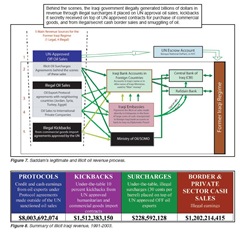
That is without breaking out much in the way of banks, institutions, individuals or doing much in the way of fine-tooth combing, save for the very highest level of transactions. It is that figure that gives and defines the highest level view of those things that are involved in OFF, but the networks that drove OFF were ones that pre-existed it and were ready to be employed in it.
The scale of OFF is not appreciated as it allowed the Saddam regime to cut its expenditures deficit and was projecting for a balanced budget by 2002 (as seen on p.15 of the Regime Finance section). While the overall budget was smaller, the immense deficit spending prior to 1995 had stopped and the economy was close to being cash solvent, save for the debt, even though its overall GDP had slipped badly since the end of the Gulf War.
What the utilization of the OFF program allowed was the allotment of vouchers to individuals, not just companies, and a large number of individuals including the head of Russia's Communist Party, Patrick Maugein, Charles Pasqua, the Russian Foreign Ministry, the Russian Ambassador in Baghdad, Sukarnoputri Megawati President of Indonesia, and even the man who ran the program at the UN, Benon Sevan. It is that corrupting influence of personal allotment vouchers, beyond the normal procedures that grew up around OFF, that would cause a serious set of investigations to take place. Further than that, a number of off-shore trades via barter were completed so as to exchange oil for goods without having a cash transaction show up on the books. This would also include things like instant sales for 'cash' outlays not paid into the banking system, but used for other off-the-books transactions.
As I have looked at elsewhere, there was another underlying strategy to Saddam's oil sales and it is described here, with a look at how some of these things worked, this from p. 38 of the Regime Finance section of the report, bold and italics in the original:
According to SOMO officials, Saddam demanded that Iraq keep the price of its oil as low as possible in order to leave room for oil traders to pay Iraq the illegal surcharges. A sales director at SOMO stated that they were instructed by the government to get the lowest price. Under normal circumstances, SOMO would have sought the highest price for Iraq’s oil, its only legal source of real revenue.
Among the companies listed in SOMO’s records as having paid illegal surcharges are some of the world’s largest refineries and oil trading companies. SOMO maintained detailed financial records listing invoices and collections for each contract. These companies, when questioned about surcharge payments, deny they were the parties that made them.
• For example, according to SOMO records, one of the most active purchasers of Iraqi crude was a Swiss-based company named Glencore. It paid $3,222,780 in illegal surcharges during the period of the program. The company denies any inappropriate dealings with the Iraqi government outside of the UN OFF program.
It is that first paragraph, where Saddam was looking for the lowest price possible, as it is 'two-fer' for Saddam Hussein. First it garners the largest possible return payment via kickbacks, surcharges, etc., which is an immediate gain for Saddam as this was how he kept his regime running. Seems about it, right? What more could he get out of this?
That is what was brought to the attention of the US Senate in 1999 by the testimony given to the US Senate Committee on Energy and Natural resources by Steve Layton, President and CEO of Equinox Oil Company, part of the Independent Petroleum Association of America, this back in the days of low oil prices:
Today’s hearing is intended to examine the current state of the petroleum industry. I must say at the outset that I have never seen the domestic petroleum industry facing a more complicated and potentially devastating set of problems than it now does. The industry has faced a low oil price crisis for the past year, but today’s problems are very different and far more threatening than the ones that began the problem.
A year ago, the price crisis was started by a combination of events – the collapse of Asian economies, a warmer than normal winter in the northern hemisphere, and ultimately a market share fight between Venezuela and Saudi Arabia. The events created a surplus of oil in the international market and prices fell. The production most at risk was marginal oil wells in the United States – wells that produce about 20 percent of America’s domestic production, an amount equivalent to our imports from Saudi Arabia. And, I might add the wells from which I make my living.
Now, we have experienced a year of low oil prices – historically low prices that threaten the very heart of U.S. oil production. Domestic oil production is divided into three general areas – the onshore lower 48 states, offshore, and Alaska. The onshore lower 48 states account for about 60 percent of total domestic oil production. The Energy Information Agency has released a recent report that over 60 percent of this onshore lower 48 production comes from independents, a percentage that has increased by ten percent over the past ten years. It reflects an irreversible trend. Major oil companies are leaving the onshore lower 48 states. Particularly since 1986 when the last price crisis occurred, major oil companies have turned their attention away from the onshore lower 48 states shutting in or selling off their production. They have concluded that these wells do not produce the volumes they need to meet the return on capital that they seek. Majors now operate in the United States primarily in the offshore and Alaska, but more and more they are seeking their new production overseas.
[..]
In fact, we would submit that Iraq now controls world oil prices. We would submit that the current U.N. sanctions program has failed on two counts. First, it has failed in its primary mission to provide humanitarian aid to the Iraqi people. Second, it has handed Saddam Hussein the victory he lost in the Gulf War. He invaded Kuwait to control oil prices; now he does and he is penalizing his enemies.
[..]
First, world oil prices are essentially set by the last barrel sold. A year ago, Iraq exported about 700,000 barrels/day. In December 1998, it exported about 2.3 million barrels/day. By March it will have another 500,000 barrels/day of capacity on line. Iraq was the only OPEC country to boost its oil revenue in 1998. As other OPEC countries have reduced production to stabilize oil prices, Iraq has become the swing producer of world oil. The swing producer sets the price.
Second, Saddam’s objectives differ from other oil producers. He wanted higher oil prices when he invaded Kuwait – money he needed to build his military forces. Now, he can’t spend money to buy arms. But, he can – by keeping oil prices low – punish his enemies, first by reducing the income to Saudi Arabia, Kuwait, Iran, and others; second, by driving critical U.S. production to be shutdown and plugged forever.
Third, looking purely at demand and productive capacity, today’s surpluses should not drive prices to their historic depths. We estimate that worldwide production capacity currently exceeds demand by about 4 percent.
As seen from the US small producers, Saddam was waging economic war against his enemies and particularly against US domestic energy capability in the form of oil production. Capped wells cannot be re-opened and must be re-drilled which means re-prospecting and looking at any changes that have happened to the intervening geological structures since original drilling. Any on-shore, domestic supplier that had to cap their wells in the 1995-2002 era while Saddam was utilizing OFF can be characterized as a non-traditional economic attack on the US to make it more dependent on foreign oil suppliers.
Namely, Saddam Hussein's Iraq.
While all of those listed that did not have direct contact with Saddam's regime could not be held responsible for being the mastermind of such a scheme, they were willing participants, each for their own objectives. Some it would be simple Return on Investment, while others would look towards debt repayment or future contracts with Saddam's regime. By utilizing his skill at promulgating self-interest in his own regime's continuation, those that helped him were critical in undermining the exact, same international restrictions that they were supposedly enforcing.
Even worse is that America's own politicians, who scurry around when the general population is being hurt by world oil markets did nothing, not one damned thing, to ensure that our own economy would not be undercut by an active enemy of the United States. All of those that sought to stop drilling in ANWR and off the coast had clear and decisive warning that bad times would come if they did not support this minor thing known as 'continued production' domestically. Being unable to support future productive needs they also ignored the warnings given of the economic attack happening right under their noses and were silent in the legislative arena. Even worse is that not a single one of those sitting in Congress then and who still remain there today have shown any evidence that much of the blame for America's inability to produce oil when it is needed via its domestic producers depends on the exact, same restrictive regulations they have promulgated. It is bad enough dealing with billionaire financiers with checkered pasts, or pro-tyrannical regime supporting businessmen, or even crooked traders willing to make a buck off of conflict. No wonder that Saddam Hussein was confident that if things just went the way they had been he would have been home free in a year or two more.
Unfortunately for him the rules have changed.
Even worse is the ones who worked this mess out of the light of day still continue their work without sanction against them. Both overseas and in the Halls of Congress.




 Supporting Friends and Allies