Showing posts with label alienation. Show all posts

01 December 2013

The play's the thing

Normally I don't do much in the way of examining plays, opera or the like, which is not to say that I haven't been to same and enjoyed them, but my ability to actually find a production that I might like and one that  I could physically attend are limited.  Generally my television watching has tended away from the norm and went to science fiction and some fantasy series, and since my troubles I've shifted from those to the so-called 'reality ' programs all of which center around small businesses.  My viewing habits have changed radically due to those programs and a subscription to Amazon Prime and owning a Roku box.  At some point I can see a massive paradigm shift in television programming where what you watch will be directly supported by you for programs that you want to see.  The concept of ala carte television, that is picking and choosing just channels you want and ditching the rest, is something that should have happened with the advent of cable television.  Unfortunately those local monopolies acted like monopolies and gave you 500 channels of which you maybe watch something from 3 or 4.  Today I have no idea how many channels are offered by the semi-competitive subscriber based system I'm on, probably a couple of thousand when you include HD channels, and out of all of those I watch stuff from maybe 5 or 6 channels.  More specifically I watch just a few series on those channels and ignore most everything else.  With Amazon Prime I can now find programs that are offered for no charge with the Prime subscription and that has meant finding presentations from television and films that I would normally not run across.  Needless to say about 98% of that is stuff I'm not interested in.  This is, of course, just a variation on Sturgeon's Law, and that is a handy thing to keep in mind when you approach any information, program, film, novel, short story... if you see a vast warehouse of material in front of you 90% of it is crud.

Of the non-crud based stuff I've run across is a set of specials from PBS, which I don't watch, looking at the historical roots of Shakespeare's plays.  Knowing a bit of history of England and being able to see what changes were made for the information to be presented as plays is fascinating.  So is the work by the actors who have just come off a particular play or are heading towards one, or who have a background in the works in part or in whole.  In particular looking at Richard II and Henry IV/Henry V was most interesting as there are so many different aspects of history that have a vital role to play in the background of that entire set of transitions between Kings.  For all the liberties taken by Shakespeare in presentation, what we get is a view of the history that was known in that period and can examine some of what was known then that may not be that interesting to the modern viewer of the works.  Yet it is not those works that are the most intriguing, but possibly the most famous play by Shakespeare which is Hamlet.

Knowing science fiction and fantasy and seeing the strong parallels drawn by authors on historical material and then presenting new material within a future or fantasy framework means that as a reader and viewer there are different ways to present material that may not be all that obvious to the average viewer.  With that said I have no strong background in all the historical productions of Shakespeare's works, so I may just be treading on an old idea, but it is new to me and a lot of fun to play with.  For me the main aspect of the play, that of the psychological development of Hamlet, is one that has been done so well, so many times, that it is hard to see how one could improve on it for an actor or director: what we have are flourishes, some modern interpretations, and a few changes in scenes that are modern in circumstance to fit what we know or think we know about human psychology.  The fantastical element of the play is limited to just those four appearances by the late King who is known in the play as 'Ghost'.

Here is one of the key elements that really struck me: the pact with the Ghost.  It is a simple one, actually, given what goes on in the play, and I'll take it from Act I, Scene V (and I'll use this copy from the Gutenberg Project):

Ghost.
Revenge his foul and most unnatural murder.

Ham.
Murder!

Ghost.
Murder most foul, as in the best it is;
But this most foul, strange, and unnatural.

Ham.
Haste me to know't, that I, with wings as swift
As meditation or the thoughts of love,
May sweep to my revenge.

Ghost.
I find thee apt;
And duller shouldst thou be than the fat weed
That rots itself in ease on Lethe wharf,
Wouldst thou not stir in this. Now, Hamlet, hear.
'Tis given out that, sleeping in my orchard,
A serpent stung me; so the whole ear of Denmark
Is by a forged process of my death
Rankly abus'd; but know, thou noble youth,
The serpent that did sting thy father's life
Now wears his crown.

A simple enough proposition, really, and it is the driving force behind the entire play.  Yet do consider that Hamlet has made a pact with his father's ghost, and the ghost has also told us just prior to this of its limitations:

Ghost.
I am thy father's spirit;
Doom'd for a certain term to walk the night,
And for the day confin'd to wastein fires
,
Till the foul crimes done in my days of nature
Are burnt and purg'd away. But that I am forbid
To tell the secrets of my prison-house
,

Strange that he is forbidden to tell of his after-life prison while just having told us of essential information of it.  Still the logic holds that at night it may roam and during day it is confined to wasting fires.  So those are the basic rules of it and on that hinges a view of the play based on the soliloquies of Hamlet which are internal monologues spoken out loud so that the audience can know what a character is thinking.  Thus a retelling centered on the pact and the soliloquies becomes a vital part of a review of the play, itself.  By putting the center on the pact, and what is the normal outcomes of such pacts in other works, we can come to a different telling in which the Ghost may make its presence felt beyond just the four scenes.

As was mentioned in the episode there have been productions in which there is no actor playing the Ghost, presumably with someone out of sight giving the lines to which Hamlet responds.  The audience is then left to decide if Hamlet is going slowly insane or if he can just see the Ghost and the audience can't.  Either way it is an effective staging for the play and allows for a view of Hamlet the Prince that you don't get with the physical presence of the Ghost.  My thought was that the best way to stage the play was to take advantage of some of those soliloquies that seem to have an internal structure in which Hamlet is speaking and then answers himself.  Thus to properly set the stage for a modern production with the Ghost as absent is to have the actor playing Hamlet record the lines of the Ghost with a somewhat lower pitch to them, as his father is usually depicted as not a frail old man but a sturdy man in his middle age.

With that established in opening scenes the actor who is playing Hamlet the Prince can now utilize the voice of his father in those spoken internal monologues and even in some of the directly spoken dialogue.  In fact it is the latter when speaking with the Players in Act II, Scene II when speaking in the AEneas' tale to Dido:

  'The rugged Pyrrhus,—he whose sable arms,
   Black as his purpose, did the night resemble
   When he lay couched in the ominous horse,—
   Hath now this dread and black complexion smear'd
   With heraldry more dismal; head to foot
   Now is he total gules; horridly trick'd
   With blood of fathers, mothers, daughters, sons,
   Bak'd and impasted with the parching streets,
   That lend a tyrannous and a damned light
   To their vile murders: roasted in wrath and fire,
   And thus o'ersized with coagulate gore,
   With eyes like carbuncles, the hellish Pyrrhus
   Old grandsire Priam seeks.'

That all done in the somewhat lower voice of his father which would be scene appropriate for Hamlet to speak in a voice of a character in a play.  It would be somewhat unnerving to Polonius, Rosencrantz and Guildenstern, perhaps, but would they truly recognize the voice of the late King transfigured through Hamlet?

Then the soliloquy just after and I will use bold to indicate the shift in voice from Hamlet to his father:

Ham.
Ay, so, God b' wi' ye!
Now I am alone.
O, what a rogue and peasant slave am I!
Is it not monstrous that this player here,
But in a fiction, in a dream of passion,
Could force his soul so to his own conceit
That from her working all his visage wan'd;
Tears in his eyes, distraction in's aspect,
A broken voice, and his whole function suiting
With forms to his conceit? And all for nothing!
For Hecuba?
What's Hecuba to him, or he to Hecuba,
That he should weep for her? What would he do,
Had he the motive and the cue for passion
That I have? He would drown the stage with tears
And cleave the general ear with horrid speech;
Make mad the guilty, and appal the free;
Confound the ignorant, and amaze, indeed,
The very faculties of eyes and ears.
Yet I,
A dull and muddy-mettled rascal, peak,
Like John-a-dreams, unpregnant of my cause,
And can say nothing; no, not for a king
Upon whose property and most dear life
A damn'd defeat was made. Am I a coward?
Who calls me villain? breaks my pate across?
Plucks off my beard and blows it in my face?
Tweaks me by the nose? gives me the lie i' the throat
As deep as to the lungs? who does me this, ha?
'Swounds, I should take it: for it cannot be
But I am pigeon-liver'd, and lack gall
To make oppression bitter; or ere this
I should have fatted all the region kites
With this slave's offal: bloody, bawdy villain!
Remorseless, treacherous, lecherous, kindless villain!
O, vengeance!
Why, what an ass am I! This is most brave,
That I, the son of a dear father murder'd,
Prompted to my revenge by heaven and hell,
Must, like a whore, unpack my heart with words
And fall a-cursing like a very drab,
A scullion!
Fie upon't! foh!—About, my brain! I have heard
That guilty creatures, sitting at a play,
Have by the very cunning of the scene
Been struck so to the soul that presently
They have proclaim'd their malefactions;
For murder, though it have no tongue, will speak
With most miraculous organ,
I'll have these players
Play something like the murder of my father
Before mine uncle: I'll observe his looks;
I'll tent him to the quick: if he but blench,
I know my course. The spirit that I have seen
May be the devil: and the devil hath power
To assume a pleasing shape; yea, and perhaps
Out of my weakness and my melancholy,—
As he is very potent with such spirits,—
Abuses me to damn me: I'll have grounds
More relative than this.—the play's the thing
Wherein I'll catch the conscience of the king.

With Hamlet there is internal structure to his thoughts that are both question and response, and even he realizes that the thoughts in his own head now settle within him to begin the process of answering to him.  With his father now an active voice there is an active role for him in the play beyond mere Ghost as he speaks to his son within his own thoughts.  Indeed for what is Hamlet but the man who would be King if all had taken its natural course?  This is something that Claudius knows and fears, and takes active steps to counter in the play, itself.  Yet Hamlet's father existed in a court where there was intrigue and Hamlet is no stranger to it, but how does one deal with such intrigue when it is pointed at oneself and has already taken his skilled father?  It would not be surprising to hear Hamlet begin to grow into the role of not just a revenging son, not just a Prince revenging his King, but as the Prince who is heir to the throne of Denmark beginning to grow out of the shell of being the young Prince.  Yet this is not Henry IV, where the son has support from a somewhat errant older fellow, but a young man who is possessed of revenge and who has revenge possessing him.  Staged like this we not only get the tormented problems of Hamlet, but also his father being in the torment with him: being there with his son is to be in the wasting fires.

The Ghost has powers not granted to the living and has already warned Hamlet about certain things, the main one is not to confront his mother.  What the Ghost can see is a future for Hamlet and is trying to find that path which will lead to the fruition of the plan and save his son, both at the same time.  Yet he can not be the one to exact the actual revenge and must have his son do it for him.  This is torment to him, the warrior king reduced to spirit in torment that must have revenge upon his slayer by the only one who would do so.  Would he not exercise any of that to be with his son as much as able to try and help him through this deed which is a revenge murder, not something done in the heat of battle?  It is the necessity of being a King to have unpleasant tasks that must be done by the King and King alone, not one that you can hand off to an underling so sensitive is its nature.  His son steps into the den where knives aplenty are turned against him and where even small pieces of advice could mean the difference between success and failure if his son but has the wits and reason to listen to the inner responses to his inner questions.  In most normal 20th century staging this is something that Hamlet must grope towards, but in such a staging as this Hamlet is guided to be that one that will exact revenge not only for his father but with some help from him, as well.  Thus this requires that the scenes be played as true to original as possible, and to strip out the 20th century Freudian conception and to turn Hamlet into someone who will start the process of revenge in a cold and calculating manner.

And yet he gets the singular opportunity to end this all after the staged play with King Claudius in prayers.  Yet, in the witching hour at night, is the prime time for the Ghost and this is when the internal monologue allows this viewpoint to come forward:

Ham.
Now might I do it pat, now he is praying;
And now I'll do't;—and so he goes to heaven;
And so am I reveng'd.—that would be scann'd
:
A villain kills my father; and for that,
I, his sole son, do this same villain send
To heaven.
O, this is hire and salary, not revenge.
He took my father grossly, full of bread;
With all his crimes broad blown, as flush as May;
And how his audit stands, who knows save heaven?
But in our circumstance and course of thought,
'Tis heavy with him: and am I, then, reveng'd,
To take him in the purging of his soul,
When he is fit and season'd for his passage?
No.
Up, sword, and know thou a more horrid hent:
When he is drunk asleep; or in his rage;
Or in the incestuous pleasure of his bed;
At gaming, swearing; or about some act
That has no relish of salvation in't;—
Then trip him, that his heels may kick at heaven;
And that his soul may be as damn'd and black
As hell, whereto it goes
. My mother stays:
This physic but prolongs thy sickly days.

This is the heart of the Ghost guidance staging: the one who points out that this is not success but grossest failure is Hamlet's father.  Revenge, you see, is a dish best served cold when one of treachery is not prepared to meet his maker but, instead, finds his death at the hands of his un-maker to bring justice to one who can place himself above normal justice.  And, really, are not these parts highlighted those of someone else speaking within Hamlet as part of the question and response that makes up Hamlet's thoughts?  Revenge can only served hot if it means justice in disposition, when there is reward to the one who has betrayed and wronged, then there is no justice at all.

At this point when Hamlet confronts his mother the idea of it happening in a space off the bedroom where personal business is transacted, letters written and talking with close friends done, one where he is coming into being as a person of revenge.  Instead of the heated bedroom romp that it was changed into during the 1920's, it becomes a focal point of coldness and Hamlet has gotten a bit too far in the role of avenging son.  A Queen has maidservants, ladies in waiting and others of the Chambers who would normally assist her and be there, but in the private Closet there is supposed to be no one who shouldn't be there.  Mind you in the heat of the moment he has forgotten his own father's warning about doing this: thus not only trying on the role of avenging son but the heat of lost opportunity drive him. 

Killing Polonius is, however, something that would be true to form for a Prince who is seeking privacy with his mother in the one place in a castle that should be private to them both.  Save for the King, of course.  For Hamlet this is not just the heat of missed opportunity but operational security and removing a listener who is a spy.  Actually that is relatively chilling and the King takes it that way as Hamlet wanted to be private with his mother and that meant no one else was to be there: not even him.  Still that gets a bit ahead of the story and what Hamlet does next, with his mother having to sit still on her chair, is listen to her son... with a corpse and, as we see later, the Ghost of Hamlet's father:

Queen.
What have I done, that thou dar'st wag thy tongue
In noise so rude against me?

Ham.
Such an act
That blurs the grace and blush of modesty;
Calls virtue hypocrite; takes off the rose
From the fair forehead of an innocent love,
And sets a blister there; makes marriage-vows
As false as dicers' oaths: O, such a deed
As from the body of contraction plucks
The very soul, and sweet religion makes
A rhapsody of words: heaven's face doth glow;
Yea, this solidity and compound mass,
With tristful visage, as against the doom,
Is thought-sick at the act.

One can picture Hamlet ticking off on his fingers: an act that blurs, calls virtue hypocrite, takes the rose of innocent love and sets a blister there, makes false marriage vows, such a deed rips the soul from the body against all religion.  Point by point he tells his mother of the case against her.  This is not the stuff of running around a bedroom, but of a judge speaking a verdict and going through the particulars in a cold, matter of fact manner that chills one to their bones.

This makes the visitation when Hamlet is disobeying his father to see his mother to be all the more important, not less, as he utilizes the deep power of the witching hour to try and set Hamlet's course straight by a direct appearance:

Ham.
Do you not come your tardy son to chide,
That, laps'd in time and passion, lets go by
The important acting of your dread command?
O, say!

Ghost.
Do not forget. This visitation
Is but to whet thy almost blunted purpose.
But, look, amazement on thy mother sits:
O, step between her and her fighting soul,—
Conceit in weakest bodies strongest works,—
Speak to her, Hamlet.

Of course this can be staged as all the prior visitations of the Ghost in this staging so that it is the recorded voice of the actor played off-stage.  The added bonus is that the one who has blunted the purpose is not Hamlet, directly, but Hamlet following the internal voice of his father.  It becomes a long list of particulars this accessory to regicide business, and Hamlet gets into it pretty deeply. But raging against the Queen is revenge and hatred somewhat misplaced as she did not do the dirty deed of killing King. 

This is why the Ghost warned Hamlet against such a meeting as it was sure to get emotional in some way, although not by the form we have come to expect in a modern staging of the play, to be sure, the confrontation is still there and extreme in its character.  The Ghost knew what it meant to kill in cold blood, it was a pretty nasty era to live in, after all, and you didn't get to the top without some large amount of bloodshed going along with it.  To do the necessary work Hamlet must now be pulled back from the brink of talking himself into killing his mother and, perhaps, starting a murderous rampage that would not properly get the King as he has too many guards.  That is the wisdom the Ghost brings in the play as it is, but in this sort of telling it becomes something quite other.

Throughout the rest of the play when there is an internal monologue or the time where Hamlet appears to reached a decision, the voice of his father would be used.  In time, as we no longer see the Ghost, the actor might, by the end, be speaking in his father's voice entirely and be the Prince prepared for the tasks of a King, even recognizing that if his own life is forfeit to the task, it must be done well or not at all.

This gives rise to a very subtle and yet potent variation of this staging, and one that plays into the heart of revenging the spirit of the dead.  It hinges on exactly what has gone on in all the regular presentations of the play in the form of the Ghost.  The Ghost is seen by others, or can be seen by others, but that is selective by the Ghost as witness in Act III, Scene V which up to the 20th century has traditionally taken place in the Queen's Closet which was a personal office.  Now if that is the case then the Ghost can also appear only to the audience and not to any of the other actors as a silent and on-stage  presence. 

That, in itself, would be a bit creepy.

What would be even more disturbing would be that at those points as I've previously outlined, instead of having the actor change his intonation of voice without his father present, would be for his father to lay a hand on his shoulder for each of those parts and for the actor to come to resolve in his own voice.  Here the guidance is direct and the audience is allowed to see the full activity of the Ghost throughout the entire play.  Castle Elsinore is the wasting fire and having to be there and during most times be unable to do much and only guide the thoughts of his son when there is opportunity would be further torment to him.  With such staging would come the actor playing Hamlet to have the voice of manhood as guided by his father, so that when conclusion comes to internal thoughts it is the learning of Hamlet of what to do in his position with so many hostile people around him.

It seems such an obvious way to stage the play that it must have been done before.  But this is not the pre-Freudian nor post-Freudian way of doing it, of course, and staged like this it would have a deep impact on any audience of any era.  Once the mother fascination is removed and Hamlet becomes dedicated to the deed of revenge, he is no longer that young man who is seeking to get himself up to the task, but one who has help to work through these questions as they are ones which not only plagued that era but all eras.  Which is why I'm sure that this is not new to me as it could have been done at any time since the first staging of the play.

Hamlet as the instrument of revenge is not done by a relatively unsettled spirit, but by one who has compassion and wisdom of experience: he was a King, after all, and the ways of being a King did not leave him.  He truly does want his son to succeed not just in the deed, but as a man and to take the throne as the rightful Heir.  His son needs seasoning, however, beyond just warfare and going after bandits and such, but to deal with the intrigue of the Court when it is running cold and villainous.  The Ghost was the man who failed at that, and he can see the many paths his son might take that lead to ruin of him as a kinslayer and Kingslayer will have few compunctions about removing the rest of the prior royal line.  While Hamlet is 'of age' and a true young man, he doesn't have that necessary depth of understanding to deal with all aspects of intrigue within the Palace walls.  He has experienced it, yes, but when a child largely protected from it and as a young man kept from it in many ways, but poor Yorick needs to be kept buried and Hamlet to deal with life and death, both after having his father slain.  And yet in the famous soliloquy there is this:

...

But that the dread of something after death,—
The undiscover'd country, from whose bourn
No traveller returns,

...

But that is not the case with Hamlet, now, is it?

09 February 2013

What is the value of... anything?

In watching the course on The Moral Foundations of Politics presented by Professor Ian Shapiro at Yale as part of their Open Yale courses, I've had one of the most interesting and entertaining courses that, for me at least, help examine the Classical and Neo-Classical realm of political and economic theory.  I've been watching this via my Roku box and they are under the Lecture Kings channel.

In the Enlightenment tradition of science, that is to say the pre-Popper understanding of science, the ability of a scientific theory to explain any set of phenomena rested on repeatability (which is to say the theory will yield the same results time after time with a set of given conditions) and that it encompassed not just known phenomena but then extended into those that were not explained by current theory.  Popper would add in falsifiability, which is to say that any theory must have conditions which, if they are met, will demonstrate that the theory doesn't work  and isn't consistent, but that is a latter post-Classical addition to the scientific method.  The great movement of science in the 17th to 19th century was that it was encompassing broad swaths of observed phenomena in nature (motion, gravity, chemistry, the movement of energy, discovering gases and the laws that govern them, etc.) that nothing seemed to be outside this realm of discovery and that since everything was a result of natural phenomena, then everything can be explained by it.  This course examines a few of the major pushes towards integration (or disintegration and reintegration) of Enlightenment understanding to the realm of economics and politics.  From this the major movers and culmination of schools of thought are seen as they base their foundations on Enlightenment understanding.

The benefit of watching such a course where it can be paused while seen by more than one person is that ideas can be caught as they are presented and examined as they come up and then see where the at-home analysis goes between individuals and where the class goes.  And while there was some of that going on with the post-introductory seminars that dealt with Utilitarianism, when the class moved on to Karl Marx the amount of discussion was making a system of watching for a few minutes and then talking about each part of Marxist views as presented.  I've written about my views on Marx and socialism before and had only the background of being in a family where my parents were Scientific Socialists that tried to adhere to the First International and generally had disdain for the later International Congresses.  That gets you crunchy on the road sort of view of Marx and his ideas, not just as they were presented by himself but also as interpreted through a certain lens of understanding.  I do have a bias on Marx coming in, no doubt about it, but I can be persuaded by rational thinking that actually attaches itself to the real world utilizing scientific methodology to do so.  Marx, it was obvious, hadn't bothered to learn the scientific method or actually talk to any scientists on things like gravity, chemistry or even learn about the calculus and how infinite progressions are utilized to yield answers and that when certain equation formulations appear they can never be answered.  Plus his early upbringing in what can be described as Generation I capitalism would leave only a certain set of trends open to Marx which would be later shifted by Gen II capitalism of the late 19th century (that era in which some of what he predicted came true, but others did weird things with capitalism that would have been pure magic to Marx).

From the presentation of a few sessions discussing Marx's view of the economy and man's place in it, I've found that the non-scientific nature of Marx's methods and lack of any touchstones of real world examples to then raise issues that aren't just Third or Fourth Wave criticisms but ones that could have been pointed out to Marx in his own time, or that he could have discovered just by looking around.  Indeed if you are using the Hegelian Dialectical method and utilizing it for Materialism, then it is best to use material when utilizing the method.  And, as a side-note, Hegel was using the Thesis leading to Anti-Thesis (or reversion towards the old order) and Synthesis (arising between the change and the reaction against it to form something new) as a means to demonstrate that the pinnacle of government for man was that of the Prussian State.  It is a methodology used towards that end and even when generalized the way the methodology was created and utilized must be acknowledged as having some inward bias to it.  Marx applied this methodology (not Hegels actual argument, just the way he argued his case) to all of human history (because if the methodology had past utility in explaining events then it must have some future utility) and found that mankind was on the cusp of creating a new order that would transform from a capitalist to a socialist society and then dissolve the State in a communist society. 

In other words he uses Hegelian Dialectic methodology to come up to a conclusion that goes beyond Hegel and shows him to be wrong... unless the Prussian State of the early to mid-19th century truly is the perfect governing State for all of mankind, in which case Marx is wrong. In any event the Hegelian Dialectic has a presumption of a 'forward' motion in social change, that is to say that changes within societies have a direction over history and that changes from the norm of society then get a pull back towards the norm and the synthesis point incorporates some of that 'forward' direction.  As a method of historical analysis this form of logical argument has counter-arguments in the known post-Roman Empire Dark Age, which was known at the time, and other counters to it seen not just in the European region (the late Bronze Age collapse is another example of such a period), but in Mayan culture pre-Columbian contact or similar episode in Japan (the closing of Japan by the noble and aristocratic class) or China both of which had societal systems that did not put any real value on 'progress' outside of the military realm and even that had a limit in Japan.  Problems with Dialectical analysis of societies are immense and utilization of it as a system of analysis is one heavily fraught with the dangers that the system misses.

The methodology of Dialectical Materialism is one used to examine an end-state of society and government by using the Dialectical method and applying it to economic and political realms.  This is a key part of Marx: he is getting to a end-state, no change possible regime, aka 'the end of history'.  Utilizing the methodology of the Dialectic, then, appears to be one to reach an end-state based on what you know, without regards to what you don't know.  Thus any change that comes from outside of the realm of the Materialist utilization of the Dialectic, which is any information outside that of the writer (Marx) during the time of the writing will have unknown and unknowable effects upon the initial conclusion based on a set of assumptions or observations. 

A first major assumption of Marx is that all that is known about the economics of capitalism of his time are true, are the entirety of capitalism, and that anything that derives from this known base is a mere variation within the known structure and that there are no external factors that will play into this structure at all.  It is an end state methodology, after all.  Yes, that is part of the objective perspective that Marx brings to the table and the claim he puts forward is that those inside the capitalist system have no idea of how it truly operates and that only an objective observer can have that or that the workers will finally gain that and end capitalism once it reaches its self-evident conclusion.

There are two major parts of capitalism that Marx is examining in the use of the Dialectic and they revolve around the conception of 'value' and that the observed phenomena of the decline of profits was universal to capitalism as a system.  Utilitarian thought puts cost of something, and thus its 'value', as a marketplace concern which is met at the price point of supply and demand.  Marx tosses that out and puts forward that there is a natural value to any commodity (that is a good that can be sold) and that this 'value' is invariant.  There is a price paid for that commodity at any given time, but there is a true inherent 'value' that resides within the commodity once it is made and that is different and stable as compared to pricing at any given time.  In the capitalist system (actually in any system) there is a required amount of unrecoverable cost (be it in labor or raw materials) that once it is compensated for you can't get back which is a sunk cost which is not the same as 'value' in the Marxist conception of things but has a direct relation to his argument as a whole. 

As the capitalist system is about selling goods at a higher than production cost to gain more than that current sunk cost (and above the natural 'value' that has been put into that commodity because its current 'value' in production cost is above its future 'natural value'), the question of 'where does this excess value arise from?' comes from Marx.  This is then utilized to put forward that there is only work value in any commodity and that 'value' can only be created by work, therefore any worker is not getting their true work 'value' from the exchange of labor for a wage.  As capitalists compete with each other they cut profit to get a leg up on their competition and this is done via exploitation of the workers (and this is not done in a pejorative sense but a 19th century sense of exploiting natural resources or exploiting one's time to good ends conception).  Efficiencies are developed which are done through the realm of increased capital cost to the capitalist.  Profits decline as the number of goods rise and their price declines, therefore the wage of the worker must decline to increase profits.

Now lets step back from this for a moment and take a quick look a the Labor Theory of Value, which Marx puts into the conception that all commodities that are sold have a natural value inherent in them that is reflected by the amount of labor to get that good.  That is the true, natural value of a commodity.  There is a problem with that as this is normally defined as a sunk cost to get to that end product. 

There is a sunk cost that goes into production via the utilization of capital (which is made via labor, of course) which is purchased at a subjective value based on what the buyer is willing to pay and what the seller is willing to take for that item.  A sunk cost is the paid for amount of time, energy and materials to get a produced good to any stage in its production and that cost is paid for at that time (or within increments of it as in paying a worker for a week's worth of work).  That asking price for a commodity can be equal to, higher or lower than the sunk cost in making that commodity at the instant of transaction.  The value of that commodity is then placed at that instance in a subjective manner, which is to say that the worker is paid for the work time at the instant of payment and a seller is paid a negotiated price at a similar time for a commodity. 

This is a critical weakness in the conception of an inherent 'value' of a commodity as the actual value of a created commodity can and, indeed, does change over time with the majority decreasing in value but with other items actually increasing in value.   The cost for that commodity is always an instantaneous one and encapsulates the entire chain of sunk cost up to that moment of sale.  A worker in the pin factory, to use Adam Smith's example in Wealth of Nations, gets paid for the work put in to draw out pins of a certain diameter and length and that pin, at that place in production, is not the entire pin, not useful as a pin and is only a part of the process of making a pin.  There is 'value' to that work and the worker is paid for it via the time incremental payment system.  For the object that will become a pin that is then part of the sunk cost to get it to that point in time. 

In that instant before it has been sharpened, the end pressed down, the pin head place, the pin polished, then put into a paper roll, etc. there is very little actual value to the piece of drawn wire that has been cut: it isn't a pin nor is it of much use outside of the pin factory setting.  Indeed those pieces that haven't been properly sized are put aside and sold for scrap value which is generally the open market value of the metals involved by weight.  If Marx complains about where all the excess 'value' goes for sales of commodities, then why no complaint when 'value' is lost via waste, pieces not well made and so on?  If work is the paramount achievement of creating 'value' then what happened to that 'value' when such pieces have no greater value than raw metal stock that has very little value added to them?  Even with automation there are still pieces that do not come out right, that have flaws in them that do not allow for them to be utilized and other defects that cause them to be cast aside for mere raw value or less. 

Why is the inherent 'value' of such an item less than its perfect counter-part as they both have the exact, same amount of labor time in them?  Is the labor value added to it zero?  It has a sunk cost that must be recouped as the labor has been paid for, so if capitalists magically create money out of thin air (or are stealing it out of the true 'natural value' of the work represented in a commodity) then how can the inherent value of a flawed piece lose the work value that has been imbued in it?  And if the capitalist is recouping some of that labor 'value' by raising the price of other pieces, then that is because he must then over-value those pieces to recoup the lost 'value' of pieces that cannot be sold.  A great push to move such lost pieces out via inspection and other means increases overall production cost, adds little value, and yet helps raise the number of items produced which helps to defray those incremental cost increases (all sunk costs as they now happen to the perfect and imperfect alike) via increased production of higher quality items acceptable in the marketplace.   What is the actual 'natural value' in the Marxist conception for those objects that don't make it? And if their 'value' is transferred to those that become actual commodities, then how does that labor 'value' get put in those finished pieces from out of nowhere as that was not labor performed on them but on pieces discarded and sold for less than their added labor 'value'.

One cannot even say that there is a true 'natural value' that is at some average between the high and the low for that class of object as the low is zero, the high an unknown, and the next pricing valuation will be based on a set of valuations that are not based on labor cost.   The value of labor, then, is what someone is willing to pay for it as a sunk cost to produce a commodity and is only paid in expectation of what can be gained via sale of that item.  An individual worker who gets paid at the instant for making something is not paid the value of the item, but for the value of the work done to the item with regards to how much skill is necessary to make it.  Marx, however, doesn't see it that way and prefers that there is an inherent end 'value', a 'natural value', to any human produced commodity: value accumulates to the end of work on an item and is always embodied in it.  That process of accumulating work on a commodity is seen as having the 'value' of what it takes someone to make it, but that the process of making it in smaller steps is a value cumulative one.

This is why there is a division of labor, as explained by Adam Smith in Wealth of Nations, is one so that a pin making factory can churn out tens of thousands of pins a day (all set in paper, a set number per box and a set number of boxes per crate) while if each worker had to do the whole process on their own the output would be dozens not tens of thousands of pins per week.  Marx puts forward that such division of labor is alienating man from his natural self and capabilities.  What it is doing via that process, however, is allowing easily learned separate steps to put less sunk cost in per piece so that the entire amount manufactured has a lower cost associated with it.  The ability to recoup cost, add in other overhead (factory maintenance, heating, cooling, maintenance of equipment, etc.) plus some additional amount known as 'profit' to pay investors a fraction of what they have invested back for the risk they are taking, plus to pay the actual capitalist a wage or salary.

Marx is not about rewarding risk, from what I can see of his conceptualization of an end-state system, but about meeting 'needs'.  Because 'natural value' is accumulated in commodities, the capitalist system will build up a huge 'value' that then will allow for its demise as that 'value' will meet the needs of everyone.  Before the end state there is a socialist period in which the problems of politics and the State are addressed by the workers who have removed the capitalist system and then remove the basis for the State and dissolve it so that a final communist system can arise.  This system will end the division of labor and heads towards a piece in The German Ideology (1845) in Part I, A, Section on Private Property and Communism (Source: marxists.org):

Further, the division of labour implies the contradiction between the interest of the separate individual or the individual family and the communal interest of all individuals who have intercourse with one another. And indeed, this communal interest does not exist merely in the imagination, as the “general interest,” but first of all in reality, as the mutual interdependence of the individuals among whom the labour is divided. And finally, the division of labour offers us the first example of how, as long as man remains in natural society, that is, as long as a cleavage exists between the particular and the common interest, as long, therefore, as activity is not voluntarily, but naturally, divided, man’s own deed becomes an alien power opposed to him, which enslaves him instead of being controlled by him. For as soon as the distribution of labour comes into being, each man has a particular, exclusive sphere of activity, which is forced upon him and from which he cannot escape. He is a hunter, a fisherman, a herdsman, or a critical critic, and must remain so if he does not want to lose his means of livelihood; while in communist society, where nobody has one exclusive sphere of activity but each can become accomplished in any branch he wishes, society regulates the general production and thus makes it possible for me to do one thing today and another tomorrow, to hunt in the morning, fish in the afternoon, rear cattle in the evening, criticise after dinner, just as I have a mind, without ever becoming hunter, fisherman, herdsman or critic. This fixation of social activity, this consolidation of what we ourselves produce into an objective power above us, growing out of our control, thwarting our expectations, bringing to naught our calculations, is one of the chief factors in historical development up till now.

In the communist society not only is all labor equal, but everyone can do all labor equally well.  And since all of those things are labor they deserve equal consideration and equal valuation because all labor is equal and done equally well.  With this being the case all will be treated exactly alike, that is in a 'fair' way about their labor so that all can have their needs met.

Do note that the capitalist system is attempting to provide for the needs of workers via labor exchange, which is to say that the workers can garner enough from their labor value to then get food, water, clothing, etc.  Their needs are met via work through the medium of exchange of value, but the actual value is placed higher than the 'natural value' of the labor involved for a commodity.  In doing so value is accumulated via the capitalist, which then has that system overthrown and after an intermediate socialist period that capital survives to meet everyone's needs.

This leads to the famous passage in the Critique of the Gotha Programme Chapter I (1875) (Source: marxists.org) which reads as follows:

In a higher phase of communist society, after the enslaving subordination of the individual to the division of labor, and therewith also the antithesis between mental and physical labor, has vanished; after labor has become not only a means of life but life's prime want; after the productive forces have also increased with the all-around development of the individual, and all the springs of co-operative wealth flow more abundantly -- only then then can the narrow horizon of bourgeois right be crossed in its entirety and society inscribe on its banners: From each according to his ability, to each according to his needs!

If you don't believe that thinking about fishing and fishing are equal in value, then you have a problem with Marx.  In his conception of the world that is the case, where having the idea of going fishing (or hunting, or farming) is the exact same value as doing these things.  That is because we are all so productively abundant in our co-operative creation of wealth!  Yes, by just thinking about creating wealth you can create wealth.  See, isn't that a great place to be in?  Labor has changed from a requirement to survive to a mere want that you contribute to the collective and then you get back the necessities to survive in return.  No man's work is better than any others, no man's ideas are better than any other man's ideas, and, really, if you are that far along in history there is nothing left to discover, explore or innovate since that all was done under capitalism or maybe socialism.  Remember you are at the end state of history here and back to mere necessities and needs, and wants are nice things but, really, with just a bit of wanting to survive you contribute enough to survive because of the big, heaping, left over value that capitalism has graced you with.

Sounds a bit like The Matrix, doesn't it?  Yeah its called 'dystopian fiction' for a reason.

Isn't it lovely how egalitarian mankind comes once he finds out that 'we are all workers now?'  The process of that change?  Recognition you are a worker!  Ending capitalism and putting in the temporary state of socialism!  All your needs will be met!  You shall be happy!  Don't worry about all the blood on your hands and under your feet to get to this place, you are so much more advanced for doing that.  Luckily you have all that capital for free, once you get rid of the owners, and it produces products with no oversight, no inputs, and no requirement of actual labor... of course you don't need any more of those things since you can do very well with what you have, right?  And work done by the daydreamer, the tinkerer, the baker, the surgeon, the physicist... why anyone can do that work equally well without missing a step.

And those things known as 'consumables'?  You know the stuff consumed to keep you alive, the stuff used up to keep things running, the stuff that wears out and needs to be replaced? How, exactly, is this end state society different than our hunter-gatherer forebears who actually did have to know a wealth of skills, do them better than average and actually keep themselves alive with a roof over their head?  Doesn't that also fit the definition of this communist society, as it also has goods passed down generation to generation with being able to make-do or do without when something breaks?  How quickly does wanting to hunt, fish, sew, etc. become survival requirements once the automated equipment breaks down and there are no easy to get spare parts and no one left who actually has bothered to work on those machines left over from the capitalist era?  Who wants to be the mechanic with little to do when you can be the artist, the critic, the cynic and the socialite?  Even assuming the food comes from bacteria (with yummy blue, yellow and green varieties and happy red every other Friday) as we know any and all things made of nature are bound by its laws and entropy is a leading one of those.  What is made does not last forever, stored value decays as nature reclaims it through her work upon all things.  That great pile and store of 'natural value' is stuck facing up to its own nature and ours.

To sum up this end state of mankind as seen through Marx has a number of problems that stretch into infinity.

It has a problem of what 'value' is in compared to current cost, and imputes that there is some 'natural value' of a made thing that is pure, separate and independent from the cost of making it, that the labor value is over-priced to gain profit and that profit is created by exploitation of past labor, not paid off by past and current labor (with expectations of future labor) combined.  That is if all the workers can't buy what they produce now, could they buy all that was produced, say, ten years ago?  Profit comes from a delta of past cost sunk into making a commodity, and it is paid for not just with current value but with a delta between past and present value and an expectation of future work value added into the economy as a whole.  Those payments for labor have already happened for the pure present and near present, and there is the expectation of continuation of it in the future.  You paid more for your car or house than its then current value, knowing it will actually decline in value, but paying it off with future labor.  The actual value of the item will be far less than you paid for it with extra, but you have had the use and utility of it in the mean time that helps to defray that cost and, indeed, continue your livelihood.

It has a problem of marginal cost of maintenance which, while marks accounts for it as 'social capital' it is a hand-waving gesture to acknowledge that this vast area has a cost all its own that increases with the complexity of the original cost of procurement.  You can't use the stored natural value from capitalism to keep it running, and that means that people must run it because the loss of any of those systems for even a short period means that the entire edifice will begin to crumble.  It is at the margins that great Empires first erode on the way to collapse, and no matter how egalitarian a system is, no matter how much 'value' is laying around, the present demands maintenance so you can have a future.  The reason for the hand-waving criticism is that someone, somewhere, who actually has some understanding of the vast and complex set of systems involved must be the ones to not fritter their days away with artwork, fishing, and other work 'wants'.  Very quickly those people, because of their skill and application of it, are the ones making decisions for everyone else. 

It has a further problem of convertibility of skills, knowledge, intellect and actual physical labor.  Truly if everyone can do everything, in turn, where does this repository of skills, knowledge, intellect and actual ingenuity and perseverance come from?  And as skills actually build up neural structure as they are used, what is the likelihood that anyone can pick up a skill and have equal capacity of it?  Even if you could do that, could gain all of this in an instant, what is the point of it when it is the time, energy and love one puts into gaining and honing skills that is a major reward for seeing the differential in outcome for the better over time.  It is that dedication that builds up self-worth and a value that isn't reduced to labor, yet even with the best of training, the best of repetition, the best of all possible capability that one puts into a skill they just may not be very good at it.  That entire division of labor business has a point beyond just nature granting some gifts while not granting them to others.  The actual derived value of such a gift is its self-discovery, enjoyment and utilization of it and appreciation of it from others beyond just monetary rewards, yet it is that 'starving artist' that receives the spur to create masterpieces: name the royal, noble or aristocrat that was as good as da Vinci, Picasso or Rembrandt and you will have named an anomaly, not the way of art.  Similarly Einstein's most productive year of four ground-breaking papers was marked as a 2nd class engineer at the Swiss Patent Office, and his recompense in the immediate sense was whatever the payment was for that job and the four papers.  Is that in any way a measure of the labor value he was paid for?  That inquisitive mind seeking answers may not yield immediate results, indeed it may not yield ANY results if the question just can't be answered, yet to Marx that is all productive labor value in an advanced communist system.

It has the problem of actually finding an end to science, answering all its questions, answering all questions of theology and metaphysics, and discovering literally every means there is to produce and advancing it to the highest stage of production.  These are not 'nice things to have' but are end state requirements to have communism as Marx describes it.  To date while there have been physicists who have said they think that there is a decrease in question feedback (answer one question and you get ten more questions is the concept), but that is not pointing to any short-term end of scientific discovery.  Indeed in Marx's time there were those declaring the end of science with all that was known about heat, radiation, steam power, chemistry, biology and electromagnetism, yet it didn't happen.  Creating atheistic communism is not an end to theology as the causation of all things then stands with no starting point and, even as we have seen in current science, a starting point may not even be a true starting point for everything.  Getting a coherent meaning of life to ourselves, as individuals, a great goal of the Classical movement, gets no closer by removing God from the equation as it still leaves a void in that place.  And if what we are coming across in modern physics is any indication, then that search for meaning must start taking on realms that are hard to describe or imagine, but are perfectly allowable by what is known of nature.  The questions of those artifacts of nature are things that can only be answered in the 'how' way by science, not in the 'why' way: how does it work vs. why does it work.  To get to communism all of these questions must have a definitive answer and for many we haven't even started to ask the questions or know just what it is we should be asking.

It is the problem of non-closed systems for economics, because capitalism works best with natural resources to find and utilize, and then use at the cheapest possible competitive rate and create commodities.  The Earth is not a closed system.  Nor is the Earth-Moon system.  Nor is the solar system.  Nor the Milky Way galaxy.  Nor our local cluster of galaxies.  Nor our super-cluster of galaxies.  It is at that, truly universal scale, that you might, possibly with lots of provisos, have a 'closed system'.  And we haven't even produced widget #1 from the Moon yet.  Yet.  With the groups now at work to get to the Moon for useful exploration and others to bring an asteroid into Earth's orbit to begin orbital engineering, mining, and manufacturing, we stand at the cusp of opening up the solar system.  That is why the efforts of all socialists and communists is to stop human advancement into space: it destroys the chances of ever seeing a communist system evolve in timeframes less than centuries, if ever.

Finally there is the problem of human nature, to work not for one's own good but for the good of others as the basis for work.  By getting necessities provided for there is no reason to work harder, longer, innovate or do anything to improve one's lot because the effects cannot be concentrated due to skill, luck or anything beyond corruption of the system.  Thus capital doesn't accrue, it is maintained and probably not all that well once the individual work incentive is removed.  To state that the grand recognition that 'we are all workers now!' will change mankind is akin to saying 'when Jesus arrives we will reach the Promised Land!'  It is a theological statement about something shifting the very basis of human nature by singular awakening and it can neither be proven nor disproven.  That means it isn't a scientific conclusion, but a theological one based on ideology.  As there is no precedent for such an event, no prior happening similar to it, it requires a singular event which has never happened before in history... like Ray Kurzweil's singularity promises.  Point to those, if you like, but a combination of trends like this actually has precedent at a smaller scale, in inventions and changes in how we think about things (like light and combustion) that take time to play out.  Even with the hyper-acceleration of the modern age, that is for knowledge, not wisdom nor insight into the nature of man.  Knowledge is great stuff, don't get me wrong, but wisdom it ain't.  In fact if you take a look at how leading a prudent life, not overspending, preparing for a rainy day, being a service to others as a gift not a requirement, as touchstones of wisdom and how to lead a good life, then we have actually backslid on the foundations of wisdom to lead a good life.  The Romans lost wisdom as they expanded so the very firm basis of a republic that actually allowed the Empire to form could not survive when its citizens slid into depravity and debauchery.  At the height of its power its people were no longer the force to sustain an Empire and it fell, quite hard.  If that is an antecedent to the modern age, then we are in deep, horrific trouble and nowhere near what is necessary to transform into some Marxian new man for the post-capitalist world.

Necessity is the mother of invention and when all your needs are met then it is Prudence, our handmaid of conscience, that reminds us to put away for that rainy day, to make sure you have extra in case of disaster, to prepare in case tomorrow really isn't a better day.  When we heed her influence we can be altruistic in helping others and create a better society that can sustain itself.  Marx removes necessity by bare provisioning, locks up Prudence in a dungeon, and tells you that you shall be altruistic because it is required.  Maybe Marx is right... but tens of thousands of years of human nature point to a different outcome.  And we have already seen what happens when you try to force this new man to arise, and it isn't a happy nor pretty sight, and the word tyranny doesn't do that state justice for how low it has sunk.

19 February 2011

Who these people are

If you are an American you surely remember the term that went to the Nobility in Great Britain and, indeed, many other Kingdoms and Empires. It was, generally speaking, the entire class of Nobles from the highest to the most petty, and their functionaries and followers. Together they considered themselves divinely gifted to lead their Nations. These were the people who may have inherited wealth at the very upper-most crust, but further down they subsided on what the serfs and peons could provide. They feel entitled to their public monies and privileges.

Bill Quick has a nice letter from Thomas Jefferson on debt in which Jefferson looks at this sort of situation, and I will excerpt just a bit of it:

To preserve our independence, we must not let our rulers load us with perpetual debt. We must make our selection between economy and liberty or profusion and servitude.

If we run into such debts as that, we must be taxed in our meat and in our drink, in our necessaries and our comforts, in our labors and our amusements, for our callings and our creeds, as the people of England are.

Our people, like them, must come to labor sixteen hours in the twenty-four, give the earnings of fifteen of these to the government for their debts and daily expenses; and the sixteenth being insufficient to afford us bread, we must live, as they now do, on oatmeal and potatoes, have no time to think, no means of calling the mismanagers to account; but be glad to obtain subsistence by hiring ourselves to rivet their chains on the necks of our fellow-sufferers.

Our land-holders, too, like theirs, retaining, indeed, the title and stewardship of estates called theirs, but held really in trust for the treasury, must wander, like theirs, in foreign countries, and be contented with penury, obscurity, exile, and the glory of the nation.

This example reads to us the salutary lesson that private fortunes are destroyed by public, as well as by private extravagance. And this is the tendency of all human governments.

Those living at the private expense for public government and putting the people in debt to them is, indeed, a plague of the ages.

There is a term for these people.

From Webster's Revised Unabridged Dictionary (1913) via die.net and I will bold a few pertinent parts:

Aristocrat \A*ris"to*crat\ (?; 277), n. [F. aristocrate. See
Aristocracy.]
1. One of the aristocracy or people of rank in a community;
one of a ruling class; a noble.

2. One who is overbearing in his temper or habits; a proud or
haughty person.


A born aristocrat, bred radical. --Mrs.
Browning.

3. One who favors an aristocracy as a form of government, or
believes the aristocracy should govern.


His whole family are accused of being aristocrats.
--Romilly.

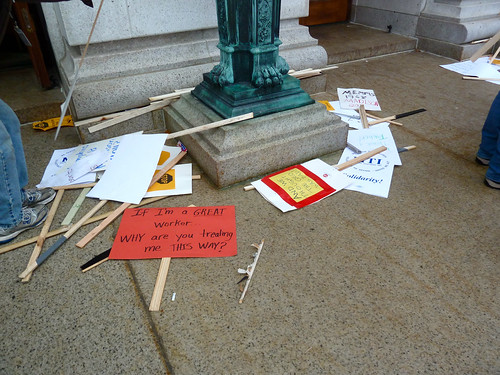
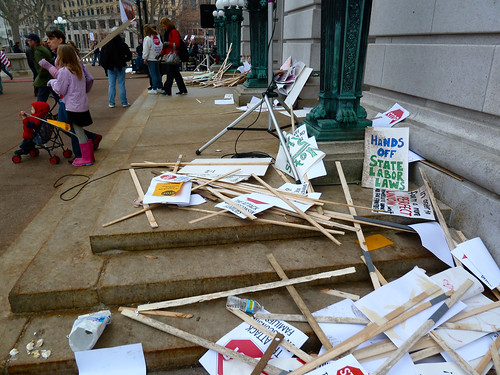
Do you see the signs of those teachers going on strike in Madison, WI?

Courtesy: Legal Insurrection


These signs are by the 'educators': teachers and their Union affiliates.

What are they protesting?

Cuts to their benefits during one of the longest lasting recessions heading into a depression the Nation has known in decades.

Why are they protesting?

They feel entitled to benefits at the expense of the public. Not the loss of jobs, mind you, just benefits.

What do they want?

They want their Union to strong arm the representative government of all the people in Wisconsin to the benefit of the minority who work in the public sector.

What do we call these people?

Aristocrats.

What form of government do you get if they 'win'?

An aristocracy.

How do they treat the public square?

P1060551


P1060545

Photos Courtesy: Ann Althouse

Cleaning up trash is for the 'little people', you see. Or just make-work for their fellow Union employees... either way you cut it, there is no regard for the public square nor the public government.

What is the class of people who could care less for the public welfare so long as they get the benefits of a hard earned dollar made by someone else?

They are the Aristocracy.

The deal with public sector unions is this: they are attempting to leverage the few over the many while those few have a direct say into their employment situation not only via the franchise right but by being able to seek redress from government via individual petition.

By seeking to force government to their ends, they are putting forth that they are perpetually entitled to the public benefit and ever rising expectations by those doing the forcing to extract more and more from their hard working fellow citizens. They are trying to divorce themselves from the hard working citizen by utilizing the public taxation so as to take those funds earned by making products and providing goods and services in a competitive marketplace for benefits and jobs in a non-competitive civil service. Unlike private employers, those working for the public have a direct say in their condition via the ballot box and by seeking individual redress of government.

There is no rationale, at all, for public sector Unions.

Zero.

Why?

Do you really want an over-educated, under-caring Aristocracy that feels free to call in sick on the public dime to trash the public square while venting their spleen and utilizing hate-filled rhetoric and impugning representative democracy, thereby? The residents in Wisconsin PAID for that via their tax bills.

Is this really what you expect in return for paying your hard earned dollars to government and seeing that the government has not laid off a single one of these people and are only threatening their BENEFITS?

Because if you are ok with that, then you are a serf.

And you are forging chains of your own servitude to government by countenancing this activity at your expense.

28 August 2009

Rise of the Ghouls

To honor the dead one must, indeed, respect the time of their passing and give latitude towards those in grief so that they may properly mourn the deceased.  While I had very few points of agreement with the late Sen. Ted Kennedy I do respect and honor the dead.

For those who attempt to exploit his death for purely partisan means, to add his name to this bill or that project, I have the same answer as to those who were putting President Reagan's name on so many things: I remember when a wait past a person's death by a decade or more before doing so was customary so that we could, truly, appreciate if a man was dues such memorials and honors.  A small shrine is one thing, as it gives a central point for mourning and remembrance.  Use of public power to anoint that name upon bills or structures is another.  It is ghoulish to do so for purely partisan reasons, and those who want such things are doing no honor to the person involved or their Nation.  I do not like it for people still alive, as is done with so many pieces of pork legislation, nor for those recently deceased without giving the public time to determine if an individual is truly great for all generations to remember, or just of passing fame.  If truly great, then a decade will not matter as a permanent spot would be given in history.  And if not, then there has been waste of time and effort and others that could be memorialized were not to get such passing fame put in place.  I have called the unhealthy fascination with the late President Reagan as an individual a form of 'necrophilia' and it is when a party tries to put forth the star power of a dead individual and ignore his policies that he put forward to get him to office.  The concentration on the charisma, although fine for Hollywood gossip columnists, is an unhealthy thing for a political party in a republic.

When those who eulogize the dead do not weigh the good and ill of the life of the deceased, I know that I am hearing not only well wishing and not wanting to speak ill of the dead, but the inability to say those negative things and say that they were part of an entire man, and that if we exalt the good then we must also come to terms with the bad.  For such legislation that he got passed that helped the Nation, Sen. Kennedy deserves our respect, honor and gratitude.  For leaving a young woman to die in icy waters trapped in a car and seeking no help to rescue her, he deserves our incredulity, disdain and serves as an object lesson of how not to act as a person, as a man.  These can be weighed, the good and bad both spoken, and say that the sum of this man's life was that of a flawed man, imperfect in many ways, laudable in some, but that of a man, nonetheless.  He would not face civil justice nor judgment for what he did and used power and influence to escape it, and that is the mark of no Lion at all but of frail, imperfect man who sets himself above the law by his actions.

To leave a person who trusts you to die without seeking as much aid as possible TO help, is dishonorable in the extreme.  To suffer no justice for it, and account for yourself is to set yourself above society and its law, and that is not the act of a citizen, but of aristocracy, royalty and nobility.  Save that under Common Law there is no one who is not to hold themselves to account for their actions under the law.  That corrosive effect of using power, wealth and influence to escape justice not only sets one apart from the law, but degrades the law for all citizens.  What is the use of making good laws if those making them feel they are immune to its actions?  Sen. Kennedy, in that instance, demonstrated why the law is necessary for all people: the powerful can use that power to escape it and get away with acts that no ordinary man could do.  What one gains is not fame and respect, but infamy and disgrace. 

No good law can make up for that when put down by the very one that seeks to escape its scrutiny.  No representative democracy can last long when the lawmakers set themselves above the law.  In that Sen. Kennedy was but an indicator of the wider corruption in the legislative branch, which has seen fit to exempt themselves from many laws that the rest of the public must abide by.  Those that seek to distract from the rot they feed on, to laud one who had active disdain for the law as a legislator, they, too, are Ghouls feasting upon the corruption of the public body and saying how good such rot is as they ingest it.


The US Justice Dept goes after the CIA and those in charge raise no fears of what this will do.  Fault lies in the fact that the CIA is a civilian entity given needs that, before our modern time, were carried out by the military either overt or covert.  When a Japanese Admiral came to espy Pearl Harbor he did so quite openly, and none molested him.  Espionage has ever been a game played by Nations and many who were not of any military were recruited and put into harms way to gather INTEL.  And for that they would fall under both civil and military law and understand that what would garner them a prison sentence at home would garner them a death sentence from our enemies.  When we ask our citizens to go 'undercover' during any war, we are asking if they want to die for us in what they are doing, for the very act OF espionage DURING wartime is a DEATH SENTENCE when captured.

Our modern enemies, these that fight Private War against our Nation, they do not abide by any law and put themselves above all law to say that they will determine the fate of all mankind.  They say so.  Openly.  Repeatedly.

The Law of Nature is that which is in all of us as we are all creatures of Nature.  When we create society we learn to put our negative liberties to use to protect us from Nature and those other societies that mean us no good.  There is no benefit to keeping them, as one man would then be able to set all of his people to war on a whim.  We regularize this process, gain input from society, weigh matters of war and peace and let our representatives know where we stand and they speak for us.  Governments represent their societies even when that society has no say in that government: Kings and Emperors all acknowledge this.  Under the way of the Common Law do we hold these actions accountable to the people so that no leader, no King, no President in a Common Law system is above the Law and neither is any Legislative body.  So to are all the organs of government responsible to the society that they are part of for the limited powers they are granted.

I have heard much of how our society will fall from grace nearly instantly if we do not bend over backwards to treat these ones waging Private War under civil courts.  Their activities put them at risk for two forms of justice: military and civil.  That is no 'double jeopardy' as their actions fall into both realms and each has different distinguishing characteristics to them.  The civil law concentrates on civil society and protections via due process of law: the accused has the right to a jury trial and the full protections under civil law.

Military law is a different realm, however, and it is not one of evidence gathering and weighing rights versus liberty.  It is weighing actions versus the protection of the entire Nation, of society and all its organs as an entire thing.  This is not the realm of 'international law', either, although it can play some role in this.  We pursue military ends when the civil means have fallen far short for our needs.  They have fallen far short.

In 1993 Mir Amal Kansi would murder CIA employees as they waited at a signal to turn into the CIA facility in Virginia.  We treated this as a mere civil mass murder, not as an act of warfare upon our Nation's civil servants.  We were wrong to do so.  We would pay a price for that.

In 1993 the World Trade Center was bombed by an alliance of Islamic Radicals.  We pursued it as a civil matter and that did not put an end to these groups or their actions.  We were wrong to think that a bombing done as a military action deserved civil response.  And we would pay for that oversight.

In 1993 the attempted Landmarks Bombing plot was found to be run by one of the men held in civil jail for the WTC bombing.  Through good luck we found out about it before it happened.  If he was in military custody as having waged Private War against us, he would not have been able to do so.  He would subvert his lawyer to help his cause.  The price paid for not treating him as one waging Private War goes on, to this day.

In 1996 we would see our military personnel attacked not once, but twice by Private War groups.  Saudi Arabia would drag its feet in helping us when we made that a civil matter, and then sequester one of the known operatives from us and execute him.  For his attack upon their soil, they had every right to do so.  As they had openly hosted the US forces in their Nation, they did not allow our Nation to find out the perpetrators so we could respond militarily to this military attack.  For that perfidy and lack of hospitality on the part of Saudi Arabia, we would pay, and pay dearly.

In 1998 our Embassies in Kenya and Tanzania were bombed.  We did not treat this as any Nation should, as an act of war upon sovereign soil in extraterritorial enclaves.  Embassies are foreign soil and this is understood going back more than 2000 years.  As it is guarded by the US Marine Corps, it is an attack upon our military.  We would treat this as a civil crime and not the acts of war that they were and are for all those that attack Embassies of any Nation.  We would pay for that when that President would not ask Congress to declare that organization to be at Private War with us, so that we could respond openly, freely and make our objectives clear.  We would pay for that with ineffectual responses and in more blood.

In 2000 one of our warships, the USS Cole, with open access to the High Seas was brazenly bombed in an act of war.  The US has never responded in an effective manner to this act of brazen Piracy which is Private War.  We would pay for that.

In 2000 a Private War group was found to have set a bomb in place to assassinate President Clinton.  By placing that device to attack the Head of State of a Foreign Nation with military means, we wouldn't take much action at all, civil or military.  We had been working long years to get at that organization and its deep links with transnational organized crime and transnational terrorism was putting people in many Nations at risk.  We would pay for that weakness.

Stretching far back into the 1960's when the PLO and FARC and other Private War groups started up, all the way to the present with just one exception, the United States has always wanted to deal with these organizations as a civil matter.  We had been losing not just military personnel, although that has been horrific in its long-term toll, but we have lost CIA personnel, civilians in government unaffiliated with DoD or the CIA, private contract personnel domestic and foreign, oil workers, farmers, teachers, clergy of many denominations and religions, aid workers, doctors, nurses, the fit and the disabled, and just plain tourists seeking to find out more about foreign lands and paying the ultimate price in a war declared upon them that our government deigns not to recognize.

Those that declare such Private War are NOT mere Public Enemies, and we treat them like that at our peril.

They follow no civilized rules of warfare.  They establish no prison camps nor allow neutral parties to examine their captives.  They have no accountable State structure over them, to hold them to account for any action.  They do more than 'just' terrorize: they loot, rob, kill, rape, plunder, and attack any they wish to for any reason they want or no reason at all.  When civilized man reclaims all his rights and liberties granted to him under the Law of Nature, he is far worse than any beast or animal.  Beasts and animals have no choice as to their lot in life, they have few decisions save kill or be killed.  Living in Nature, red of tooth and claw, is all they have and they utilize what rudimentary abilities they have so as to protect themselves in life.

Terrorists are not beasts, though they reclaim all the beastly rights and liberty to themselves once more.

They actively step away from civilization, disdain civilization, attack civilization and seek to be the sole lords over everyone and everything.  No tract they put out will make them a Nation or State until they actually work hard to establish laws for themselves that they will be held accountable to, and then put down a flag, put on a uniform and openly protect this society they are forming.  We recognize them as humans only in form, not in humanity.  They wage war without oversight, accountability or any thought save to intimidate and kill their way to Conquest without Mercy.

What we have in the Laws of War are very, very succinct: these ones are not due anything more than the determination of their status.  Their status, as in all civilized realms, determines their fate.  When they declare war upon us on their own with no backing from any Nation nor State, and declare that upon ANY NATION ON THIS EARTH they then declare their hostility to ALL NATIONS.  When they declare war, their status is set to be judged by the Laws of War upon the battlefield.  When captured in civil settings they are Pirates, no matter the place of their action, be it upon the High Seas or dry land, their attacks set them aside from normal crimes and the only, singular, determination that matters is if they are part of that organization that has so declared war upon us or if they do so as individuals.  Under all military law up to our modern era, this determination was given in the battlefield by the active combatants and summary justice was delivered: no prisoners were taken save for INTEL needs and then, once that was done, they were executed as spies.  In our land, on the civil side, the price for Piracy is rather low: Life Imprisonment.

CIA members who risk their lives to get INTEL from such beings are stepping into the area where man has renounced all civil authority over him, and trying to get information from those who have reclaimed all their rights and liberties that Nature gave them.  My sole worry is for the health and well being of those men and women who step into that situation and that they come out whole and undamaged physically and mentally as they are stepping into a world far worse than that of any psychopathic killer.  They step into the chaos of Nature and seek to wrest any scrap of information to save the lives of their fellow citizens.  They pay a price in remorse for their actions and need for counseling and even having to step away from that work when the price to THEM becomes too high, and they risk themselves and their Nation by breaking down.

When one President gives sanction for this, and has duly informed Congress and another gives lip motions to support those agents and then sets another agency against those very same agents, that is the act of a Ghoul.  Even when they have had misdeeds, even horrific ones, they have gotten our sanction via TWO Presidents.  From all readings of the redacted IG report, the problems and abuses early on were addressed, the programs changed to have more accountability and include better information sharing to ensure that our men and women who had to get INTEL from those being held maintained their civilized stature.  Of systemic abuses, we have seen none to date.  Of accountable actions, keeping Congress informed, and acting in a civilized manner and adjusting the system to be held to HIGHER accountability, we have seen much.

This is not upholding the law unless there is PROOF of long-term deceit, misinformation, lack of oversight and treachery.  To state that there has been any of that when all evidence, to date, points in the exact opposite direction, then leaves you in with the other Ghouls of Conspiracy theories. 

Really, anyone who can run such a good conspiracy should be doing a better job running everything else, no?

And yet our minor problems are enlarged with the electron microscope so as to be made out to be civilization ending.  And those who kill wantonly, without any law to back them?  They get every excuse for their actions, which are to tear down the civilization that allows those who excuse them to live good lives.  That is dishonorable to the overwhelming majority, indeed the near totality, of all those who serve this Nation and put themselves into harms way for us that act with honor and justice on their side.  Forgiving mass murders is to invite more mass murder and to say that you do not value the lives of civilized man any more highly than that of those who have walked away from civilization.  That is not a mark or honor of being civilized, but a mark of how uncivilized you are when you uphold those that fight Private War above those who are accountable to the law by placing themselves under it.  To be unable to recognize that this most precious of voluntary associations is WILLING and that those UNWILLING are uncivilized misses the point of being civilized: to DISTINGUISH between the two and end the latter as they are a threat to all mankind.  Which includes: you.

To do otherwise is to cruelly say that barbarism is civilized behavior and to invite worse and far worse, by doing so.  That, too, is a rot within the body of our society, and has many feasting on it as well, who say this is good, this inability to distinguish.  They wish the rot to spread and think themselves immune from it.  And yet by consuming and spewing such rot far and wide they proclaim themselves as part of it and willing to be barbaric and support any barbaric action against those who hold themselves accountable to the law.


Then there is the attack that DID get a military response: 9/11.

A day when the hand of Private War reached out to end the lives of nearly 3,000 innocent people in a single day.  Both civilian and military were killed, our Nations airspace put at peril, our transport system used against us, and a blatant act of war from a Private War group got a military response against those harboring them.  Helping Pirates gets you 10 years.  Becoming a Pirate gets you life.  Thwarting civil justice gets you war when so many are killed.

This war started to shine a light on the dark web of connections between terrorists, 'Rogue Nations' and transnational organized crime.  I've spent the last couple of years chronicling those links, those connections, and tracing them high up into the power structures of Nations.  I haven't found that to be fun, but it has been extremely enlightening if not just down right horrifying.

When I find politicians in bed with thugs, killers, and transnational organized crime leaders I am horrified.

And that is just on the political 'Right'.

On the 'Left' I get to add terrorists and radical Marxists of various stripes.  Even more fun is that some of the same individuals in the various underworlds support BOTH 'sides' of politics in America.  There is a lovely neutrality of organized crime to politics, save when it threatens them directly, as Mussolini did the Sicilian Mafia.  No one in the MSM or even the blogosphere really has seemed to step up to the plate on this for politics, but that is due to the uncomfortable ties between politicians, businesses, and organized crime.  The few individuals who do that are standouts, and I applaud them, mightily.  Now if only those on the 'Left' who try to say those on the 'Right' are in the thrall of corporations would ever bother to look at their OWN politicians and organizations, but if you have good intentions you can't be bad, now, can you?  If you have blood on your hands and contribute to a 'good' cause, you can't be bad, now, can you?  If you are cozy with organized crime and terrorists but have the right political flavor du jour, you can't be bad, now, can you?

When 3,000 innocents are killed in an act of war by a Private War organization, that requires a military response and GOT ONE.  Those who made war now have it visited upon them.  It was their choice to walk away from civilization, return to the Law of Nature of the Strong over the Weak and to be able to kill without compunction or reason.  No one 'forced' them to do this.  No one 'oppressed' them to do this.  Many of the individuals involved with 9/11 were college educated, middle-class and able to speak sweetly and nicely.  They had all the benefits of civilization and walked away from them with open eyes and closed minds.  They don't value 'multiculturalism' and that is anathema to them.  Trying to 'understand' them means understanding that they do not want your 'understanding' only your compliance with their will.  And if you don't they will just as readily kill you as talk with you.  That is what happens when you turn away from civilization: you turn away from civility.

You believe that power is an absolute right to rule others to fit your beliefs.

We now see that 9/11 is to be turned into a day of 'National Service and Remembrance'.

I can see Remembrance, there is no higher goal than to remember the sacrifice of the innocent dead.

National Service, however, is not part of that.

Giving back to your fellow man to build society is this thing we call 'Charity' and no government can take the place of individuals building society.  When it tries to do so it robs society via oppressive taxation and believes that one can create 'good' by legislative fiat.  When those in power try to 'Nationalize' Charity, it becomes enforced giving, enforced work and slavery to the State.  To use the innocent dead to push this is ghoulish in the extreme, and is a direct feasting upon our memories of the dead and trying to turn it towards the State.  That has not worked so well in any Nation that has tried it, this concept of 'National Service' being a good idea in its own right.  Italy, Germany, Russia, China, North Korea, and many, many, many other Nations have tried this and found only Despotism and Tyranny as the end of this 'good' idea.  Don't mind the millions dead due to death squads, gulags, concentration camps, re-education camps, gas chambers, firing squads and a World War that resulted when these 'good' ideas are tried out.

The dead are heaped at the feet of those who have tried this.

And now the ghouls appear to want more of this, and try ever so sweetly to ignore history and the final result of where these 'good' ideas lead.  Since these claim to be 'intelligent' or even 'smart' individuals, I will then say that they must KNOW history and WANT this end for their fellow citizens.  Tens, hundreds, thousands, even millions of 'smart' people have wanted this, only to find that what they create has no use for them and, even worse, sees them as a THREAT once it gets going and some of the first to find out how 'good' this is are those that backed it.  Often at the point of a bayonet.

Conscription during wartime is a National Survival necessity: there will be no ability to have a Nation without it.

Although modern warfare is changing that, yet again.

During peacetime, for a republic of free people, it is enforced work upon the population, dictated by government.  We removed that with Amendment XIII.  That is not limited by race or color: it is true for all citizens of the Nation.


I heard the ghouls moan about the high cost of the conflicts in Iraq and Afghanistan and heard about it for years.  How they would impoverish the Nation.

Then when one of their own is elected and spends more in 6 months than the entire cost of both conflicts COMBINED?

Our dead soldiers served their purpose for these partisans to 'win' at any cost, and try to say that those of us who spoke up about rampant spending during the previous Administration were actually supporters of it and shouldn't criticize when one of theirs is spending far more than the previous Administration did by multi-fold.  I do not expect reason from those that feast upon the dead to push their talking points.  They have demonstrated they have no ability TO reason, no moral compass and will utilize the dead to mere partisan ends and do not give a damn for the deep and hard sacrifices others make to let them keep their hides unscathed.  They push 'health care' after bemoaning how bad the VA system is and refuse to actually FIX THAT FIRST TO HONOR OUR SOLDIERS.

Because they deserve it more than the worthless people who use their deaths to their partisan ends.

They seek to remove Charity from our society and call that 'good' as Charity just 'can't do what government can do'.

Like have enforced 'National Service'!

Or run concentration camps.

Or firing squads.

Or send out thugs to beat up the innocent who merely disagree with them.

Strange to say it, but Charity just can't do those things so it must be so very bad...that is where the partisan 'logic' and 'reason' ends up whenever it is deployed to put 'National Service' ahead of Charity.

Ask a ghoul to fix something and they will destroy it.  They always want more flesh to consume so they can tell you how good it would be for you to be a corpse for them.

I am not the one who wants 'National Service' built upon the dead.

I am no ghoul, but wish to respect the dead as best I can without having someone tell me how to do it and that, really, I should think about 'National Service'.

I served in DoD on the civilian side for 14 years.

Feeling I was not doing enough for my Nation during wartime, I volunteered for an NIH study so as to help my fellow citizens and let medical science try out something that was relatively 'safe'.

The lead up to that, however, turned out to be not so safe, and I accept the price I paid as part of what goes with giving back to my Nation and my fellow citizens.

I have seen 'health care' up close and personal.

I have seen the very best in the business befuddled by my case.

I have seen and bear witness to a practicing physician who helped to finally start tracking the problem down.

And I continued on with the NIH trial to its conclusion, even when I had to be picked up and dropped off and could barely walk 50' on my own.

I have seen people even worse off than I am with conditions so rare they don't have names.

'Health care' is no magic bullet and is still more an art than a science.

No amount of money, no amount of insurance, indeed NOTHING can help you if you get one of those rare and nameless maladies.  The ghouls have no sovereign cure, save to take your money, your liberty, your freedom, and then tell you exactly what you will get in life... until life does something to you they can't figure out.  Then you are on your own, and it is best not to be on your own without liberty, freedom and the ability to get your own answers outside of a rigid system.  Your life depends on it.

I have freely, willingly and with open eyes served my Nation.

Gladly did I volunteer for medical research as it is important for me to support my fellow man.

I would never, ever support any move to MAKE YOU DO GOOD.

There is no greater evil than that, taking away your liberty in that way, as it is enslavement.

Even such as Sen. Kennedy deserves his rest and our remembrance of him, good and ill, so we may take our measure of the man.

For those that have walked away from civilization, they have decided their fate and the only question is how much blood they can spill before their demise.

Those that feast upon their dead to enact their agendas?

They define themselves: Ghouls.