Showing posts with label budget. Show all posts

18 November 2012

Do you remember when Progressives used to believe...

Actually you would have to understand past positions by candidates who were Progressives way back when the Progressive movement started.  So lets do a bit of a refresher course to take a look at where Progressives were on policy and where they are today.  This should be fun, no?  All that intellectual integrity and stuff, you know?

Do you remember when Progressives used to believe...

1) That large companies were the 'problem'?  You know back in the Good Old Days when there were guys like Vanderbilt, Carnegie, Rockefeller, and JP Morgan the Progressives got all in a twist about corporate trusts, 'fat cat capitalists' and companies that used to put worker's life and safety at risk for increased private profit?  The guys that were the posterboys for anti-trust legislation, many of them had a major problem with control and money.  Yet in their waning years they also started to give the boatloads of cash away to fund libraries, universities, private foundations and even charities.  Most industrialists of the sole-owner variety do that because they had a long-term conscience even if their short-term ethics sucked.  The Sherman Anti-Trust act was put together to end such monopolies and legislation thereafter went after oligopolies and unfair collusion to rig the marketplace in their favor.

Today we have 'too big to fail' to describe such companies and through their lobbying of Congress corporate giants like GM and Chrysler got government cash and had their bond holders screwed over in favor of the Unions.  Government is not only propping up failing industries, it is propping up failing Labor Unions, as well.  And yet this flies in the face of the necessary reduction in sizes that companies must go through when fiscal priorities finally put them in bankruptcy court for re-structuring.  The necessary income and outgo all get renegotiated from the ground-up, so that failing parts of a company can be removed and the company restructured.  This means Big Labor takes a haircut, various smaller sub-organizations are determined on their fiscal viability and many get cut off, and creditors and bond holders come to legal terms with reduced expectations but still having a vital stake in the companies that go through such restructuring.  The government decided all that, and not well, so that companies had to undergo restructuring not based on fiscal reality but political crony gain.  Yet that is as unfair to the creditors and investors as crunching workers for added profit and the US taxpayer ends up footing the bill for such practices.  These are companies that would have done much better being restructured, selling off parts and trimming others to become lean and profitable against more competition.

And, BTW, that earliest era of Anti-Trust was specifically made to increase competition.  That was seen as forcing the marketplace to have to adopt more than pricing and income to become competitive and would continue the private movement by smaller industries to pay workers more under safer working conditions so that they could own their own homes that had amenities that you couldn't get by working with the Titans of Industry and Banking.  More on that in a bit.

Just so you can see the differences: original Progressivism has Big Business as bad, but their modern counterparts have such things as good and must be supported by the taxpayer!  Isn't that swell?  Sounds like collusion to me to shaft other industries in favor of cronies, which is an anti-competitive process.  They should be prosecuted, Big Business, Big Labor and Big Government.  Too bad Big Government writes the laws, huh?


2)  Remember when the banks were seen as the problem?  You know the Big Banks, those by JP Morgan that could lend money to the US government to cover its entire debt for a year?  That apparently wasn't going to last because it wasn't actually forcing the US federal government to offer its debt on the open market.  Yet the evil, fat cat bankers were making money off the debt of the American government and the American taxpayer was footing the bill!  Luckily those Big Banks colluded to create a new entity and proposed legislation that went to Congress with the election of Woodrow Wilson and the Federal Reserve was born!  An institution that is opaque as to who runs it, opaque on its transactions, has a license to print money, makes money off of selling the US debt and would never, ever be passed as legislation today to favor the largest banks with goodies and guarantees and shaft the smaller banks by excluding them from the federal debt market.

Oh, wait, that did happen again, and was called the Toxic Asset Relief Program, or TARP!  It was TARP that brought in the 'too big to fail' meme and what it was supposed to do was buy out real estate assets from banks so as to shore up the market.  Instead what it did was force money at banks both solvent and insolvent types to hide the one or two huge banks that were facing critical solvency issues.  Banks like BB&T were told that they would be audited with a fine-tooth comb and raked over the coals for any minor paperwork problems if they didn't take the cash.    From that we learn that the Federal Reserve and US Treasury put such pressure on small and mid-sized banks to make it look like the entire sector was failing.  It wasn't.  BB&T paid everything back early so they could get out of the hold the federal government had on them and told what little they knew about the larger banks that were being covered by this wasteful fraud.  What 'too big to fail' did was to create a class of 5 banks that could do anything, take any risk, hazard the funds held in them with any venture they wanted and the US federal government would guarantee their continued existence.  In other words they became banking cronies of Big Government and backed by you, the US taxpayer.

No matter what you say about President Jackson, he knew a corrupt, crony banking situation when he saw it and got rid of the 2nd National Bank and forced the system to scale down so that localized banking at the State level could rise to take its place.  During the recession that started overseas in Great Britain and a few of the Continental Nations, that spread to the US and gave cover to later generations to conflate an overseas problem that was going to hit the US (via foreign held investors) and the demise of the National Bank.  The head of the National Bank also threatened to break the Nation if the thing was dissolved.  Today they don't need threats, just the convenient presence of lobbyists and pointing out that the Federal Reserve now prints money to cover the National Debt, and now HOLDS 60% of it.  They, apparently, wish to own the US federal government and its assets.  Luckily the federal government has all that lovely land it controls in Western States, no?  A match colluded to in the halls of Congress.  But then Progressives never actually treated the Big Banks like they did Big Business, back in the day, and break up such entities. No if you had to have a Big Government you had to have a Big Bank sector to finance it at taxpayer expense. Too bad Big Government writes the laws that protects and creates such entities and programs under the guise of 'breaking the system in order to save it' because they are 'too big to fail'!


3)  The rise of Big Labor was something that Progressives wanted, and pushed for as a counter to Big Business.  You needed to have Big entities to go after each other led by a Big Government mentality that makes it possible, after all.  Apparently all the US federal government under the power of Progressives in both parties knew how to do was to establish punishing bureaucracies with regulations so that Big Labor could get a Big Government backing to rise up against Big Business.  Those were the Good Old Days of brass knuckles, armed confrontation and organized crime getting into the racket because it was, after all is said and done, a racket.  That other path of lauding corporations that actually did well by workers, like George Westinghouse and Henry Ford (at least in his early years) showed that if you had safe working conditions, good pay, allowed workers to buy their own housing, put medical facilities into the manufacturing footprint and then subsidized social groups to build a strong surrounding community with good housing, sanitation and roads, that this would be a better thing than extracting every cent from overworked workers in bad working conditions.  Westinghouse had to face down the Big Business and Big Banks of his day and found their manipulative ways were intent on breaking his business because it was actually successful, expanding, increased PUBLIC SAFETY, increased productivity and gave a half-day off on Saturday which was unheard-of amongst the Vanderbilt, Rockefeller and Carnegie types.  He beat Edison at his own game, took 'inside' risk with interior profit to expand business and the few time he had to take on external capital he got punished for it.  A decade after his death his workers erected a monument to him in Pittsburgh, PA.  George Meany, the man responsible for the American Federation of Labor, said that if more capitalists had followed Westinghouse, there would be no organized labor movement in America.

No such men are never championed by Progressives because they freely offer such benefits to compete, make a profit and be responsible to their workers and communities.  You could find George Westinghouse at a lathe helping a lathe operator years after his companies became successful, which was not stereotypical behavior.  So instead of backing these men by offering tax discounts or some such (and that is a subsidy, don't get me wrong on that) to encourage good behavior and drive out bad, the Progressives wanted to 'reform' Big Business and not have it actually have to compete against those offering better labor standards by facing a profitability problem of subsidized good standards.  The power of government was used to force 'regulations' on industries to prevent child labor, unsafe working conditions and the such like, which are all laudable goals, just that the means are those of power, not persuasion.  Really, how many years were children going to be working in coal mines once heavy equipment could do their work at a fraction of the cost?  Vanderbilt's New York Central Railroad refused to put in Westinghouse's air brakes because the life of brakemen (who had to sit at the top of cars and manually turn brake wheels to slow each car, jumping from car to car) was cheap.  Publicity from the next major accident because of this, however, caused ridership to crash and the NY Central Railroad soon sported Westinghouse air brakes.  They are actually cheaper to run when lawsuits and liability are taken into consideration, and the Vanderbilt family proved that point by having to install safety features due to public outcry.  Similarly the large excavator was going to usher in a new era of mining that actually required brawnier men to move equipment around and children going through cramped shafts was going to be relegated to a bygone age.  You can still, to this day, however, find garment sweatshops with working conditions barely better than what was seen in the 1870's through 1910's as they are far easier to conceal than twisted and broken bodies of children from coal mines, and yet are also a heavily regulated industry.  And yet the Labor Movement got US federal backing and it is simply a means for workers to organize themselves... and then kick-back money into campaign coffers of their political backers.

Progressives are all against graft... when they aren't getting it, you see.  When they are getting it, they will dress up such graft with high sounding ideals and good intentions, but take the graft just the same.  Progressives are not about clean government, but dirty government that encourages cronies, kick-backs, hands out goodies to cover those two things, and ensures that by taking graft it gets a political constituency that will always back it, no matter how awful its candidates are.  Because, you see, those candidates are part of the 'enlightened party' of elites that is on both sides of the aisle in the halls of power.  While a man like Teddy Roosevelt wasn't all that easy to convince with money, a man like Woodrow Wilson, was, and he loved that elite establishment as one necessary to mold the US population into being much more amenable to being led, instead of just represented.


Today this means that there is an elite establishment that sees much good in 'spreading the wealth around' mostly to cronies so as to corrupt them further and make them compliant to the whims of political struggle.  This elite segment of the body politic uses hard earned taxpayer money to pay off an ever larger voting constituency by hooking them on such dollars, and by hooking banks, industry and labor into such lifelines of corruption, they seek to make the least competent actor in all of this (the US federal government) as the controlling factor of all life in America.

Give the Big Banks control of US federal debt so that they can use such debt to then call on the federal government to make good on it, and if it can't then to seize US federally backed assets.  There are large swaths of land out there to be taken and a whole bunch of residential land with Fannie and Freddie backed and held loans that can also be grabbed.  Hope yours isn't one of them.

Give Big Labor authoritarian stakes in Big Business companies by breaking contracts to do so, the most vital of which are the best understood: those of holding debt obligations from private actors.  By exchanging the 'bail out' money with GMAC TARP funds, GM is just as beholden to the federal government as when it had both such forms of cash, they just shuffled debt from one column to another.  The bondholders got screwed, franchise operators got screwed because government determined that cronies should retain dealerships even when they weren't making any money, and money making dealerships were cut even when those would help the company make sales.  Chrysler had its stake sold to the Italian automaker Fiat.  Has anyone taken a look at the state of affairs in Italy recently?  Would any sane person or company even venture such a deal?  And then take a haircut on it to boot?  Plus still have federal backing for the deal?

The Big Banks, those ones that convinced the Labor Dept. to sell the idea to Nixon of creating Ginnie Mae to give corporate banks an entry into the residential home market, does anyone doubt that the system started by them (that of federally backed security on loan packages) is one that is utilized by political whims?  It was aimed, directly, at killing the vital if conservative S&L system, and that then opened the excuse to political actors for a 'Community Reinvestment Act' to stop the 'redlining' of communities... that were not good investments and that went far beyond race.  By no longer having a locally savvy S&L system the Big Banks opened themselves up to creating an ill-run fraudulently created system that then put the smaller operators at extreme risk due to the cost of increasing regulations and the threat of federal audits.  Only the Big survive in that world of finance and that is one backed by the US federal government via legislation and US taxpayer funds.  What you wind up with is a brittle system of a few Big Banks that are 'too big to fail' and an economy resting on them so that when they do face problems the Nation crumbles under a debt load held by those very same banks which can seize assets in the form of land and companies that the federal government has bailed out.  Plus smaller competitors.  Isn't that sweet?

Always and ever the Progressives harp on Big Business, and yet it is also their benefactor and now has so many lobbyists and revolving door personnel writing regulations to protect them and shaft small business that it isn't funny.  Van Jones' Apollo Alliance writes vast swaths of a 'stimulus' bill that benefits: failing companies, puts money into the pockets of political activists and corporate political backers and then dares to say that these are 'investments' in the future.  But that is how Progressives work when they call themselves Communists: they just change the name and verbiage to make it sound palatable, but the muck they serve is still muck.

Do you remember when Progressives and their Leftist cohorts actually felt they meant what they said about 'protecting workers' and 'holding business and banks accountable'?

I do.

I didn't believe them as I grew up hearing that blather because what they did was opposite of what they were saying.  What they wanted was pure and unmitigated power over everything, which includes you and me.

You were born free.

And then government stepped in.

Perhaps, just perhaps, this long trail of abuses done for so long should lead to some change because governments, after all, are instituted amongst men... men are not created by government for its convenience, after all.  Although they will try to sell you that line now that they have IPABs.  Just wait until enforced number of births are required for 'the good and well being of society'.  If you think they are nasty with the power over death, just wait until you find out what happens when you give them the power over life.  And they will call such enslavement liberty and say that it is good.

If you don't remember when they used to say differently now, then your children will never have it taught to them because YOU didn't teach it to them now.  They can't restore America if we allow them to be corrupted by our government.  We are the ones given the honor, duty and hard work of making government accountable to us, as individuals and society, not as a collective.  Yeah, you will probably lose the goodies promised you.  You are going to lose them anyway, at this rate.  Once you are used to that idea, then one of less government is no longer frightening and even quite inviting.

If you only dare to remember what they said and how they have lied to you then, and now.

09 October 2011

What I'm looking for in the way of policy

The United States has a problem.

That problem is the size, scope and power of its government.

We have a series of on-going economic crises, yes, and those stem from the problem.

The 'Housing Crisis' starts not with 2007 but back in the late 1960's when HUD lobbied President Nixon to create an agency to allow for the packaging of home loans with government guaranteed security on the risk of those loans.  Yes one government agency was telling the President that we needed more government!  It seemed like a good idea at the time, no doubt, but what this did is allow the large commercial banks to have guaranteed risk portions in their portfolio dedicated to residential lending.  These large organizations could out-compete local S&L's who could not take on such wide and varied risk as the larger entities could.  S&L's remained tied to what made sense for lending in a local market and the intervention of GNMA created a national market that had risk tolerances above and beyond what normal lending practices for the S&L's would allow.  This meant that the S&L's had to seek to diversify their risk portfolio into areas they had never been in and, as inexperienced players, they went down in the 1980's.  To get to the S&L crisis of the 1980's you have to have GNMA created by President Nixon.

At that point a home was still just a home, however, and not an upwardly increasing value property.  Prior to the 1960's home base valuation would go up at 1% per year, if you were lucky, thus a home was not an investment that would appreciate but a roof over your head.  After the creation of GNMA came a slow but steady rise in home valuation above the rate of inflation.  This was tied to other regulations that were illiquid until certain dates, which is to say 401(k) plans and IRAs.  These were protected assets that you could carry over after a bankruptcy, while a home became subject to bankruptcy proceedings. Consumers shifted their savings patterns away from reducing mortgage debt (via pre-payments or ahead of schedule payments) to put money into safer vehicles, like those provided for in the tax code.  Those investment vehicles meant that money was tied into them for the long term, protected and could appreciate faster in value than a home could.  Thus the home now became a secondary investment vehicle because the next round of regulations loosened up the Loan To Value ratio for lending.  With less stringent loan regulations comes higher home prices as people can expect to ask more than their prior 1%/year appreciation and GET IT.

Were the banks involved?

Yes, they were, at every step of the way.

Are they the sole culprits?

No.  The influence of Congress in its role to allow the creation of new regulations that allowed greater risk to flow into the system, while urged on by the banks, was something that was taken up by those Congresses.  No one forced them to do it and no President was forced to sign on to these bills.  To change the playing field you needed Congress and multiple Congresses obliged through vehicles like the Community Reinvestment Act in the 1980's, and then the loosening of requirements on how much had to be put down to get a loan in the 1990's.  By the early 2000's the NINJA loan (No Income, No Job or Assets) along with highly leveraged ballooning loans were the vehicle pushed by the regulatory atmosphere that was enabled by the regulators via the Congressional bills to do that.

Fannie Mae and Freddie Mac played large roles in this, as well, since they could use their money to lobby Congress directly.  This is an instance of a quasi-governmental agency getting a direct line into Congress, which means that the regulators and facilitators could now spend their money on politics to woo legislators.  Today these two entities continue to bleed the US treasury in ill founded loans that are guaranteed for risk by Ginnie Mae.

Thus we now have as culprits: Congress, large commercial banks, quasi-governmental agencies, government agencies, Presidents and those doing the asking for so much money on their homes.

These are the pre-conditions for a bubble and the agencies, quasi-governmental agencies and regulations (along with regulators) are still around unchanged since the housing bubble popped in 2007-08.  Not a single one of them has even been 'adjusted' by two Presidents.  No Congressional majority or minority in either party has even SUGGESTED killing off the source of the rot and returning to basic and fundamental local economic institutions assessing local risk for local lending.

Mind you this isn't the FIRST TIME that the government has sought to reshape the physical landscape via housing policy.  That goes back to Harry Truman and the Housing Act with its repercussions seen via a retrospective of those blacks who lived in areas deemed to be 'ghettos'.


Next up is the EPA started by... President Nixon.

Do not ever try to tell me that Nixon was in any way, shape or form a 'conservative'.  These agencies he created are Progressive monuments to governmental power.

Throw in the Dept of Energy with the EPA and you have a nasty pot just needing the right legislation (like the Endangered Species Act) plus activist regulators (seeking to 'expand' their Congressional mandate), plus an overly regulated mining and oil industry (via the Interior Dept.) and what you get is a strategic attack on the energy infrastructure of the United States dedicated to stopping industrial production and impoverishing American citizens.  Strangely enough the EPA didn't need to exist at all as States were already implementing their own regulations to stop pollution, clean up air and water, and didn't need federal help to do that.  Burning rivers stopped before the EPA even existed due to those regulations.  Simple observation shows that you cannot apply the same environmental regulations from sub-arctic tundra to sub-tropical swamp land.  It doesn't work.  And if you need to change it via local environmental needs the place to do that is the most local of areas, the State or local government, not at the highest end which is the federal government.

Indeed the federal charter we call the US Constitution allows for States to get together and ask the federal government for help in setting up a multi-State organization to deal with cross-border issues.  So long as it does not tread on federal powers, such organizations are the way for States to deal with common problems across their borders.  The federal government doesn't run such organizations, the member States do.  This concept was also brought up under the recent health care debates to allow multiple States to pool their requirements, de-conflict them and create their own multi-State based insurance requirement system for those wanting to get health insurance.  What these sorts of agencies do is cut the federal government out of the regulatory loop because it has no power to start that loop in the first place.


Not to harp too much on Republicans but the next place of rampant graft, corruption and federal policy going where it shouldn't is in the Dept. of Agriculture started by... President Lincoln.

Hey!  He couldn't be right all the time.

The Dept. of Agriculture was a key government instrument for helping to expand farming into the Soutwest of the US.  It encouraged the type of straight furrow, high water farming that was the norm in the Mississippi direct drainage basin in place that had a bit less rainfall.  A bit less when we got to them, at least.  What this did is encourage the expansion of farms with government help so that these techniques were used when the local natives didn't use nor want them at all.  Why didn't they want them?  Dry spells lasting years to a decade or more which cyclically go through the region due to Pacific wind currents.  The result is known as the 'Dust Bowl' and it was miraculously 'ended' by USDA people wanting tree wind breaks planted and examining the idea of contour farming.  Oh, the rains returned, too.  The plus side of all this was knocking down the western locust so we don't get swarms of them going over the  great plains every couple of years.  That was due to farming in Colorado and Wyoming... of course those farms are now becoming uneconomical so they are dying out and you can expect the locust to come back as their population was only cut down to wild areas, not eliminated.

Isn't that great?

Along with 'modern' farming policy comes the draining of the Oglalala Aquifer which sits under a number of western States and is utilized for dry, upland farming via irrigation.  Note this is not native dry, upland farming which used little irrigation, but the reduction of a deep aquifer that has a re-charge time that no one has measured but an inch a year for a few hundred feet of it begins to tell you of the time frames involved.  Sounds like a good, multi-State organization is needed here instead of the corrupt blunderbuss of the USDA.  No scalpel needed, just ignore the problem until it becomes a 'crisis' and expand government to 'solve' it!  Gotta love how that works, huh?

Next on modern farming is turning food into fuel.  What an asinine idea!  You can't eat ethanol... well you can but its not a great foodstuff, unlike beer... and the conversion rate of corn to ethanol is excellent but ignores the fact that such policies are hitting the third world, and soon the first world, hard.  Mexico has a problem in that their old, rural agricultural system that helped to sustain their population went north in search of jobs.  First to the cities and then, when those manufacturing jobs from the US went overseas to places like Thailand and Vietnam, those migrants decided that the US was a great place to get illegal jobs.  This was great while corn was cheap via the US, but corn has gotten very expensive because human food corn is now being replaced by corn to make ethanol, which I go over in this article.  Now with jobs running scarce in Mexico along with food where is the money at?  Why criminal organizations, of course!  Jobs disappearing due to globalization is one thing, but food disappearing due to asinine farming policy of a neighboring nation is another.

Then there are the subsidies to agriculture beyond just paying people not to farm.  Those are about 12-15% of the USDA budget and go far beyond corn to such things as setting price floors for some crops (like sugar beets) and guarantee payments.... plus payments to those farmers owning a farm in one State and not farming there to get their payment in another State. 

Isn't that great? 

The US government 'protects' certain crops NOT through long-term storage of a small percentage each year in case of famine but by paying people who can't compete in the world market and paying others NOT to compete in the world market, both on the taxpayer dime.  Thankfully the current generation of farmers is in their late '50s and early '60s and as we aren't encouraging the next generation to take up agriculture as a business...

What problems could we POSSIBLY get from that?

Why I haven't even hit on the 'entitlements' yet, and I have already covered all of the energy and food production for the Nation under the lovely control of the federal government via regulations that only suit the feel-good Congresscritters and the petty tyrants in the bureaucracy wanting to control the Nation.

Who needs Islamo-Fascists when you can get the home grown regular sort at home?

Of course we also have the other sort to deal with overseas, too... not that we will have any energy or food to deal with them.

Mind you the rest of the planet depends on our food supply and the fact that China has not had a good harvest and even some dustbowls recently points out that they are on the brink of a catastrophe.  There are already food shortages in the kleptocracies in Africa, but that is normal and cyclical... having governments that were relatively stable dictatorships go under to such things is a different matter...


The next President?

Name the one that will aim to take out, not manage 'better' or 'reform' but REMOVE any or all of the following: USDA, EPA, FHA, Fannie/Freddie/Ginnie, select parts of the Dept. of Interior, Dept. of Energy.

I can add to that list: Dept. of Education, DoJ (did you know when we had a small government that each agency had to enforce its own little jurisdiction and there was NO DoJ?), BATFE, Dept. of Labor (can't people figure this out on their own), SBA, anything involving the arts & humanities... and the UN and its dues and various hangers-on.

When you are facing insolvency it is time to do away with luxuries and that time is now here.  These places can be closed down, their funding removed, and those that are part of the federal government have their property and equipment sold off to generate some final revenue.


Yes, the entitlements have to take a hit.  I have a standard prescription for those.

Close off SSA to new entrants.  End the retirement age. Turn SSA into a regular spending program and get rid of FICA.  Give everyone an account they can spend from that is federal tax free where any investments can accumulate without any hit to them, and then allow spending after holding them for 20 years or 20 years after the date of issuance of the SSA card.  In other words find good savings that appreciate even minimally and you are set.  Anyone in SSA who wants to get out can, and have such an account in their name immediately with the thanks of the US government to becoming a self-sufficient citizen once again.  Once the last person getting payments dies or quits the program, it is ended.

Add Medicare and Medicaid together.  Divide by 2.  Apportion via Block Grants to the States to spend on health care for their people.  Stage this down to zero over 5 years.  That is the end of the federal take-over of your medical care, and you are on your own.  Lobby your State and local governments or help with charitable institutions to get something to cover those without the ability to get good medical care.  The US government sucks at it.

Put together a flat tax for corporations and individuals, remove all other taxes.  For those earning under the poverty line the tax can be graduated down, but everyone MUST pay into the US government as it serves ALL OF US without exception.  If you can figure out how to live without having a job, then our blessings should be upon those people as they have figured out how to carry their load without burdening the rest of us.

These give a firm and stable position that if you want to 'retire' you must DIY with NO help from the government and if you can't figure out you need health care then charitable institutions are your answer.

Do taxes go up?  Yes for those currently paying no federal income tax, but they may find that their new 'tax rate' is actually lower as there is NO FICA around to bite you.

No new taxes are necessary for this: no consumption tax or sales tax.  Those are left up to the States as we don't TRUST the US federal government to have such income capability.  Look how it has squandered the Progressive Income Tax by jerking everyone around with it.


Defense policy?

It starts at the borders.

Not Afghanistan, Iraq, Libya or Timbuktu.  We have a massive criminal insurgency threatening to spill over into the US and we have zip, zilch, nada in the way of preparations for it spilling over.  Sorry, that doesn't fly and neither do 'open borders' or 'path to citizenship' that doesn't start with an Embassy in a foreign country.

I'm willing to cut down on the illegal immigrant magnets by doing a 'Three Strikes and You're Out' policy for employers:

- First instance, fine and a couple of weeks in the pokey for all involved in the hiring chain from CEO to local approval office in a company.

- Second time is a massive fine (say 10% of the gross income of a business) and a year in Club Fed for all in that hiring chain.

- Third time the company is broken up at auction, never to be reformed and all in the hiring chain go away for 10 years in Club Fed.

There, that is a sane immigration policy in support of our defense policy and should get some of the corporate scofflaws out of the way in no time at all.  See how that goes?

I'm sure that would deflate the OWS people in no time and taking the support for the big banks away would collapse their fun little support for tyrannical socialism/communism/progressivism/anarchism.  They will hate not having Big Daddy Government to hit up for support, but them's the breaks.


In other words a policy that looks like:

1) A vastly smaller federal government getting back to basics and leaving the States and the people alone, which means ending entire agencies and their regulations all at one go.

2) Ending the entitlements as they cost too much, keeping promises to those on SSA and letting the States figure out if they want something better on their own for medical care.

3) Flat tax, no exceptions, everyone sends a check to the IRS.

4) Defense must start at home at the borders.  COIN isn't just for overseas any more.

5) Letting the legal system handle the collapsing banks and corporations either via their own hand in tinkering with regulations that will not sustain them or in hiring those they shouldn't hire.  Good companies go unmolested.  The bad ones downsize or disappear via normal legal means.  Nothing, and I do mean NOTHING, is 'too big to fail'.


Yes, Rome wasn't built in a day.

It was, however, looted in 3.

We are closer to the latter than the former.


For the life of me I can't seem to find a politician who has a clue on what policy is.

Plans come from policy.

Methodology is utilized to enact plans.

If no one has a policy, then their plans are based on nothing, anchored to nothing and entirely too flexible for my taste.  I can tell a Presidential Candidate who has no policy in minutes.  I am not voting for any who can't articulate what it is as they are, by default, a Progressive.  No matter how nice the 'plans' sound, they are words spoken in the winds of opportunism.

15 March 2011

The disaster that preserves

The people of Japan can't catch a break.  In just a week they have had:

- A magnitude 9.0 earthquake off-shore of their North Eastern coast

- A set of tsunami events ranging in the 10' to 30' range over the North Eastern coast

- Land subsidence that has changed the coastline by having the sea level drop, due to plate adjustment from the quake

- Multiple nuclear plants facing problems with containment of their reactor systems due to the above

- The re-awakening of a volcano that had picked up from its slumber in JAN-FEB 2011 and then went quiet for a couple of weeks

- The removal of some towns and cities by the quake, subsidence and tsunami events

- An infrastructure system badly damaged in the way of physical plant in roads, bridges, waterways, electricity transmission, water purification and sewage disposal


The hype and hyperventilating has been over the nuclear power facilities, not the loss of people, towns, livelihoods and the destroyed infrastructure.  The areas that might be effected by a loss of coolant and meltdown of a reactor have been evacuated, where the earth and sea has not already done that for the Japanese people.  The irradiation of land without people on it is bad, yes, but can be recoverable via bio-remediation and gives the perfect opportunity to put in some park land once any hot spots have been dealt with IF and only IF a meltdown happens.  And do note that this is not a modern, inherently safe Generation IV set of nuclear power plants but some early Gen III designs that were slowly being taken off-line and the quake and subsequent events have pushed that along.

Given that these are older plants designed to withstand a 7.9 quake and that they are old in design, what did it take to get them to this point?

- A magnitude 9.0 quake, far nastier than anything they were designed for, yet they stood up to that

- Land subsidence of up to 15', which no one can design for

- A tsunami in the 30' range that killed the back-up diesel system necessary to run the coolant systems during shutdown

- The battery system barely able to keep things running on the coolant side for a few hours slowly giving out

- The destruction of transport infrastructure that made getting back-up generators in for the coolant system nearly impossible for at least 12 hours.

- The containment system working, as designed, to allow the longest possible time to cool down cores during emergency shutdown during disasters

---

Now name the places in the US that would have those sorts of problems AND have a 30+ year old reactor.

You are required to find a subduction plate fault that is within 3 miles of the coastline, and doesn't have any emergency generators on higher ground.  Oh, and it must be of a Gen III or earlier design.  I'll give a Wikipedia list a quick once-over, as it is unlikely to miss any large power plants.

Diablo Canyon is on the coast, but not near a subduction zone fault.

San Onofre is on a strike-slip fault that doesn't generate tsunamis, or at least none of the size of a subduction zone fault.

Rancho Seco is decommissioned and not meeting the distance criteria nor the fault type criteria.

Vallecitos is a research reactor and does not meet the fault type or distance criteria, although landslides might be a problem there.

Trojan Ranier is shut down and partially demolished, not meeting the immediate distance criteria.

Humboldt Bay may be near the proper fault type and have distance criteria met, but it is shutdown to the point the fuel has been removed.

Aerotest Operations, Inc. in San Ramon is not near the proper fault type and the distance to shoreline is unknown, but is a research reactor of the TRIGA type.

Reed College in Portland, OR has a TRIGA type research reactor and may otherwise meet the criteria of both fault type and distance to water with tsunami potential.

---

Out of the list of power reactors and research reactors I'm coming up with one research reactor at Reed College that could get a subduction zone quake, tsunami and subsidence associated with it.  It is in a college and is a far, far different design type than anything seen for major power production, like the Japanese plants.  While it, like the Japanese plants, would not experience the full 9.0 of the Cascadia Fault, it would get the time allotment (expected to be 5 minutes) and then the possibility of some land subsidence (although unlikely that far inland) and the effects of a tsunami funneled up the Portland river.

All the rest of those reactors, and those in CA I didn't list, could experience part or all of a strike-slip magnitude 9 fault for 1.5 minutes, maximum during The Big One.  They would not suffer the tsunami event, however, and all power back-ups should ride through even a 9.0 quake with proper situation of them.

The only other event that could get to nuclear power plants would be in the Midwest, with the New Madrid Fault Zone and the East Coast with the Cumbre Vieja event.  I go over that in my Top 5 disasters post from a few years ago... believe me, nuclear reactors are the least of our worries with those.

So the worries in the US?  So close to nil as to be unreasonable.

The vicarious worries for the Japanese people?  They are in the midst of multiple disasters and a nuclear meltdown, while worrisome, is not a top priority.  Finding the living and getting them food and water, or evacuating them is a #1 priority... not that you could tell it by US news coverage.  The human body can only go a few days without water... about 3 days... while going without food can be up to a few weeks, depending on activity level.  Getting potable water to survivors who have lost all clean water sources due to the earthquake and tsunami is critical and vital.  Finding the survivors in remote, or newly remote areas, is also critical so up there with Job #1.

What is happening in Japan, however, is that companies and individuals are opening their hearts, homes, and storehouses of goods so that anyone in need of food, water or shelter can get it.  Japan is notable in that it is a monoculture Nation: it only has one culture and that is the Japanese culture.  It is like living in a huge extended family that spans all the islands of Japan.  Families pull together during disasters, help each other out and get each other back on their feet.  Nations can do this, as well, with a resilient and self-reliant cultural basis.  The US springs back from disasters relatively quickly, and people hate to wait to be rescued as that is undependable.  A dependence culture has been pushed from the government side and that shows in places like NOLA where people were unwilling to do for themselves and waited for rescue on rooftops.  It is one thing to do that if you are looking after children or the elderly, it is another thing to do that when you are able-bodied and your children and elderly have someone just a bit better off to look after them. 

In Japan the people there know that the time to mourn the dead is only after they are found, and that caring for the living is a top priority that requires sacrifices: personal and financial, plus time.  Having a unitary culture helps, no end, in this sort of thing, and learning that waiting for rescue is an imposition on others when you can be doing it yourself means that you contribute via self-rescue.  That may not be the 'best' option, but if you have a clear goal and means to get to it, then your contribution is to remove yourself from the rescue equation and allow resources to be concentrated on those who are in worse condition than you are.  It is no disgrace to have put forward your best attempt and fail, it is a disgrace not to have tried at all.  If you wonder why shows teaching you how to survive in the wilderness have gone up in popularity, it is that they show you how simple things can save your life.

From the government side there is a problem in Japan, however.  Their debt is over 200% of GDP and there is very little head room for government to borrow.  The idea that the fiscal system will lock up has caused the National government to print money, thus devaluing the currency, and that is a forerunner of inflation.  I can't say I agree with that, overmuch, and while I understand the worry, the reaction to it seems counter-productive in the long haul.

On the flip side of things, there has been an examination of a 2 year tax moratorium for the disaster struck areas.  I would say that is a move in the right direction and should be extended to a 5 years with no taxes and then easing in taxes over another 5 years so everyone can prepare for the imposition of the economic requirements over a period of a decade.  While this would cut tax revenue for that period, it means that there would be a much, much better chance of a robust recovery. 

To do this the National government would need to cut some services and stop building other infrastructure so as to free up the budget to shrink while rebuilding in the North East starts.  Building codes are one thing, telling everyone where to build and why is another, and the people who go to resettle the region will SEE the high water marks and start thinking about EXACTLY how they want to deal with such events.  Some areas may find that insurers will not insure buildings in those areas that have been swept clean.  It is not the job of government to step in as a final insurer when it is, itself, so deep in debt that it can't afford new debt load.  Building of seawalls and break-walls and other such structures is the venue for government.  Trying to tell people where it is safe to build when they can see it for their own eyes, is something else again.

In general a 5 + 5 would require the large family group that is Japan to tighten its belt, re-assess its needs as a people and Nation and, perhaps, stop offloading some things to government.  Convention centers in small towns with decreasing populations is not a wise outlay of investment, and yet that sort of thing has taken place along with necessary infrastructure spending on the government side of things.  Japan has, basically, not recovered well from the 1990's economic bubble, and done a number of things that have stopped its full recovery.  Now would be the best time to start changing the attitude towards government as it can't do everything.  It can't build harbors, convention centers, town halls, bullet trains, parks, and so on, while wisely spending in all venues plus do all of the social spending that it does.  Something has to give in that and the quake, tsunami, volcano and other disasters may just be the wake-up call on the need to start cutting the bureaucratic State down to a manageable, less intrusive size.

That can start in the North East and a major, multi-year tax holiday will show just what the people of Japan can do if they don't have the massive overhead taking money at every turn during rebuilding.

It is what the people are doing with each other, giving food away, bringing in the tempest tossed to their homes, and generally providing a hand up from disaster, not a hand out to dependency.

There is great wisdom to be learned from the people of Japan, and I truly want them to succeed as a people and Nation so as to preserve their culture and take their fate into their own hands.  The people embody this wisdom.  Perhaps their government can learn from them.

19 February 2011

Who these people are

If you are an American you surely remember the term that went to the Nobility in Great Britain and, indeed, many other Kingdoms and Empires. It was, generally speaking, the entire class of Nobles from the highest to the most petty, and their functionaries and followers. Together they considered themselves divinely gifted to lead their Nations. These were the people who may have inherited wealth at the very upper-most crust, but further down they subsided on what the serfs and peons could provide. They feel entitled to their public monies and privileges.

Bill Quick has a nice letter from Thomas Jefferson on debt in which Jefferson looks at this sort of situation, and I will excerpt just a bit of it:

To preserve our independence, we must not let our rulers load us with perpetual debt. We must make our selection between economy and liberty or profusion and servitude.

If we run into such debts as that, we must be taxed in our meat and in our drink, in our necessaries and our comforts, in our labors and our amusements, for our callings and our creeds, as the people of England are.

Our people, like them, must come to labor sixteen hours in the twenty-four, give the earnings of fifteen of these to the government for their debts and daily expenses; and the sixteenth being insufficient to afford us bread, we must live, as they now do, on oatmeal and potatoes, have no time to think, no means of calling the mismanagers to account; but be glad to obtain subsistence by hiring ourselves to rivet their chains on the necks of our fellow-sufferers.

Our land-holders, too, like theirs, retaining, indeed, the title and stewardship of estates called theirs, but held really in trust for the treasury, must wander, like theirs, in foreign countries, and be contented with penury, obscurity, exile, and the glory of the nation.

This example reads to us the salutary lesson that private fortunes are destroyed by public, as well as by private extravagance. And this is the tendency of all human governments.

Those living at the private expense for public government and putting the people in debt to them is, indeed, a plague of the ages.

There is a term for these people.

From Webster's Revised Unabridged Dictionary (1913) via die.net and I will bold a few pertinent parts:

Aristocrat \A*ris"to*crat\ (?; 277), n. [F. aristocrate. See
Aristocracy.]
1. One of the aristocracy or people of rank in a community;
one of a ruling class; a noble.

2. One who is overbearing in his temper or habits; a proud or
haughty person.


A born aristocrat, bred radical. --Mrs.
Browning.

3. One who favors an aristocracy as a form of government, or
believes the aristocracy should govern.


His whole family are accused of being aristocrats.
--Romilly.

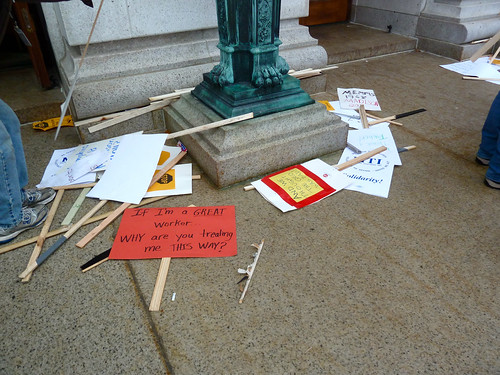
Do you see the signs of those teachers going on strike in Madison, WI?

Courtesy: Legal Insurrection


These signs are by the 'educators': teachers and their Union affiliates.

What are they protesting?

Cuts to their benefits during one of the longest lasting recessions heading into a depression the Nation has known in decades.

Why are they protesting?

They feel entitled to benefits at the expense of the public. Not the loss of jobs, mind you, just benefits.

What do they want?

They want their Union to strong arm the representative government of all the people in Wisconsin to the benefit of the minority who work in the public sector.

What do we call these people?

Aristocrats.

What form of government do you get if they 'win'?

An aristocracy.

How do they treat the public square?

P1060551


P1060545

Photos Courtesy: Ann Althouse

Cleaning up trash is for the 'little people', you see. Or just make-work for their fellow Union employees... either way you cut it, there is no regard for the public square nor the public government.

What is the class of people who could care less for the public welfare so long as they get the benefits of a hard earned dollar made by someone else?

They are the Aristocracy.

The deal with public sector unions is this: they are attempting to leverage the few over the many while those few have a direct say into their employment situation not only via the franchise right but by being able to seek redress from government via individual petition.

By seeking to force government to their ends, they are putting forth that they are perpetually entitled to the public benefit and ever rising expectations by those doing the forcing to extract more and more from their hard working fellow citizens. They are trying to divorce themselves from the hard working citizen by utilizing the public taxation so as to take those funds earned by making products and providing goods and services in a competitive marketplace for benefits and jobs in a non-competitive civil service. Unlike private employers, those working for the public have a direct say in their condition via the ballot box and by seeking individual redress of government.

There is no rationale, at all, for public sector Unions.

Zero.

Why?

Do you really want an over-educated, under-caring Aristocracy that feels free to call in sick on the public dime to trash the public square while venting their spleen and utilizing hate-filled rhetoric and impugning representative democracy, thereby? The residents in Wisconsin PAID for that via their tax bills.

Is this really what you expect in return for paying your hard earned dollars to government and seeing that the government has not laid off a single one of these people and are only threatening their BENEFITS?

Because if you are ok with that, then you are a serf.

And you are forging chains of your own servitude to government by countenancing this activity at your expense.

15 February 2011

Simplicity budgeting

With the latest White House budget put out by President Obama, there is little in the way of actual spending cuts or regulatory reform going on, and much in the way of increasing spending and taxation. This as the government nears its debt limit ceiling.

Again.

The lack of 'Hope & Change' in this budget for FY 2012 has been noted by many on the Left and Right, and that the Administration lacks the ability to actually show that anyone in the Administration understands the ramifications of the 2010 elections are plain: Stop The Spending. Yes, Stop The Spending is meeting Stuck On Stupid.

Interestingly enough the budget process for FY 2012 (not the FY 2011 work that is due soon) will be different than what has been going on since the 1960's, as outlined in this Politico article by Jake Sherman & Jonathan Allen on 01 DEC 2010:

House Republicans are devising a plan to simplify spending decisions by considering government funding bills on a department-by-department basis in the new Congress, according to Republican insiders.

The move would facilitate cutbacks in government programs and, GOP aides say, enhance oversight and accountability for individual agencies, fulfilling promises made by Republicans on the campaign trail and in their Pledge to America. But it would also threaten to complicate an already tattered appropriations process on the House floor and in negotiations with the Senate, which is why the mechanics of the transition are still under discussion.

In a speech to the American Enterprise Institute earlier this year, Speaker-designate John Boehner (R-Ohio) outlined the idea that he, Republican transition chief Greg Walden (R-Ore.) and rank-and-file Republicans are now working to implement.

"Let's do away with the concept of 'comprehensive' spending bills. Let's break them up, to encourage scrutiny, and make spending cuts easier. Rather than pairing agencies and departments together, let them come to the House floor individually, to be judged on their own merit," he said at AEI more than a month before the midterm election. "Members shouldn't have to vote for big spending increases at the Labor Department in order to fund Health and Human Services. Members shouldn't have to vote for big increases at the Commerce Department just because they support NASA. Each department and agency should justify itself each year to the full House and Senate, and be judged on its own."

This is the way budgeting used to be done before the Cold War got into full swing: Congress decided the budget for each part of government separately. The unitary budget process creates a huge ball of wax and the 'take it or leave it' form of governing, in which much bad can be packed into a bill that covers the entire federal government. It is a way to hide spending and force 'compromise' not only amongst parties in Congress but with the President. It is also highly irresponsible as each part of government should receive a separate review and be divided from other agencies to see if it is carrying out its duties in an effective manner consistent with its enabling legislation and the Constitution.

Doing it this way, piece by piece, affords opportunities for savings, reductions or changes in the way an agency works, and a review of an agency each and every year in a way that unitary budget process requirements do not meet. By allowing pork to be packed into a unitary budget, good oversight and control of the fiscal side of government, by Congress, is over-ridden by political needs to 'get things funded'. Congressionally Directed Actions put in by individual Congresscritters means that those items are not properly budget for in the Operations & Management portions of those agencies getting such funds. All accounting for those funds must be done on the set operational budget that does NOT include the earmarks. This stretches staff and reduces proper Congressionally mandated oversight on spending and puts a direct line by individual Congresscritters into government departments. By removing the opportunity for political abuse of the unitary budget process, the actual abuse is expected to diminish.

Beyond that salutary effect, however, there is something even better with this process: cutting budgets of individual departments or agencies, or even requiring that they schedule to reduce their overall size or disband completely. This form of budgeting to remove an agency is rarer, still, as Congress so rarely does this as to make such times noticeable, as I pointed out in another piece. That is the formal 'tell the agency it is time to tidy up and go home' form of Congressional budgeting. There is the other form when no spending is coming forth via the budgetary process to fund a department or agency: shutdown.

With the unitary budget process that is an all or nothing affair: either the entire government is funded or it isn't. That is a game of 'chicken' with the government held hostage to it. Thus an 'across the board' cut to all departments becomes an all or nothing affair if you use this process. When you go to piecemeal budgeting, then you get individual parts of the government segregated out for funding. This is a powerful legislative tool as it can serve very well in the hands of those seeking to remove power from government via the expedient means of not funding those parts with the power. Congress is obligated to fund very little of the federal government: servicing the debt, DoD, salaries in the three branches, the Mint, USPTO, parts of Commerce and the IRS, a piece or two of Interior, government archives, duties related to the border on immigration and naturalization as well as the orderly processing of goods individuals at the border, a postal system, plus any necessary buildings for those activities. Those are the mandatory parts of the budget, per year. Everything else is discretionary, and I do mean EVERYTHING including 'entitlements' as individuals have no contractual right (via Megan McArdle) to expect anything from SSA, Medicare or Medicaid:

Well, sort of. The first thing to point out is that legally, changing social security benefits would not be default, because (as the Supreme Court has already ruled), beneficiaries have no legal, contractual right to their benefits. They enjoy them at the sufferance of Congress, and Congress has the perfect right to change them. Doing so will not affect our status as a borrower adversely in the eyes of people we actually borrow money from. Indeed, it might enhance it. The first thing a lender wants to know is not whether you are a good person, but whether you are likely to repay the money they lend you; they are interested in the former only insofar as it implicates the latter.

During the Johnson Administration the system lost its 'lock box' with 'account' concept as all funds were available from SSA to the general fund by putting Treasury Bills in their place for future promise of payment. So servicing the debt includes those bills held by SSA. More importantly is that all the 'entitlements' are at the sufferance of Congress and are, thusly, discretionary spending.

Putting 'entitlements' to the end of the line after the mandatory funding parts, and then dealing with the rest of the discretionary budget, first, allows for a few things to be done.

First, austerity packages to federal departments and agencies can be created and passed by the House to demonstrate that it 'gets the message' of 2010.

Secondly the Senate is put into a position of a House unwilling to bump spending up for anything and it is the Senate then faced with the 'pass it or lose it' deal. This is so because a House can clearly say that in not passing a spending bill for something like, say, the EPA or Dept. of Agriculture, that the Senate clearly is in the 'clean sweep' mode and just wishes to do away with them. Then the House thanks the Senate for its fiscal responsibility and does NOTHING further on that department or agency. It passed what it had to pass and the Senate is free to pass that. Really, who is going to 'lobby' for the Dept. of Education beyond the Teacher's Union? Who will actually be HURT if the Dept. of Agriculture goes under? Monsanto?

Third the Senate, faced with either austerity or nothing, passes austerity and puts THAT on the President's desk. He has the exact, same choice as the Senate: if he wants a part of government to go away, he can simply not sign the bill. And get THANKED by the House for his fiscal rectitude.

Yes, games will be played on the 'if you agree to pass this bitsy program then I will pass/sign that bitsy program' but that would only be with the Senate. The House can say that austerity is the rule from here on out, and get used to it.

The group of Republicans following the Tea Party elections of 2010 offer enough of a block to be able to block parts of the budget as they have already demonstrated on things like the Patriot Act. This puts Democrats in the nasty position of having the 'chance' to show up the fiscally responsible House members by joining with the few remaining fiscally irresponsible Republicans to try and pass a 'bi-partisan' budget that is not responsible.

Mind you that is a career ender for 2012, which would see a return of those following their constituents and an angry populace voting out the irresponsible House (and Senate) members.

By doing it this way the line gets clearly drawn about who is serious about fiscal responsibility and who isn't.

And because 2012 will be looming, angering the voting public really isn't such a hot idea and that may even sway the irresponsible ones just a smidgen.

Then you tackle 'entitlement' reform... because everyone, up and down the line, will see that you are serious about cutting spending EVERYWHERE which will include 'entitlements'. Be a shame if the Senate or President didn't want to fund those, no?

06 December 2010

Unthinkable, thought

The Economist presents an article on 02 DEC 2010 on How to resign from the club.

The 'club' in question is the Eurozone, and resigning from it is presented as a showing how Nation States can get over a debt crisis via examining past such crises in other Nations. The EU has a problem in that it is not a Nation State but a cooperating agreement amongst Nation States and, thusly, more of a confederation than a federation (as these things are normally termed for such governmental arrangements). Thus leaving the EU would be done to localize debt to those debtor Nations within the EU and as a result end the Euro as a currency. The article presents the rationale for this, but does not come down in an advocacy position, but a neutral one as this is an article to examine the process not the implications of it beyond the economic.

To start the reasons for leaving are put into question form:

The idea of breaking up the currency zone raises at least three questions. First, why would a country choose to leave? Second, how would a country manage the switch to a new currency? Third—and perhaps most important—would leavers be better off outside the euro than inside it?

Why Leave

First is the 'why' question for a country - what is the rationale for this leaving of a common currency?

The primary reason is economic independence from the common currency and there is a reason for doing so for both strong and weak economies (as measured in their economic activity, debt load and state of solvency).

Germany, with a relatively robust manufacturing economy that has been shedding social programs and increasing the retirement age, is seen as able to cover its debt better than other Nations in the EU. Thus their portion of the common debt would have the backing of a strong currency and even see an influx of funds from other countries from individuals seeking a 'safe haven' for their cash. This would require massive changes to the banking regulation which seeks to get at savings accounts outside the country, but that could be put down as effective for EU funds only, and those converted to other currencies (like the brand new Deutschmark) would not have that regulatory overhead. This would be kept in check, to a small extent, by keeping lines of credit open for liquidity to foster economic activity. The change-over would cause an export problem as the strong DM would mean that the value of its goods would rise as compared to under the Euro, but that would be from a stable economic base that has actual liquidity to it. Thus a transition, though hard, would not be expected to be long.

Greece and weak countries, at the other end of the scale, also need economic policies that reflect their populations. The Euro has been no boon to these countries, either, as the ability of the earned Euro to purchase goods from stronger Nations within the Eurozone has decreased. Weaker economies having to compete inside the Eurozone are unable to do so and they are pressed from the outside by Asian manufacturers able to undercut Eurozone production costs. Thus, while holding to a Euro means having a more powerful currency, you have far less of it due to lack of economic activity and governmental promises on retirement and other payouts to selected groups of people within their Nations. Leaving the zone means that these countries (Greece, Spain, Italy, Portugal, Ireland) can put out currencies that can be devalued and yet find a stable floor based on the state of the economy. These Nations would become quite poor as they have a non-economical basis for their social structure in regards to working life, labor costs, and taxing policy, all of which would return to local control without EU overhead. And independent Nation is better able to navigate social policy, as an example, than a larger Confederation forcing an end social policy via a currency and regulatory system that does not take local conditions into account. These Nations did not change their policies coming into the Euro, beyond some one year benchmarks, and continued their spending policy for a generation based on lower interest loans garnered by joining the EU. Now that all comes due with defaulting on debt looming on the horizon.

How to Leave

The 'how' part is the mechanical part - the way to get from Point A to Point B.

Here the article is short and sweet, with some analysis after:

How could this be done? Introducing a new currency would be difficult but not impossible. A government could simply pass a law saying that the wages of public workers, welfare cheques and government debts would henceforth be paid in a new currency, converted at an official fixed rate. Such legislation would also require all other financial dealings—private-sector pay, mortgages, stock prices, bank loans and so on—to be switched to the new currency.

That plus have the printed and coined new currency ready to go, and having the banks exchange the old and new. The original set conversion ratio would last for a period of time and then the old scrip is no longer legal tender (although a minor collector's item for numismatic enthusiasts for generation after). This has been done a few times in the history of the US and happens far more frequently outside the US.

Argentina is a Nation that did this during its fiscal crisis and, as a result, destroyed its own banking system with a contraction in available credit to cover losses on loans that had a more favorable exchange rate than other items so as to keep savers mollified.

Germany would tend to have a stronger currency than an abandoned Euro, not only because Germany has left the Euro but due to the Euro having represented an average value across all Nations: the less capable Nations brought the value of the Euro down as they did not change social and fiscal policy to that of thrifty Nations like Germany. A new DM would gain its own adherents and those that then convert their local currencies on the basis of the DM for purposes of trade and commerce. The cost of the value of its debt would fall, over time, if it could keep its fiscal house in order and maintain a productive economy with low economic overhead by the national government. Its current holdings in other EU countries would be devalued while its own currency gained strength, and limitations on capital movement from weak countries would limit the ability of Germans to shift those funds or convert capital into liquid assets.

Weaker Nations would have to set limits on the amount of withdrawals per person, per year to transfer into a DM. This is on top of the losses that all people would suffer (personal, commercial, financial and institutional) due to the sudden change in value of the Euro in regards to the currencies leaving it. Those in weak countries paid in devalued currency would not like that state of affairs and yet see that they have limits on exactly how much of that currency can leave the Nation. This acts in the form of a firewall that limits currency trading and capital flight at the expense of internal accounts being devalued. Thus some capital is retained even during a general currency devaluation. Here good laws would allow for a legal process of wealth transformation to take place so as to avoid lawsuits over the incurred costs of devaluation. The internal scrip for these Nations would be debt obligation (or IOU) scrips that would, over time, be converted to a real currency. It would be an extremely devalued currency, yes, but the only one for legal tender in the Nation after all the Euros had been converted to them.

While a shrunk Euro would still have its member Nations to back it, those outside of it would be faced with the EU board acting to the interests of members... although the question of how long the Euro would survive comes into being with Germany leaving or one or more of the weak economies deciding to 'go it alone' to survive.

Fallout

Shifting a National currency, even when done via normal means such as the need to replace one format of bank notes with another or going on/off a gold/silver standard is one that does happen for normal Nations. In the latter part of the 20th century this has happened more often than most people think as you consider the Nations that have gone off of a worthless internal scrip to create one of value: Poland, Hungary, Czechoslovakia, Romania, Bulgaria, East Germany (moving to the DM then Euro), and Russia. These Nations all faced a scrip that was uniform under Communist rule, but of no real value outside of its trading block. Dollars went for ten to one hundred times the official exchange rates inside these Nations, and when time came to break away their currencies got unhooked from the centralized system run from Moscow. We don't notice those change-overs, in the West, but they did happen quietly and efficiently as the Eastern Bloc vanished in a matter of years, taking Russia with it out of the Communist era.

Argentina has been more problematic, but while facing a set of challenges for having a currency not pegged to a foreign currency, it is a set of problems largely under the control of the Nation and its policies. That is the goal of the exercise, to bring the financial house under sovereign control and have a Nation set its own path on what is agreeable and disagreeable to it and suffer what fate hands out to those choices.

The US

The United States has many artifacts of the EU in its common currency arrangement: member States taking on huge debt load at rates that they could not normally get, a massive decrease in productivity due to the overhead of the State, and the flight of capital and individuals from some States to others. Additionally the National system has taken part in multiple Ponzi schemes for public programs, these being Social Security, Medicare and Medicaid, all while enacting laws and regulation that increase the cost of manufacturing causing a flight of capital overseas for decades, thus lower the rate of economic growth. On a National level spending, regulation and social payouts are the mirror of that in some European Nations now looking to cut back on them severely: Great Britain, Germany, France. Meanwhile there is also a debtor State problem with a number of States with their own social programs that are fiscally unsound in the realm of public spending: CA, NY, IL, MI, MA all come to mind.

There is already the start of a debt scrip system going on in CA as the State is now offering IOUs to those who should receive refunds on their income tax. At this point CA does not accept such scrip to pay off debt to the State, but the moment it does so it has its own and devalued currency. NY has made some similar sounds as well as a few other States so highly in debt that they cannot offer standard refunds on taxes.

This state of affairs of States having their own currencies existed right up to the Civil War and is perfectly legal but how you do it is important, and CA is not headed into good territory there.

Here are the powers of the Constitution in this realm:

Section. 8.

The Congress shall have Power To lay and collect Taxes, Duties, Imposts and Excises, to pay the Debts and provide for the common Defence and general Welfare of the United States; but all Duties, Imposts and Excises shall be uniform throughout the United States;

To borrow Money on the credit of the United States;

To regulate Commerce with foreign Nations, and among the several States, and with the Indian Tribes;

To establish an uniform Rule of Naturalization, and uniform Laws on the subject of Bankruptcies throughout the United States;

To coin Money, regulate the Value thereof, and of foreign Coin, and fix the Standard of Weights and Measures;

To provide for the Punishment of counterfeiting the Securities and current Coin of the United States;

[..]

Section. 10.

No State shall enter into any Treaty, Alliance, or Confederation; grant Letters of Marque and Reprisal; coin Money; emit Bills of Credit; make any Thing but gold and silver Coin a Tender in Payment of Debts; pass any Bill of Attainder, ex post facto Law, or Law impairing the Obligation of Contracts, or grant any Title of Nobility.

CA is running afoul of Section 10 of the US Constitution and to complete its system of scrip would be required to offer gold or silver backing for its debt obligations. Basically a gold or silver debt scrip.

Just how much gold and silver does CA have? Beyond what is in 'them, thar hills' not much due to the FDR Administration having gold taken into Ft. Knox from all over the Nation as it was illegal to have large quantities of gold. Which brings up the question: is it legal for the US federal government to have done that? As the States are permitted to make legal tender of gold and silver, does the US government have the power to stop them from doing so by confiscating the gold and silver from those States?

Consider a proposal to have CA, say, ask to have its portion of the US held gold and silver reserves returned to it via population size. It would be recognized that the federal government has its own need of reserves and that could be made at 30% of the total held for the Nation.

Just working with gold the US has 4,603 tons, or 147.4 million troy ounces, the latter of which is easier to work with for numbers (going via Wikipedia for ballparking here), and this isn't including other bullion reserves like those at West Point.

So a proposal to keep 1/3 in reserve for the federal government means the following is available to the States via population: 98.27 million troy ounces.

Current population of the US at the census site: approx 311 million people.

Current population of CA: approx 37 million.

Call that just a bit shy of 12% of the population, which would yield it 12% of the gold: 11.8 million troy ounces.

Total long and short term debt issued by CA (Source: CA Treasurer's Office): approx. $53.3 billion

Note that CA's debt is huge compared to any price of gold today.

With that said the State would have the legal basis to offer a currency with a conversion rate to the US dollar for CA incurred debt. If set sufficiently above the current rate of conversion, say at $1,500 per ounce, the new Golden Bear (which I invent for this purpose) currency would have a lower valuation than US currency but have full gold backing to it. CA could start issuing this currency to those who would be getting tax refunds or other forms of funds from the State and create a dual currency system within the State for its own gold tender and standard US greenbacks. In addition CA would probably place a holding time limit for cashing out gold, so that the Golden Bear will have time to circulate and get a real value, perhaps as much as 5 years for that.

CA would then have to decide if it wanted to incur debt via US dollars or its own Golden Bears. While 11.8 million troy ounces sounds like a lot, that is less than 1/3 troy ounce per citizen in the State. If CA can get its fiscal house in order in 5 years, stop the debt outflow and get a sane tax climate in place for investors, it can offer a 'safe haven' currency that is gold backed (possibly have silver backed ones as well, but it is difficult in getting the silver reserve figures) and holds the State to the value of the currency.

The Golden Bear would be a 'hard' currency and if set above the current conversion price of gold, then gain few attractors but serve as a reserve system to pay off internal debts owed to the citizenry. Citizens would be faced with a currency that would take a few years to convert to physical gold (with 1 troy ounce = 1.0971428571 ounce = 31.1034768 gram) with each Golden Bear dollar only about 0.02 gram weight or waiting to get paid in US greenbacks once CA got more of those to go around... which it might do by marketing Golden Bears or converting a portion of its debt into Golden Bears for payout (possibly the short term debt). Once in circulation the value of the US greenback would float compared to the Golden Bear and it is possible that CA might even see an influx of some cash if it can get its fiscal house in order.

Of course CA and probably AK would see a major uptick in the gold prospecting business as getting gold and getting gold backed tender in return makes the gold portable. CA might see an increase in gold reserves, over time, if it got its house in order. Other States might take this route to try and get some foundation to their economies and find some, final bottom to their fiscal woes as they have a new and much smaller economic platform to move to. This would mean that most of the 'services' in the way of regulations, 'entitlements' and even such things as public pensions would either get liquidated or devalued or have a final gold backed tender put into their holdings which they can sell at market prices.

Congress did not have the power to stop this after the Civil War and no power was given to it during or after then to allow it to stop such things: they are allowed in Article 10 explicitly. While paying off debts to the federal government would still be done in greenbacks, if those are seen as getting worth less and less, then the States would have a means of fall-back currency by issuing gold and silver backed tender based on the holdings being held for all of the people at the bullion depositories. The US federal government would still have a substantial gold and silver deposit for the Nation, but the rest would be used by the States to create legal tender in the States for State obligations. And as it is circulated debt backed by gold, it is not normal valued currency and might be impossible to tax (can you tax debt? my guess is: no).

A two-track system would be a PITA, to be sure, for each State, yes. But this might be a way to give the people of those failing States some assurance that there is a final, much smaller, fall-back position for their States that would have an opportunity to shed obligations and right their economies. And with a gold backed system the people would be assured of being able to get some useful currency after their State's bankruptcy and re-ordering to become solvent. We would still be a common Nation, but those in financial crisis would be allowed to figure their way out on their own and not put the entire Nation at peril for the spendthrift ways of the few.

08 August 2010

Public employee funding problems

I am a disability retired public employee.

Just so you know.

Over at Power Line, John Hinderaker has a post on Two Americas: The Reality which goes into the problem of public employee pension funds and the budget busting trends that were put into place over the last number of decades.  This includes such things as giving a fully retired employee not only their highest of the last three to five earning years (base pay) of which you get a percentage of that, but also things like Cost of Living Adjustments, healthcare coverage, and all sorts of retiree benefits that require a lot of money as the age for which one can retire has gone down due to the 2% rule.  The 2% rule (on the federal side, your local situation varies, no doubt) is that you can retire early and lose a percentage of your base adjusted pay for retiring at, say 50 with 30 years of service, and you get 2% back for each year you stay in until full retirement at 55.  Yes, you read that right: 55.

That might have been workable for the 1930's (as you didn't get such lovely benefits like health insurance and you weren't expected to live to 65, on average) and government jobs tended to under-pay per sector of the economy.  After the 1980's the under-pay issue was seen as not enticing enough good workers to the government and a nice adjustment system got put in to raise the base pay and then add in for locality adjustments... during the Internet Bubble years of the 1990's no one noticed this due to the number of good jobs in the private sector.  The inflation of base pay, however, took on a power of its own regardless of the economy, and with the downturn in the economy the public sector now makes more, per equivalent position, than their private sector counter-parts.  States and localities may not have been as generous as the federal government, but in those venues the various workers came to rely on the pension system which often saw investments by organizations set to 'manage' them.  The California Public Employee Retirement System (CALPERS) was one of the one gambling money for pensions into high risk derivatives and stock investments that, when those went south, saw the entire income plummet for the retirement system.

This was mirrored in smaller degrees by a number of State and local pension systems or other retirement systems that thought a quick buck would be a long-lasting buck... and the good days would never, ever, end.  The State systems did this to benefit those working in the pension systems and that means when the Lake Woebegone Economy (all investments are always above average) saw the lake drain out as it was artificial, the States and localities found themselves with investments not gaining them money, actually growing smaller, and being unable to cover pensions without the help of tax dollars.  Lots and lots of tax dollars went into the system and now will need to bail them out.

The federal government relies on tax dollars for pensions and for individual private investment for retirees so that they can have an independent source of funds they can manage on their own.  Instead of the public employee system it is Social Security that has 'empty lock box syndrome' as the lock box was opened during the Johnson Administration and the money that, in theory, was your retirement 'investment' got spent like normal funds and a great big IOU went into the lock box.  Now the lock box is full of IOUs and that system is running in the red which means it is either: A) adding to the deficit and thusly the debt, or, B) eating up regular taxes and forcing other parts of the government to run a larger deficit, or, C) both A and B.

You will not be seeing a penny of your SSA 'investment' if you aren't already drawing it or aren't up for retirement in a few years as the entire she-bang will go insolvent somewhere between tomorrow and 2020.

I don't expect to see a single, red cent of SSA as I am only disabled for my work and SSA is set up to say that if you can breathe, move around a bit, function for 10 minutes a day, then you can, indeed, 'find work'.  As I can get a few hours of conscious thought in a day, have some energy and work very hard at trying to overcome what my body has handed me, I don't quality... and never expected to.   Just to get that out of the way, so you know that I 'paid in' to that corrupt system and expect no help from it.  Ever.  It is a 'sunk cost' and my money spent by the government already.

Now the question is: what to do about this mass of increasing debt because everyone is living so much longer that no one bothered to see if that motorhome and around-the-world vacation by the retired every couple of years was in any way, shape or form, affordable from public coffers.  Turns out they aren't because of demographics and our rewarding those in public service with great benefits, high paying jobs, fantastic retirement, health care, and cost of living adjustments.  Often with a Union taking a 'cut' from all of that.

To counter that there is one very, very harsh piece of medicine which is not contract law... well it is, but not the part most people are used to.  It turns out that when contracting with Sovereign Entities (normally Nations but I would expect that States have similar capability) they have a relatively easy thing to do: terminate contracts without recourse to sue the Sovereign as they ARE the Sovereign entity.  Some may allow you to sue, but that is an allowance if the Sovereign power wants to let you sue.  If it doesn't you have zero, as in no, recourse.  It is the source of the law, after all, and when the source determines it needs to terminate a contract for its convenience it can do so.

In the federal contracting side this is a T4C: Termination For Convenience of the government.

That is written into every single federal contract even if the verbiage never, once, appears as it is part of the contract verbiage that anyone getting a contract with the federal government are supposed to know before entering into a contract with it.  Yes a Sovereign Power is allowed to do that.  Yes it has been upheld in court numerous times.  No it is not illegal as that is the law as stated and if you don't bother to learn the law, you are still obligated to know it.  From that I expect other Sovereign entities, like the States and possibly more local powers, to have that same ability.

When push comes to shove a government can and will terminate contracts and obligations that hold it down, and it is far, far better to shaft individuals than to shaft other Nations.  Doing the former only gets you unrest, possibly a revolution if you don't play your cards right.  Doing the latter can get you a major war, at worse, and a huge loss in trade as most of the debt holders are people who trade with you... and doing that during an economic downturn is suicide.

Push is coming to shove on this, and no matter how 'liberal' or 'nice' a State or the federal government says it is via what it writes down, it holds the ability and actual duty to cut off those obligations when it is endangered.  Of course when its gotten that far the actual Sovereign isn't all that stable as a power and is flailing around for any way to save itself... but as we lose outside investors due to our economic problems, and as the largesse shoveled at public employees becomes a major part of the problem, I expect the movement by those in power to try and save their skins by sacrificing the retired and their retirement systems to become paramount.  Shedding that burden might get you a lot of angry retirees, yes, but it might just soothe everyone else for a few months until the next economic calamity hits.  By then the government is just doing anything it can to keep the pitchforks, torches and boiling vats of tar away.

Do I expect this to happen?

With some States, yes.

SSA and the medical apparatus of Medicare and Medicaid will also go down due to similar problems.

I suggest a Grand Bargain to get rid of those systems and help the economy, plus put the federal government on a starvation diet.  We made promises to ourselves via our government that we cannot keep, and as the amount of pain increases due to those promises the more inviting tossing them becomes.  I am more than prepared to see my SSA as a 'sunk cost' already spent and never to be seen.  The Grand Bargain would get the economy going if we dared to do it.  Soon we may not have that option.

Then things get interesting as the 'chuck it' and T4C appear as damned good ways out.