My thanks to King Banaian at Hot Air for pointing out the testimony of Mr. Pinto and the attachments therein.
Note finances, borrowing, etc. are not an area of my expertise and I am giving the best shot at this that I can without deep backing in economics, lending markets and so on. That said I do know how to read graphs, have a good idea of risk assessment from not only my personal life but my prior career in the civilian side of DoD, being a generalist systems analyst in my outlook and having to manage my own finances knowing my body has a very high risk downside. That and having read a bit about the way the federal government has gotten into the housing system. And I haven't seen much good before writing this article. I am not amused. What follows is lengthy (very, very lengthy) as I take time to explain what I am reading and seeing, and what I draw from that. YMMV.
Yesterday was the last day for complaints.
In reading a presentation before the Subcommittee on Housing and Community Opportunity of the Financial Services Committee of the House of Representatives by Edward J. Pinto on 08 OCT 2009, it is impossible to not reflect on the intrusive nature of government to change the nature of our economic lives by encouraging 'good' activity via the tax code and other regulations. Of the interesting items to come up is a chart measuring percentage of FHA foreclosures as a part of outstanding loans from 1951-2009:

Ahhh, graphs! Anyone wanting to do a quick examination of what you can say with graphs can check out my posting on regression towards the mean. This is a simple two axis chart to just measure the given percentage, which started out as miniscule at 1951 and has skyrocketed in a two-stage fashion: once 1957-1981, where a definite increasing slope can be drawn although not at a great angle for a median, and then from 1981-2009 which is much steeper. Of course a single less steep median from 1951-2009 can also be put in which would trend below the large spikes in the 1960's and again in the 1970's, then above the line until 2002 or so with the years since then trending above the line. The smaller time-period break down gets two phases that may or may not be warranted, and the single line gets an overall trend from start to finish. Mr. Pinto goes on to present papers done previously that start to put in the variables that get the overall trendline and those dynamics tend to play out more in a complex graphic arena, although broken down into 2-axis graphs for simplicity of presentation. I would suggest that at least ternary graphs need to be invoked multiple times to show multi-variable cost/benefit ratios, but those would take awhile to do and I don't have good graphing software to handle the stuff. Mr. Pinto's main presentation goes from approx. 2005 to 2009 covering the banking bailouts and other problems seen in the home mortgage and financial industries, and then presents historical papers to examine the overall problems and how they developed.
The first of these attachments is by Peter J. Elmer and Steven A. Selig of the FDIC Division of Research and Statistics done as a working paper in 1998 on The Rising Long-Term Trend of Single-Family Mortgage Foreclosure Rates. It is a fascinating document as it does a multivariate analysis of how individuals and families have approached their finances, risk assessments and investments in response to changes in the tax code. It is a working paper that is as fascinating for what it doesn't say as for what it does, and I will cover a couple of salient sections of it that examine just how we respond as individuals and families to structural changes in the financial arena are non-obvious and yet readily apparent when you think about it. As can be seen from the chart of Mr. Pinto, the foreclosure rate in 1997 was still increasing and the FDIC wanted to find out why this was happening. I will be retyping their text and doing the best job I can of transcribing the work involved.
From early on this paragraph sticks out and emphasis is mine:
All theories of mortgage default stress a key role for homeowner equity, and empirical analysis supports this emphasis. Since the most direct measure of equity is the loan-to-value ratio (LTV), we expect to observe a positive relationship between LTVs and foreclosure rates, although the relationship may not surface until several years after mortgage origination. As Figure 3 illustrates, rising LTVs explain several, but not all, aspects of the foreclosure rate trend. In the early 1950s mortgage lending was remarkably conservative, as witnessed by an average LTV of only 58 percent in 1952. Rising LTVs throughout the 1950s suggest a transition to modern-era lending practices, when LTVs have averaged over 70 percent. This transition explains the exceptionally low default rates of the 1950s as well as rising rates in the early 1960s. Unfortunately, LTV trends fail to track foreclosure rates for two decades after the mid-1960's. A possible relation reappears in the late 1980s and 1990s, as slowly rising LTVs again follow rising foreclosure rates. However, this most recent relationship is questionable because of the close relationship between conventional and FHA rate trends, as noted in Figure 1. That is, since FHA mortgages have had high LTVs for many years, and the FHA patterns in Figure 1 are very similar to conventional patterns, it seems unlikely that rising LTVs are solely responsible for the rising long-term trend in mortgage foreclosure rates.


Yes if you were doing trend analysis using regression towards the mean you would have identified the bi-modal system just like the experts did! You get one mean from the 'modern-era' transition and then another one that appears in the 80s and 90s.
With that said there is a misdirection in the analysis in that paragraph in examining LTVs. The analysts put forward that there is a positive relationship between LTVs and foreclosures, so that if the lender covers more of the value of the home then there is a net trend to higher foreclosures. Do note that while the FHA tracks conventional rates of foreclosures, there is a delta between them as the FHA is directed to cover more of the value of the home, thus having a higher LTV. Figure 1 and Figure 3, thus, have a relationship between higher FHA LTVs and higher foreclosure rates for FHA loans. While that difference is miniscule at start in 1951, by the 1970s the delta between foreclosure rates varies between 0.5% to 1.0% higher for the FHA vs conventional financing as seen in Figure 1, and that delta rarely gets below 0.5% higher for the FHA thereafter. The FHA covers more of the value of home mortgages and assumes risk for doing so via higher foreclosure rates.
Figure 3 lacks the FHA foreclosure rate so as to get a direct 1:1 comparison between their LTV and foreclosure rate. Going back to Figure 1 and getting the deltas allows us to see that if this had been done there would be a need for some exaggeration of the FHA LTV as it spikes to nearly 2.0% in the mid 60s and over 1.5% in the mid 70s. However conventional foreclosures are a lagging proxy for FHA foreclosures and is also used as a reference.
What is a 'lagging proxy'?
A 'proxy' is a closely related graph that has high correlation to another graph plotted along the same axes, but having divergence from the related graph. In using only conventional foreclosures, the authors of the paper have put in a proxy for the FHA foreclosure rate in Figure 3. There are many reasons to do that, like graph clutter, but they have far busier graphs elsewhere in the presentation. Another reason is scale exaggeration for a third, related, scale being used in a cross-comparison and that is a good indicator for the use of a lagging proxy in Figure 3.
The 'lagging' part, as seen in Figure 1, is that where FHA is on foreclosures in one year is reflected in overall conventional foreclosures 2 years later. There is little to no lag in the 1951-60 timeframe, but thereafter a minimal 2 year lag appears, so that when FHA foreclosure rates reach a local high in 1964 the conventional foreclosures reach their local high in 1966. At the end of the decline at the local trough the FHA reaches it in 1969 and conventional rates reach it in 1972-73. The next FHA peak in 1973 is seen in 1976 for conventional rates. There is less correspondence on the weak multi-year trough, and even a slight reversal in 1979 where the FHA lags conventional foreclosure rates, after that you get a period of 1:1 correspondence of slope until the FHA reaches the beginning of a spike in 1989 followed by conventional rates in 1991. Overall the conventional foreclosure rate either mimics or lags FHA rates, at a lower percentage level. Due to the nature of the highs and lows seen in larger periods of the graph where lagging happens, the general concept is to use conventional as a lagging proxy. That means that FHA loan foreclosures are a LEADING proxy and what you see, today, has a good chance of immediate to 2 year correspondence in the conventional foreclosure rates for a given time period.
These are corresponding graphs, then, not coincidental nor, of necessity, linked via causal factors between one measurement and the other: indeed both respond to outside factors and when economic stress happens the more exposed FHA market reacts with volatility because it does lend out at a higher LTVs as the authors point out. For foreclosures and economic stress, FHA loans are the 'canary in the coal mine' reacting first and with volatility and signaling a problem that is likely to hit conventional loans either immediately or in the very near future.
Now I've put modern era lending practices in a highlight as it is a shift from conservative, old fashioned S&L style lending for home mortgages, done by small local institutions that refuse to expose themselves to high levels of risk, to less risk averse lending practices starting in the mid-1960s. The older style of lending meant that you had to have a significant portion of the value of a home covered up front and/or in collateral, plus have a good employment record for one individual in the household. That is the typical, nuclear family lending practice supported by the way families were formed in America just after WWII. It is also a shift in affluence away from the extended family, which included grandmothers and grandfathers, and possibly entire households of aunts and uncles, living under one roof so as to economize on living expenses.
That is the old style 'traditional' American family, with 3 to 5 children as a norm making for a full household. Even when such families didn't live under one roof, they were close to each other, normally within a few city blocks, so as to have a close-knit reliance system for taking care of children, watching over homes and helping out on joint projects for the families involved. The suburban expansion to wide open spaces, cleaner air and the ability to commute to work change where Americans were living but that also meant that lenders were not so ready to take up high risk on unproven suburbia. This family would have mom, dad and 2.5 children and by the early 1960's mom was on 'the pill', and family expansion rate was going down and mom could re-enter the workforce once the children were in school. The neighborhood S&L was a mainstay of that early suburban life and only started to fade when higher risk lenders, like FHA, got into the market. That enticed commercial banks to higher risk lending and led to the slow decline of the S&L system.
The result? What is the result when less local, more distant banking institutions move into a market and assume more risk on loans? First you get a marginalization of the older lenders who are restricted in their lending practices by statute. That is why S&Ls sought the easing of regulations as those very same, conservative, regulations were killing them and they were being replaced by other lenders who had more liberal lending practices allowed by statute. Congress has played a large role in the banking and finance industry by setting up systems that may make sense when they are put down, but end up picking winners and losers in the long run. When S&Ls had to directly compete against commercial institutions and the federal government, itself, and they had more liberal LTV rates which assumed more risk, these S&Ls were being forced from the business by Congressional fiat. By the time the regulations were eased, the S&Ls grasped at anything, including very risky loans, and the failure of the S&L system is the result and the taxpayer had to bail them out because Congress was a major cause of the failure.
Remember if you like nice, tight, federal regulations, then you had those in the early 1950's when the FHA could not assume a higher LTV save marginally, and there was a bright line in lending for homes between locally controlled S&Ls and non-locally controlled commercial banks. All the regulations since then, to liberalize loans so that institutions take on more risk has caused an increase in foreclosure rates and wiped out that most conservative part of the banking industry. That happened by regulation, not by lack of it.
Fascinating what you can get from a data analysis when you put it in wider context, no?
The next paragraph to look at follows the first:
A second variable that effects homeowner equity is the rate of appreciation in house prices. High home appreciation expedites the buildup of equity by reducing the current LTV, i.e, loan to current value. Other variables being equal, high home appreciation is expected to reduce defaults as current LTVs decline and wealth increases. As shown in Figure 4, to indexes of house appreciation increased in the late 1960s, remained high until the early 1980s, then dropped to much lower levels until the present time. These trends suggest that house appreciation is especially useful in explaining the relatively low rates in the 1970s and some rise in the early 1980s. However, the relative stability of appreciation rates through most of the 1980s and 1990s is difficult to reconcile with the continued rising trend in foreclosure rates as well as with the plateau apparent in the mid-1990s.

See? I told you they had a busy graph!
And there is our old friend the Conventional Foreclosure Rate showing up again, which is a real help with these graphs.
Before modern day lending practices were put in place, a home's value wasn't expected to rise very much over the life of the mortgage. Taking a look at the early part of the graph from 1954 to 1966 and you see home appreciation rates rarely getting to 0.05% per year, and most of it under 0.02% per year or between 20 and 50 cents of appreciation per $1k per year. So if you had a home worth $50k it would go up between $20 and $50 per year, more or less, and over the life of a 30 year fixed rate loan you might see home appreciation go up by $2-3k. Your home would appreciate in value, but not quickly was the expectation coming into the post-war era and a home was a shelter and moderate investment that you wanted to get paid off so you could own it fully, free and clear. That changed during the late 1960's, and as foreclosure rates started to drop home appreciate rates started to climb. For this graph note that the CPI-Shelter is a lagging indicator, save for a few years, of the NAR Median Sales Price and that figures: when you pick up a more expensive home it increases your cost of living as part of the CPI for shelter.
If we take the analysis that the transition to modern era lending is in the mid to late 1960s then the CPI reflects that change as the amount you can take out for a mortgage increases (because of the larger LTV) and as foreclosed homes come back to the market we see the appreciation of homes increasing. When Median Sales Price appreciation for homes gets put in we see them leading the conventional foreclosure rate by a couple of years. Just like the FHA foreclosure rate also leads the conventional foreclosure rate. That period from 1970 to 1980 is a good indicator of a leading proxy, but it falls completely apart with the decline in home appreciation between 1980 and 1982. At that point foreclosures continue their upwards path (all the way to the current day) while home appreciation rates remain steady within a band from 0.02% to 0.07% per year. Something is going on to de-couple foreclosure rates from home appreciation rates and it begs the question: how can you have steadily increasing foreclosure rates and steady increase in home value?
I would expect that is a multi-part answer as it would be difficult to put a finger on any one thing that is causing that.
Some factors I would expect?
The Community Reinvestment Act starting to ramp up its output in the early 1990's, when we start to see Adjustable Rate Mortgages and 'no money down' mortgages, which are essentially maximum risk LTV mortgages. Still those were not a common part of the market early in that plateau and would only be a contributing part in foreclosure rates increasing, although 'turning homes' for quick sale and cash would also see a nominal appreciation level that was unsustainable. When the term NINJA loan was created to cover those with No Income No Job or Assets getting loans, then the end of the speculative and high LTV era was coming to a close. They were a causative symptom, in that they showed up due to legislative factors and regulation changes in the 1990s, which finally burst the bubble.
Another thing that might hit this is a saturation in the expectation of home prices with an expectation of steady increase in home value far above that conservative 1950's rate. Once an area gets a relative saturation level for prices, and that varies widely by geography and income factors, there would be a move to build new tracts of similar or slightly better housing at those new price points. New builds expand the market and put a cap on appreciation as new unit availability keeps the appreciation of other, older units down. There are some indications of that in areas where I lived, including the financially strapped Western New York region during the late 1980's. Even with the middle of the 'Rust Belt' still lingering, new subdivisions were going into suburbs at a rate that had not been seen since the mid-1960s. Moving to Northern Virginia and examining the home market in the area, it was easy to discern much higher levels of building from the mid-1980's then a lull in the early 1990s and then a gangbusters expansion of subdivisions from 1994-2006. As all units saw an increased and unsustainable appreciation the indications of a housing market bubble became clear and it was only a matter of time before it burst, sending values tumbling. So capping of appreciation via new builds and expanding the market also plays a factor in this.
I am giving a section on Trigger Events that cause foreclosure to start short shrift. I am a bit more interested in the overall market analysis of how the environment for increasing foreclosures comes about and less on the actual events that cause households to go into foreclosure.
Changes in risk assessment, however, is part and parcel of foreclosures and Americans have had to change their risk map to cover the changes in terrain due to legislation. That is covered under Household Risk Posture for foreclosures, but are an indicator of expectation changes in the market, also. The type and amount of risk you take on changes when the cost/benefit ratios are altered by regulation, and those regulations can be far outside the housing market. Here we can see that a set of legislation meant to 'do good' changes our perception of risk:
Compounding the problem of lower savings rates is the fact that an increasing proportion of savings are being held in relatively illiquid forms, such as 401(k) and IRA types of retirement savings plans. Although one can make "hardship" withdrawals from a 401(k) plan to protect a home from foreclosure, the penalties are severe. The IRS requires the plan sponsor, or trustee, to withhold the estimated income tax on the withdrawn amount plus a penalty equal to 10 percent of the withdrawn amount. Thus, for example, a borrower who needs $1,000 to meet a mortgage obligation, and pays a 20 percent tax rate, would have to withdrew $1,428.57 to receive the amount needed. Hence, this type of tax-sheltered saving, while ideal for retirement, is not effective as a safety net for adverse shocks to income.
A bit further on is the dovetail to this:
Not surprisingly, the vast majority (approximately 65 percent) of the increase in debt has been in the form of mortgage debt, which comports with the rising LTVs noted in Figure 3. Of course, the tax deductibility of the mortgage interest stimulates individuals to rely on mortgage debt as a primary form of leverage. But how can tax incentives be motivating higher leverage if they have been in place for many years? Engen and Gale (1997) suggest a fresh perspective on this issue that provides an economic rationale for recent trends in increased mortgage borrowings. That is, their study finds that increased savings in 401(k) plans are associated with increased mortgage debt and a reduction in home equity. In essence, the financial advantages of 401(k) plans may be causing individuals to substitute savings in 401(k) plans for savings in home equity, thereby causing both mortgage leverage and the likelihood of default to increase.
This is a 'No Shit Sherlock' moment.
If you have an income and have a finite set of ways to divide it and you can invest money in a relatively well protected from any disaster financial plan for retirement or into a home that you could lose during an economic downturn, in which, exactly, will you place your money? And if you can use your mortgage debt as a means to leverage the remaining income, would you not want to get the most home for the money with the knowledge that it may be a transitory home in which you will get little to nothing from it? If you go bankrupt your IRA tends to be untouched, in most cases. Your home flies off the table faster than you can sneeze. And if you see that there is a steady appreciation of home values and are willing to take the subsidized risk of your income loss for a few years, you can turn that home and perhaps even make a small profit. The concept of 'home equity', where you build up the amount invested in your home goes out the window as it is unsafe in the modern lending era due to the high LTV and the small stake you have in a high cost home. In such a market when you are a new entrant and you have two ways to defer or mitigate taxes, one which builds up relatively safe equity and the other that doesn't, which do you put your money into?
The shift to liberalizing lending practices and the legislation to back it, means that lending institutions take on the bulk of the risk for home mortgage lending and the borrower has taken little to none. The tax supported 'good' of a home mortgage interest deduction means you don't bear the full cost of what it takes to pay off a mortgage and the perceived risk is then lessened due to the deduction. By being able to put in tax deferred savings for retirement, you gain future benefit at relatively low up-front cost compared to the discounted higher cost of a home mortgage. And if you can take out a second loan based on the home mortgage, then you can begin to maximize expenditures as you expect the rising value of the home to cover your mortgage obligations while you pay set monthly amounts on loans for big ticket items, thus taking cash out of the household income flow depriving the rest of the areas of household spending of that amount. By seeing a continuation in home appreciation from a high base, an individual may feel 'empowered' to spending far more than their income allows via debt vehicles.
These two putative 'goods', saving for retirement and home mortgage interest deduction, are done via the tax code, not the lending code, and are overlooked as causal points for foreclosures. Even worse is that they change risk factoring for individuals and families in ways that are not anticipated when either of them were passed, as the assumption was that all other economic factors were going to remain static in the lending arena. Those in the lending legislative areas did not examine how risk changes in the tax code changed perception of acceptable risk. Worse still is that there is an unspoken assumption that banks can and should take up the entire risk of your home. The banks responded with lending packages that put off the building up of equity for years, because the people taking such loans were not good risk candidates and at least the bank wouldn't lose much money if any single mortgage holder went belly-up.
Is it any wonder we got a housing bubble from this?
Now remember that as we head into the next paragraph as it has implications for what is going on the past few months:
In addition to savings, insurance provides individuals with a financial tool for guarding against the ill effects of unexpected problems. In this regard, Figure 10 emphasizes that a significant portion of the population is not covered by health insurance and that this percentage has increased by more than one-third since the data were first reported for 1978. Moreover, the statistic understates the magnitude of the problem by including population segments that are covered by health insurance in their entirety such as the military and senior citizens covered by Medicare. Thus, the increase in the portion of the population without health insurance constitutes a significant increase in the overall risk profile of households.
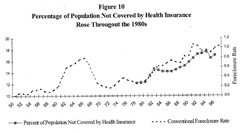
Actually including the number of people covered including the military and those on Medicare is a proper representation of those covered because they are covered. If it is meant that they are not covered by private health insurance, there is a point to be made, but we are the ones who set up the system we have and must live with its effects.
We also subsidize health insurance via the tax code. We have business write-offs for a portion of the expense for such packages provided for employees, employees can write off a portion of their cost via itemized deductions. So why are fewer people getting health insurance? It is yet another cost/benefit ratio, and when the cost of insurance outweighs the benefit of having it or providing it, then the risk for not having it outweighs the cost of having it. And those deductions for health care have gone hand in hand with increasing numbers of big ticket lawsuits for insurance carriers and doctors, both of which change their risk stance by increasing costs: premiums from insurance carriers and for doctors passing along the cost of malpractice insurance to the patients.
So now put in three variables for a household: IRA savings, home equity and mortgage deductions, and health insurance. If we have been financing our IRA contributions via high LTV mortgages with write-offs on the interest, then the cost of health insurance must be factored in to determine the priorities of a household. Which is more important, carrying health insurance or paying down your mortgage? Or investing in your IRA? The reason I put forth that this thing morphs into a ternary graph is because the household finances are finite and multivariate. After the cost of food, clothing and paying the utility bills, come keeping a roof over your head, keeping yourself well and investing for your future. Each of those other variables have their own priority and cost expectations, and with a generally set income divided in a number of ways, you only get finite sub-portions left for each of those portions, and we prioritize those based on cost/benefit trade-offs.
'Mandating' health care then imposes another large chunk of finite cash expenditures to be used up on that coverage. So what won't you do if you have that mandated? And the costs will rise as that has been the expectation with medical care ever since legislation was passed to help write off part of its cost via itemized deductions. And as we have gotten so easy on risk with homes, and that is now ending, you can't bundle the cost into expected price appreciation there. Nor can you withdraw money from your IRA to cover medical expenses, save for catastrophic ones where surviving is more important than how much you will have to pay in the way of taxes. And if it is a mandatory part of the budget, either via monthly payments or paying a 'penalty' for not buying it, those are non-zero sums and must be factored into the residual cost/benefit analysis.
The paper looks at the trends of bankruptcy and foreclosure rates, and they are intimately linked as both are related to financial difficulty. What comes out of that examination, however, is not the sort of analysis I expect from the FDIC:
The coincident rise in mortgage default and personal bankruptcy rates is also intriguing from the standpoint of society's attitudes toward leverage and financial risk. That is, the trends are consistent with the notion that households have increased their risk posture by opting for greater leverage and lower net savings. Of course, these trends also reflect the willingness of lenders to take on greater risk by increasing the availability of credit to highly leveraged households. Lenders and borrowers must both embrace these changing attitudes towards risk before an increase in risk can be contracted at market prices.
A fascinating paragraph in the tone it takes towards those that get involved in the mortgage contract market. It is at one stroke passive and authoritarian. It is passive in that it describes a changing risk market in the abstract divorcing the causes of those changes from the changes, themselves. And the authoritarian tone comes with the last paragraph which has the feel of 'thou shalt deal with this changed market in which you have no power to stop the changes' sort of deal. The unspoken assumption is that the changes are wholly divorced from the causes and the market, full of individuals and companies making contracts, must adjust to the landscape being changed by these forces and accept that changed landscape without asking questions about why it changed.
After they have examined the role of government in IRAs and home mortgage deduction, the conclusion that society is changing its stance on risk is not something that can be supported. The risk landscape is redone multiple times via legislation from 1951 onwards by government without any check from society on it. Social activists have been well neigh wanting increased risk exposure to the middle class to gain 'benefits' for social causes often masked as being 'for the poor' or 'for the sick' or 'for the children', not for society as a whole. The incrementalist approach has been to take existing federal programs, FHA say, and then start changing its risk acceptance via law and regulation, not via being implored from society, as a whole. Something like the mortgage interest deduction is purported to be 'for the middle class' or 'for the home owner' but is a change in what is expected in the way of risk and benefits from home ownership. Yet the legislation for those things did not start big, but small, and were grown over time as functions of government regulation.
In the Structural Change section the paper does begin to examine this, but consider that the paper accepts that these are changes directed by society when, in fact, they are coming to appease 'social activists' who want to liberalize banking to 'the poor' or those who face 'discrimination' due to ethnicity. To get to that point, however, takes original changes to the structure of the lending system:
During the 1950s and 1960s most single-family mortgages were originated by "traditional" lenders, primarily savings and loan associations and mutual savings banks. In addition, mortgage bankers served as correspondents for insurance companies that invested in mortgages and for thrifts in capital-surplus areas, such as some cities in the Northeast. These "traditional" lenders performed all or most of the mortgage lending functions, including mortgage origination, servicing, portfolio management, and investments in the mortgages. They were headquartered in the local markets, where they originated loans and typically had other business relationships with the mortgage borrowers.
That is, perhaps, the best summation of the traditional mortgage lending system I have ever run across. Very clean and succinct. It is this traditional system that would be targeted by banking and lending legislation:
The advent of mortgage securitization in the 1970s changed the borrower/lender relationship breaking apart the various functions that had been performed by the banks and thrifts. In particular, it becomes much less common for the same organization to both originate a mortgage and retain it as a portfolio investment. Lenders with traditional ties to the borrowers were replaced by national service organizations with no tie to the borrower apart from the mortgage and with servicing policies based on national rather than local standards.
Here, again, the passive voice with securitization. Mortgage securitization did not 'just happen' and was not due to some natural happening or to the Gods of Financing saying 'mortgages shall now be securitized'. Quite the opposite, it was intentional federal policy. Mortgage securitization started with the Department of Housing and Urban Development in 1970, and the creation of the Government National Mortgage Association (Ginnie MAE). You know, the folks who gather up bad loans and turn them into AAA government backed investment vehicles? Risk pools for the FHA? Heard of those things in the recent home mortgage 'crisis'? Started as a swell service to help disperse risk and, instead, ended up saying that high risk stuff is low risk, which is how incrementalism works from 'activists' who want policy changes bit by bit. First you get some conservative regulation words together, create a bureaucracy, back it with the federal government, spin it off as a GSE, regulate that, change the regulations so that more risk is added to the system to appease 'social activists' who want more money flowing to those who can't pay it back, which changes the entire risk structure of lending.
That is how the commercial banks started getting into the mortgage business as these risk pools would get US GNMA certification as being absolutely, positively AAA in safety. Goes from a swell program meant to 'do good' to one that injects lots of risk into the system and gets regulators to back that up by threatening to audit banks that don't accept the risk guarantee. And because this is pooling risk, and going through the right federal paperwork to do so, the smaller S&Ls and thrifts were stuck out in the cold trying to expand their businesses against commercial banks with huge monetary backing and being able to pass the federal sniff test. Really, how can you compete against a huge bank willing to take on large local risk with 'social activists' pounding on your door and federal regulators telling you that you must lend to people who have high risk? The S&Ls and thrifts were not designed to utilize high risk vehicles, is it any wonder they crashed and burned in the 1980s?
By creating a national market for local loans the local lenders who knew conservative good risks got priced out of the market by banks able to take on higher risks, locally, and willing to undercut local lenders with deals that those local portfolios couldn't match. Throw in some 'social activists' and you get a lovely agenda to wipe out the local, community supported banking system and replace it with a national one that can be regulated from DC. Not regulated all that well because DC can't figure out local markets and takes a bludgeon of national markets in a One Size Fits All, Fits None Well approach. The creation of GNMA has had consequences in the S&L and thrift area, namely stifling and then undercutting them so they needed a bailout, and it has served as a means of social engineering by Congress to inject risk into the lending system so as to get money out to politically preferred groups who have poor risk profiles.
As the charts demonstrate there was pre-1970 volatility in foreclosures, but after 1970 there is volatility in home appreciation. By the 1980s and 1990s foreclosure rates become decoupled from home appreciation rates, indicating that the market is making far riskier loans at greater amounts and not letting the market set the balance between appreciation and foreclosure in a low risk environment. Something is changing that risk profile to allow this to happen. Mind you this is examining a paper that is bundled as an attachment in 2009 to Congressional testimony and the paper, itself, was put out in 1998. My analysis is covering the risk time-frame of the attachment and putting it into perspective and a perspective that is not that out of line with the known history at 1998.
The paper examines what happens when non-local lenders get involved in the market: loans become less flexible, there is less forbearance from lenders who are not in the community on repayment with delinquent borrowers and less ability to offer adjusted repayment schedules if an individual temporarily hits hard times. Without that local knowledge the borrower is treated as a statistic or set of statistics and not as a person living a life. That is part of the increase in foreclosures, to be sure: traditional lenders who ensured that borrowers had a larger stake in their homes wanted to ensure that such borrowers did not lose that stake via financial hardship, while via securitized loans distant banking institutions cared less about the individual borrower and more about repayment schedules. When risk is added to the market via that securitization process, the lenders make loans on property at higher values due to the changes in risk assessment via securitization and are enticed via regulators to increase loan size while decreasing collateral and initial borrower stake in the property.
A section on Empirical Results I will largely bypass. It is an examination of traditional foreclosure rate models which the authors then examine to see if there can be new additions to the model to better examine how foreclosure rates have changed in regards to steady appreciation. To that model they add: liability-to-assets ratio, business failure rate, the share of mortgage owned by someone other than the owner. From my scientific background what I am seeing is a model that once worked trying to be adjusted or 'fixed' to take into consideration phenomena that are not predicted by the previous model. What this points to is not the need for adjusting an old model, particularly when the new variables now outnumber the remaining old ones, but for an entirely new conceptual approach to what is being modeled. When new empirical data arrives that is in discord with an old model and it has to be patched to try and follow what is coming in via the data, you are not on firm ground for a sound theoretical basis of what you are explaining. Something similar happened with planetary observation and the retrograde motion of planets in the night sky over a series of observations was breaking the model of 'crystal spheres' that the planets were a part of. Epicycles and sub-spheres were added and even allowed you to keep track of planetary motion, although the math was daunting, and it took a new conceptual framework of planetary motion to explain the phenomena via differential orbital mechanics. That is what I get in the overview of that section: a need to thoroughly revamp the nature of the model so that the events being witnessed are based upon the natural outgrowth of causative events in a wider context. Here the individual foreclosure happens in a highly volatile atmosphere that has many factors out of control of the individual and examining rates must take that wider atmosphere into account, and not just the personal space around an individual.
But that is only my quick glance at the topic.
The conclusion presented is interesting:
The rising long-term trend in foreclosure rates is at least partially explained by a variety of variables. Although traditional determinants of default, notably house appreciation and LTV explain some portion of the long-term trend, they appear to stop short of explaining the more recent, unsettling, rising trend. In an effort to explain the remaining portion of the trend, we have explored the notion that the incidence of shocks to individual lifestyles or "trigger events", such as divorce have increased. A related, but distinct, hypothesis is that the risk posture of individuals has increased, especially as individuals increasingly leverage their homes as part of a broader strategy of managing their overall wealth portfolio. Although evidence exists supporting both hypotheses, the risk posture hypothesis appears more consistent with a variety of disparate incentives and trends relating to household financial management.
And why are households changing their financial management?
The authors have danced around that unspoken question throughout the entire paper. That households have changed their risk appreciation to manage household finance ignores the drivers of what is changing the perception of risk. Those driving factors, such as increased risk insertion to portions of the market via FHA lending practices and having those lending practices supported by GNMA post-1970, allows for the insertion of political risk assessment to please sub-sections of society to be injected directly into the mortgage system. When regulations expand that to include commercial lending practices, the entire market has risk added to it NOT from the ground-upwards, but from the top-downwards via mandates from DC.
Owning a home has, traditionally, had an absolute value attached to it: when you pay off the loan you are free and clear of all outside forces telling you what to do with your risk management. Getting rid of the mortgage meant that you now had a broader set of funds available for monthly budgeting and you had a valuable asset that provides you shelter from the elements. If you retired and moved with selling your home, you had a small appreciation in value of the home which would help cover the purchase of a new home, moving and even (with a little work) leave some liquid assets over for investing. If you moved and rented your home or sold it intra-family, you had a good source of income for many years and still had the option of selling the home, and you would be very interested in having good renters take care of it or be very glad that members of your family appreciated your home enough to pay you for it. Owning a home was never meant to be an easy thing to do as it represents a huge investment in time, energy and working capital that you removed from your daily life so as to build equity in the home.
With changes in risk assessment and mandated lending practices enforced by regulators, banks became leery of lending such large amounts and changed the lending vehicles to ensure that most of the up-front payments for the first few years were on interest and very little on principle, so that building equity did not start immediately, but was delayed for years. That puts in a buffer for a bank to make money in a risky environment when told to loan to those that do not meet old style financial criteria as seen before the risk injection period in the 1950s. That era of the 1950s had artifacts to it that set down how we expected the economy to run with respect to mortgages:
- Mortgages required a high up-front investment, often over 30%, to demonstrate that one could, indeed, save the money necessary for a home which indicated one had the funds to actually care for and run a home,
- Mortgages required a steady work ethic that rewarded long-term employment and put a high value on just being able to 'do a job' to sustain oneself and one's family,
- Mortgages were lent by local institutions and, most likely, you also had savings, checking, and other accounts with that institution so as to form a working relationship for wealth management that extended beyond the home to one's daily life,
- Mortgages stayed locally with the lending institution so it would serve as a source of building up the local community through prudent lending packages that ensured financial stability of those involved in those loans.
The result was low appreciation rates, low foreclosure rates and the homeowner having a high equity stake in their home making it a valued asset, not a commodity. This formed tightly knit communities that were financially risk averse but pro-growth, as good economic times were required to safeguard the equity in a home and a downturn would diminish that stake via foreclosure and having to pay off the lender, first.
Every change in regulations have removed those stable points in lending practices and the S&L and thrift failures of the 1980s is a result of undermining that model from government regulation that changed the risk assessment system and opened up the commoditization of the home market as the market was nationalized. That meant that aggrieved sub-sections of society working through 'community activists' changed conditions nationally going through DC, not locally going through State and local governments. The power of a federal audit to freeze a banking institution is not to be underestimated, and when such threats are utilized to change the risk atmosphere the banks are painted as villains for wanting a low risk lending environment.
Instead the entire nation gets a higher risk environment that sees the commoditization of homes, lenders making loans to those without the financial backing to pay back a loan, rising home prices that stimulate price-point home construction, and the reduction in equity in homes held by borrowers. The result is a foreclosure rate that steadily increases and people willing, and able, to walk away from a mortgage by mailing their house keys to the bank. Going after those who cannot even pay a mortgage and who have poor work habits and no assets is not a good choice for a bank as it has a low rate of return for the legal investment. And when you try to foreclose on homes, 'social activists' want those who are unable or unwilling to pay for them to stay in those homes and castigate the banks as the evil ones who 'forced' people to walk in the door, ask for such loans and put their names on the bottom line to get them.
By not looking at the causative factors of the changing risk environment, the authors of this paper (which is only one attachment of many on a larger submission to Congress, and I haven't even gotten to the annex of this paper!) hit a roadblock from the perspective of the FDIC. Why?
First off is the FDIC is the Federal Deposit Insurance Corporation, which guarantees savings that individuals put into FDIC covered banks. They are interested in foreclosure rates as it may point to a larger banking and financial system problem that will negatively impact the FDIC. Thus the interest on foreclosures and not on the environment causing them in wider context. By concentrating on why individuals go into foreclosures, and only giving a light overall market change analysis, the FDIC is concerned with its major topic - individual savings accounts and the institutions holding them. In isolation that is all well and good, but misses the dynamics of the previous 47 years and the incremental way the market has changed due to legislation and regulatory input.
Secondly, and it is a problem in the federal government, there is an attitude of 'thou shalt not speak ill of other federal agencies'. I was a member of the federal bureaucracy in DoD and ran across that unwritten rule numerous times, which required the blandifying of citations of problems in other agencies or glossing over them so as not to indicate which agency was at fault. Being unable to speak out about the FHA, GNMA and other institutions in any save the most remote and third-hand ways, the authors are practicing a job survival skill: do not tread upon another agency's territory. Turf wars are bad enough with Congressionally mandated programs, don't be stirring up any on your own is the attitude of the bureaucracy. I sympathize! Been there, done that, got the t-shirt. It also means that one's analysis cannot be in-depth, far ranging and investigate fundamental changes to one's area or turf due to changes in the related turf around you. You dare not even walk up to the line and say it, but stay a good few feet from it and whisper just barely about it.
Third is that the Federal Reserve has that turf. Or should have it, at least. But the Federal Reserve is yet another federally regulated entity with its own turf and turf protection schema and has its own agenda system. Someone should have been speaking out when Fannie and Freddie were lobbying for injecting more risk into the lending system, but the regulators did not want to speak ill of GSEs full of the friends of politicians running them. Speaking out about the patronage system that goes with the intrusion of the federal government in lending is a sure way to end your term inside the Federal Reserve, FDIC, GNMA or any other institution related to mortgages and finances. CYA and job protection are Job #1, and 'thou shalt not speak ill of other federal agencies' is wrapped up in that. These are, perhaps, not the wisest choices for people to oversee each other. And, no, 'whistleblower' protection laws do not protect you overmuch once the shit hits the fan, and your job is made a living hell because you are blowing the whistle. Who would hire you after you blew the whistle? It is the right thing to do, of course, but also puts your long term livelihood at risk, no matter what the legal protections are.
As it is these authors have presented enough facts and give enough outlay of the problem so that it starts to define itself, even when they can't speak about it.








 Supporting Friends and Allies