This will be a site to record my thoughts and musings as they occur. A 'vanity' blog or website. Postings will be sporadic as the nature of this site is not a conversation with others, but a monolog to help me in troubled times.
To Those who find good ideas, they are free for theft so long as attribution is given. They are to be *built upon* not used to demean and tear down. Ideas I present I do not declare to be *good* or *perfect* merely *better* or *different*.
There are two recent scandals that have very similar themes to them, and their parallels are interesting.
Phase I : The Start
First is the Madoff Ponzi Scheme started by a then young and up-and-coming investor who demonstrated some knowledge of the market and decent returns. He decided on a methodology of using secret sets of data for market forecasting and putting out graphs that showed a steady return on investment, year on year, if you just invested with him. A few inside members of his family and financial coterie knew that was nearly impossible to do, yet he was able to show the payouts. If the market went up, he went up steadily and if the market went down, he went up steadily: Bernie Madoff obviously had a secret way to know just which companies to invest in to yield that steady return on investment. He could show graphs of market sectors and show how his earnings correlated with some, but not all, market segments and that by the investing system he had, he could show that his services could obviously steady out market fluctuations and do better than just track the market.
Second are the individuals who put out a paper in the mid-1990's that demonstrated that a group of trees in Siberia were following 'instrument' readings and that there was a steady amount of 'global warming' witnessed elsewhere, too. Indeed they could show that carbon dioxide was a 'secret ingredient' to global warming and that the trees tracked that perfectly and were good measures for temperatures. They then had a select sub-set of trees that were claimed to be representative of the whole and tracked the whole very well and were useful as indicators for whole forests. That secret sub-set of trees wasn't put out, and its data held outside of greater review by the scientific community. Whenever questions of temperature fluctuations arose, they could point to the predictive 'hockey stick' graph that proved that the entire system was warming year on year, regardless of fluctuations. Not all indicators could be explained away by this, of course, but the claim was that they had 'other factors' and 'weren't indicative' of the whole planetary climate. By using a secret subset of data and special interpretations, those pushing global warming claimed that their methodology was superior to any others.
Phase II: The Deception
Madoff flouted the regulatory schema, and even was able to win popular approval for his work from regulators who would over-look minor problems and even recommend that he address Congress on financial matters. That ability to ride out the internet bubble surely showed that he had some great way to beat the averages. Yet, even by the late 1990's, a market analyst and mathematician was showing that the financial numbers that Madoff published could not be right: they were based on market factors that demonstrated volatility and he was inflating numbers beyond what the market return would allow him to do. Even with that regulators would not examine the Madoff Empire, and he still had the ears of those in the halls of power in DC and easily continued his 'market beating scheme' for years, gulling people with his lovely numbers that were not sustainable when analyzed. Yet he convinced regulators who investigated that all was on the up-and-up and that his books were in order. Really!
Critics of global warming started to notice that there was a non-correlation between graph data actual data, that there was something badly askew from what those publishing the data purported and what the data showed. Yet, by then, those pushing the line of alarmist global warming had already won over the minds of politicians and power brokers, and used their power to stifle the opposition. They would use their names at prestigious venues to continue showing that their numbers were 'right' and that they were, indeed, on the up-and-up. As other global data sets acted in non-accordance with the hypothesis of 'global warming' those pushing it then resorted to culling data, showing incomplete data sets and purporting that they were the whole thing. Yet when publications came in to ask 'where is the data' and 'how do we know its verifiable', the supporters would show their sub-sets and show that their books were in order. Really!
Phase III: The Cat Let Out of the Bag is a Beast
The day came during an economic downturn when a number of investors in the Madoff Scheme needed their money. One or two Madoff could handle, but when heavy investors started to ask for their money, they got subterfuge, excuses, and partial payouts. Something was up and when those representing the individuals holding funds in the Madoff Scheme examined the record, they found the financial and mathematical analyst that had, for years, been showing that there was something seriously wrong with what Madoff was doing. Even with that regulators were put off, but not permanently, and as the number of customers grew, the hue and cry increased and Madoff finally had to do something. When the numbers started to come out the Ponzi Scheme was revealed, and it was massive, the largest ever seen.
The day came when a number of skeptics and journals started to demand the original datasets on tree rings, as later evaluation of the actual forests and trees revealed a non-correlation between long published data and the current data. Graphs had been broken down, analyzed and shown to have some data sets grafted on to others, and yet other sets 'adjusted' by yet other sets of data, all which tended to skew the results being shown. The day came when those holding the data had to respond, publish a paper and also release the data set to a third party. When that data got out, others started to raise questions on methodology and measuring practices, and if the original researchers had considered that there were systemic errors in data sets they used. Still the supporters used their contacts to put off such hard questions, and when governmental requests for information came in, the researchers stalled or claimed to have 'lost the data'. Finally, one day, the data sets that had been used for multiple papers were released, along with the documentation on what was being presented, what held back and why. The scheme to distort the numbers so as to get certain ends out of the political system, be it mere grants and contracts or larger payoffs via industrial regulation changes, were revealed to be a huge fraud in the scientific arena, far surpassing Lysenkoism and the Piltdown Man scandal. Truly no one had ever seen such a distortion of science before.
As I have always said: you must show me the numbers, that is the actual, real data, on global warming for me to even consider it as a hypothesis. Now the numbers are coming out and just like with Madoff, they don't add up.
Phase IV for Madoff was trial(s) and imprisonment for fraud.
Phase IV for 'global warming' is just starting and those involved in it will continue to use anything in their means to put of a day of reckoning. The reason there will be no Cophenhagen Treaty on Global Warming, is that there is something rotten in the State of Denmark that global warming activists have brought with them.
Looking at Steve Chapman's article at Reason on Mortgage Madness (Via Insty) there are a few interesting things that come to light.
First is that in this housing downturn the FHA often requires only 3.5% down on a mortgage, which means the lender is on hook for the rest. This in a market where commercial lenders are now wanting 20% down due to the number of foreclosures and people who default on their repayments.
Second is that the FHA now makes four times as many loans as it did during the height of the stock market bubble. And their foreclosure rate is climbing... meaning that they are going to 'need' another bailout right quick.
Third is that this lending by FHA is being done on their cash reserve of $30 billion in a bet that housing prices will not fall.
Fourth, as pointed out in the comments, the government now has an $8,000 first time buyer bonus tax credit which means you get to write off $8,000 in the purchase of a new home.
The net result?
Well, think of that $8,000 as the 3.5%, although it is actually less due to fees, etc. consider it a 'ball park estimate'.
That makes the 100% that you can get in the way of a home in the $228,000 range.
Turn and sell that home for anything almost immediately and you stand a good chance of making money on the deal as your first $8,000 is repaid via taxes and even a small amount of yield can pay for the paperwork of the original purchase and the resale, leaving a good sized net yield.
Free money!
If you can get it, that is.
Now we had all better hope it doesn't actually work that way.
Because the bet is that people will actually be able to get MORE for their homes, while the last three years has seen the market decline due to previous easy lending from the FHA and rules and regulations from the Community Reinvestment Act that pushed private lenders to accept more 'local' loans from people with poor ability to pay them back. What you would expect is that no one will pay for even the cost of those homes and that these first time buyers will take their tax credit and then default if they can't pay for their mortgage and would be unwilling to throw good money after bad by having paid more for a home in a declining home value market.
Which is what we have now.
Thus the reason people unable to get 20% down flock to the FHA.
Which is drawing on its reserves.
Which is seeing its default rate climb (these are Non-Performing Loans of the over 90 days past due type that are indicative of a shaky market).
Which means it will want another bailout.
To lend more to those unable to get a commercial loan.
And that starts the process all over again.
Then the amount we have to pay out on bonds will go up as people see the US as a bad place to invest since we will be inflating our currency to try and pay off this debt at a lower cost.
Mind you, the swell folks Upon The Hill are going to re-authorize the CRA to pressure more commercial banks to follow this routine.
The regulations have not worked as intended. The regulators are not exercising good fiscal judgment based on politically backed laws that require these things. And the commercial sector is trying its hardest to keep bad loans from getting into the market to stabilize it, but those lovely laws and regulations will increase the pressure to do otherwise.
I'm sure that will help us no end as the government seeks to inflate the housing bubble with tax dollars and debt at the National level.
All for that lovely government 'help'.
Not from Wall Street does this corruption come but DC.
When I last updated, I was heading towards getting a parts-complete set of parts for the Pico-ITX system. At this point the major parts are now in and I was faced with having to all the parts mounted in the Toaster from Hell. The big point that was holding me up on that is one that should have given me caution to just buy a standard case and be done with it: lack of tools to make parts.
Really, if I had just a few minor tools I would have been finished some time ago, even lacking bells and whistle parts. As it is I'm still lacking some bells and whistles (like getting the on-board audio system which has a non-standard header set-up) going. Finally I decided on the 'no frills, just get this damned thing completed' agenda. Thus I have come down to faceplates: those pieces of metal made to hold buttons and other interface things like sockets for power and USB connections. I had decided on a CRU Dataport housing for one of the 3.5" slots in the Toaster and will go with the 2 x 2.5" SATA notebook drives in one of the housings. In theory I can run both of those off of the IDE output from the Pico-ITX board... which requires a notebook IDE to standard IDE adapter and then a standard IDE to dual SATA adapter... made in China that last one is... don't ask me which site I scrounged it from, I couldn't tell you. That was good. I also found some small fans, 1" square for circulation and those are a major plus. I previously had a Pico power supply (requires external brick adapter) for DC-DC connections and would dearly love to get an AC-DC board for the system, but that was not available when this all started. Beyond that I've been purchasing bits'n'pieces here and there, including aluminum sheet and shim stock and all sorts of fun drill bits to adapt over to my small driver, a nibbler to take off small sheet metal pieces, and generally wishing I had a regular machine shop/mechanics shop nearby that I could rent some time from.
That last bit points out to my first idea on all of this, which was to install a two-slot frame (one 3.5" x 1" and one 3.5" x 1.5" slot next to each other with 1/8" between them T/B) so that I could then mount regular faceplates seen on the slots at the back of normal desktop computers. I can find those pre-punched by the truckload. To do that, however, I would have needed to pieces of equipment I don't have: one is a drill press, so that I could get all the lovely holes worked out and tap them, and the other is a press-brake for sheet metal for nice 90 degree bends. Access to those two would have just had me down to parts scrounging in a week and the project done in a couple of months. Without those two pieces of equipment, I have been having a rough time of it.
Even drilling out the holes for the I/O equipment (buttons, interfaces, etc.) had nearly made me give up on the idea and just buy a case. Early last week I was nearly at that point and was seriously pricing out cases. But as I had other projects going and I had been looking at other sites, I remembered what one guy did with his new Ruger Mark III pistol: he took out the chamber loaded indicator. More than that, he had sealed up the slot for it and not by welding. When I remembered that, all the parts fit together and I was soon looking at epoxy putty and resins that would set up to be nearly as strong as steel. And has all the workability of steel for drilling, sanding, etc. At the moment I remembered that, I knew that I no longer had to get all the holes perfect the first time as I could hack out as much as necessary for a 'rough fit' and then putty/resin around the rough area and would then get a nice fit for the interface parts. Beyond that for the putty, if you put a screw in and then putty around it and screw out the screw when it is half-set, you have a pre-tapped hole for that screw. No matter how bad it looked on first hit, I could smooth in putty or resin and that would be that.
Yes, for those of us without the necessary machining equipment (and I really could use a buffing/grinding wheel too, but that is cosmetic) there are ways to 'fake it'. I will still bitterly curse that VIA did *not* make the holes on the Pico-ITX fit into the exact holes for a hard drive: they were within a few millimeters for that. That would have allowed for a standard drive housing adapter and shortened this process up no end sans equipment.
Once done it will be a small home-media server, and at this point I could have done better for less money, but learned far less... which tells you how much media I utilize on a monthly basis: the project is more interesting than what I watch or listen to.
The Mossberg 16ga. and GWA/Marlin 60 are both finished, save for one E-ring off the Marlin that is indicated on no diagrams, anywhere, for any version of the Marlin 60 and derivatives. It functions fine as-is, but should get a modern action in there if it is needed for the long term. Both shoot very well.
Had two pick-ups at a gun shop down in Manassas, which was quite amazing as both were on my long-term buy list: one for immediate and one for future needs. One was an LW Seecamp .32 which is not for CCW but for close-quarters use for various reasons. Shooting the LWS .32 is an interesting experience as the hammer is external and it functions a bit more like a revolver than a semi-auto. As you pull the trigger back you can see the hammer come back and can judge just when it is you will fire. The action on it, for being such a small pistol, is tight... and it has a recommended ammo list that now has the Speer Gold Dot at the top, with the Winchester Silvertip and Federal Hydra-Shok as the second tier preferred rounds. As the slide has such a short travel on it, there is the distinct ability to stovepipe or jam a round when firing, and any problems with magazine feed are noticeable in that regard. I tested a factory LWS magazine and TripleK magazine, and the TripleK had feed problems... plus the spring wasn't arranged right on the inside so that rounds tended to jam in the magazine. It needs a better spring, really. I suffered a total of one stovepipe and one jam off of 24 rounds and would have to give a lot of testing to say which is best as I still don't have any of the Winchester rounds in. For a 'point in the right direction' pistol, it does its job and that is all I ask of it.
The second was a gift for my niece as she had been lusting off of the Titanium Carbon Nitride Desert Eagle from Magnum Research. Can't say that I blame her, although it is not my color of choice... still, finding that in 50AE for hundreds less than it goes for used is a major find. Ammo isn't cheap and she doesn't have a range to get used to it, so it sits with her until she can get back here for our new range that will take up to 50 BMG. Came with a cheap Tasco Red Dot on it, so it should have decent accuracy for most hunting purposes.
The Thompson is in Hatfields for a bit of cutting down on the mag catch so I can use old FA mags with it. I can't get an answer from any of the top-line Pros or shops to work on it, and Hatfields comes highly recommended... and I have no idea if the local best, Mr. Garrett, would even look at it. So a few more weeks until that is back. Must have for old magazine madness...
In-between the Pico-ITX and what is going on now, the concept of 'put your own gun together from parts' seemed like a great waste of time for some fun. At the low end of that is converting a Vz. 61 Skorpion from its de-milled full auto into a semi-auto after ditching the full auto parts and getting a semi-auto frame. I went to Military Gun Supply for the old parts kit, and Czechpoint USA for the new frame and other parts that went missing in the de-milled kit. The former came quickly, within a few days of ordering, but the frame and parts have taken awhile to finally process through and I should be able to pick them up next week (if all goes well, etc.). More on that in a bit.
After that is the new 'hobby' of older guns I've decided to spend some time with. As I am a late-comer to the firearms field, and we have an administration that is causing a run on some of the more popular calibers, I looked at some of the good, old weapons from wars past and put a bit down for two Russian Mosin-Nagant 91/30's. With the demise of the Soviet Union and Eastern Bloc there is a large number of these guns and ammo on the market for those willing to take the time to clean one up. They are relatively accurate, and if I could afford a Finn 39 I would have gotten one for the highest accuracy you can get from the line, but I couldn't justify that and could two of the Russian ones on the theory of: buy two to have one reliable.
Actually, if it weren't for the economic downturn, this would become my spare time time eater. In my family genetic make-up is latent 'packrat syndrome' which I have been able to semi-successfully fight off for years. It will surface, now and again, with various items, but finally die out. By restricting the scope of each resurgence and being able to part with older stuff I've gotten, I am able to keep a relatively clutter-free home. Older arms, however, are just fascinating to me, what with my interest in warfare and such. If I was well and able and in normal retirement, I could spend a wonderful time heading all the way back to the beginnings of armed warfare, all the way down to flintknapping. But such is not the case, and economics now becomes a major restriction on old arms.
How arms are designed, why they were designed and the methodologies used, and how those evolved is a study of man's creativity applied to the martial arts. Firearms are, themselves, an examination of how mankind has evolved chemistry, metallurgy and machining to address climate, skills and field conditions for equipment. Each improvement in any one area required an examination of all other areas involved with the equipment type and would change the methodology of warfare. And as our modern times makes the older equipment now readily available, one can get a feel for how and why things were done the way they were. Beyond the social area of arms, such as Cowboy Action Shooting or the Re-enactor communities, an interest in the industrial changes in mankind (in the older sense of one's industry used to produce something and not the factory/modern sense) allows for how knowledge is garnered, used and adapted to changing times. How those things changed would have an impact on society and Nations over centuries and are part of an interlocking driving force within mankind. To remove the martial side is to deny our origins in Nature and make us prone to the vicissitudes of those willing to become barbaric. To remove society makes us revert to that primitive state and need to start afresh. To remove the organs of society brings disorder and to over-apply them brings stagnation, both of which cause conflict as the natural need of mankind to ask more of himself unfettered by government is equal to the side red of tooth and claw we must restrain within our hearts.
So the Mosin-Nagant rifle starts with lovely 19th century engineering and then gets modified and used past that because of the sound thinking that went into them. Even after their military utility had reached a minimum, and there are still some deployed by a few forces just like the Lee-Enfield, they hold a reserve for those interested in sport and history. They lose none of their utility, and the sound design work shows through as it does with any weapon well made and cared for. That last part is the one to deal with next which is cosmoline. I've dealt with that for small parts, but for something like this requires a larger heating arrangement. Thus the 'Rifle EZ-Bake Oven' made from a trashcan and other parts is what is directly next on the agenda along with finishing the Pico-ITX system. I spent about a week trying to think of something better and more reliable: even in VA we don't get the very hot days for more than a short part of the year, and suburbia trees keep things cool and semi-shaded so no 'trashbags and rags' in the car deal would do.
If you have to do it via the 'net, like I do for most purchases, then Ron's Home & Hardware is where you will want to end up. It became a one-stop shop for the necessities of aluminum garbage can, racks, cord, socket, etc. plus some cleaning supplies like 0000 steel wool and sand paper. Yes, getting an aluminum garbage can shipped to you is costly, but if you need to get it all at one place and not spend time hunting around for parts, then Ron's is the place to go. I have zero complaints on the prices as, even with shipping, they came out to less than I could buy the stuff for locally. Of course once you get a set-up like that, for moderate heat, the question of putting a finish on other parts, say a Vz. 61 Skorpion frame, comes into the fore-front. Being able to maintain a steady 120-185 degrees F for an hour or so puts you just in the realm of all the lower to middle cost means of blueing and coating metal.
I had thought I was going to send the major parts (frame, receiver and barrel) to a gunsmith to do. Still might, really.
But here's the thing: have you ever looked at the mod end of the finishing/plating/painting end of the world?
I wound up at Caswell Plating and got into a quandary over what to do. Yes the Black Oxide (blueing) kit is cheap... the Cobalt electroless not so cheap, nor the Black Krome... and that got me to thinking about exactly what I was trying to achieve with what I was doing. I had thought of something gaudy like a Black Oxide frame and Chromed receiver to make it look like a really trashy piece of junk that just happens to fire bullets. Also heat wouldn't effect them much. But, exactly what is going to get hot in the gun itself? The barrel, of course, the chamber, and maybe about the last inch or so on the receiver where the barrel comes out, ditto the frame and chamber area, plus very front of the bolt. And as that will only be semi-auto 'shooting for fun and accuracy' (such as it may be) that leaves only 10% or so of the exterior reaching high temps. And that leads, naturally, to paint... high temperature paint, which is also available at Caswell's in the paint area.
Someone appears to have gone wild with paint technology since I last looked at it some decades ago. The car and cycle modders have just taken things to places where there is money in putting out truly stunning (and often truly gaudy) paints. The Dupli-Color folks, alone, have more in shiny, liquid, color-shifting and temperature shifting paint than I can easily shake a stick at. And here I am not having a decade and more of adjustment trying to figure out just what it all means. Just at the high temp end, alone, I can find enough good looking car colors to keep me busy. But for godawful gaudy I could do a Metalcast job on the receiver (presumably with basecoat if I Black Oxided it...or just anyways...) and, yes, it would become a gun not hard to miss and that no one, in their right mind, would want to steal. Yeah, that shiny anodized look in red immediately lets you know that whoever has that gun is not entirely well. Of course I do want the interior to get a Black Oxide treatment, at least on the frame, as that is what the old chopped-up frame had done to it and I would assume with good reason.
Now if I could figure out the temperature range of the Mirage multi-coat or Alsa Corp. Prizmacoat, then I would be in dangerous territory. Not to speak of the Alsa Eclipse heat sensitive paint... which would let me see just which parts of the gun got hot as I use it. Yes, add all this plus standard surface stuff like Black Oxide together and, really, it doesn't matter how 'good' the Black Oxide looks if you are going to be covering it over with something far worse and eye catching. Really, doing that means that the cheapest Black Oxide work only serves as an adhesion layer to the paint. Throw in a high temp enamel suitable for use where you aren't using a high output firearm, and you only leave the barrel as something that you will want to leave with a standard coating. And as this stuff tends not to like oil and such, the baking comes first as my ability to clean cosmoline out of the trashcan once I use it for that purpose is minimal, save for disassembling the electrical parts and filling it with a degreaser after plugging holes.
If you wonder why I'm not posting: I'm busy.
I leave commentary here and there and am also cleaning up my two fictional works: my Star Trek story and Terminator cross-over story. Those are personal projects that I am posting so that folks know I'm still alive. I do leave commentary here and there, but it is infrequent and scattered. I am getting ready for the months ahead... when I'm not talking, I'm doing. And I do mean what I do. You can see what I've talked about so you can know what I'm doing and why I'm doing it.
Thanks for dropping by!
More time once I'm done having fun with DIY projects....
He's so new that he is passe, so great that he hasn't done a thing worthy of note that people feel compelled to say they support him.
And his supporters?
Heh.
Got that knock on the front door yesterday morning after Democratic presumptive nominee Sen. Barack Obama decided to put Sen. Joe Biden on the ticket. Yes a man and woman in their late 50's/early 60's showed up to ask me if I had thought about my choice for President. Joy, oh rapture, no? They were, of course, Obama-rama-ding-dongs. Look, I can't help that as I have zero respect for Sen. Barack Obama and quite a lot of disrespect for the felons, terrorists, and Chicago Machine politics that he has used to get himself into such a 'hope 'n change' place like Washington that he couldn't even be bothered to address the problems of Chi-town's machine. Well, he can't help that, they are his backers, after all.
Still, you have to love the con-job being pulled that will get out two such young looking near retirees out on a Saturday morning to canvass for him. Virginia is, of course, a swing state. And you know the script, I presume, so the bare lead-in is necessary, but the man did most of the talking:
'Have you thought about who you are going to vote for this election?'
-Why, yes, yes I have.
'Have you thought about Barack Obama?'
-I've examined him, yes. [I always try to remain cordial, respect elders, etc. Even if they are goofballs.]
'Will you be voting for him?'
-No, no I won't.
'Will you be voting for Sen. McCain?'
-Probably not, depends on different factors.
'Will you be voting for a third pary?'
-No, no I won't.
'Will you be voting?'
-Yes, yes I will.
'I see... who will you be voting for in the Senate race?'
-I am still making up my mind. [Perhaps it is time for a write-in campaign? What a mess this place is.]
'How about the Representative's race, will you be voting for Frank Wolf or [insert non-descript name of Democratic candidate here]
-That depends, does she think a trip to Syria as a good thing to do? I've pretty much had it with Congressmen supporting foreign dictators and tyrants.
'... ahh... I see... You aren't registered for a party. Do you consider yourself a Democrat?'
-No, I don't.
'A Republican?'
-No.
'Do you have any affiliation towards a party?'
-I'm a Jacksonian.
'Ah... a... a what?'
-A Jacksonian.
'We don't see many of those around anymore.'
-You would be surprised.
[Now the woman asks] 'What is a Jacksonian?'
-We are a live and let live people. While we support liberty everywhere, we can only safeguard our own, but to those that befriend us as friends and allies, we should stand with them to help them defend their liberty. If we cannot stand with our friends and allies in the world in their support of liberty then who should we stand with? It is a great good to help those seeking liberty to stand up and teach them to defend themselves to secure their own liberty as best as they can. We believe that the greatest gift we have is our liberty used via charity and good works. We do not hand over things to government that rightfully belong in our hands as the people, as government is the place we put our negative liberties so that we may have the greatest exercise of our positive ones. It is not a political philosophy but a way of living life that is good and honest. [Highly paraphrased, but you get the idea. I do not seek active antagonizing, that reflects poorly upon me as an individual]
[The woman continues] 'Who are you supporting this election?'
-No one. None are worthy of my support.
[Back to the man] I see. Thank you for your time. May we leave some literature for you to read?
-Of course. [The landfills don't mind.]
'Have a good day then.'
-And to you both. Thank you.
Ah, the light was dawning on someone there, in those misty hours where the sun had not yet made the dew chase away from the grass... but we have a north facing house, that is pretty normal. Still if you add up the 'live and let live', 'keep government small', 'support friends and allies', 'support charity', 'support liberty', and 'you are measured by those you do support in liberty', then you get a pretty fair thumbnail-sketch of things as the need for the Civil Sword should be rare but not seen as unnecessary. People like to concentrate on the latter and miss the former, and how much Jacksonians do value their friends in this world. Of course the denigration of those seeking to give respite or succor to tyrants, despots and dictators does point out the great lacks of Sen. Obama: he hasn't seen a one he won't meet with to 'seek peace'.
Just like Neville Chamberlain. And a number of the later rulers of Rome once the barbarians were at the gates.
Yes, a disturbing undertone there that will nibble at the conscience of two people who should be wiser for their age.
Their race? Does it matter? Black, white, asian, jewish, hispanic... if you are a citizen you deserve the respect of not having that matter, and those who bring it up are generally Democrats. We are supposed to be equal before the law with no 'set-asides' or 'special interests' or 'quotas', but to be equal under the due process of law both on the criminal and civil side, as citizens. I have said the same, basic, overlay to people of many different ethnic extractions because we are all created equal and all citizens of this great nation. Those who play 'favorites' end up with names like Hitler, Stalin, Pol Pot, Castro, Hussein [really, that isn't against the Senator!], bin Laden, Mugniyah, Ceauşescu... dictators, tyrants, despots, mass-murderers, terrorists - THEY play favorites. Not a good thing to emulate, that.
There is one other thing that has shown up since the Biden naming for VP candidate, and that is this bit from (H/t: Allahpundit at Hot Air) a Rasmussen poll:
Not surprisingly, Democrats were more supportive of Obama’s decision than anybody else—52% of those in his party agreed with his pick while 19% disagreed. However, just 43% of Democratic women said the presumptive nominee made the best pick while 23% disagreed.
Yes, a snap-poll and all that, so sacks of salt on the wagon. The anti-Obama sentiment amongst Democrats may have subsided from its height (about 30% from what I've seen) and the 'unity' may have brought that down to around 20%. That is pretty much the hard-core group, the PUMA group: Party Unity My Ass. This is a problem for Sen. Obama as the move to bring in Sen. Biden and not even talk to the PUMA's standard-bearer, Sen. Clinton, and the slow attempts to marginalize them and her are driving a race/gender/age based set of wedges into the Democratic Party. That work to *not* continue on with party tradition by having a traditional roll call vote for the nomination, not work with Sen. Clinton, not to even vet her for the VP slot, not to help out with a couple of fundraisers where he does more than say 'oh, and could you help Sen. Clinton, too?' each of those is a point of antagonism within the identity driven politics of the Democratic Party.
He has also forgotten what happens when a nominee *loses* in the fall: they tend to get excluded a bit from party leadership roles while always talked about as to 'how good their campaign was'. Ask Gore and Kerry on that.
And if this was an attempt at 'hope 'n change' then why did Sen. Obama pick the man who led the Iraq Study Group? Remember the folks who wanted to divide up Iraq? Apparently they both wanted to lose there.
Divide and Lose.
That should be the campaign slogan of their campaign.
It is only 'Divide and Conquer' when you do it to your enemies.
Something wholly treacherous when it is proposed for your friends.
Jacksonians also have a long memory, and that will not be forgotten.
As I see them as follows augmenting based on White House assessment of SEP 2007 but updated for the happenings of the last few months:
(i) Forming a Constitutional Review Committee and then completing the constitutional review.
Satisfactory.
(ii) Enacting and implementing legislation on de-Ba’athification reform.
Law passed by Iraqi Parliament. Implementation follows in budget.
Complete.
(iii) Enacting and implementing legislation to ensure the equitable distribution of hydrocarbon resources to the people of Iraq without regard to the sect or ethnicity of recipients, and enacting and implementing legislation to ensure that the energy resources of Iraq benefit Sunni Arabs, Shi’a Arabs, Kurds, and other Iraqi citizens in an equitable manner.
Law passed by Iraqi Parliament. Implemented in budget.
Complete.
(iv) Enacting and implementing legislation on procedures to form semi-autonomous regions.
Complete.
(v) Enacting and implementing legislation establishing an Independent High Electoral Commission, provincial elections law, provincial council authorities, and a date for provincial elections.
Laws passed by Iraqi Parliament, elections scheduled.
Complete.
(vi) Enacting and implementing legislation addressing amnesty.
Law passed by Iraqi Parliament. Implementation follows in budget.
Complete.
(vii) Enacting and implementing legislation establishing a strong militia disarmament program to ensure that such security forces are accountable only to the central government and loyal to the constitution of Iraq.
With the recent progress in laws passed on de-Ba'athification, elections, autonomy and amnesty, the Iraqi Parliament has this to do next. With militias now being shifted into Concerned Local Citizens groups and those being processed to ensure that insurgents and criminals are not present, this is moving well on the non-legislative areas. Final agreements will be done in accordance with new Iraqi laws, and many groups have processed through into regular Army and Police Forces or will become Provincial or Local police forces. Final and official laws need to be drafted and implemented, but the framework is now present and working for that to happen.
Satisfactory.
(viii) Establishing supporting political, media, economic, and services committees in support of the Baghdad Security Plan.
Baghdad is 75% secured fully with the remaining portions partially secured. All local governments are in agreement on the need to secure those areas and progress continues on the rest. Necessary mechanisms are in place and agreed-upon for this to happen. Time to build infrastructure is in a timeframe of years, not months or weeks, which includes the standing up of Concerned Local Citizens and processing those to Army or Police (local, city, provincial). The legal infrastructure is in place for this to happen and it is proceeding.
Satisfactory.
(ix) Providing three trained and ready Iraqi brigades to support Baghdad operations.
Satisfactory.
(x) Providing Iraqi commanders with all authorities to execute this plan and to make tactical and operational decisions in consultation with U.S. Commanders, without political intervention to include the authority to pursue all extremists including Sunni insurgents and Shiite militias.
Iraqi units will take years to build up a logistics system and NCO corps that is reliable, as well as Officer Corps that has necessary breadth, depth and experience in operations. Currently the bulk of Iraqi forces now are in a self-determining mode with logistical assist from the US and operation assistance as needed.
An Iraqi Air Force is standing up with cargo aircraft and trained pilots. It is currently awaiting necessary COIN aircraft for flexibility in security operations to reduce dependence upon Coalition forces.
Satisfactory.
(xi) Ensuring that Iraqi Security Forces are providing even-handed enforcement of the law.
Currently Iraqi Security Forces (local, provincial and national) are going through different stages of turn-over via Coalition readiness teams. As different parts of Iraq are in need of different levels of oversight and assistance, this will continue to be an uneven metric for at least two more years. Already a number of local police operations are now done indigenously, with only overwatch by Coalition transition teams and are effectively self-sustaining.
Satisfactory.
(xii) Ensuring that, as President Bush quoted Prime Minister Maliki as saying, “the Baghdad Security Plan will not provide a safe haven for any outlaws, regardless of [their] sectarian or political affiliation.”
With the de-Ba'athification laws and amnesty laws, all of those still armed and attacking in Baghdad are either insurgents, criminals or both. They are targeted equally and effectively by the Iraqi Army and Iraqi Security Forces without discrimination. Smaller pockets of outlaws are still being identified as part of the over-all security plan and are being eliminated either via kinetic or non-kinetic operations.
Satisfactory.
(xiv) Establishing all of the planned joint security stations in neighborhoods across Baghdad.
Satisfactory.
(xv) Increasing the number of Iraqi Security Forces units capable of operating independently.
While there will be a need to continue recruitment and training, the number, quality and capability of all Iraqi Security Forces is increasing. The Inspector General system is in place and operating, with numerous insurgents and law breakers within the Security Forces having been identified, arrested and prosecuted.
Satisfactory.
(xvi) Ensuring that the rights of minority political parties in the Iraqi legislature are protected.
Iraq currently has a large variety and number of political parties and they all have access to the election process and have their rights protected.
Satisfactory.
(xvii) Allocating and spending $10 billion in Iraqi revenues for reconstruction projects, including delivery of essential services, on an equitable basis.
With increased oil revenue the Iraqi Government is now delivering the bulk of money for reconstruction projects and they are being implemented in an even-handed way. Iraqi spending now far outweighs Coalition contributions and the greatest need is in oversight and accountability of funding for Iraqi funds spent in Iraq. The Coalition is working with the Iraqi government to ensure that proper accounting measures are put into place to adhere to Iraqi laws in this area.
Satisfactory.
(xviii) Ensuring that Iraq’s political authorities are not undermining or making false accusations against members of the ISF.
The Inspectors General system across the Iraqi government is still being stood up. Those pertaining to the Iraqi Army and Security Forces are moving quickly and effectively to find and root out corruption and insurgents, along with criminal elements that find their way inside the Security Forces. This will continue to be a work in progress, but the number and quality of investigations and prosecutions with convictions indicates a working system is being created and implemented.
Satisfactory.
As I see it there are 5 completed areas of legislation that have been addressed by the Iraqi Parliament. The other 13 areas are in various stages of progress, but all indications show that plans, implementation and accountability are in place to properly scale each for Iraq.
The Democratic Party coming into power in 2006 had set 6 benchmarks for themselves and have not accomplished a single one, with the first being the most important:
1) Honest Leadership and Open Government
Iraq is, apparently, doing much better with two major ethnicities and a host of minor ones, tribal governments, multiple parties, two major religious sects and a host of minor ones, and having to work their way out of decades of dictatorship and come to means to work things out according the rule of law inside their Nation.
The US Congress can't find anyone that will actually lead it in an honest fashion nor promulgate openness in appropriations, oversight, or even keep to its Oath of Office. Unlike Iraq, the US Congress cannot even pass a budget on time nor pass any major legislation with regards to US security.
It is a failure.
Perhaps they should all retreat over the horizon to Antarctica and 'chill out' in an environment that encourages things to move faster than they do as racing against glaciers just might be more their speed of things. But that just might require them to get off of their legislative butts for something more than pontification and holding hearings on steroids in professional sports. Or anything to do with professional sports, really, as they are the ones that Authorized the Use of Force in Iraq.
A more frivolous government I cannot name.
And the only ones more closed and dishonest are dictatorships and Communist.
Thank you for all of those wanting benchmarks! You are showing Iraqis to be better at this 'democracy' concept than the US. And how inadequate those who called for them are.
In science one of the things that folks try to do in experiments is to figure out ways to reduce the impact of random variables. This sounds easy, but it is a very tricky endeavor as something that you may think of as fixed or being non-deterministic or static, may turn out to be an independent variable that will influence what you are measuring. The most famous of these is the gravity experiment which has an independent variable on Earth's surface called: atmosphere. When dropping something in an atmosphere there is a problem with mass to surface area ratios, that change findings apparently at random... soon you are trying to find out why two objects of the *same* mass don't fall at the same rate and looking at surface are and learning about dandelion seeds, maple seeds, and having to make things like lift and drag coefficients and account for friction... in no time at all you have forgotten about gravity and invented all sorts of wonderful ways to model the average air speed of a sparrow.
Those little extras prove very handy in understanding the world around you and soon it dawns upon you that yes! atmosphere is a problem. Ways to remove it as a variable include removing lift and drag out from the air via things like inclined planes and seeing if there is any way you can easily get all of the air out of an enclosure. You learn much about friction, air pressure and the tensile strength of materials.... and how to seal leaks. Friction, luckily, stays relatively the same for certain surface type interactions, can be categorized, measured and you can start measuring gravity! While mankind would, actually, also create the vacuum pump, good air seals and the pressurized hair spray, we would also put on demonstrations of things in a vacuum falling at the same rate. Of course stepping onto a surface without any atmosphere to worry about would take a bit:
The Apollo 15 Mission Commander David Scott would do a service to mankind and create a headache for conspiracy theorists everywhere. Of course evidence of the astronauts walking around demonstrated a lack of atmosphere: in walking around they would kick up lunar dust. It would fall back to the surface at a measurable speed that was pretty much beyond the SFX folks of the day.
Still, if you did *all* possible controlled experiments on Earth you would slowly shift to an average value of gravity. Initial values might be too *high* but that is the nature of first controlled experiments of a given type: you don't know what can happen and measurements can be off by quite a bit. And then you correct everything you can think of and the measurement drops far below expectations. This is an effect that takes place outside of science and is often known as the 'Rookie Year Effect' in sports. Given that each individual player in a given sport has their own subtle difference, when they become part of an established setting, they outperform: no one knows how to react to them until mid-season.
Rookies, having a great start, then do not vary their play and soon find themselves in a 'slump' as a sophomore. Part of the art of professional athletics of any sort is to vary your play and keep your opponents off-balance. In martial arts, this is known as 'not doing the same thing over and over': mix it up, don't do the same set moves all the time, understand your strengths and weaknesses and take advantage of openings. After a large number of professional matches, which your opponents have been studying, your ability to adapt in the ring/octagon comes to the forefront and you are now managing your own style. Professional team players do this, also, and those that post year-on-year solid performances are now performing to their mean as a professional player. One year measurements, given everything else being equal, are not true measurements of the mean or average ability demonstrated in a given milieu.
Or, at least that is the 'theory', which is nothing more than an observation of "star" rookies.
But just how true is this phenomena? In the media driven age we come to expect a lot out of highly drafted rookies and the spotlight of the media adds its own problems. So lets take a look at a few players to get an idea of how regression towards the mean shows up over careers. In baseball the slugging percentage is the sum total number of bases divided by the at-bats, with a single counting as 1 x bases, a double as 2 x bases, etc. and that at-bats as the number of times an individual is up as a hitter. If a player could get a home-run every time at-bat, they would have a perfect score of 4.000. Note that walks are excluded from the statistics.
Here is how that looks for a relatively well known player:
Here the player has his scores and the average of the entire league as the blue line. Note the poor rookie start and yet the ability to 'recover' from that and to have a good slugging percentage over a decade that is above the average for the league. And you can, indeed, have an 'off-season' but for a prime player there is reversion to their form until career end, but even there some regression to the mean can be seen in a truly bad year then getting close to the normal range in the following year. The other thing to notice is that all of the MLB players are 'picking up their game' during this time period as the average is not flat and straight across, but slowly rising over time with a perceptible slope. Everyone is getting better over that time period.
A decade further on and we take another well known player's slugging percentage:
Here the MLB slope is pronounced as compared to the previous graph, also that the percentage scale has been somewhat compressed to pull in the higher top number range. Here, again, the 'rookie jinx' of outperforming the opening year and then falling badly off the following is not seen for this statistic. This player started off very well and then saw a slow decline in slugging ability over his career, which was a long one. Also notice the two spikes that show up in the graph and that they demonstrate regression towards the mean in the following year.
Regression to the mean in sports usually indicates a random event or events causing either an unusual peak or valley in play, and it is rare that an individual can actually reach that 'higher level' of play.
This phenomena is something that happens across fields and, as a concept, is as applicable to econmics, say, as it is to slugging percentages or the average size of seeds from siblings as compared to the parent stock if no other selection basis is used. Only if there are structural changes or selectivity against certain trends do we then see a changing in the mean, which then changes performance evaluation. As seen in baseball that slugging percentage has been on the rise for decades and, apparently, indicates a concentration on learning how to hit the ball and hit it so that bases can be gained.
Economies are similarly interesting as they represent an ongoing function of society and, thus, will reflect the trends of it. Take Haiti, which has suffered decades of structural problems and internal strife and conflict since the Nation was formed. While not having a long term statistical series, even a shorter one can see that this economy has had a period of stagnation that has lasted for some time:
That initial start is low, then heads upwards then down to the mean and there it sits for a few years before showing a couple of years of growth. For a number of economies the expectation is year-on-year growth, but Haiti must have another factor at play, something that retarded economic expansion until that factor changed.
A quick look at another trend gives us insight into how a deviation from the mean can be seen in another graph:
The rate of inflation in Haiti, already pretty high, had a definite spike over this timeframe, and that has an effect on the overall economy and its performance as seen in GDP. There are other factors at work, of course, such as trade, foreign relations and internal stability problems, but those tend to get reflected in statistics that measure discreet variables of the economy. When there is instability, prices tend to go up beyond expectation either due to reduced supplies or even basic unease about the future. When those factors moderate, inflation slows and the economy begins to expand again.
Part of my overall view of things is to take this sort of factoring into account. When there is stability in a system, it tends to have a mean (even if it is a derived one, like continued economic expansion at a given rate) that takes external factors to vary it greatly. Even then the regression to the mean is a powerful force that does not make itself known directly and is difficult to control in a running system. It takes a lot to change a system that is running well. For all the labor relations problems in MLB, the slugging percentage still tends to go up every year. Such an external factor influencing things can be seen in the following:
Very few economies on the planet can take an infrastructure loss of over $1 trillion, the cost of the lost real estate represented by the World Trade Center buildings that collapsed, and the insurance hit from those and the lost productivity and disruption of transit in a major city like NYC and still see a *positive* GDP growth for the year. In fact most of the loss in 2000-2001 was the collapse of the 'internet bubble' that had overpriced and overinflated technology sectors. That came winding down just as 9/11 happened to add in large scale infrastructure loss on top of purely economic loss from over investing in inflated stocks.
Yet the underlying strength of the economy shows up after those random factors had played out: economic growth returned to the mean and has been, steadfastly, bumping along that mean growth rate ever since. That is not what we hear in the media, which cites other factors like unemployment, the cost of a barrel of oil or pointing to bad investment in the form of $1 trillion in sub-prime loans in the private residential sector. From 2001 the lesson is clear: the US economy can take far in excess of a $1 trillion loss in a single year, and most likely near double that due to the crashing tech sector, and not even reach into negative economic growth. Put that over 2-5 years, which is the rate that those taking sub-prime loans will take to wash through the economy, and you get a near non-event with, at worse, a 1-2% drop in GDP growth over that period per year. Actually, if we have learned anything from 9/11, it is far better to take the hit all at once, than to spread it out: the ability of the economy to rebound to the mean is extremely powerful and putting a structural problem in over a number of years may have a deleterious effect in the longer haul. Do it all at once and handle it, and the economy bounces back; spread it out and you may cause worse problems for the long haul.
That may seem counter-intuitive, but the US has demonstrated this capability *and* needing to rev up for a war in Afghanistan at the same time, along with the tech bubble bursting and the huge loss of infrastructure not only from 9/11 but numerous companies going under. Sub-prime loans, restricted to poor loan products by lenders and taken up by unwise individuals to get more than they can afford will not see: a loss in jobs, two large holes in the ground in the center of NYC, a foreign war starting up, or an entire part of the economy's technical infrastructure going through a recession. Those people holding such loans will still have a source of income, absolutely awful lenders will get pushed to the side-lines and possibly out of business, and those wise institutions will reap the benefit of becoming known as solid lenders and reputable for not trying to entice individuals into debt they cannot afford. As very little industrial or commercial capacity will be hit by the sub-prime lending problem, the actual ability to grow while such a problem hits the economy is undisputed given recent US history when those very fundamental parts of the economy were the ones taking the direct attack internally and externally.
And then there are recovering economies, like that of Iraq:
Here structural changes have been an ongoing concern since the invasion of 2003, but the graph, itself, is representing something different as the mean coming into 2002 shows an economy of only $58 billion, which is in no way represented to the level it is rebounding to, which is nearly 60% higher. Even the 2006 fall-off is at a far higher level, than 2002, which looks very much like Reggie Jackson's career entry or Haiti's GDP in the 1999-2001 timeframe. While we can't tell much of Mr. Jackson's training and such in '68-70, we can say that it established a trend line near his mean for slugging. Haiti however, points to there being other influences on the Iraqi economy, so it is time to dig a bit deeper and see what else there is going on.
This, if anything, is even more chaotic! The Iraqi economy *before* the 2003 invasion had experience a swing from +15% to -5.7% in a single year: over 20% change negatively between 2000-2001. The 2003 invasion brought a huge drop, again equivalent of the pre-war 2000-2001 drop, and then saw a change from -21.8% to +52.3% or over 74% change in the growth in the GDP in a positive direction, not only wiping out the drop over 2000-2003 (-44% cumulative), but then rebounding 30% above that. Mind you this is a Nation in disarray, getting its first taste of insurgency and yet we see a massive economic rebound beyond what any normal economy can sustain. Iraq fell and hard, losing that 30% gain and another 20% on top of that during the insurgency of 2004-06. Then after those wild swings the economy shifted to slightly positive.
If an insurgency is going to have a negative effect, it must sustain its ability to threaten and suppress the economy so as to inflict economic hardship on the population. The slew of infrastructure attacks from 2004-05 did that, but by 2006 the economy had begun to rebound from those losses. Obviously something else was going on, and that is told here:
When the coarse grained material leaves you at a quandary, head to the finer grained sources. Here the actual driver of the Iraqi economy, being its people, now comes forward as the source of change. On the per capita basis Iraq has seen a major jump in income even during the worst of the insurgency in 2004-06: apparently the concept of individuals being able to make a good living has hit Iraq and *not* in insurgency payments. The reflection of how well individuals are doing within the Nation gives lie to the the less than 10% refugee problem being a 'insoluble problem', as the people of Iraq have been making headway even as people were 'fleeing the insurgency'. When one puts down that premise, the reflection must be in the population and their ability to cope, or not, with the insurgency. It was by late 2006 that the idea of re-opening the factories there would start to take hold and by early 2007 that would begin, even before 'the surge'. Something more structural was happening in Iraq before 'the surge', apparently, that no one wanted to report on.
For all the insurgency, killing, loss of services, loss of infrastructure, hospitals closed, schools closed, bombings, murders, shootouts and the rest of it, there is one place where they have not been reflected and that is in these three key statistics which continue along their mean slope unchanged by all of that: death rate, life expectancy, infant mortality. In a Nation truly as bad off as it was painted these slopes not only are going in the wrong direction, but are *unchanged* throughout the entire affair from invasion through insurgency and all the way up to the start of this year. Apparently all that was going on had ZERO effect on the major dynamics of the Iraqi population.
This is one of the hardest lessons to learn about Counter-Insurgency work: if the people are not driven into despair in one of these three major areas due to violence, being deprived of basic services, or through some form of genocide you do not have much of an insurgency going. You soon go from glorified insurgent to a Royal Pain in the Ass that actually *can* be removed. An insurgency must cause a deviation from the mean that is long-term and disheartening enough to drive people to some form of radical solution. Usually that is how revolutions form: when government so ill meets the needs of the people of a Nation that the people just turn on the government and remove it as that is better than doing *nothing*. If you are very, very, very lucky and you have a generally well educated population used to civil culture, and that has not been under a reign of terror for a few decades, you will get a Philippine type 'People Power' movement. That is generally not the case in history as tyrannical regimes prefer populations to be on the uneducated side or so indoctrinated in the belief that they tyranny is 'good' that it will take a lot of abuse to dissuade them of that.
I have been saying for well over a year and going on two that Iraq is not going to hell because of the trendlines. These three, key items have been rock solid which points to an internal outlook of Iraq that is longer-term even into the Saddam era. For all the brutality, viciousness, corruption and just plain killing of Iraqis by Saddam, these trend lines did not change - the Iraqis were willing to put up with a lot so long as they got minimal services. The question was: would the breaking of the minimal services throw the Iraqi people into a revolutionary form of society attacking every-which-way and splintering the place? By SEP 2006 and the turning of Anbar on al Qaeda that answer was plain: NO.
By the end of 2006 each of these trend lines had shown evidence of shifting to a new mean: GDP Actual, Growth Rate and Per Capita. The underlying foundation of the Iraqi civil society that sustained the ongoing trend lines in death rate, life expectancy and infant mortality had withstood the shock of the insurgency and was showing signs of turning on it. 'The surge' was meant to drive out the worse external actors, clear out their internal supporters and start giving native Iraqi Army and Police room to entrench themselves within their society. The flow back of refugees is happening in those ethnically mixed neighborhoods because their neighbors *want them back*. There will be a residual that will not want to return: killers, supporters of AQI/JaM/Badr organization/criminal networks/Iranian Qods force, Ba'athists when not picked up by the former two categories, and those just wanting to start a new life somewhere else. Looking at those societal trendlines and their stability over time, my guess is that last will be a minority, but that is only a guess.
Now for a bit of graph analysis given equal time distribution! More fun than a body can handle this 'graph analysis' business...
Each of these graphs will be following an internal measured time that is equal along the Y-axis (with the numbers) and an equal spacing X-axis that I will keep unlabeled for now. These are all direct measurement graphs, not of derived figures, so it is something varying over time for each graph.
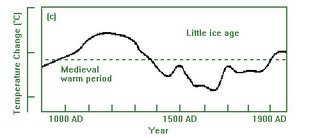
Here, between the interval of 900 to 2000 we see a recording with a mean line put in, so that one knows what the overall average is of the entire graph. Sort of like the Iraqi GDP per capita, isn't it? Especially from 1200 to 2000, you get something vaguely resembling it, although the recovery period doesn't outdo that 1200 period.
Perhaps a bit more like the US GDP Real Growth rate with a sudden drop off and recovery that never does get up to the previous growth rate? Maybe more like Reggie Jackson's 1972-'77 period, with that slump and then recovery, but not up to pre-slump slugging average. In any event you get the feeling that there is some regression to the mean, but with somewhat wide swings on either side of it, but never going outside of a limited range.
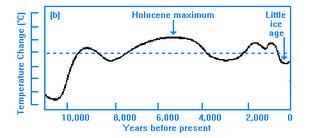
The next graph is also interesting in that regard:
A pretty good rendition of the 'rookie lead-in' ala Reggie Jackson, isn't it? And while there is previous record it also has a feel of Cal Ripken's career although not as many post-slump spikes nor the overall evenness of his career. More like Reggie's over the long-haul.
Some feel of the Haiti GDP or US GDP Real Growth Rate here, also, with a steep decline leading to a pretty flat recovery with minor ups and downs. There is a strong pull to that mean line through the graph, especially after that 'rookie' time entry.
This next one is more problematical, however, as the mean line obviously doesn't have any real impact on the measurement:
In fact you could draw the actual mean line between the fourth and fifth hash marks on the X-axis and still not get any feel for a regression towards or away from it. No feeling of stability at all here. Such a high amount of variability over time and the average is only that: an average with only a bit of draw power from entry to 2 and then some between 4 and where 5 would be. There is a feeling of a range that the measurement will not move beyond, but that is only like error bars on either side of an average reading. Pretty damned stochastic with preceding measurements not really indicating which way things will go, with sharp peaks and sudden declines; deep valleys and sudden rises. Might as well flip a coin after each measurement to see if you go up or down!
The next two represent two different measurements taken during time intervals as seen on the Y-axis going from 0 to 60, but each measures something different. Both are at the same place and the same time.
Absence or presence of a mean? There is a general slope as a mean here, obviously and the measurement trends along it. Here the Iraqi death rate, life expectancy, and infant mortality are the guides: a very strong mean. That said this graph has a wide deviation from it between time 20 and 35. If you flip the graph around and the insurgency could have done *that* to life expectancy between 2004 and 2006, we wouldn't be seeing much of a country left: just about everyone would be dead. I shudder to think what would happen if al Qaeda ever got their hands on nuclear devices, as I expect that life expectancy would see a major trough something along those lines.
Luckily this is not measuring that, so there is little problem there. But whatever it *is* measuring sure had a wide deviation from the mean slope and only recovered somewhat and then went down with the general slope again heading towards 0 on the X-axis.
Then there is the last one to consider:
Ah, such a lovely mean to show up! Right there, just above 10 is a mean that is almost rock steady and no matter how bad the trough is, it gets pulled right back up to the mean. Between approximately 28 and 33 you do have a very deep trough, but after that it not only gets pulled up again, but that 'rookie effect' shows up with a bit of over compensation. If these were baseball seasons and slugging averages, your career would have a few bad years, but then pop right back up to a rock-steady average.
And as these last two are co-measured, of different things at the same place at the same time, we should expect to see some correlation. There are some, but only on downward slopes where the top graph leads the bottom: around 12-15 and 20-30. But it looks like the bottom one leads the top in a few areas: 15-18, 33-34, and that spike around 36. So there are weak correlations, but nothing that I would pin as definitive, with sometimes the first leading the second and just as often the second the first.
Well, there you go having some fun with regression towards the mean... what?
What are those last series of graphs? I originally featured those in this post, and did a bit of photoshop work to remove original axis labels and such so that a feel could be had on just how graph reading and interpretation could help distinguish between strong and weak correlations on data. The last two I decompiled from a larger graph where they were put together, and I pulled them apart to better examine them... most folks have a problem doing that, so removing all sorts of extraneous information allows the data to show clearly through. Still, it was down and dirty photoshop work.
So I will now put them up so you don't have to go wandering back to that previous post:
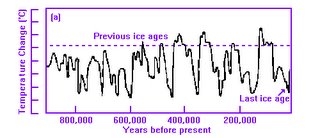
Yes, that last one is the compiled graph with the 0-8 first one being in 1,000 of ppm of carbon dioxide in the atmosphere and the lower one being mean global temperature by adding 12 degrees Celsius to the X-axis.
Notice the examined results leading to the conclusion that there is, at best, a weak correlation between global temps and carbon dioxide?
The graphs do not lie.
Apparently those in the global warming religion do. Or they don't know how to read a graph...
Trying to save what thoughts I have in case my time for having them comes to an end. I keep many ways of looking at the world and from many perspectives, but they are each a part of a larger whole and reflect my thoughts and feelings.
Diabetic, cataleptic, naracoleptic, hyperlipidemia, cerebral atrophy, allergies and *still* glad to be alive. Founding and sole member of The Jacksonian Party. mail: ajacksonian at gmail dot com
I am: Hal Clement (Harry C. Stubbs) A quiet and underrated master of "hard science" fiction who, among other things, foresaw integrated circuits back in the 1940s.
Alignment: Neutral Good A neutral good character does the best that a good person can do. He is devoted to helping others. He works with kings and magistrates but does not feel beholden to them. Neutral good is the best alignment you can be because it means doing what is good without bias for or against order. However, neutral good can be a dangerous alignment because because it advances mediocrity by limiting the actions of the truly capable.
Race: Humans are the most adaptable of the common races. Short generations and a penchant for migration and conquest have made them physically diverse as well. Humans are often unorthodox in their dress, sporting unusual hairstyles, fanciful clothes, tattoos, and the like.
Class: Wizards are arcane spellcasters who depend on intensive study to create their magic. To wizards, magic is not a talent but a difficult, rewarding art. When they are prepared for battle, wizards can use their spells to devastating effect. When caught by surprise, they are vulnerable. The wizard's strength is her spells, everything else is secondary. She learns new spells as she experiments and grows in experience, and she can also learn them from other wizards. In addition, over time a wizard learns to manipulate her spells so they go farther, work better, or are improved in some other way. A wizard can call a familiar- a small, magical, animal companion that serves her. With a high Intelligence, wizards are capable of casting very high levels of spells.




 Courtesy of our friends at
 Again from the folks at
 Courtesy of



 Supporting Friends and Allies