Showing posts with label criticism. Show all posts

08 January 2014

Why modern education isn't

Now open your books, class...

Laurentius_de_Voltolina_001Image Courtesy: Wikipedia

That is a picture of a late 14th century classroom at the University of Bologna.

353px-Meeting_of_doctors_at_the_university_of_Paris

Image Courtesy: medievalists.net

That is a meeting at the University of Paris in the Middle Ages.

University of Binghamton_newlanding

Image Courtesy: SUNY at Binghamton

And here is a modern counter-part, circa early 21st century, Binghamton, NY.

What made the University in its modern form?

Books.

Lack, thereof.

The modern university of having a teacher or professor or doctor or priest sitting in a central position of power and students looking to that individual for wisdom was necessary back in 1350 as moveable type hadn't been invented yet.  Books were scarce, rarely printed, and quite often hand copied.  Thus the best way to disseminate knowledge was to have someone who had time to read lots of books on a subject teach students from a curriculum that was dutifully, or not so dutifully, copied down in the form of notes.  If you had to really know what was in the book you could go to the library and, if you were lucky, they actually had a copy of it available.  Getting to read it was a matter of bureaucracy.

Even with moveable type books were still expensive but at least somewhat available... in the library... to read.

The availability of books for private libraries and at home did take a while to get into gear, and was mostly something for the rich and well off up to the late 19th century to early 20th century, where books were still cherished in poor families.  By the post-WWII era, books were readily available as forms of modern printing and the cost/benefit ratio of long press runs took over, and soon you had salesmen hawking the Encyclopedia Britannica in the new suburban neighborhoods.  It wasn't alone, of course, and the book store, once something that only those with a scholarly or Bohemian lifestyle went to, were soon in strip malls.

Yet the entire educational system still depended on 'experts' to present pre-digested 'material' for students to copy down.  Mind you mass-media was now available and out in semi-rural Western NY, out in pine tree and cow country, our black and white TV got Sunrise Semester where, in the early, pre-dawn hours, one could tune in to a course being presented on TV for that semester and do course-work by mail.

Amazing!

Revolutionary!

It went nowhere, of course, as those big palaces of learning had political clout, alumni, professors and buildings, all of which needed grease of the monetary variety to function.  And if you didn't like the public schools, well, you just weren't 'modern'.

For that you have to go back to late 15th and early 16th century and Martin Luther who wanted everyone to learn to read so they could read the Bible on their own.  In their own language.  This concept was expanded upon by Johann Heinrich Pestalozzi (1746-1827) and the web site dedicated to his contribution gives a list of the things he wanted put in place for what we would call 'Primary Education':

Pestalozzi’s approach has had massive influence on education, for example, his influence, as well as his relevance to education today, is clear in the importance now put on:

  • The interests and needs of the child
  • A child-centred rather than teacher-centred approach to teaching
  • Active rather than passive participation in the learning experience
    The freedom of the child based on his or her natural development balanced with the self-discipline to function well as an individual and in society
  • The child having direct experience of the world and the use of natural objects in teaching
  • The use of the senses in training pupils in observation and judgement
  • Cooperation between the school and the home and between parents and teachers
    The importance of an all-round education – an education of the head, the heart and the hands, but which is led by the heart
  • The use of systemised subjects of instruction, which are also carefully graduated and illustrated
  • Learning which is cross-curricular and includes a varied school life
  • Education which puts emphasis on how things are taught as well as what is taught
  • Authority based on love, not fear
  • Teacher training

Pestalozzi’s influence over the spirit, the methods and the theory of education has continued into the twentieth and twenty-first centuries and most of his principles have been assimilated into the modern system of education.

And by 1900 you got schools that look like this...

bpk 20.012.125

Photo Courtesy: GHDI

Oh, wait, that is a factory at AEG in Germany at the turn of last century!  So sorry!
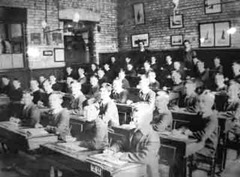
tiered-classroom

Photo Courtesy: 1900s.uk.org

There you go!  Rank upon rank of students at desks all doing the same tasks... I mean that is so different from an industrial facility, isn't it?  And that is so very different than the University!  I mean, you have... individual desks, no wait, that was there in Bologna... students writing notes on the topic, no wait, they were doing that in Bologna, too.  Hmmm...are we sure the production line wasn't invented in Bologna?

At least today is so different!

5277d3ad6e79a98d3a2b1a1b7ecffca4

Photo Courtesy: LA Childhood Education Examiner

I mean here the students can also push their desks together!  And learn the same thing... at their desks... at the same time...

Growing up with this sort of system, I never realized just how antiquated it was, even while I was just auditing college courses on Sunrise Semester.  When I was 6? 7 perhaps?  Definitely less than 10 years old.  The New Media of that era of the late 1960's to early 1970's was television, a one to many media that should function very well as an immediate replacement for that 14th century institution known as the 'Educational System', with bells and whistles like Kindergarten added in by the Germans.

And yet the US came into the late 19th and early 2oth century with a different sort of teaching environment.

oldsch

Photo Courtesy: Will County News blog

That is a one room schoolhouse, a place where children of both genders and different ages all learn in the same environment.  By the time of that image in 1938 there was some segregation by age.

One-Room Schoolhouse

Photo Courtesy: education14 blog

Yet a generation prior to that, this was not the case.  That idea of systematized learning also meant segregation not just by subject, but by age, and the requirement for specialized teachers not only by subject but by age range.  The education profession was turning into a reflection of the work environment, to some degree, but was also becoming a sort of guild system which had decided that further employment of its system required further specialization.  And yet the topics involved for reading, writing, math and even basic history, are ones that are amenable to distinction within a heterogeneous but delimited age range, say 6 to 18 years old. 

In a one room schoolhouse such instruction was mandatory due to the variety of ages coming to the school and the limited time to teach a subject.  Thus a subject was taught as a multi-level form of instruction in which basic facts could be provided and expanded upon in a fashion to suit the learning capacities not just by age but by individual.  This gave children a wider exposure to a given subject and a chance to pick up advanced learning at a young age.  Older students get a refresher and some new material, while younger students get more than they can handle so they have to learn just what it is that they will have to handle.  Simultaneously and in different subjects all by one individual leading the students.

That is teaching.

Talking on a single subject and having student writing down notes, that is instruction, and a largely passive affair.  This has been the case since the start of the modern University as seen in places like Bologna and what we have to day is an relic form of institution trapped in the old system that was driven by a lack of ready material in the form of ink printed on paper and bound into codices.

Today the world does not have a problem of ready material availability and, in the advanced post-industrial revolution Nations, a lack of access to them.  Quite the contrary the classical works are now available, by and large, for free via digital means which should be a great boon to education across all of mankind.  Yet the classification by subject and learning level for a cohort of homogeneous age students is not compatible with this ready availability.  Indeed no instructor in any subject, save for a few of the actual hard sciences, can be said to have any idea of the extent of their subject or be so well versed in it as to encompass its modern size. 

It is true that subjects that start in the Ancient Classical period and going through the Reformation, Peace of Westphalia, Enlightenment and post-Enlightenment era of the 19th century are relatively staid historical subjects.  These subjects serve as the basis for all later education in ALL FIELDS from views on religion and morality through what Nations are through economics through the hard sciences and into the requirement of personal ethics that upholds a given moral code and structure for the basis of individual freedom.  And here is the solution to basic education in these areas: record them at multiple current schools, digitize the lectures, hyperlink ideas together via topic, and formulate a program of self-instruction on them by individuals with actual written tests without access to anything but written source materials in hard copy format to demonstrate individual knowledge and fluency on topics.  This would be a self-paced, age independent system so that individuals could learn at the pace they wished to learn at and only if they see a requirement for demonstration of such knowledge need they ever be tested on it.

Getting to 20th century topics would also require such fluency and background, but the educational materials for them would not be limited by any means.  Demonstration of knowledge of the basis for these ideas and how they came to be is a touchstone demonstration of knowledge.  Just as being able to master the tools and concepts of welding, machining, and creation of materials via additive processes, there is a requirement that someone who actually knows how to do these things certifies that a student also knows them so, too, would the requirement for understanding economics, morality, the moral basis for ethics, physics, chemistry, biology, or any other subject useful for a career require the demonstration of being able to think independently without aid of any device save hard copy source material and marginal notes. 

These are mental tools that have direct applicability and requirements of mastery to them which can be tested in an age heterogeneous environment where there is no limit to re-taking such tests (albeit a small fee might be involved) and that could be sent to any three individuals with certified mastery of such knowledge up to that level,  and graded separately.  This would give the person seeking education feedback from three individuals with varying background and insights, and while passing an exam faults and flaws in everything from syntax to logic structure, along with historical accuracy would be given.  For the topical sciences the divorce of the hard sciences from the rest of post-Enlightenment topics would only come at the specialization level after demonstrating a knowledge of the basis for a given topical science and ability to do lab work in them, both held in equal proportion as science is as much about understanding a topic as testing it via lab experimentation.  Thus the basis for the sciences and their connections to the each other and to the world they worked in, historically, would be a major factor in understanding the place of the sciences in everyday life and have a requirement that anyone wishing to understand that place must also understand the method of experimentation and the moral and ethical basis for it.

Such testing isn't just written on many topics, but is also conversational: being able to demonstrate an immediate ability to reason through new topics on the spur of the moment is something we only do at the Graduate School level for individual topics, but are something that form each of us as individuals in our lives.  Being able to hold a discussion on, say, the basis for the Nation and what the function of a State is will vary across periods from Ancient Classical all the way to the modern age, but the groundwork for that reasoning is one that is historical and requires historical knowledge to make an informed decision.  Just as modern understanding of quantum theory rests on electromagnetic theory, and that, in turn, has links forward to relativity and backwards to Newtonian physics, the ability to discuss that as a topic in its modern realm requires a basis of understanding of its history and why the questions we ask today come about.  In attempting to divorce history from our modern lives, to seek to disconnect the modern State from our historical and cultural understanding of it, is a disservice to all men just as trying to disconnect biology and human experimentation from morality and the duty of citizens to practice their ethics on a known moral code in service to their fellow man both lead to ruin of not just Nations and societies, but mass slaughter of individuals.  Without a historical understanding of the present, the future is one of horror.  A little knowledge is a dangerous thing, but none is fatal.

If we are to take James Burke of Connections fame to heart then the basis for understanding our role as individuals in a complex world is to understand the basis for how our complex world came about.  Education, then, is no longer something limited by age, by class, by gender or by any other category we impose on humanity: it is for everyone at all ages at all times of their lives from the moment that cognitive thought first starts to the last thoughts of those at the end of their lives.  Fluency in the range of topics to address the modern world should have, however, no requirement that people learn them via an enforced educational system that relied on a lack of source material availability to require such things as Universities and, later, schools.  Jobs have requirements to them, and learning the basics of reading, writing, logic, basic four function mathematics, reasoning, syntax, spelling at a fluency and daily use level may have some age determinants in them, but even those can be highly automated via pre-recorded instruction that would serve as the basis for entry to taking further examinations to demonstrate skill and mastery of a topic later.  Many jobs, however, have only the need for basic mastery of material to them and while some might class these jobs as 'low' they are only low in their demonstrated skill requirement: people hauling trash make a good living doing so and those paid a pittance for doing manual labor for farming can still get a good life from doing so.

The entrance to higher capability in any field is a demonstrated ability to master topics and expand mental capacity so as to properly understand how a given area of knowledge fits in with all other areas of knowledge to create a complex web of knowledge that goes back and forth in history.  A concentration in a given topic can go far with just a little auxiliary knowledge in broader topic ranges, right up to the point where you question the morality of research and the ethics of doing certain kinds of research, at which point all those minor entrances into the other topics that allowed for a concentration in a given field must come into play and an individual put in the time and effort to learn what the moral basis for society and freedom are, and what their ethical obligation is to such a society actually is. 

All bureaucrats should have this as part of their essential 'must know' category of knowledge as it is the functionaries of the State that perform acts upon their fellow man and that can, indeed in our era must, contain a full and broad understanding of what society is, where our source of freedom and rights come from and the obligation of the individual in service to the State to not perform acts of immorality upon others as an ethical obligation to themselves, their society, their fellow man and the State they have created.

There is no Royal Road to education.

Our current formulation has run into the 21st century which is now set to sweep away all systems based on limitation of access to materials be they mental or durable goods, and bring a new age of humankind into being based on what we know of ourselves to be as individuals in Nature who are obligated to its laws and as individuals granted access to a moral code that seeks to engender liberty for each man without coercion upon him to think like anyone else.  You cannot get that through the University system, the current education system, or the current systems supporting them which are now failing in this modern era and have been failing ever since the first one-to-many forms of broadcast became available.  Our society upgraded the tools it has to learn but has not applied them for the utility of each individual.  That era is now ending not from the top-down, but from the bottom-up. 

I have already seen schools built in the post-WWII era turned into office space after being sold by their districts.  And I've seen entire cities crumbling because a way of life that was thought to be perpetual was so rooted in place that it required vast amounts of revenue to keep a dead way of life going as a veneer on the physical plant of the city itself.  The answer is not to throw more money into these institutions which have failed in critical ways to adapt and adopt to the 20th century, not to speak of the 19th and 18th century.  They were not even appropriate to the 20th century to say nothing of the 21st.  It is time we change our view of education from the warehousing of pre-teen and teenagers to the development of knowledge and skills that can be demonstrated by each and every individual if that is their desire.  Education must no longer be enclosed by brick walls and attempted to be walled off within our minds to institutions, but opened up as a conception that is held by each of us who are eternally students and, in our turn, practitioners of those things we sought to embed in mere material structures.  That, of course, will shake us all up as to what it means to have a job, when it is appropriate to have a job and how betterment of oneself is in one's own hands and not enforced by a bureaucracy that, in seeking to do 'good', walls us off from the eternal good of self-education and reasoning.

01 January 2014

Recovery

A personal retrospective on my physical well-being.

I hope to get some more normal posts up, but such is life.

Late in 2004 I began a trip into a land of darkness where my mind was slowly losing track of work and I was beginning to feel exhausted beyond anything I had experienced in my life before that.  With that also came a lack of awareness of these things and the simple and all too human attempt to rationalize these sensations.  Being made senseless and having one's mind dimmed when aided and abetted by rationalization meant that things that should have alerted me to my dire straights were passed off... until my body forced the issue by giving me a cataleptic attack while driving.  No accident resulted, but that warned me that something truly serious was going on, even through the mists of my befuddled state of mind and being, which was turning into a strange place where being awake and being asleep meant little difference at all.

By 2005 I just wanted to know what was causing these attacks and if they could be dealt with, and the list of tests I went through was long and deep.  The only change had been in a standard medication, one of the statins, and when my endocrinologist heard the symptoms he took me off them, but the damage had been done and worse was to come after that until the full extent of it was finally reached.  My brain had the normal attributes of someone a good 20 years older than my physical age, and yet that was not a natural thing.  Narcoleptic conditions run in the male side of my family and I had thought I had escaped them as they have two general periods of onset: up to teenage years and then again in one's 60's.  Well, my brain had reached that magic age, I guess, just decades ahead of schedule.

Climbing out of that pit meant trying to get my thought structure back together as it had been shattered and eroded by this condition.  I had become a creature of willpower alone, determined not to let this be the end of my life.  The hardest work in my life would not be physical, would not be trying to write great pieces of fiction or histories to last the ages, but to merely scrape back a formulation of my thoughts out of a land between waking and dreaming and back, fully, into the land of the waking and living.  We take the fact that we think for granted, at least most people do, but somewhere within my psycho-dynamic toolkit there is a repair kit that allowed me to begin the hard work of reconstructing my mental capabilities to get some thinking capacity up and running again.

Those dark days are dealt with in my early blogging, which take place after the internal collapse of my mental structure, diagnosis and the first medications to deal with the actual phenomena.  There is no magic pill to rejuvenate the mind, as yet, to repair damage and to regain lost capacity.  Maybe we shall have that in some future, but until that point one is stuck with the old fashioned way of hard work.  I set myself some tasks to exercise my mind: learn some rudiments of Javascript, find out just what terrorism is (not the talking around it to attempt to call it something else, but its actual being as an activity) and then to learn connectivity structures based on Person-to-Person systems which are the basis for so much of human life that it pervades the far reaches of the horrific and the criminal realms.  For, as my Uncle Joe used to say disparagingly of so many corporate and government affairs, 'it isn't what you know, its who you know'.

Thus diagnosis was done by others, but I was willing to go through just about any test they cared to put me through, and I would hazard a good couple of hundred of vials of blood were taken to that end.  I have a long, long, long list of things I don't have and for that I am very thankful, indeed!  I will give the Sherlock Holmes method of scratching off stuff from a list and whatever you are left with is what it is a hat tip: it works.  Unfortunately it is the brute force method of logic, and I prefer inductive reasoning of 'this is the only thing that fits to make the entire thing work' sort of approach to the list scratching business.  As I have learned, that is a bent of mind that one must have by some means other than education as no one can teach you how to take a look at a whole thing and then see where something is missing and say what it is.

Countering the effects of the problem, although not the problem itself, came next.  I was a Type 1 diabetic before this happened and can tell you that dealing with a problem is not the same as curing it.  For all the advances in genetics, biology, biochemistry, and 3D structural analysis of molecules and how they interact, plus the human genome, a simple auto-immune disease dating back into the far reaches of human ancestry is still beyond modern medicine to cure.  Somehow every promising approach is thwarted by it.  Yet one gains a toolkit of mental requirements to deal with such a problem on a daily basis and that means I had one available for yet another problem that has no cure.  We know that there are cases of spontaneous remission of Type 1 diabetes after about 20 years of having it: the poor immune system just gets tired of fighting that part of the body and natural regeneration takes place for islet cells.  That I still have the condition points to an immune system that is still misdoing its job!  Now I also get to take medications that modern medical science can say what its structure is, but has no real idea of how it works.

There are times when I suspect the strain of being known as Witch Doctor is still with us to this day. 'What is it, what does it do?' you ask and the response is 'Dunno, it just works, take it.'

I am not nor ever have been impressed by degrees sitting up on a wall.

Doctors are still practicing medicine.  They need more practice, less overhead, please, as the practice still is not perfected.

Now all of this research, fiddling with code, playing with stuff got me to firearms as there was a warning bell going off in my head circa 2007.  A good year before the elections, hell before there were candidates, some part of me was saying: Prepare For No Good Shall Come Of This.  I took NRA training to ensure that I properly understood function and safety of firearms, plus only rudimentary cleaning... there needs to be a real course on that, not just gunsmithing but just 'how the hell do you clean this piece of Swiss watchmaking called a gun?' sort of course.  And I like older firearms, so drift punches, springs, and scouring around for parts became a ready past-time.  All of this is DIY in the firearms community, and the modern arms are much, much simpler to work with than much of the older stuff until you get back to the bolt action rifle: those are, at least, pretty simple to understand.

My goal was to next find out what sort of useful skills I had or could gain, and I'm still on that path today.  Firearms leads to stocks made of wood and that means wood finishing.  In my family lineage is woodworking going back at least a couple of generations, and I had not only shop class but a father who did cabinetry in his spare time.  That means I had some of the old 'young shop assistant' sort of deal going on, although not a lot of it, enough to get me familiar with the tools of the trade.

Building back stamina became the major goal as of 2009-10 and woodworking, well once you start using the manual tools you now have a major way to utilize physical capacity and measure endurance, now, don't you?  Even on the power tool side, the lifting and toting of boards, planks, and other less savory bits of trees can get you all sorts of exercise, especially if you have a small shop and need to set up and break down the power tools so that you can have access to the rest of the shop when you aren't using them.

Up until the past few weeks here has been the deal: 1 day of a few hours of work, 2 days of recovery.  Doesn't matter if the day is woodworking, shopping, or whatever, either.  On rare times I could string a couple of days together and then need additional down time to recover.  That was getting me to an even keel, but the boat still had water up to the gunwales and I was bailing as fast as I could.  Stamina was not returning but I at least could keep what I had.

About a month ago I talked with my neurologist who told me that there are some preliminary longitudinal studies that indicate that for diabetics in Japan and Germany (two populations with a major concern over the disorder by genetic causation) that the use of a CPAP helps to lower the HbA1c (a basal blood glucose reading that you strive to get to 7% as a diabetic) by a full 1%.  That is an eye-opener, to be sure.  A real eye-opener as a CPAP improves flow of air to the lungs while sleeping.  I had tried a CPAP before as there were indications of some marginal sleep problems, and they continue to be marginal and the neurologist doesn't know what to make of the actual readings as they aren't showing a disorder but something else going on... but that a CPAP might help that and the the cause to actually get one.

Done!

The prior CPAP device made my sleep worse, not better.

There have been improvements over the last 6-7 years, not grand ones but gradual ones, to the point where I can actually tolerate the device, more or less.

It will take some months of use to see what it does for that long term basal blood glucose reading.

A more immediate effect is to get lots of oxygen into my system at night and well distributed through my body.  I do wake up logy, no two ways about it: it is the sleep of someone who has worked themselves to exhaustion.  I knew what that felt like, back before 2004.  It is the sleep that when you wake up you just had no idea of how tired you actually were.  Apparently I need that sort of sleep.

From that sleep I now have better and larger amounts of physical energy and mental awareness longer into the day and even into the evening.  I can accomplish a lot more with the energy once I get the logy feeling out of the system.  Learning to hand plane maple that has just been skip planed is really hard work, let me tell you.  Yet I haven't been tempted to power tools (although I have a planing jig for a router) because it just feels good to be able to put some actual physical capacity into the work.  For a few hours at a stretch.  So now I can have sore muscles when I wake up!  This is a good thing.

The next step of the recovery is actually reversing not just the effects of one of my major conditions, but the thing, itself.  Those require an actual, functioning medical system in which trying to redistribute wealth and making everyone sicker in the name of 'health insurance' is not the goal.  That is an enemy to actual scientific advancement.  Strange that the most backward looking people are now on the political Left: they are starting to sound like the old fogies who just want to do things the same, tired old way that doesn't work well because that is all they know and will tell you about how righteous it is to do things the broken, tired, old way.  Yet the 21st century isn't going to wait for them to catch up, and no matter how much kicking, screaming, and theft under the guise of 'doing good' goes on, this century is set to steamroller the prior 3,000 years of advancement with changes that seemed impossible just a decade ago.  Be it the first formulation for a warp drive or getting to the bounds of computer capacity and then leapfrogging that with quantum computing or finding out that the ways to deal with disorders and diseases isn't to just ameliorate the effects but treat the damned things with some skill ('what does this drug actually do?' 'I dunno, it just works') and get the idea of practice out of the way or education that is self-performed via online systems of study that can't be categorized but can be tested as to skill, knowledge and capacity to utilize it... everything, and I do mean everything, that has been the foundation for the modern world is about to undergo a sea change that will make the Industrial Revolution seem like something for children.

Thus my goal is to survive the current bout of MegaStupidity via Centralized Insanity of Government and get to this new age of Individual Freedom and Liberty writ large.

As has been my threat: the more I recover, the less I will be posting.

I hate repeating myself and that is mostly what I would be doing to no good effect.

I need to recover so I can join this up and coming age of wonder.

The age of Back to Basics, DIY and reaching for the stars and getting off this damned starter home of a planet.

And I hope you will join me.

For we are better than the old 20th century has led us to think.

And governing is the problem, and government is not the solution.

18 October 2013

Voting in the 21st century

The 20th century is over and it left a long, blood-stained path behind it.  Unfortunately our political class is married to it, still, and continue to campaign like the 20th century is still going on.  The politics of division such as 'The War on Women' or wanting to put a huge, government led system down for 'health care' ignore the realities of the 21st century.  These realities I've talked about before in Dawn of a New Era, and those drivers are the ones that are currently shifting the basis for what we know as our modern civilization.  Yet the 20th century, for all its problems, has also blessed us with an infrastructure that is vital for the immediate continuance of civilization in the 21st century: electricity, potable water, sewage systems, paved roads, airports, and a vast web of pipelines.  Without this infrastructure in all of its parts modern civilization quickly decays.  A major disruption of the pipeline system crossing the Mississippi River would cripple the entire Nation.  I outlined five major events that are either cyclic (meaning they happen on a regular basis due to forces of nature) or a singular event that has its now understood predecessors so that it is not cyclic, as such, but part of an understood and ongoing process, and all will happen at some point in time to North America.

I will add to those yet another: solar weather.  In testimony on 12 SEP 2012 to the House Homeland Security Subcommittee on Cybersecurity, Infrastructure Protection and Security Technologies, the head of the National Protection and Programs Director gave us this on the topic of solar weather:

Solar Weather is created as a result of massive explosions on the sun that may shoot radiation towards the Earth. These effects can reach the Earth in as little as eight minutes with Solar Flare X-rays or over 14 hours later with a Coronal Mass Ejection (CME) plasma hurricane. An extreme CME is the Department’s biggest Solar Weather concern. It could create low-frequency EMP similar to a megaton-class nuclear HEMP detonation over the United States, which could disrupt or damage the power grid, undersea cables, and other critical infrastructures. The United States experiences many solar weather events each year, but major storms that could significantly impact today’s infrastructures are not common but have previously occurred in 1921 and 1859 and possibly in several other years prior to the establishment of the modern power grid. The U.S. Department of Energy and utility owners and operators have been focusing on potential threats and steps that utilities can take to reduce possible impacts.6 Work is underway in cooperation with a number of federal agencies including the: National Aeronautics and Space Administration (NASA), Nation Oceanic and Atmospheric Administration (NOAA), United States Geological Survey, Department of Energy, Department of Defense, and DHS with industry support and participation to ensure this threat is understood.

The concept of 'ensuring the threat is understood' for a known threat that is understood is verbiage for 'we want to get a few bureaucrats to hold meetings and write reports that might have some conclusions in a decade'.  Just so you know what that means.

The 1921 storm fed power into the nascent grid and took the telegraph service down with blown fuses and damaged equipment and lasted from 13-15 MAY 1921.  Over at Space Weather there is a somewhat longer look at the effects of the 1921 event:

May 13, 1921 - The New York Railroad Storm - At 7:04 AM on May 15, the entire signal and switching system of the New York Central Railroad below 125th street was put out of operation, followed by a fire in the control tower at 57th Street and Park Avenue. Railroad officials formally assigned blame for a fire destroyed the Central New England Railroad station, to the aurora. Telegraph Operator Hatch said that he was actually driven away from his telegraph instrument by a flame that enveloped his switchboard and ignited the entire building at a loss of $6,000. Over seas, in Sweden a telephone station was 'burned out', and the storm interfered with telephone, telegraph and cable traffic over most of Europe. Aurora were visable in the Eastern United States, with additional reports from Pasadena California where the aurora reached zenith.

Such storms originate from a sunspot and can last for hours, days or even weeks.  They have two distinct parts to them when they happen on the orbital plane of Earth and intersect with the planet as the Sun rotates.  First is the initial wave of particles and lightweight radiation: gamma rays, x-rays, along with UV.  Transit time from the sunspot to Earth is just a bit over 8 minutes as they are going at the speed of light.  These interact with the Earth's magnetic field and are deflected by it to the north and south magnetic polar regions.  These particles give the first real taste of the storm and if it isn't much of storm that is all you will get and have some aurora effects a bit further from the poles than normal.  Larger storms send particles along that path and they also interact with the Earth's magnetic field, but due to their mass they also start to push it lower.  This brings the aurora effects to lower latitudes and can make them quite spectacular, and also bring down more in the way of heavier particles to cause secondary radiation effects when they interact with the atmosphere.

This is the stuff that also starts to effect satellites, and if it isn't hardened against this sort of radiation that can be the end of the satellite.  The major problem with this part of the storm is first the pushing in of the magnetic field, which causes ripples that cause long wave ground currents which travel through anything conductive at or just below the Earth's surface, but then as the storm passes, the magnetic field springs back and oscillates, causing more of these currents.  How much current is induced is effected by the wavelength of the magnetic oscillation, which can induce a current down to half the wave length of the oscillation.  What this effectively does is puts a current into things like transmission wires (above and below ground) and into any pipe made of conductive material.  Thus a water system with metal pipes will have an electrical charge going through them. 

Also power plants will have an electrical current fed into them via long-line transmission wires, usually taking out transformer stations, but those may not fail fast enough to protect the power station, itself.  Grounding out a plant does no good as the ground wire is most likely 'live' with current.  In your home if you are grounding out through water mains made of metal pipe, then you will also experience this effect, particularly if the ground wire is not going through the central fuse box or circuit breaker box.  Even killing the main switch to the grid from your home won't stop this unless the ground is centralized through there.  It is much better to have a local ground that is only a few feet long instead of one that is the equivalent of miles long.

A solar storm like this is known as a Carrington Super Flare and one like that was responsible for the Solar storm of 1859.  At Space Weather there is a collection of newspaper articles and I'll give a few excerpts to give an idea of what this sort of ground current means:

Singular Effect of the Uarora Borealis on the Telegraph Wires. New York. August 29, The Superintendent of the Canadian Telegraph Company's line telegraphs as follows in relation to the effect of the Aurora Borealis last night: '…so completely were the wires under the influence of the Aurora Borealis, that it was found utterly impossible to communicate between the telegraph stations, and the line had to be closed.' The same difficulty prevailed as far South as Washington. [Chicago Tribune, p.4]

.…The French telegraph communications at Paris were greatly affected, and on interrupting the circuit of the conducting wire strong sparks were observed. The same thing occurred at the same time at all the telegraphic station in France…[The Illustrated London News, September 24, 1859].

…Lousiville KY, August 31-The telegraph wires between this city and New York, as also throughout Canada, were interrupted by the unusual overcharge of electricity which always pervades the atmosphere during the continuance of this phenomenon…[The New Orleans Bee, September 1, 1859].

…During the auroral display on Thursday night in Boston some curious phenomena were witnessed in connection with the telegraph wires. The following conversation, says the Boston Traveler, between the Boston and Portland operators on the American telegraph line, will give an idea of the effect of the Aurora Borealis, on the working of the telegraph wires: Boston operator, (to Portland operator)--"Please cut off your battery entirely from the line for fifteen minutes." Portland operator-"Will do so. It is now disconnected." Boston-"Mine is disconnected, and we are working with the auroral current. How do you receive my writing?" Portland-Better than with our batteries on. -Current comes and goes gradually." Boston-"My current is very strong at times, and we can work better without the batteries, as the Aurora seems to neutralize and augment our batteries alternately, making current too strong at times for our relay magnets. Suppose we work without batteries while we are affected by this trouble."
Portland-"Very well. Shall I go ahead with business?" Boston-"Yes. Go ahead."
The wire was then worked for about two hours without the usual batteries, on the auroral current, working better than with the batteries connected. The current varied, increasing and decreasing alternately, but by graduating the adjustment to the current, a sufficiently steady effect was obtained to work the line very well. This is the first instance on record of more than a word or two having been transmitted with the auroral current. The usual effects of the electric storm were manifested, such as reversing the poles of the batteries, etc…[The Daily Chronicle and Sentinel, Augusta, Georgia, Thursday AM, September 8, 1859].

In addition to the technological issues posed by these 'earth currents' entering the telegraph lines, was the very real potential for direct human injury. The most spectacular, and now legendary, story is told by Frederick Royce: a telegraph operator working in Washington DC. at his station between 8 and 10 PM. " I did not know that the Aurora had made its appearance until 8 or 81/2 o'clock. I had been working 'combination' to Richmond, and had great difficulty from the changing of the current. It seemed as if there was a storm at 'Richmond'. Concluding that this was the case, I abandoned that wire and tried to work the Northern wire, but met with the same difficulty. For five or ten minutes I would have no trouble, then the current would change and become so weak that it could hardly be felt. It would then gradually change to a 'ground' so strong that I could not lift the magnet. While the Aurora lasted the same phenomena were observable. There was no rattling or cracking of the magnet, as is the case in a thunder storm. I looked at the paper between the arrestors, but found no holes. Philadelphia divided the circuit at the request of New York, and we succeeded in getting off what business we had. The Aurora disappeared a little after 10 o'clock - after which we had no difficulty, and we worked through to New York. During the display I was calling Richmond, and had one hand on the iron plate. Happening to lean towards the sounder, which is against the wall, my forehead grazed a ground-wire which runs down the wall near the sounder. Immediately, I received a very severe electric shock, which stunned me for an instant. An old man who was sitting facing me, and but a few feet distant, said that he saw a spark of fire jump from my forehead to the sounder. The Morse line experienced the same difficulty in working." [New York Times, Sept. 5, 1859]

Do remember this is with the telegraph system at the period, and it tells us of the problems of induced ground currents under that pushing down of the magnetic field, during the event which lasted from 28 AUG – 2 SEP 1859.  This all with equipment made of simple coils of wire and batteries.  Now put that sort of electrical charge into the entire power grid of every Nation on Earth in this, the early part of the 21st century.

Unlike a nuclear EMP you probably won't have much of your personal electronics effected by this sort of event unless you are far north of the aurora and getting a lot of that secondary radiation bouncing around: then you might get some of that sort of thing.  What most nuclear EMPs don't do all that well is induce ground currents across the surface of the planet like a CME.  No, the problems aren't from that, but that other part: the induced ground current.  The 1921 event saw transformers explode from a relatively minor solar storm without much of an electrical grid to do that.  Modern electrical grids have orders of magnitude more transformer stations than were on the entire planet in 1921.  Large Nations may utilize some very large transformers for their long-haul lines, and the US has about 6 of these which are vital in connecting up some of the major hydro-electric generation systems into the rest of the grid, and no one really makes those things any more.  Even worse there is at least one of them that took a special rail line to put in place and that has since been removed, and as geomorphology and geography dictate where these things go, it was and is in an ideally situated spot for its function.

Now this effects my voting... I mean this is what the article is about, no?

I've read a bit about what it would take to put in isolation systems for power plants, and it is about $1M per power plant, which comes out to $0.03/month for an individual customer for about 5-10 years to get the project done for existing plants of all sorts: coal, natural gas, nuclear, solar.  You name it and if it isn't built with this sort of protection to start with, it needs a retrofit if it is slated to stay online longer than the life of the retrofit project.

This does not need to happen at the National level: individual States can do this on their lonesome and even coordinate efforts if they want.  No law against it and nothing in the Constitution prohibits it so long as it doesn't tread on federal power grants from the people.

Now find a politician who even KNOWS this stuff.

Go ahead, try and find one that puts SURVIVAL first.  Because if we get a CME from a Carrington Event, then modern civilization is toasty.

'War on women'?  Without electrical power you don't get potable water.  You don't get a sewage system.  You don't get fuels transported via pipelines (and how the induced currents will hit them is anyone's guess).  A good part of the satellites will be dead, although you might still have GPS, but that depends on the size and strength of the event... and taking into account that the Earth's magnetic field has been declining for a few decades since it looks like it is time for a pole reversal in the next few thousand years.  So which is more important: birth control/abortion or survival?

Your choice in the voting booth decides your fate in the future.

More locally the regular geophysical disasters have some very grave implications, like the New Madrid Fault Zone letting slip for a few months.  That will most likely take out bridges, pipelines and a good number of long-haul electrical lines, plus damage or destroy some dams close to the event.  That St. Louis to Memphis region hasn't experienced anything like that since the quake events from 25 DEC 1811 to 7 FEB 1812, which was three major quakes and so many small quakes that it was hard to ensure one's footing during the time it happened.  As so much of the Nation's goods flow north and south along the Mississippi, a sudden onslaught of debris flows going through the river system will cause damage.  For some hours the Mississippi River ran backwards near New Madrid, and the river shifted its course in a few places, drained one lake and created another, as well as causing sand geysers... you tell me what this means for the flow of goods, services and power throughout North America.

And being close to the East Coast means that the island of La Palma's Cumbre Vieja having an earthquake causing a massive landslide will have dire consequences for the entire Eastern Seaboard of the US, Canada, and the entire Caribbean, not to speak of the reflected and refracted tsunami events hitting Europe, Western Africa and Eastern South America.

So how does the 'War on women' play out when National and probably international trade is effected by a large portion of the US going off-line?  Devastation from the NMFZ to the Mid-West and the lower Mississippi River will probably take out a few refineries and pipelines from the Gulf, too, so getting back up and running with those might take a few years.  And as for the Cumbre Vieja landslide event for the Eastern Seaboard, well, there are major population centers and the tsunami will travel across the ocean as a wave at about the speed of a jet liner so you get 6 hours of warning if it can be identified and detected.  A wave form coming in that tops the Empire State Building when it hits NYC isn't something to sneeze at, and similar will hit across the entire coast.

Can we find a politician that puts basic survival first?

Or at least encouraging citizens to prepare because our government is so woefully inadequate that it can't figure out if cheap disaster preparation is more important than birth control when the survival of civilized life is at stake?

Or how about decentralization and disintermediation of government services from the federal to the State and local levels?  The federal government has proven incapable of keeping unguarded memorials open during a government furlough... I mean that is worse than lackluster, it is criminal to prevent the people from seeing public memorials due to a funding fight.  That is piss poor stewardship of sites entrusted to that government and the States really do need to step in and intervene by rescinding permission for the federal government to hold lands in their state for public use.  Eminent domain those babies to get rid of the awful steward in charge of them: we can get more accountable buffoons, cheaper than the federal government can.  On the State level strange functions like 'liquor control boards' are buggy-whip deals and need to go.  And for roads that aren't Interstates and don't really go beyond a couple of counties in a State, why aren't those handed over for purely local control?  Hardening the electrical grid takes State level initiative and waiting for the federal government to study it to death is a recipe for disaster.  And that disaster WILL effect you if the right event hits with NO preparation.

You, at least, can prepare.

A few days of food, potable water, and some method of dealing with physical waste products goes a long way towards dealing with the small problems.  At a month you are at least buying time to take good stock of a much larger disaster.  You can and should prepare beyond that, but when you are in that mode then the problem OF GOVERNMENT comes to the forefront.

It isn't serious about anything.

Politicians care more about dividing electorates than serving them.

Politicians and their parties want political and polarizing fights, ignoring survival level problems that should be the domain of government: self-government, local government, State government and last and least is the federal government.  Yet all we get are top-down solutions for bottom-up problems.

That is the 20th century mindset and it is a recipe for disaster.  It was in the 20th century and it is worse now because we have spent zero time preparing for anything larger than heavy wind storm... and even those don't get any preparation and days of power going out.  Super Storm Sandy gave us the time from civilized behavior to barbarism in the 21st century: 72 hours.  And the supplies to 'deal' with it were so far away that it took a week or more to get them to the disaster... that is a guarantee of a bad disaster going barbarous.  And yet simple decentralization of goods to local management would have alleviated the immediate problems long enough to allow a better regional response.

Didn't happen.

Now with that in mind, picture a Carrington Event in the 21st century.

Not the destruction of Super Storm Sandy, yes, and even gets you a pretty light show for a few days.  The lack of all infrastructure, however, gets you the same decay rate, everywhere that is not prepared.  And we don't have Interstellar friends to bail us out of a global CME.  Yet with some basic preparation for the power plants, getting a decent set of replacement transformers in storage in a salt mine or other safe place, a basic grid can start to reappear in days.  With distributed food and water, plus some localized systems for processing same, you can keep civilization going and get it back on its feet.  Birth control and abortions will be in short supply, I'm afraid, but then having food to eat, water to drink and a safe place to bed down for the night will rise far above any 'War on women' sort of deal as we try to stave off barbarism and a war of Each For His Own.

Thus I have a list of things that politicians must be willing to talk about or they do not get my vote at all.  Period.

Decentralization of services along with an understanding of disaster preparation at all levels of government.  That means FEMA can go away and have its stores divided up by the States and distributed locally.  They suck at disaster response.

This goes double for the State level.

Prioritization of threats so that mere lifestyle 'threats' come long, long, long after basic survival threats.  Yes, nothing is going to save us from Yellowstone if it goes through one of its major eruptive events, unless we have a viable way to get off this planet.  Preparation right up TO that for ANYTHING ELSE should be a priority of all governments starting with self-government.  It isn't costly to be prepared.  A bit of extra canned food stored away after each shopping trip does wonders over a few months to a year.  Stored containers of water with basic additives to allow them to stay potable for up to 5 years is cheap, so is bleach or compounds for swimming pools to make bleach.  A bucket and plastic bags to deal with human waste, plus knowing where to dispose of it doesn't cost much at all.  Each locale has its own other requirements, but getting the basics in place means you won't be a victim of a disaster unless it directly takes you out with its direct damage. If you don't want to take care of yourself, then you have only yourself to blame for the consequences.

If you have read this article: you have been warned.  Nature doesn't care much about you, about me, about our civilization and isn't all that nice, come right down to it.  Don't bother me with 'climate change' if you are unwilling to face realities of Carrington Events that seem to get to us about every century or so.  Oh, its heading on towards a century since the last one... aren't we lucky?  And New Madrid is hitting its readiness for an event in its cycle.  Ditto the Cascadia Thrust Fault.  And who knows when just the right quake will hit La Palma?

I'm looking for a politician willing to address the realities of infrastructure repair (not just 'jobs bills' or that Interstate stuff but the REAL INFRASTRUCTURE) and hardening, along with disaster preparedness.  Because if we don't get serious about these things then civilized life as you and I know it will be cut off with a real disaster.  And the more we let politicians divide us and try to centralize power, the more certain that the first disaster we get will also be ending our civilization increases.

So far, no luck.

04 September 2013

What are tactics and what is strategy?

From dictionary.reference.com:

tac·tics

[tak-tiks]

noun

1.  ( usually used with a singular verb ) the art or science of disposing military or naval forces for battle and maneuvering them in battle.

2.  ( used with a plural verb ) the maneuvers themselves.

3.  ( used with a singular verb ) any mode of procedure for gaining advantage or success.

4.  ( usually used with a singular verb ) Linguistics .

a.  the patterns in which the elements of a given level or stratum in a language may combine to form larger constructions.

b.  the study and description of such patterns.

And from the same source:

strat·e·gy

[strat-i-jee]

noun, plural strat·e·gies.

1.  Also, strategics. the science or art of combining and employing the means of war in planning and directing large military movements and operations.

2.  the use or an instance of using this science or art.

3.  skillful use of a stratagem: The salesperson's strategy was to seem always to agree with the customer.

4.  a plan, method, or series of maneuvers or stratagems for obtaining a specific goal or result: a strategy for getting ahead in the world.

Using just the dictionary style reference, I would disagree with strategy item #3 example as a salesman is employing a tactic in pursuit of the strategy of a sale.  I'll use die.net to show how a prior generation examined these two words:

Source: Webster's Revised Unabridged Dictionary (1913)

Tactics \Tac"tics\, n. [Gr. ?, pl., and ? (sc. ?, sing., fr. ? fit for ordering or arranging, fr. ?, ?, to put in order, to arrange: cf. F. tactique.]

1. The science and art of disposing military and naval forces in order for battle, and performing military and naval evolutions. It is divided into grand tactics, or the tactics of battles, and elementary tactics, or the tactics of instruction.

2. Hence, any system or method of procedure.

And strategy:

Source: Webster's Revised Unabridged Dictionary (1913)

Strategy \Strat"e*gy\, n. [Gr. ?: cf. F. strat['e]gie. See Stratagem.]

1. The science of military command, or the science of projecting campaigns and directing great military movements; generalship.

2. The use of stratagem or artifice.

Both of these items involve planning, but their scales are very different given the problem to be addressed.  Tactical decisions are typically battlefield decisions with goals set on the battlefield as guided by overall strategy.  Thus an operation to 'take a hill' to divert the enemy and feign an attack in one place so as to distract from the main thrust is a tactical decision of the best way to carry out the larger theater tactical or theater strategic goals.  A theater of war is one that encompasses a number of areas, so that there was a European Theater of Operations in WWII as well as a Pacific Theater of Operations in that same war.  Each Theater of Operations had its own set of goals set by the Theater of Operations Strategic Objective.  Individual battles were tactical instances of utilizing force to achieve the larger set of objectives set in the Theater of Operations.  In the European Theater of Operations there was an over-arching Grand Strategy above the Theater level that required that Fascist Italy and Nazi Germany be defeated. 

At the Theater Level this required a series of operations starting in Africa, to dislodge the Afrikacorps and Italian forces from there so as to remove pressure on British shipping.  For a time that was the only part of the European Theater of War that was operable for the Allies, beyond a basic defense of the UK.  To achieve the end of the Theater Strategy required Theater Tactics on the deployment of troops, their numbers, types, amounts and logistical support without which the operation would have failed and the Theater and Grand Strategy set back.  All of the subsequent battlefield tactical decisions, the stuff you see so many programs about, are all in pursuit of the larger goals.  There are different skill sets and approaches required for these different areas of operation, and one must discriminate between them so as to ascertain just what the strategy is and which tactics are suitable.

And this quote sums up the applicability of strategy and tactics as concepts to diplomacy:

All diplomacy is a continuation of war by other means.
- Zhou Enlai

That is why the US State Dept. has different areas of responsibility or Theaters of responsibility to it, and what diplomats seek to gain is the advantage for their Nation by finding agreement with other Nations.  It is much, much better if everyone agrees with each other's requirements and things can be done in a peaceful manner because you lose far fewer lives and have a lower cost (perhaps even a mutual cost reduction or net benefit!) via diplomatic agreements than you get via warfare.  In the early days of warfare, when produced items and agriculture were relatively primitive, one could gain great riches by going to war and plundering one's enemies.  Today that is much less the case and mechanized warfare has a high cost to it that goes higher the more sophisticated the equipment comes.  Diplomats, then, are the first wave of troops and commanders you send overseas to see if you can find some agreement amongst Nations: they are the shock troops that employ a set of tactics that do not, typically, involve killing others.  Diplomats are servants to the Grand Strategy of the Nation State, which is set by whoever is put in charge of that stuff, but it is usually an Executive function of a Nation State (although there are exceptions like the Republic of Venice and its Council of Doges).  It is that Grand Strategy that guides the Nation State and it is executed by diplomats and by the military of a Nation that takes into account when diplomacy fails.

Diplomatic failure does not always lead to war as that is situation dependent, so that a minor faux pas with a friendly power is something to snicker at, while the same faux pas with an antagonist might lose you the diplomat, the Embassy and put the Nation State into a war without any preamble to it.  The back-up plan for the first wave of effecting a Grand Strategy is the military might of a Nation.  Failure of diplomacy is not always something a diplomat can do anything about, particularly if a belligerent Nation cuts off diplomatic ties and accepts no behind-the-scenes talks.  At that point, when diplomatic means are refused at all levels, it is the responsibility of the military to pick up the slack and begin preparing for a hostile Nation to go into an active state of hostilities.

Diplomacy is part of a spectrum of warfare and George Washington underscored that point while as President by making all diplomatic efforts part of the War Dept.  Because any minor failure, with even a modest foreign power no matter how distant, might mean disaster for the trade and survival of the young United States, the diplomats all understood the gravity of their situation by going through a military command structure run by the military.

Can mere tactics create strategy?

Yes, it can.  The best case in point is the set of tactics described between WWI and WWII by B.H. Liddel Hart in his book Strategy in which he described how mechanized warfare would work and the necessary change in Strategic approach it required not just in warfare but in the logistics behind warfare.  A series of papers between the World Wars described just how armored and mechanized mobile troop units would create a new style of warfare and that Nation States would need to adjust not only their tactics but their strategies to accommodate this new warfare.  He was not alone in this review of how mechanized mobile armor platforms would change everything about how war was fought (just as the machine gun did for World War I, though very few pre-WWI strategists recognized the importance of this tactical innovation).  World War II and the post-WWII era saw the bulk of those insights come to pass and we now live in a world where the foundational understanding of warfare is mechanized and mobile warfare in all venues of all theaters of operations.

From World War I also came a modernized reprise of chemical weapons attacks done on a large Grand Tactical scale on the Fronts during the war.  Grand Tactical is a set of arms or methodology for deployment of troops and arms that are employed across all Theaters of War.  Chemical and Biological Weapons pre-date the modern era and were used in the siege of castles and the subduing of cities going back to an era that predates riding horses into battle.  This class of weapons only gain the Weapons of Mass Destruction moniker when they can be produced on a scale large enough to turn the tide of war when an enemy has no defenses against it.  As such these tactical devices in the CW and BW areas can only meet the WMD tag when used against those without defenses, but are little different from other mass forms of arms utilizing conventional forms of attack.  Nuclear devices gain the WMD tag by destroying a mass in an instant, and that effect is a large scale one, hence weapon of mass destruction in both size, scope and effectiveness.  CW and BW arms do not meet those criteria of size, scope and effectiveness, even when all the stars are aligned for use of them.  Against the defenseless these sets of conditions are easier to meet, yes, but nature will have her way with them in the way of wind, humidity and a number of other factors that will limit or negate the use of them in a way that nuclear devices are not prone to.  Fallout is an effect of a nuclear device, not the reason you use one, thus how nature moves a cloud of radioactive fallout is secondary to the use of the device itself, while spreading chemical or bio components in a direction of the wind that is not wanted thwarts the primary intent of the weapon, itself.

This now moves us to the present and what President Obama wants, or doesn't want, in regards to Syria.  I'll take a part of a piece by Miriam Elder in BuzzFeed on 01 SEP 2013 on the topic of Strategy and what President Obama wishes to do in Syria:

“The results of this mystifying lack of preparedness have been abysmal,” he wrote, calling Obama’s decision to seek congressional approval for the strikes “constitutionally sound, but strategically appalling” and suggesting the White House find “an objectives-based strategy.”

Hof struck at what, for those who spend their time thinking about grand strategy and not domestic politics, is the heart of the matter. The administration has consistently separated the goals it hopes to achieve with a military strike — punish Assad, send a warning to similar states, restore U.S. credibility — from the objectives it hopes to achieve politically: to reach a negotiated peace in Syria with Assad no longer at the country’s helm. In terms of strategic planning, the separation of the two is almost a rookie error.

I do understand that Miriam Elder may not be up on the differences between strategy and tactics, as the middle ground of the two realms can be hazy even to those on the inside of the operational spheres in question.  However, with analysis, it is possible to separate what is strategic and what is tactical from her review.

First is the lack of preparedness cited by Frederic Hof, and that is an easy thing to designate as a tactical error.  Being unprepared to enforce a policy decision, which is a part of the overall Strategy of the United States, is a tactical error by a President.  I do agree that seeking the approval of Congress is not just sound, but a necessity so as to gain the necessary funds to supply the military for doing anything with regard to Syria.  And when a President seeks to perform offensive operations that expend logistical supplies, equipment and possibly lives, that means that Congressional approval can show support for the policy decision.

That policy decision is one that drives objectives, and here Mr. Hof states that the strategy is objectives-based.  Objectives are to be driven by strategy from policy, and when those get reversed it demonstrates that you have no policy and no strategy at work.  Thus an 'objectives-based strategy' is no strategy at all as objectives are driven out by strategy.

As seen previously tactics can drive strategy and, perforce, change objectives, but that only comes from the understanding of the change in tactics.  An 'objectives-based strategy' that does not clearly and succinctly say what the larger strategy framework is to drive out those objectives actually is, then gives the appearance of having no larger based strategy at work.

The goals as outlined are multi-fold and deserve some examination to determine if they are just goals or if they are tactical or strategic plans.

First is to 'punish Assad', presumably through military strikes.  Yet this can be achieved through non-military means like has been seen in the case of Iran, Cuba and North Korea, through diplomatic sanctions, seeking to cut off aid in the form of banking to the regime, or through other non-military means.  Indeed, even though Syria is not a signatory to the Chemical Weapons Convention, a President can go to the other CWC signatories and point out that their lack of action with regards to Saddam Hussein has now led the world into a realm where terrorists are now getting their hands on CWs via the means of civil war.  The goals given in the CWC is to prevent such spread and proliferation from happening and the CWC signatory Nations should have it pointed out to them that they have an obligation to act to their stated Foreign Policy goals that they voluntarily signed up for via diplomatic means.  A much wider array of Nations could be asked to either put up and support what they signed up for, or to walk away from the CWC saying that they cannot support it any more.  If punishing Assad and the Syrian regime is a goal, it is questionable if it is best served by any military strikes by the US without gaining the backing of a treaty group that said they wanted to curb if not end such activities. By pointing out this venue there are also other treaty venues outside of the UN to go through to 'punish Assad' through diplomatic means, and they might actually be effective and save lives, and curb the spread of CWs.  All of this can start with a simple policy statement that the US has no interest in the outcome of the civil war in Syria, but that we deplore the use of WMDs and will seek agreement amongst all those Nations with similar foreign policy goals to start achieving those ends.

When translated to a military level, then, 'punish Assad' is a tactical goal in service to a stated Strategy.  Yet, when it is a 'goal-based strategy' that is effectively saying that the goal is the only thing in the strategy and that there is no larger framework to the goal.  It is a goal in service of itself, which is not just irrational but can have long-term consequences when the aftermath of trying to reach the goal, or failing to do so, happens.  And it will happen once the goal is stated and achieved or not achieved because it has been stated as the goal of the Nation of the United States.

Second is 'send a warning to similar States'.  This can be achieved through multiple means, as well which I outlined in the first goal area: cutting off banking, seizure of accounts, cutting off US trade with such regimes, working with the CWC treaty organization of Nations... all of that done without a single shot fired by the US.  In fact that would be a much clearer warning that the US is fed up with such things than a military attack, as it would be done quickly as part of a stated foreign policy with objectives to stop the proliferation of WMDs at the Nation State level.  Of course that would take actually having that as a policy.  That can only be done by the President as he is the one who creates much of the foreign policy execution and how it is done, without having to go to Congress.

When translated into the military realm this concept of 'sending a warning to similar States' is nebulous.  There are many ways to achieve this when given a military set of conditions and not all of them deal with actually trying to destroy or eliminate the weapons themselves.  As a goal it must have a framework of what is to be achieved, and simply curbing the use of such weapons in Syria can be done by such things as destroying infrastructure, attacking shipping, or dropping lots of small arms to the civilian population with a note on each piece asking nicely if they would 'take care of this tyrant for their own safety' in a way similar to dropping Liberator pistols in occupied France during WWII to help the Underground Resistance there.  That is something that would be guided by conditions and by Congress, if there can be an actual foreign policy statement given to this 'goal' that puts it in service to some larger strategic framework.

The third goal to 'restore US credibility' means that the US has already lost credibility in this case.  That is due to the lack of having a foreign policy that can be stated as a Grand Strategy: there is no Grand Strategy at work to drive out policy and, from that, goals and instances of objectives in service to the Grand Strategy.  Without having a Grand Strategy that can be clearly and succinctly stated, this cannot be achieved.  It does not have to be a great foreign policy statement and the US has gotten away with rather short ones in its history:

- Walk softly and carry a big stick.

- Keeping the worlds worst weapons out of the hands of its worst people.

- Confronting an Evil Empire and calling it to reform.

- Carter Doctrine of Blood for Oil.

- Monroe Doctrine to keep foreign powers from the Western Hemisphere.

You don't need something fancy and convoluted to hang a foreign policy on and, in fact, the shorter and easier it is to remember the better off you are.  Each of these drove policy not only for the Administration that stated them but were an influence on future Administrations and the direction of the Nation as a whole.  The simplest way, then, to restore US credibility is to have a foreign policy that can be clearly stated as a Grand Strategy for the Administration.  That doesn't take ANY military maneuvers and can be accomplished by one man and one man only: the President of the United States.

The political objective that all of this is supposed to tie together is to reach a negotiated peace in Syria and end up with Assad out of power.  That should actually be a foreign policy objective tied to a Grand Strategy.  By trying to make it a political objective, to score 'points' by showing you can 'get something done' which has as its goal bolstering the status of the occupant of the Office.  Without having any real planning on the foreign policy or military side, the result of even achieving this objective is put in doubt as, without any pre-planning for success, others can step in to define it for themselves and actually snatch success away and for themselves.  That would be contrary to the stated objective, and is a result of a lack of any foreign policy to drive out goals and objectives which then puts the entire State Dept. and Dept. of Defense into the picture to help understand what the aftermath of such an objective is before you even attempt to achieve it.  That then creates not just a foreign policy failure but a political failure, as well, plus damages the credibility of the US still more.

In fact going through this entire procedure without a stated Grand Strategy for foreign policy damages the credibility of the US.  One way to not damage the credibility of the US is not to go through this procedure in the first place and have the President understand that some failures have a single father and that for the good of the Nation his personal credibility must be sacrificed. 

Yet he could just figure out a foreign policy Grand Strategy and avoid all this, while using the non-military options to show how that Grand Strategy will play out.

For as much as this President talks, he can't appear to say what his foreign policy Grand Strategy is.  Instead he gives us a few objectives that don't even require a military response, but that is the first thing he goes to.  And that loses him credibility far faster than choosing anything else he could choose.

No good shall ever come of that.

09 June 2013

Presumed Guilty

In the justice system of the US the individual is presumed innocent until proven guilty.  There is a system of law built on that assumption and its framework requiring requests to seek personal information on individuals under criminal investigation is encoded into the US Constitution in the Bill of Rights:

Amendment IV

The right of the people to be secure in their persons, houses, papers, and effects, against unreasonable searches and seizures, shall not be violated, and no Warrants shall issue, but upon probable cause, supported by Oath or affirmation, and particularly describing the place to be searched, and the persons or things to be seized.

Amendment V

No person shall be held to answer for a capital, or otherwise infamous crime, unless on a presentment or indictment of a Grand Jury, except in cases arising in the land or naval forces, or in the Militia, when in actual service in time of War or public danger; nor shall any person be subject for the same offence to be twice put in jeopardy of life or limb; nor shall be compelled in any criminal case to be a witness against himself, nor be deprived of life, liberty, or property, without due process of law; nor shall private property be taken for public use, without just compensation.

Amendment VI

In all criminal prosecutions, the accused shall enjoy the right to a speedy and public trial, by an impartial jury of the State and district wherein the crime shall have been committed, which district shall have been previously ascertained by law, and to be informed of the nature and cause of the accusation; to be confronted with the witnesses against him; to have compulsory process for obtaining witnesses in his favor, and to have the Assistance of Counsel for his defence.

Amendment IV sets up the Judicial Branch as the one to authorize Warrants as the Executive Branch is the one doing the work of enforcing the law and cannot be said to be disinterested in a case, thus requiring a third party to adjudicate the request.  The Legislative can't do that as it only makes the law, and the Executive is the enforcer of it, so by default it is the Judicial Branch that does that work.  What you do in your life, what things you get and how you get them are thusly protected from government scrutiny because you are presumed innocent of any crime to start with.

Amendment V puts in place the requirement of due process of law, which means that the steps of collecting evidence, going to a Judge for a Warrant, and then proceeding through a trial is required and guilt ascertained before any penalty may be put in place by government on an individual.  Amendment IV creates the process of required collection only after suspicion of criminal conduct is raised, and then evidence gathering after that via the Warrant process.  That is the due process of law and it is sustained by Amendment V.

Amendment VI sets up the requirement that all information collected by law enforcement on an individual in a criminal proceeding be handed over to that individual and those representing his defense in court.  Also the defendant can call witnesses including those who have done the collecting and analyzing of data as that is part and parcel of the evidence itself.  With that the due process of law is given a final safeguard to allow a defendant to see exculpatory data, examine the process used to gather the data and see if any of their fundamental rights were violated in its collection.  That isn't just to keep law enforcement in line, but to allow the innocent a chance to demonstrate that the prosecution was not thoroughly done and that they have the wrong person involved.

Got it?

Suspicion of criminality.

Collection of data.

Required intercession of a Judge for Warrants to examine personal property and how it is acquired.

Charges put against an individual in open court.

Handing over all collected evidence and allowing the process of discovery to be a two-way street so that the investigators can be put under scrutiny as well.

Counsel to assist in aiding the defense of the accused.

Trial by Jury.

A process made to safeguard your rights and liberty.

Now fast forward to PRISM, NSA and its massive data collection storehouse in Utah.  A place that is set up to gather as much information as possible, and it does not respect borders and collects everything.  Yes the NSA is collecting data on you, too, and if you are lucky it will just sit on a disc in an array in UT... until some bureaucrat gets a Warrant to investigate you.

Notice what has just happened?

By pre-collecting data you are now Presumed Guilty of a crime.  This is the tool of an authoritarian if not totalitarian State seeking to have its own way with individuals by having necessary records to accuse individuals of activities that are unlawful.  Are you violating the law?

Take a look at the list of federal regulations.  Since the start of the Regulatory State, back in the early part of the 20th century, agencies/departments with Congressionally authorized power to make and enforce regulations have blossomed to go into every corner of daily activity.  From the car you drive to the food you eat to the medications you take to the bed you sleep on: all of that is gist for the regulatory mill of fines, penalties and investigation.  On any given day you are in violation of dozens of federal regulations just by using common sense to live your life, and with the extension of federal power into banking, commerce, investments and a plethora of other areas, your chance of being a criminal jumps by leaps and bounds.  It is worth checking out Glenn Reynolds' latest paper on this topic to see how bad it is: Ham Sandwich Nation: Due Process When Everything is a Crime.

If you are presumed guilty that means that your personal expectation of privacy is out the window... say, as a side light, those supporting this set-up cannot be for Roe v. Wade as it supports a personal right to privacy under a framework of law that requires collection of evidence to start at suspicion of wrong-doing, not beforehand.  By trying to pin privacy to 'emanations' and 'penumbras' and not to Amendment IX and X, the SCOTUS has set up the overturning of privacy rights as a Judicial feature that can be undone with a single gavel.  Isn't that sweet?  If you are pro-information collection State you are against Roe v. Wade.  Ah, what a tangled web they weave, no?

Back to the presumption of innocence being overturned by pre-collection of data.  The system described in the Bill of Rights is a hard one and puts the onus of hard work on the State, not the individual.  The State must figure out if you have committed a crime, it must show evidence that points to this, it must do the gumshoe work of collecting data de novo (which is to say afresh, although past convictions will stick to you like glue), process the evidence and then actually go to a public court to bring charges.  This is not an unburdened system and it is the burdening that protects your individual rights.  Want a Police State?  Make it easy to get data on people!

Here is a bit from an article at The Week:

Armed with what amounts to a rubber stamp court order, however, the NSA can collect and store trillions of bytes of electromagnetic detritus shaken off by American citizens. In the government’s eyes, the data is simply moving from one place to another. It does not become, in the government’s eyes, relevant or protected in any way unless and until it is subject to analysis. Analysis requires that second order.

The court in question, BTW, is a FISA court, not a public court and it is a panel of Judges, not one with a sole jurisdiction involved.  Their proceedings remain secret and are never published so you can't find out what the NSA has been doing.  This is where the rubber hits the road and do note that over collection and pre-collection is a feature, not a bug of this system.  Government has already collected your data, so all it requires is a bit of judge shopping by DoJ to get that information released, like AG Holder did with the multiple investigations into journalists from AP, FOX and CBS.  Get a judge willing to let you do the dirty deed (and at the federal level you can have a large choice of jurisdictions as a prosecutor and even judges within a jurisdiction) and then just hit up the NSA for its pre-gathered evidence.

From a Politico story on this we get this:

And Rep. Aaron Schock (R-Ill.) told POLITICO that the classified intelligence briefing sessions he’s attended haven’t disclosed details on the two data-gathering programs as were unveiled this week.

Schock, in Congress since 2009, said he had “no idea” about the phone data gathering, or any briefings for House members to discuss it, until news reports this week.

Like other members who said they learned of the data-gathering efforts when they were revealed in the Guardian and the Washington Post, Schock said the administration classified briefings he’s attended have revealed very little information.

“I can assure you the phone number tracking of non-criminal, non-terrorist suspects was not discussed,” he said. “Most members have stopped going to their classified briefings because they rarely tell us anything we don’t already know in the news. It really has become a charade.”

Well if you see everyone as potentially violating federal laws and regulations, then the idea of 'non-criminal suspects' flies out the window as there are none.  The prejudice in the system of pre-collection goes to full fruit at this point and the burden of demonstrating innocence now falls to those being investigated.  And as it isn't just DoJ that has policing powers, as DHS, EPA, and multiple other agencies/departments have shown, the NSA now gets to serve as a central point of common information and maybe even the coordinator between agencies for sharing information as it has this lovely pre-collection warehouse to store all of that lovely agency/department data for use by others.  Isn't that grand? 

And since terrorists use narcotics trafficking, white slavery, trafficking in illegal gems or semi-precious stones, etc. to do their deeds, and that has an environmental impact, particularly in parks along the porous borders, the pre-justification for collecting that data into a single storehouse is now evident.  Instead of separate and defined jurisdictions and powers, the technology creates a single system with the complete set of governmental powers to wield against an individual based on any infraction of any regulation that no human can be expected to know and requires an automated system to just catalog it.

Who knows if you are violating any of those laws, rules and regulations covering a vast array of separate domains?  You certainly can't say if you are or not because you don't know them all and you can't know them all.

The very first thing authoritarian to totalitarian systems do is put in place a system of justice whereby you are presumed guilty.  Add in layers of unknowable law, secret courts without well defined jurisdiction, judge shopping across known jurisdictions and within known jurisdictions and all you need is one magic 'go ahead and get them', turn the key to the NSA storehouse, and within hours you can be getting summons for taking that tag off your mattress, using marine gas to fill up your car, using a detergent additive with too much phosphate... and if you don't give in or even know how to respond, well, it only starts with fines.  Soon jail time starts to get put in as you are a serial abuser of the system, donchyaknow?

And do note that with Obamacare your medical records, what you take and who you've seen are also part of that.  Be hell to get stuck in an audit with the IRS asking you about the cost of your recent colonoscopy and wanting pictures, now, wouldn't it?  Just ask Tea Partiers and patriotic groups about that sort of scrutiny with just the current IRS.  Oh, they have police powers, too, as part of Treasury.  Isn't that swell?

Your safeguard against such a condition?

The presumption of innocence.

The goal of any tyrannical or despotic State?

Presumption of Guilt.

It is shown not in what they say, but in what they do.

And the pre-collection and storage of data demonstrates that they operate on a Presumption of Guilt, not one of Innocence.