08 January 2014

Why modern education isn't

Now open your books, class...

Laurentius_de_Voltolina_001Image Courtesy: Wikipedia

That is a picture of a late 14th century classroom at the University of Bologna.
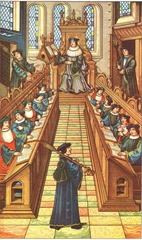
353px-Meeting_of_doctors_at_the_university_of_Paris

Image Courtesy: medievalists.net

That is a meeting at the University of Paris in the Middle Ages.

University of Binghamton_newlanding

Image Courtesy: SUNY at Binghamton

And here is a modern counter-part, circa early 21st century, Binghamton, NY.

What made the University in its modern form?

Books.

Lack, thereof.

The modern university of having a teacher or professor or doctor or priest sitting in a central position of power and students looking to that individual for wisdom was necessary back in 1350 as moveable type hadn't been invented yet.  Books were scarce, rarely printed, and quite often hand copied.  Thus the best way to disseminate knowledge was to have someone who had time to read lots of books on a subject teach students from a curriculum that was dutifully, or not so dutifully, copied down in the form of notes.  If you had to really know what was in the book you could go to the library and, if you were lucky, they actually had a copy of it available.  Getting to read it was a matter of bureaucracy.

Even with moveable type books were still expensive but at least somewhat available... in the library... to read.

The availability of books for private libraries and at home did take a while to get into gear, and was mostly something for the rich and well off up to the late 19th century to early 20th century, where books were still cherished in poor families.  By the post-WWII era, books were readily available as forms of modern printing and the cost/benefit ratio of long press runs took over, and soon you had salesmen hawking the Encyclopedia Britannica in the new suburban neighborhoods.  It wasn't alone, of course, and the book store, once something that only those with a scholarly or Bohemian lifestyle went to, were soon in strip malls.

Yet the entire educational system still depended on 'experts' to present pre-digested 'material' for students to copy down.  Mind you mass-media was now available and out in semi-rural Western NY, out in pine tree and cow country, our black and white TV got Sunrise Semester where, in the early, pre-dawn hours, one could tune in to a course being presented on TV for that semester and do course-work by mail.

Amazing!

Revolutionary!

It went nowhere, of course, as those big palaces of learning had political clout, alumni, professors and buildings, all of which needed grease of the monetary variety to function.  And if you didn't like the public schools, well, you just weren't 'modern'.

For that you have to go back to late 15th and early 16th century and Martin Luther who wanted everyone to learn to read so they could read the Bible on their own.  In their own language.  This concept was expanded upon by Johann Heinrich Pestalozzi (1746-1827) and the web site dedicated to his contribution gives a list of the things he wanted put in place for what we would call 'Primary Education':

Pestalozzi’s approach has had massive influence on education, for example, his influence, as well as his relevance to education today, is clear in the importance now put on:

  • The interests and needs of the child
  • A child-centred rather than teacher-centred approach to teaching
  • Active rather than passive participation in the learning experience
    The freedom of the child based on his or her natural development balanced with the self-discipline to function well as an individual and in society
  • The child having direct experience of the world and the use of natural objects in teaching
  • The use of the senses in training pupils in observation and judgement
  • Cooperation between the school and the home and between parents and teachers
    The importance of an all-round education – an education of the head, the heart and the hands, but which is led by the heart
  • The use of systemised subjects of instruction, which are also carefully graduated and illustrated
  • Learning which is cross-curricular and includes a varied school life
  • Education which puts emphasis on how things are taught as well as what is taught
  • Authority based on love, not fear
  • Teacher training

Pestalozzi’s influence over the spirit, the methods and the theory of education has continued into the twentieth and twenty-first centuries and most of his principles have been assimilated into the modern system of education.

And by 1900 you got schools that look like this...

bpk 20.012.125

Photo Courtesy: GHDI

Oh, wait, that is a factory at AEG in Germany at the turn of last century!  So sorry!
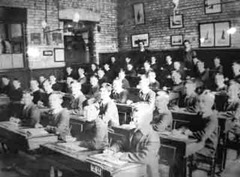
tiered-classroom

Photo Courtesy: 1900s.uk.org

There you go!  Rank upon rank of students at desks all doing the same tasks... I mean that is so different from an industrial facility, isn't it?  And that is so very different than the University!  I mean, you have... individual desks, no wait, that was there in Bologna... students writing notes on the topic, no wait, they were doing that in Bologna, too.  Hmmm...are we sure the production line wasn't invented in Bologna?

At least today is so different!

5277d3ad6e79a98d3a2b1a1b7ecffca4

Photo Courtesy: LA Childhood Education Examiner

I mean here the students can also push their desks together!  And learn the same thing... at their desks... at the same time...

Growing up with this sort of system, I never realized just how antiquated it was, even while I was just auditing college courses on Sunrise Semester.  When I was 6? 7 perhaps?  Definitely less than 10 years old.  The New Media of that era of the late 1960's to early 1970's was television, a one to many media that should function very well as an immediate replacement for that 14th century institution known as the 'Educational System', with bells and whistles like Kindergarten added in by the Germans.

And yet the US came into the late 19th and early 2oth century with a different sort of teaching environment.

oldsch

Photo Courtesy: Will County News blog

That is a one room schoolhouse, a place where children of both genders and different ages all learn in the same environment.  By the time of that image in 1938 there was some segregation by age.

One-Room Schoolhouse

Photo Courtesy: education14 blog

Yet a generation prior to that, this was not the case.  That idea of systematized learning also meant segregation not just by subject, but by age, and the requirement for specialized teachers not only by subject but by age range.  The education profession was turning into a reflection of the work environment, to some degree, but was also becoming a sort of guild system which had decided that further employment of its system required further specialization.  And yet the topics involved for reading, writing, math and even basic history, are ones that are amenable to distinction within a heterogeneous but delimited age range, say 6 to 18 years old. 

In a one room schoolhouse such instruction was mandatory due to the variety of ages coming to the school and the limited time to teach a subject.  Thus a subject was taught as a multi-level form of instruction in which basic facts could be provided and expanded upon in a fashion to suit the learning capacities not just by age but by individual.  This gave children a wider exposure to a given subject and a chance to pick up advanced learning at a young age.  Older students get a refresher and some new material, while younger students get more than they can handle so they have to learn just what it is that they will have to handle.  Simultaneously and in different subjects all by one individual leading the students.

That is teaching.

Talking on a single subject and having student writing down notes, that is instruction, and a largely passive affair.  This has been the case since the start of the modern University as seen in places like Bologna and what we have to day is an relic form of institution trapped in the old system that was driven by a lack of ready material in the form of ink printed on paper and bound into codices.

Today the world does not have a problem of ready material availability and, in the advanced post-industrial revolution Nations, a lack of access to them.  Quite the contrary the classical works are now available, by and large, for free via digital means which should be a great boon to education across all of mankind.  Yet the classification by subject and learning level for a cohort of homogeneous age students is not compatible with this ready availability.  Indeed no instructor in any subject, save for a few of the actual hard sciences, can be said to have any idea of the extent of their subject or be so well versed in it as to encompass its modern size. 

It is true that subjects that start in the Ancient Classical period and going through the Reformation, Peace of Westphalia, Enlightenment and post-Enlightenment era of the 19th century are relatively staid historical subjects.  These subjects serve as the basis for all later education in ALL FIELDS from views on religion and morality through what Nations are through economics through the hard sciences and into the requirement of personal ethics that upholds a given moral code and structure for the basis of individual freedom.  And here is the solution to basic education in these areas: record them at multiple current schools, digitize the lectures, hyperlink ideas together via topic, and formulate a program of self-instruction on them by individuals with actual written tests without access to anything but written source materials in hard copy format to demonstrate individual knowledge and fluency on topics.  This would be a self-paced, age independent system so that individuals could learn at the pace they wished to learn at and only if they see a requirement for demonstration of such knowledge need they ever be tested on it.

Getting to 20th century topics would also require such fluency and background, but the educational materials for them would not be limited by any means.  Demonstration of knowledge of the basis for these ideas and how they came to be is a touchstone demonstration of knowledge.  Just as being able to master the tools and concepts of welding, machining, and creation of materials via additive processes, there is a requirement that someone who actually knows how to do these things certifies that a student also knows them so, too, would the requirement for understanding economics, morality, the moral basis for ethics, physics, chemistry, biology, or any other subject useful for a career require the demonstration of being able to think independently without aid of any device save hard copy source material and marginal notes. 

These are mental tools that have direct applicability and requirements of mastery to them which can be tested in an age heterogeneous environment where there is no limit to re-taking such tests (albeit a small fee might be involved) and that could be sent to any three individuals with certified mastery of such knowledge up to that level,  and graded separately.  This would give the person seeking education feedback from three individuals with varying background and insights, and while passing an exam faults and flaws in everything from syntax to logic structure, along with historical accuracy would be given.  For the topical sciences the divorce of the hard sciences from the rest of post-Enlightenment topics would only come at the specialization level after demonstrating a knowledge of the basis for a given topical science and ability to do lab work in them, both held in equal proportion as science is as much about understanding a topic as testing it via lab experimentation.  Thus the basis for the sciences and their connections to the each other and to the world they worked in, historically, would be a major factor in understanding the place of the sciences in everyday life and have a requirement that anyone wishing to understand that place must also understand the method of experimentation and the moral and ethical basis for it.

Such testing isn't just written on many topics, but is also conversational: being able to demonstrate an immediate ability to reason through new topics on the spur of the moment is something we only do at the Graduate School level for individual topics, but are something that form each of us as individuals in our lives.  Being able to hold a discussion on, say, the basis for the Nation and what the function of a State is will vary across periods from Ancient Classical all the way to the modern age, but the groundwork for that reasoning is one that is historical and requires historical knowledge to make an informed decision.  Just as modern understanding of quantum theory rests on electromagnetic theory, and that, in turn, has links forward to relativity and backwards to Newtonian physics, the ability to discuss that as a topic in its modern realm requires a basis of understanding of its history and why the questions we ask today come about.  In attempting to divorce history from our modern lives, to seek to disconnect the modern State from our historical and cultural understanding of it, is a disservice to all men just as trying to disconnect biology and human experimentation from morality and the duty of citizens to practice their ethics on a known moral code in service to their fellow man both lead to ruin of not just Nations and societies, but mass slaughter of individuals.  Without a historical understanding of the present, the future is one of horror.  A little knowledge is a dangerous thing, but none is fatal.

If we are to take James Burke of Connections fame to heart then the basis for understanding our role as individuals in a complex world is to understand the basis for how our complex world came about.  Education, then, is no longer something limited by age, by class, by gender or by any other category we impose on humanity: it is for everyone at all ages at all times of their lives from the moment that cognitive thought first starts to the last thoughts of those at the end of their lives.  Fluency in the range of topics to address the modern world should have, however, no requirement that people learn them via an enforced educational system that relied on a lack of source material availability to require such things as Universities and, later, schools.  Jobs have requirements to them, and learning the basics of reading, writing, logic, basic four function mathematics, reasoning, syntax, spelling at a fluency and daily use level may have some age determinants in them, but even those can be highly automated via pre-recorded instruction that would serve as the basis for entry to taking further examinations to demonstrate skill and mastery of a topic later.  Many jobs, however, have only the need for basic mastery of material to them and while some might class these jobs as 'low' they are only low in their demonstrated skill requirement: people hauling trash make a good living doing so and those paid a pittance for doing manual labor for farming can still get a good life from doing so.

The entrance to higher capability in any field is a demonstrated ability to master topics and expand mental capacity so as to properly understand how a given area of knowledge fits in with all other areas of knowledge to create a complex web of knowledge that goes back and forth in history.  A concentration in a given topic can go far with just a little auxiliary knowledge in broader topic ranges, right up to the point where you question the morality of research and the ethics of doing certain kinds of research, at which point all those minor entrances into the other topics that allowed for a concentration in a given field must come into play and an individual put in the time and effort to learn what the moral basis for society and freedom are, and what their ethical obligation is to such a society actually is. 

All bureaucrats should have this as part of their essential 'must know' category of knowledge as it is the functionaries of the State that perform acts upon their fellow man and that can, indeed in our era must, contain a full and broad understanding of what society is, where our source of freedom and rights come from and the obligation of the individual in service to the State to not perform acts of immorality upon others as an ethical obligation to themselves, their society, their fellow man and the State they have created.

There is no Royal Road to education.

Our current formulation has run into the 21st century which is now set to sweep away all systems based on limitation of access to materials be they mental or durable goods, and bring a new age of humankind into being based on what we know of ourselves to be as individuals in Nature who are obligated to its laws and as individuals granted access to a moral code that seeks to engender liberty for each man without coercion upon him to think like anyone else.  You cannot get that through the University system, the current education system, or the current systems supporting them which are now failing in this modern era and have been failing ever since the first one-to-many forms of broadcast became available.  Our society upgraded the tools it has to learn but has not applied them for the utility of each individual.  That era is now ending not from the top-down, but from the bottom-up. 

I have already seen schools built in the post-WWII era turned into office space after being sold by their districts.  And I've seen entire cities crumbling because a way of life that was thought to be perpetual was so rooted in place that it required vast amounts of revenue to keep a dead way of life going as a veneer on the physical plant of the city itself.  The answer is not to throw more money into these institutions which have failed in critical ways to adapt and adopt to the 20th century, not to speak of the 19th and 18th century.  They were not even appropriate to the 20th century to say nothing of the 21st.  It is time we change our view of education from the warehousing of pre-teen and teenagers to the development of knowledge and skills that can be demonstrated by each and every individual if that is their desire.  Education must no longer be enclosed by brick walls and attempted to be walled off within our minds to institutions, but opened up as a conception that is held by each of us who are eternally students and, in our turn, practitioners of those things we sought to embed in mere material structures.  That, of course, will shake us all up as to what it means to have a job, when it is appropriate to have a job and how betterment of oneself is in one's own hands and not enforced by a bureaucracy that, in seeking to do 'good', walls us off from the eternal good of self-education and reasoning.

01 January 2014

Recovery

A personal retrospective on my physical well-being.

I hope to get some more normal posts up, but such is life.

Late in 2004 I began a trip into a land of darkness where my mind was slowly losing track of work and I was beginning to feel exhausted beyond anything I had experienced in my life before that.  With that also came a lack of awareness of these things and the simple and all too human attempt to rationalize these sensations.  Being made senseless and having one's mind dimmed when aided and abetted by rationalization meant that things that should have alerted me to my dire straights were passed off... until my body forced the issue by giving me a cataleptic attack while driving.  No accident resulted, but that warned me that something truly serious was going on, even through the mists of my befuddled state of mind and being, which was turning into a strange place where being awake and being asleep meant little difference at all.

By 2005 I just wanted to know what was causing these attacks and if they could be dealt with, and the list of tests I went through was long and deep.  The only change had been in a standard medication, one of the statins, and when my endocrinologist heard the symptoms he took me off them, but the damage had been done and worse was to come after that until the full extent of it was finally reached.  My brain had the normal attributes of someone a good 20 years older than my physical age, and yet that was not a natural thing.  Narcoleptic conditions run in the male side of my family and I had thought I had escaped them as they have two general periods of onset: up to teenage years and then again in one's 60's.  Well, my brain had reached that magic age, I guess, just decades ahead of schedule.

Climbing out of that pit meant trying to get my thought structure back together as it had been shattered and eroded by this condition.  I had become a creature of willpower alone, determined not to let this be the end of my life.  The hardest work in my life would not be physical, would not be trying to write great pieces of fiction or histories to last the ages, but to merely scrape back a formulation of my thoughts out of a land between waking and dreaming and back, fully, into the land of the waking and living.  We take the fact that we think for granted, at least most people do, but somewhere within my psycho-dynamic toolkit there is a repair kit that allowed me to begin the hard work of reconstructing my mental capabilities to get some thinking capacity up and running again.

Those dark days are dealt with in my early blogging, which take place after the internal collapse of my mental structure, diagnosis and the first medications to deal with the actual phenomena.  There is no magic pill to rejuvenate the mind, as yet, to repair damage and to regain lost capacity.  Maybe we shall have that in some future, but until that point one is stuck with the old fashioned way of hard work.  I set myself some tasks to exercise my mind: learn some rudiments of Javascript, find out just what terrorism is (not the talking around it to attempt to call it something else, but its actual being as an activity) and then to learn connectivity structures based on Person-to-Person systems which are the basis for so much of human life that it pervades the far reaches of the horrific and the criminal realms.  For, as my Uncle Joe used to say disparagingly of so many corporate and government affairs, 'it isn't what you know, its who you know'.

Thus diagnosis was done by others, but I was willing to go through just about any test they cared to put me through, and I would hazard a good couple of hundred of vials of blood were taken to that end.  I have a long, long, long list of things I don't have and for that I am very thankful, indeed!  I will give the Sherlock Holmes method of scratching off stuff from a list and whatever you are left with is what it is a hat tip: it works.  Unfortunately it is the brute force method of logic, and I prefer inductive reasoning of 'this is the only thing that fits to make the entire thing work' sort of approach to the list scratching business.  As I have learned, that is a bent of mind that one must have by some means other than education as no one can teach you how to take a look at a whole thing and then see where something is missing and say what it is.

Countering the effects of the problem, although not the problem itself, came next.  I was a Type 1 diabetic before this happened and can tell you that dealing with a problem is not the same as curing it.  For all the advances in genetics, biology, biochemistry, and 3D structural analysis of molecules and how they interact, plus the human genome, a simple auto-immune disease dating back into the far reaches of human ancestry is still beyond modern medicine to cure.  Somehow every promising approach is thwarted by it.  Yet one gains a toolkit of mental requirements to deal with such a problem on a daily basis and that means I had one available for yet another problem that has no cure.  We know that there are cases of spontaneous remission of Type 1 diabetes after about 20 years of having it: the poor immune system just gets tired of fighting that part of the body and natural regeneration takes place for islet cells.  That I still have the condition points to an immune system that is still misdoing its job!  Now I also get to take medications that modern medical science can say what its structure is, but has no real idea of how it works.

There are times when I suspect the strain of being known as Witch Doctor is still with us to this day. 'What is it, what does it do?' you ask and the response is 'Dunno, it just works, take it.'

I am not nor ever have been impressed by degrees sitting up on a wall.

Doctors are still practicing medicine.  They need more practice, less overhead, please, as the practice still is not perfected.

Now all of this research, fiddling with code, playing with stuff got me to firearms as there was a warning bell going off in my head circa 2007.  A good year before the elections, hell before there were candidates, some part of me was saying: Prepare For No Good Shall Come Of This.  I took NRA training to ensure that I properly understood function and safety of firearms, plus only rudimentary cleaning... there needs to be a real course on that, not just gunsmithing but just 'how the hell do you clean this piece of Swiss watchmaking called a gun?' sort of course.  And I like older firearms, so drift punches, springs, and scouring around for parts became a ready past-time.  All of this is DIY in the firearms community, and the modern arms are much, much simpler to work with than much of the older stuff until you get back to the bolt action rifle: those are, at least, pretty simple to understand.

My goal was to next find out what sort of useful skills I had or could gain, and I'm still on that path today.  Firearms leads to stocks made of wood and that means wood finishing.  In my family lineage is woodworking going back at least a couple of generations, and I had not only shop class but a father who did cabinetry in his spare time.  That means I had some of the old 'young shop assistant' sort of deal going on, although not a lot of it, enough to get me familiar with the tools of the trade.

Building back stamina became the major goal as of 2009-10 and woodworking, well once you start using the manual tools you now have a major way to utilize physical capacity and measure endurance, now, don't you?  Even on the power tool side, the lifting and toting of boards, planks, and other less savory bits of trees can get you all sorts of exercise, especially if you have a small shop and need to set up and break down the power tools so that you can have access to the rest of the shop when you aren't using them.

Up until the past few weeks here has been the deal: 1 day of a few hours of work, 2 days of recovery.  Doesn't matter if the day is woodworking, shopping, or whatever, either.  On rare times I could string a couple of days together and then need additional down time to recover.  That was getting me to an even keel, but the boat still had water up to the gunwales and I was bailing as fast as I could.  Stamina was not returning but I at least could keep what I had.

About a month ago I talked with my neurologist who told me that there are some preliminary longitudinal studies that indicate that for diabetics in Japan and Germany (two populations with a major concern over the disorder by genetic causation) that the use of a CPAP helps to lower the HbA1c (a basal blood glucose reading that you strive to get to 7% as a diabetic) by a full 1%.  That is an eye-opener, to be sure.  A real eye-opener as a CPAP improves flow of air to the lungs while sleeping.  I had tried a CPAP before as there were indications of some marginal sleep problems, and they continue to be marginal and the neurologist doesn't know what to make of the actual readings as they aren't showing a disorder but something else going on... but that a CPAP might help that and the the cause to actually get one.

Done!

The prior CPAP device made my sleep worse, not better.

There have been improvements over the last 6-7 years, not grand ones but gradual ones, to the point where I can actually tolerate the device, more or less.

It will take some months of use to see what it does for that long term basal blood glucose reading.

A more immediate effect is to get lots of oxygen into my system at night and well distributed through my body.  I do wake up logy, no two ways about it: it is the sleep of someone who has worked themselves to exhaustion.  I knew what that felt like, back before 2004.  It is the sleep that when you wake up you just had no idea of how tired you actually were.  Apparently I need that sort of sleep.

From that sleep I now have better and larger amounts of physical energy and mental awareness longer into the day and even into the evening.  I can accomplish a lot more with the energy once I get the logy feeling out of the system.  Learning to hand plane maple that has just been skip planed is really hard work, let me tell you.  Yet I haven't been tempted to power tools (although I have a planing jig for a router) because it just feels good to be able to put some actual physical capacity into the work.  For a few hours at a stretch.  So now I can have sore muscles when I wake up!  This is a good thing.

The next step of the recovery is actually reversing not just the effects of one of my major conditions, but the thing, itself.  Those require an actual, functioning medical system in which trying to redistribute wealth and making everyone sicker in the name of 'health insurance' is not the goal.  That is an enemy to actual scientific advancement.  Strange that the most backward looking people are now on the political Left: they are starting to sound like the old fogies who just want to do things the same, tired old way that doesn't work well because that is all they know and will tell you about how righteous it is to do things the broken, tired, old way.  Yet the 21st century isn't going to wait for them to catch up, and no matter how much kicking, screaming, and theft under the guise of 'doing good' goes on, this century is set to steamroller the prior 3,000 years of advancement with changes that seemed impossible just a decade ago.  Be it the first formulation for a warp drive or getting to the bounds of computer capacity and then leapfrogging that with quantum computing or finding out that the ways to deal with disorders and diseases isn't to just ameliorate the effects but treat the damned things with some skill ('what does this drug actually do?' 'I dunno, it just works') and get the idea of practice out of the way or education that is self-performed via online systems of study that can't be categorized but can be tested as to skill, knowledge and capacity to utilize it... everything, and I do mean everything, that has been the foundation for the modern world is about to undergo a sea change that will make the Industrial Revolution seem like something for children.

Thus my goal is to survive the current bout of MegaStupidity via Centralized Insanity of Government and get to this new age of Individual Freedom and Liberty writ large.

As has been my threat: the more I recover, the less I will be posting.

I hate repeating myself and that is mostly what I would be doing to no good effect.

I need to recover so I can join this up and coming age of wonder.

The age of Back to Basics, DIY and reaching for the stars and getting off this damned starter home of a planet.

And I hope you will join me.

For we are better than the old 20th century has led us to think.

And governing is the problem, and government is not the solution.

09 December 2013

In the workshop–router table

My main project for the past year has been working on a router table for my workshop.  I don't have much time to do such work and things that take me well nigh forever would take someone who was relatively healthy a much, much shorter period of time.  Also my general lack of skills also has something to do with this, and I took up making a router table as a skill teaching project for myself, and for that it was worthwhile even if the result was failure.  Yes failure is always an option, and to combat it the idea with limited time is to set minor goals one can achieve in a short period of time.  Bit by bit you move forward and at the end, if you played your cards right, you get something half-way useful.

Works, too!

So with no further fanfare, I'll start in on the thing, itself.  No images are color corrected, btw, and the overhead lights don't give a visible yellow cast to things, but that is the way stuff in the distance gets without color correction.  As an example the Incra tracks are an orange-gold color, not that weird yellow green.

Router_Table-001

Router_Table-008

This is the front end view, or the business end of things.  My first decision a few years ago was to get a Veritas router table plate from Lee Valley Tools.  I did that because I needed more work surface than your standard router table plate inset into a basic benchtop router table.  My main point of dissatisfaction with a benchtop system is that it couldn't easily handle long  pieces of material: they are great for smaller pieces, but the moment you get to 2x the width and active work portion of it, then you have a problem of actually getting a piece to stay flat to the table.  What I wanted was a system that could deal with that problem by having a larger work surface, and a couple of inches here and there get doubled and the pieces get slightly bigger.  Still the Veritas surface, even with a couple of inches extra, and lovely steel plate with which to use rare earth magnets to hold pieces down, needed some more space.  To get more space means a longer dimension and then pick up the outfeed of longer pieces on something else.

That set up the parameters of being 34" high to use my workbench for outfeed, or manipulating larger pieces, and having a long dimension in which I could shift the fence system around and use that long dimension.

Router_Table-003

Router_Table-002

Router_Table-009

With the trim and such I have 48" of space for active use, and nearly 50" overall long.  Two Incra T-Tracks with measuring tape pieces are on the major sides starting up at the miter slot and going to the end of the table.  Internally there are some regular old aluminum T-Tracks that I got from Orange Aluminum

Just under the top on the right side is a large drawer, which I'm using to hold all my 10" saw blades, and on each side is a small circular saw till for the 7 1/2" blades and one of my dado sets.  Saw tills are tilt out, not pull out drawers.

The side exteriors have a 4" dust collection blast gate which is currently serviced by a Ridgid shop vac.

Router_Table-006Router_Table-005

Now I have finally gotten the shop vac out of the way of the rest of the shop and centralized it.  It is still easy to get out and use on its own when that is necessary, like for outdoor cleanout tasks.  This met the requirement for having the shop vac stowed away to where it would have some standardized fittings to it, so that it would be easy to set up between multiple pieces of equipment.  Any future machining pieces will have a 4" blast gate at the same height so that it can be easily attached to an ad hoc collection arrangement.  I don't have the space necessary for a dedicated system, and this will do nicely until then.  Also I can fit a portable dust collector I have to this system and take the vac out and put in a blast gate on its side, so that an actual 4" system can run through all of this.  That portable system is loud and really needs to be run outdoors or with something between it and the shop environment.

Router_Table-004

All of this gets powered up from the rear with two inlets for 120v AC.  Internally it is wired with 14 ga. Romex or equivalent and I ran it all through the 'can I power it all up and have no shorts?' phase of things while the top was still off.

Note that the entire affair is on casters with brakes on the corners and one in the center to support the bottom of the table so that it doesn't sag. This is a 'must have' necessity of any pieces of shop machine equipment from this point out until such time as living environment allows for a real shop to be put in place.  With that said it is damn handy to be able to wheel heavy equipment around, and anything made out of nearly 5 sheets of 3/4" Baltic Birch plywood is to be considered a bit on the heavy side.

Router_Table-007

At the front again, the controls on the left are for one of the internal outlets (it is a duplex with the connector between outlets removed) and I have some LED strip lights to put in yet which will be run off the left side switch panel.  Also on the left is the shop vac outlet switch.  On the right is a standard 15A machine switch to run the Hitachi M12V2 router I picked up reconditioned from Big Sky Tool and they did a great job of getting the missing couple of pieces from my router that were supposed to be with it, and are one of the few places I could find that had such a router available at a price I could afford.

On the left and right are drawers running approx. 17" and 3" across, which is handy for putting small parts into.  I have to see if tins from mints can fit in them as handy organizers.  Right now they have my miscellaneous jig pieces, router bits and whatever else belongs with a router or jig work.  The bottom drawer contains all the other router stuff and over-size bits, plus any of the excess stuff necessary for the table or making jigs.  One of the great positives of having that huge expanse in the rear of the table is being able to put Incra jigs on it, and I'll be starting out with a very basic positioner type and seeing how well it can integrate with the Veritas fence.

One thing I've noticed is that the T-slot nuts I get from Lee Valley will work in either the Veritas or Incra equipment, but the Incra nuts only work with their own equipment.  In theory each of these is using standardized slots, but in practice they are not using standardized fittings.  Go figure.

One additional piece to add to this will be a car jack with one of those circular cups made of plastic.  That I will put under the router and use for gross positioning of it, because trying to get the elevation right by lifting it by hand is a PITA.  Time to repurpose one of the jacks I got for squaring up the refrigerator and freezer and pray I never need it for that again.

Also to be done are light door catches for the side doors, and for those small rare earth magnets should fit the bill.  That front door was made out of ripped trim pieces... am I the only one to have thin ripped hardwood tend to warp?  In any event, all of that was given a temporary glue-up, then glued to plexiglass and the thing warped to the slight warping of the trim pieces.  I had always thought I would use a hasp or small cylinder lock on the door, but it would be unsightly if the top and bottom were pulling away.  The answer is to 1/2" cylinder x 1/2" long rare earth magnets (with something like 35 lb. pull apiece) on the interior frame corners and then two 3/4" nominal square pieces of 28 ga. galvanized sheet steel glued to where they can't be seen from the front.  Works like a charm!

Other than that the basics are 5 sheets of 24"x48" Baltic Birch ply from Rockler, plus a couple of sheets of 1/4" ply from them, and then Padauk cut to size, ripped and mitered at the corner (and the fit is not so hot, but the benefit of not gluing the in is that I can always replace them), plus some 3/4" square nominal Padauk for the corners (dowel top and bottom), and 1/4" thin rip 15/16" Padauk for the lower trim.  Mostly that was done for looks, but also it hands me a clamping surface on the top which is needed for jigs.

Originally I had ideas of making the entire thing knockdown and if I sacrifice the lower trim, it still can be.  The top, however, is totally removable and separate from the router plate support system which has all the drawers in the front in it.  This means that if the top gets totally ruined, it can be replaced completely as nothing is attached to it.  At one point I had ideas of putting a set of heavy duty chest hinges in the back which would allow the entire top to swivel up like a car hood... but the thing was already complex enough that I didn't want to do that once I realized that the tills would have to go or be seriously downsized or a major tray put in on the top which would replace the drawer and tills.

Hardware I got from all over with a lot coming from D. Lawless Hardware, but other pieces are coming from Lee Valley and Amazon.  And about a zillion other places I've scrounged parts from... I have a long list of hardware suppliers from the absolutely modern to the 'if it has to be stock period Victorian, we got the knob for you!' sort of place.  Mostly I went cheap on the knobs and handles, but the concealed Soss hinges are a nice touch for the doors even if they are a PITA to install. 

I make no money, get no benefit and no perks from any place I link to – I am just a customer. YMMV.

Basically the table is in the 98 to 99% stage, lacking the LEDs (which I need to splice some wires together to let them fit) and magnet catches.

I finished it with walnut oil (1:4 limonene for a couple of coats, then progressive 1:3, 1:2 and 1:1) and have used an equal portion by volume of beeswax and carnauba wax (90/10), linseed oil (not boiled) with just a bit of leftover walnut and tung, plus limonene.  If you don't need the wax finish all that quickly, just put the limonene (or turpentine if you use that) together with the beeswax in a sealed glass jar (like a mason jar) and set it on shelf that gets sunlight for a week, and it should be dissolved.  I used wax flakes and did a basic 'shake the hell out of it' dissolving, left it sealed in a jar in a warm room for a few weeks and then finally had to use a double boiler, and to do the final dissolving and add the oils.  A fun note is that by basic volume you get a soft wax suitable for rubbing on surfaces, if you do it by weight, you get a hard wax suitable for your tools.  Too much air in wax flakes to do it properly by volume, but it makes for a great wax to rub on, like I did with the surface of the router table.  I have one batch of wax with just linseed oil and a bit of lavender oil (like a quarter teaspoon to a cup of linseed oil), and need to find someone who has lost their sense of smell to pawn it off on as a furniture wax.

The limonene I got as 'technical grade' from someplace on Ebay, and it is derived from oranges.  My prior stuff was from limes.  When I use the waxes as a finish it smells like I've just made some tea... and when I applied the walnut with limonene, it smells like a salad dressing.    Limonene is your turpentine replacement and it is used in shampoos, cosmetics, and as a sort of universal solvent for all things sticky.  Use just as turpentine, and while it is nice you still need heavy ventilation...non-toxic doesn't mean it won't give you a headache.

The trim is done in super blonde shellac that I got from Shellac Shack and with just one 2# cut coating using a French padding technique, and it came out just fine.  Padauk has a lot of natural oil in it and I really can't see wanting to try and mess up the character of the wood by an oil finish.  Only two coats and then a bit of final rubbing out to cut the luster of the shellac and I have zero complaints on that.  A router table finished that you can eat off of if you had to, but I wouldn't recommend it.

Currently doing some of the minor tasks that got put aside for this.

Nearly done with a Oneway grinding/sharpening/honing jig for my 6" DeWalt bench grinder.  Simple compared to a router table.

Next up will probably be a toolchest/workstation/shelving unit for all the major tools that need a real home (like my bench planes and hand saws) and it must conform to the 34" height requirement.

A real benchtop for a set of rivet shelves/workstation has to be done, as well, and that will probably be a rip and glue up sort of deal, with lots of planing and sanding at the end of it.  I got in a couple of small 8/4 Maple slabs to cut the ends for such a thing, but the ripping of other woods will be the major chore.

General tool storage is a big headache and that really should be in boxes, so that is on the agenda at some point.  Custom boxes.

A miter saw station (mobile) to conform to 34" standard and dust collection standard.

I would love to get the contractor table saw down to 34", but see no way to do that with its current stand.  Although I tend to use that outdoors, if it had a proper dust collection system for all the stuff that doesn't go down its exhaust, that would be splendid... no way to cut the noise, though.

Then on the household end a Queen size loft bed would be great to get floor space back in an upper room, but that is looking to be a 'purchase' option rather than hand-made custom option, save for creating a lower interior sewing and computer space under the bed.

A gun display case, not that I have that much to display, but it's the principle of the thing.

All of this should go so much faster with a router table.

In theory, at least.

Practice is something else, again.

01 December 2013

The play's the thing

Normally I don't do much in the way of examining plays, opera or the like, which is not to say that I haven't been to same and enjoyed them, but my ability to actually find a production that I might like and one that  I could physically attend are limited.  Generally my television watching has tended away from the norm and went to science fiction and some fantasy series, and since my troubles I've shifted from those to the so-called 'reality ' programs all of which center around small businesses.  My viewing habits have changed radically due to those programs and a subscription to Amazon Prime and owning a Roku box.  At some point I can see a massive paradigm shift in television programming where what you watch will be directly supported by you for programs that you want to see.  The concept of ala carte television, that is picking and choosing just channels you want and ditching the rest, is something that should have happened with the advent of cable television.  Unfortunately those local monopolies acted like monopolies and gave you 500 channels of which you maybe watch something from 3 or 4.  Today I have no idea how many channels are offered by the semi-competitive subscriber based system I'm on, probably a couple of thousand when you include HD channels, and out of all of those I watch stuff from maybe 5 or 6 channels.  More specifically I watch just a few series on those channels and ignore most everything else.  With Amazon Prime I can now find programs that are offered for no charge with the Prime subscription and that has meant finding presentations from television and films that I would normally not run across.  Needless to say about 98% of that is stuff I'm not interested in.  This is, of course, just a variation on Sturgeon's Law, and that is a handy thing to keep in mind when you approach any information, program, film, novel, short story... if you see a vast warehouse of material in front of you 90% of it is crud.

Of the non-crud based stuff I've run across is a set of specials from PBS, which I don't watch, looking at the historical roots of Shakespeare's plays.  Knowing a bit of history of England and being able to see what changes were made for the information to be presented as plays is fascinating.  So is the work by the actors who have just come off a particular play or are heading towards one, or who have a background in the works in part or in whole.  In particular looking at Richard II and Henry IV/Henry V was most interesting as there are so many different aspects of history that have a vital role to play in the background of that entire set of transitions between Kings.  For all the liberties taken by Shakespeare in presentation, what we get is a view of the history that was known in that period and can examine some of what was known then that may not be that interesting to the modern viewer of the works.  Yet it is not those works that are the most intriguing, but possibly the most famous play by Shakespeare which is Hamlet.

Knowing science fiction and fantasy and seeing the strong parallels drawn by authors on historical material and then presenting new material within a future or fantasy framework means that as a reader and viewer there are different ways to present material that may not be all that obvious to the average viewer.  With that said I have no strong background in all the historical productions of Shakespeare's works, so I may just be treading on an old idea, but it is new to me and a lot of fun to play with.  For me the main aspect of the play, that of the psychological development of Hamlet, is one that has been done so well, so many times, that it is hard to see how one could improve on it for an actor or director: what we have are flourishes, some modern interpretations, and a few changes in scenes that are modern in circumstance to fit what we know or think we know about human psychology.  The fantastical element of the play is limited to just those four appearances by the late King who is known in the play as 'Ghost'.

Here is one of the key elements that really struck me: the pact with the Ghost.  It is a simple one, actually, given what goes on in the play, and I'll take it from Act I, Scene V (and I'll use this copy from the Gutenberg Project):

Ghost.
Revenge his foul and most unnatural murder.

Ham.
Murder!

Ghost.
Murder most foul, as in the best it is;
But this most foul, strange, and unnatural.

Ham.
Haste me to know't, that I, with wings as swift
As meditation or the thoughts of love,
May sweep to my revenge.

Ghost.
I find thee apt;
And duller shouldst thou be than the fat weed
That rots itself in ease on Lethe wharf,
Wouldst thou not stir in this. Now, Hamlet, hear.
'Tis given out that, sleeping in my orchard,
A serpent stung me; so the whole ear of Denmark
Is by a forged process of my death
Rankly abus'd; but know, thou noble youth,
The serpent that did sting thy father's life
Now wears his crown.

A simple enough proposition, really, and it is the driving force behind the entire play.  Yet do consider that Hamlet has made a pact with his father's ghost, and the ghost has also told us just prior to this of its limitations:

Ghost.
I am thy father's spirit;
Doom'd for a certain term to walk the night,
And for the day confin'd to wastein fires
,
Till the foul crimes done in my days of nature
Are burnt and purg'd away. But that I am forbid
To tell the secrets of my prison-house
,

Strange that he is forbidden to tell of his after-life prison while just having told us of essential information of it.  Still the logic holds that at night it may roam and during day it is confined to wasting fires.  So those are the basic rules of it and on that hinges a view of the play based on the soliloquies of Hamlet which are internal monologues spoken out loud so that the audience can know what a character is thinking.  Thus a retelling centered on the pact and the soliloquies becomes a vital part of a review of the play, itself.  By putting the center on the pact, and what is the normal outcomes of such pacts in other works, we can come to a different telling in which the Ghost may make its presence felt beyond just the four scenes.

As was mentioned in the episode there have been productions in which there is no actor playing the Ghost, presumably with someone out of sight giving the lines to which Hamlet responds.  The audience is then left to decide if Hamlet is going slowly insane or if he can just see the Ghost and the audience can't.  Either way it is an effective staging for the play and allows for a view of Hamlet the Prince that you don't get with the physical presence of the Ghost.  My thought was that the best way to stage the play was to take advantage of some of those soliloquies that seem to have an internal structure in which Hamlet is speaking and then answers himself.  Thus to properly set the stage for a modern production with the Ghost as absent is to have the actor playing Hamlet record the lines of the Ghost with a somewhat lower pitch to them, as his father is usually depicted as not a frail old man but a sturdy man in his middle age.

With that established in opening scenes the actor who is playing Hamlet the Prince can now utilize the voice of his father in those spoken internal monologues and even in some of the directly spoken dialogue.  In fact it is the latter when speaking with the Players in Act II, Scene II when speaking in the AEneas' tale to Dido:

  'The rugged Pyrrhus,—he whose sable arms,
   Black as his purpose, did the night resemble
   When he lay couched in the ominous horse,—
   Hath now this dread and black complexion smear'd
   With heraldry more dismal; head to foot
   Now is he total gules; horridly trick'd
   With blood of fathers, mothers, daughters, sons,
   Bak'd and impasted with the parching streets,
   That lend a tyrannous and a damned light
   To their vile murders: roasted in wrath and fire,
   And thus o'ersized with coagulate gore,
   With eyes like carbuncles, the hellish Pyrrhus
   Old grandsire Priam seeks.'

That all done in the somewhat lower voice of his father which would be scene appropriate for Hamlet to speak in a voice of a character in a play.  It would be somewhat unnerving to Polonius, Rosencrantz and Guildenstern, perhaps, but would they truly recognize the voice of the late King transfigured through Hamlet?

Then the soliloquy just after and I will use bold to indicate the shift in voice from Hamlet to his father:

Ham.
Ay, so, God b' wi' ye!
Now I am alone.
O, what a rogue and peasant slave am I!
Is it not monstrous that this player here,
But in a fiction, in a dream of passion,
Could force his soul so to his own conceit
That from her working all his visage wan'd;
Tears in his eyes, distraction in's aspect,
A broken voice, and his whole function suiting
With forms to his conceit? And all for nothing!
For Hecuba?
What's Hecuba to him, or he to Hecuba,
That he should weep for her? What would he do,
Had he the motive and the cue for passion
That I have? He would drown the stage with tears
And cleave the general ear with horrid speech;
Make mad the guilty, and appal the free;
Confound the ignorant, and amaze, indeed,
The very faculties of eyes and ears.
Yet I,
A dull and muddy-mettled rascal, peak,
Like John-a-dreams, unpregnant of my cause,
And can say nothing; no, not for a king
Upon whose property and most dear life
A damn'd defeat was made. Am I a coward?
Who calls me villain? breaks my pate across?
Plucks off my beard and blows it in my face?
Tweaks me by the nose? gives me the lie i' the throat
As deep as to the lungs? who does me this, ha?
'Swounds, I should take it: for it cannot be
But I am pigeon-liver'd, and lack gall
To make oppression bitter; or ere this
I should have fatted all the region kites
With this slave's offal: bloody, bawdy villain!
Remorseless, treacherous, lecherous, kindless villain!
O, vengeance!
Why, what an ass am I! This is most brave,
That I, the son of a dear father murder'd,
Prompted to my revenge by heaven and hell,
Must, like a whore, unpack my heart with words
And fall a-cursing like a very drab,
A scullion!
Fie upon't! foh!—About, my brain! I have heard
That guilty creatures, sitting at a play,
Have by the very cunning of the scene
Been struck so to the soul that presently
They have proclaim'd their malefactions;
For murder, though it have no tongue, will speak
With most miraculous organ,
I'll have these players
Play something like the murder of my father
Before mine uncle: I'll observe his looks;
I'll tent him to the quick: if he but blench,
I know my course. The spirit that I have seen
May be the devil: and the devil hath power
To assume a pleasing shape; yea, and perhaps
Out of my weakness and my melancholy,—
As he is very potent with such spirits,—
Abuses me to damn me: I'll have grounds
More relative than this.—the play's the thing
Wherein I'll catch the conscience of the king.

With Hamlet there is internal structure to his thoughts that are both question and response, and even he realizes that the thoughts in his own head now settle within him to begin the process of answering to him.  With his father now an active voice there is an active role for him in the play beyond mere Ghost as he speaks to his son within his own thoughts.  Indeed for what is Hamlet but the man who would be King if all had taken its natural course?  This is something that Claudius knows and fears, and takes active steps to counter in the play, itself.  Yet Hamlet's father existed in a court where there was intrigue and Hamlet is no stranger to it, but how does one deal with such intrigue when it is pointed at oneself and has already taken his skilled father?  It would not be surprising to hear Hamlet begin to grow into the role of not just a revenging son, not just a Prince revenging his King, but as the Prince who is heir to the throne of Denmark beginning to grow out of the shell of being the young Prince.  Yet this is not Henry IV, where the son has support from a somewhat errant older fellow, but a young man who is possessed of revenge and who has revenge possessing him.  Staged like this we not only get the tormented problems of Hamlet, but also his father being in the torment with him: being there with his son is to be in the wasting fires.

The Ghost has powers not granted to the living and has already warned Hamlet about certain things, the main one is not to confront his mother.  What the Ghost can see is a future for Hamlet and is trying to find that path which will lead to the fruition of the plan and save his son, both at the same time.  Yet he can not be the one to exact the actual revenge and must have his son do it for him.  This is torment to him, the warrior king reduced to spirit in torment that must have revenge upon his slayer by the only one who would do so.  Would he not exercise any of that to be with his son as much as able to try and help him through this deed which is a revenge murder, not something done in the heat of battle?  It is the necessity of being a King to have unpleasant tasks that must be done by the King and King alone, not one that you can hand off to an underling so sensitive is its nature.  His son steps into the den where knives aplenty are turned against him and where even small pieces of advice could mean the difference between success and failure if his son but has the wits and reason to listen to the inner responses to his inner questions.  In most normal 20th century staging this is something that Hamlet must grope towards, but in such a staging as this Hamlet is guided to be that one that will exact revenge not only for his father but with some help from him, as well.  Thus this requires that the scenes be played as true to original as possible, and to strip out the 20th century Freudian conception and to turn Hamlet into someone who will start the process of revenge in a cold and calculating manner.

And yet he gets the singular opportunity to end this all after the staged play with King Claudius in prayers.  Yet, in the witching hour at night, is the prime time for the Ghost and this is when the internal monologue allows this viewpoint to come forward:

Ham.
Now might I do it pat, now he is praying;
And now I'll do't;—and so he goes to heaven;
And so am I reveng'd.—that would be scann'd
:
A villain kills my father; and for that,
I, his sole son, do this same villain send
To heaven.
O, this is hire and salary, not revenge.
He took my father grossly, full of bread;
With all his crimes broad blown, as flush as May;
And how his audit stands, who knows save heaven?
But in our circumstance and course of thought,
'Tis heavy with him: and am I, then, reveng'd,
To take him in the purging of his soul,
When he is fit and season'd for his passage?
No.
Up, sword, and know thou a more horrid hent:
When he is drunk asleep; or in his rage;
Or in the incestuous pleasure of his bed;
At gaming, swearing; or about some act
That has no relish of salvation in't;—
Then trip him, that his heels may kick at heaven;
And that his soul may be as damn'd and black
As hell, whereto it goes
. My mother stays:
This physic but prolongs thy sickly days.

This is the heart of the Ghost guidance staging: the one who points out that this is not success but grossest failure is Hamlet's father.  Revenge, you see, is a dish best served cold when one of treachery is not prepared to meet his maker but, instead, finds his death at the hands of his un-maker to bring justice to one who can place himself above normal justice.  And, really, are not these parts highlighted those of someone else speaking within Hamlet as part of the question and response that makes up Hamlet's thoughts?  Revenge can only served hot if it means justice in disposition, when there is reward to the one who has betrayed and wronged, then there is no justice at all.

At this point when Hamlet confronts his mother the idea of it happening in a space off the bedroom where personal business is transacted, letters written and talking with close friends done, one where he is coming into being as a person of revenge.  Instead of the heated bedroom romp that it was changed into during the 1920's, it becomes a focal point of coldness and Hamlet has gotten a bit too far in the role of avenging son.  A Queen has maidservants, ladies in waiting and others of the Chambers who would normally assist her and be there, but in the private Closet there is supposed to be no one who shouldn't be there.  Mind you in the heat of the moment he has forgotten his own father's warning about doing this: thus not only trying on the role of avenging son but the heat of lost opportunity drive him. 

Killing Polonius is, however, something that would be true to form for a Prince who is seeking privacy with his mother in the one place in a castle that should be private to them both.  Save for the King, of course.  For Hamlet this is not just the heat of missed opportunity but operational security and removing a listener who is a spy.  Actually that is relatively chilling and the King takes it that way as Hamlet wanted to be private with his mother and that meant no one else was to be there: not even him.  Still that gets a bit ahead of the story and what Hamlet does next, with his mother having to sit still on her chair, is listen to her son... with a corpse and, as we see later, the Ghost of Hamlet's father:

Queen.
What have I done, that thou dar'st wag thy tongue
In noise so rude against me?

Ham.
Such an act
That blurs the grace and blush of modesty;
Calls virtue hypocrite; takes off the rose
From the fair forehead of an innocent love,
And sets a blister there; makes marriage-vows
As false as dicers' oaths: O, such a deed
As from the body of contraction plucks
The very soul, and sweet religion makes
A rhapsody of words: heaven's face doth glow;
Yea, this solidity and compound mass,
With tristful visage, as against the doom,
Is thought-sick at the act.

One can picture Hamlet ticking off on his fingers: an act that blurs, calls virtue hypocrite, takes the rose of innocent love and sets a blister there, makes false marriage vows, such a deed rips the soul from the body against all religion.  Point by point he tells his mother of the case against her.  This is not the stuff of running around a bedroom, but of a judge speaking a verdict and going through the particulars in a cold, matter of fact manner that chills one to their bones.

This makes the visitation when Hamlet is disobeying his father to see his mother to be all the more important, not less, as he utilizes the deep power of the witching hour to try and set Hamlet's course straight by a direct appearance:

Ham.
Do you not come your tardy son to chide,
That, laps'd in time and passion, lets go by
The important acting of your dread command?
O, say!

Ghost.
Do not forget. This visitation
Is but to whet thy almost blunted purpose.
But, look, amazement on thy mother sits:
O, step between her and her fighting soul,—
Conceit in weakest bodies strongest works,—
Speak to her, Hamlet.

Of course this can be staged as all the prior visitations of the Ghost in this staging so that it is the recorded voice of the actor played off-stage.  The added bonus is that the one who has blunted the purpose is not Hamlet, directly, but Hamlet following the internal voice of his father.  It becomes a long list of particulars this accessory to regicide business, and Hamlet gets into it pretty deeply. But raging against the Queen is revenge and hatred somewhat misplaced as she did not do the dirty deed of killing King. 

This is why the Ghost warned Hamlet against such a meeting as it was sure to get emotional in some way, although not by the form we have come to expect in a modern staging of the play, to be sure, the confrontation is still there and extreme in its character.  The Ghost knew what it meant to kill in cold blood, it was a pretty nasty era to live in, after all, and you didn't get to the top without some large amount of bloodshed going along with it.  To do the necessary work Hamlet must now be pulled back from the brink of talking himself into killing his mother and, perhaps, starting a murderous rampage that would not properly get the King as he has too many guards.  That is the wisdom the Ghost brings in the play as it is, but in this sort of telling it becomes something quite other.

Throughout the rest of the play when there is an internal monologue or the time where Hamlet appears to reached a decision, the voice of his father would be used.  In time, as we no longer see the Ghost, the actor might, by the end, be speaking in his father's voice entirely and be the Prince prepared for the tasks of a King, even recognizing that if his own life is forfeit to the task, it must be done well or not at all.

This gives rise to a very subtle and yet potent variation of this staging, and one that plays into the heart of revenging the spirit of the dead.  It hinges on exactly what has gone on in all the regular presentations of the play in the form of the Ghost.  The Ghost is seen by others, or can be seen by others, but that is selective by the Ghost as witness in Act III, Scene V which up to the 20th century has traditionally taken place in the Queen's Closet which was a personal office.  Now if that is the case then the Ghost can also appear only to the audience and not to any of the other actors as a silent and on-stage  presence. 

That, in itself, would be a bit creepy.

What would be even more disturbing would be that at those points as I've previously outlined, instead of having the actor change his intonation of voice without his father present, would be for his father to lay a hand on his shoulder for each of those parts and for the actor to come to resolve in his own voice.  Here the guidance is direct and the audience is allowed to see the full activity of the Ghost throughout the entire play.  Castle Elsinore is the wasting fire and having to be there and during most times be unable to do much and only guide the thoughts of his son when there is opportunity would be further torment to him.  With such staging would come the actor playing Hamlet to have the voice of manhood as guided by his father, so that when conclusion comes to internal thoughts it is the learning of Hamlet of what to do in his position with so many hostile people around him.

It seems such an obvious way to stage the play that it must have been done before.  But this is not the pre-Freudian nor post-Freudian way of doing it, of course, and staged like this it would have a deep impact on any audience of any era.  Once the mother fascination is removed and Hamlet becomes dedicated to the deed of revenge, he is no longer that young man who is seeking to get himself up to the task, but one who has help to work through these questions as they are ones which not only plagued that era but all eras.  Which is why I'm sure that this is not new to me as it could have been done at any time since the first staging of the play.

Hamlet as the instrument of revenge is not done by a relatively unsettled spirit, but by one who has compassion and wisdom of experience: he was a King, after all, and the ways of being a King did not leave him.  He truly does want his son to succeed not just in the deed, but as a man and to take the throne as the rightful Heir.  His son needs seasoning, however, beyond just warfare and going after bandits and such, but to deal with the intrigue of the Court when it is running cold and villainous.  The Ghost was the man who failed at that, and he can see the many paths his son might take that lead to ruin of him as a kinslayer and Kingslayer will have few compunctions about removing the rest of the prior royal line.  While Hamlet is 'of age' and a true young man, he doesn't have that necessary depth of understanding to deal with all aspects of intrigue within the Palace walls.  He has experienced it, yes, but when a child largely protected from it and as a young man kept from it in many ways, but poor Yorick needs to be kept buried and Hamlet to deal with life and death, both after having his father slain.  And yet in the famous soliloquy there is this:

...

But that the dread of something after death,—
The undiscover'd country, from whose bourn
No traveller returns,

...

But that is not the case with Hamlet, now, is it?

01 November 2013

Evils of government

Examining the Declaration of Independence past the famous opening lines shows a type of society that is unique amongst mankind.  It is a society that is tolerant of much in the way of government abuse and over-reach and yet one that has its limits and will, in the end, push back against that government which has over-reached itself in regards to the individuals in society and society itself.

The pertinent text is as follows and I'm using the site Early America for this:

We hold these truths to be self-evident, that all men are created equal, that they are endowed by their Creator with certain unalienable rights, that among these are life, liberty and the pursuit of happiness. That to secure these rights, governments are instituted among men, deriving their just powers from the consent of the governed. That whenever any form of government becomes destructive to these ends, it is the right of the people to alter or to abolish it, and to institute new government, laying its foundation on such principles and organizing its powers in such form, as to them shall seem most likely to effect their safety and happiness. Prudence, indeed, will dictate that governments long established should not be changed for light and transient causes; and accordingly all experience hath shown that mankind are more disposed to suffer, while evils are sufferable, than to right themselves by abolishing the forms to which they are accustomed. But when a long train of abuses and usurpations, pursuing invariably the same object evinces a design to reduce them under absolute despotism, it is their right, it is their duty, to throw off such government, and to provide new guards for their future security. --Such has been the patient sufferance of these colonies; and such is now the necessity which constrains them to alter their former systems of government. The history of the present King of Great Britain is a history of repeated injuries and usurpations, all having in direct object the establishment of an absolute tyranny over these states. To prove this, let facts be submitted to a candid world.

One cannot find such ideas in, say, Italy or Spain, nor in Greece nor Germany, but only in the English tradition.  England is that place which has multiple roots and the name, itself, Angla-Land comes from the Angles who settled the Island along with the Saxons.  Together these Norse peoples, originally from Denmark, created a society that had fused with the local culture so as to form a new society, as I described in Roots of Constitutional Government.  With the formation of England under King Alfred the Great also came the recording of these people's history so that they could know the events of their own past and that was recorded in multiple versions of The Anglo-Saxon Chronicle.  Together the local versions of the Chronicle form the historical understanding of a people up to the Norman Conquest, which would be the third and last major Norse infusion of people and culture into England (original Anglo-Saxons, the victory of Canute and then of William the Conqueror).  The last brought French influence to England, but the local ruling system survived, with changes, even after that time and it was a durable system that left local nobles able to check the power of Kings who over-reached themselves.  Yet, as seen just prior to Canute's victory, it was a system in which years could go by in building pressure to bring a King's grasp under control.  That internal set of divisions did cause the loss at the Battle of Maldon, but the battle itself served as a unifying point for Anglo-Saxon culture.  By that point in time the basics of the society and how it reacted to its government were set.

It is a society in which government over-reach is tolerated to an extent, but the more that government pushes for power over localities, the more that resistance will build.  A central conceit of Progressivism is to encroach so slowly on society with the power of government that the people are corrupted with their own funds. Just as the Declaration came out so, too, did Tom Paine's Common Sense, in which he laid out the case for Independence.  He recorded the state of society in the colonies as follows:

The present state of America is truly alarming to every man who is capable of reflexion. Without law, without government, without any other mode of power than what is founded on, and granted by courtesy. Held together by an unexampled concurrence of sentiment, which, is nevertheless subject to change, and which, every secret enemy is endeavouring to dissolve. Our present condition, is, Legislation without law; wisdom without a plan; a constitution without a name; and, what is strangely astonishing, perfect Independance contending for dependance. The instance is without a precedent; the case never existed before; and who can tell what may be the event? The property of no man is secure in the present unbraced system of things. The mind of the multitude is left at random, and seeing no fixed object before them, they pursue such as fancy or opinion starts. Nothing is criminal; there is no such thing as treason; wherefore, every one thinks himself at liberty to act as he pleases. The Tories dared not have assembled offensively, had they known that their lives, by that act, were forfeited to the laws of the state. A line of distinction should be drawn, between, English soldiers taken in battle, and inhabitants of America taken in arms. The first are prisoners, but the latter traitors. The one forfeits his liberty, the other his head.

Notwithstanding our wisdom, there is a visible feebleness in some of our proceedings which gives encouragement to dissensions. The Continental Belt is too loosely buckled. And if something is not done in time, it will be too late to do any thing, and we shall fall into a state, in which, neither RECONCILIATION nor INDEPENDANCE will be practicable. The king and his worthless adherents are got at their old game of dividing the Continent, and there are not wanting among us, Printers, who will be busy in spreading specious falsehoods. The artful and hypocritical letter which appeared a few months ago in two of the New York papers, and likewise in two others, is an evidence that there are men who want either judgment or honesty.

The media of old is reflected by the current media: it adheres to power, gives it succor and thinks only of itself in relation to power.  Look not for honest amongst them.

The Declaration gives a long list of abuses and usurpations of power by the King, and that puts a final bit into place that describes the society that is forming the Declaration.  These had been going on for years, indeed well over a decade in building up to a breaking point.  It is not a society that takes umbrage quickly nor is it one that seeks to upset the applecart at the slightest excuse, but one that bides its time to judge its government and seek ways to bring it into line with society.

To get a feel for this we can move ahead to the early part of the 20th century and to a piece by Rudyard Kipling called The Beginnings:

It was not part of their blood,
It came to them very late
With long arrears to make good,
When the English began to hate.

They were not easily moved,
They were icy-willing to wait
Till every count should be proved,
Ere the English began to hate.

Their voices were even and low,
Their eyes were level and straight.
There was neither sign nor show,
When the English began to hate.

It was not preached to the crowd,
It was not taught by the State.
No man spoke it aloud,
When the English began to hate.

It was not suddenly bred, 
It will not swiftly abate,
Through the chill years ahead,
When Time shall count from the date
That the English began to hate.

Notice that those preaching hate to crowds, preaching divisiveness and utilizing government to try and stir hatred amongst the citizenry are the ones who become the target of the ire of society.  It does take a long series of abuses and usurpations leading towards despotism to cause such a culture as this to begin to hate... its government.

And no amount of lies by the government or its media sycophants can forestall society when it finally does shift to secure its future once more.